Azor Ahai was not about one person killing another. It was about bringing people together.
There are prophecies littered all through both the Game of Thrones television show and the text itself. Maggy The Frog’s prophecy for Cersei weighs heavy on her and it’s fair to wonder if it became a self-fulfilling prophecy at one point. There is the Stallion Who Mounts The World from the Dothraki and there are Bran’s dreams about becoming the Three-Eyed Raven. (Which, you know, he may not have been the first choice, given the bones littering the Three-Eyed Raven’s cave. But that’s another matter.) The most popular prophecy from the show is that of Azor Ahai, or Prince Who Was Promised; the hero who is to be reborn amidst salt and smoke while under a bleeding star. Before getting to the show, a little back story.
Thousands of years before the events of the books/show, the White Walkers came from the Lands of Always Winter to end civilization. Old Nan tells the story in the first book of how the Last Hero – name unknown – took his sword, his dog, his horse, and 12 companions to head North to find the Children of the Forest and deal with the Walker threat. Old Nan explains all the companions died except for the Last Hero, but we don’t find out the end of the story.
Other texts indicate that the Last Hero found the Children and they, along with the Night’s Watch, defeated the Walkers (called The Others at times) in what was called The Battle for the Dawn, having discovered the lethal properties of Dragonglass. It may not have been a battle, it could have just been some sort of treaty (we know the Walkers made one with Craster), but regardless, the Walkers were pushed back into the very North. Brandon the Builder would come along and raise the Wall, and that would push the White Walker threat out of mind.
(It’s worth noting similar stories are said to appear across Essos as well, so there must be some credence to what occurred. There was assuredly a hero/leader and many battles, but like many historical facts, they are likely skewed by the victors and are blurred by the short-sightedness of the history we tell ourselves. This is important to remember as we proceed.)
The ambiguous nature of prophecy makes them inherently dangerous. Just think of Stannis Baratheon in his show arc. From the very beginning of season two, right until Ramsay guerrillas the shit out of Stannis’s army, the red priestess Melisandre is certain that Stannis is Azor Ahai. She has seen it in the flames: the Bolton banners falling, Melisandre walking the battlements of Winterfell, yada yada yada Stannis gets executed by Brienne. He knew it, and what’s more, he believed it. Melisandre was right, just about the wrong person. The Bolton banners fell and she walked the battlements of Winterfell, it was just because of Jon’s ragtag Northern army (with a big thanks to Sansa) and not Stannis. She was right about what she saw, just wrong about the cause, and thousands died because of it. (There’s a real-life lesson there.)
Azor Ahai is the story of Game of Thrones. Yes it’s about political battles and intra-family relationships and dragons and all that. But at its heart, the story is about a person amidst salt and smoke (is he a ham?). It’s about a hero who has returned to defeat the threat of the White Walkers and the Night King.
So, who is Azor Ahai?
Rhaegar Targaryen, Jon’s pops, thought it was him. He was born in the Tragedy at Summerhall, when many Targaryens (including one of the Kings Aegon) died trying to (allegedly) hatch dragon eggs, thus the smoke (from the fire) and salt (from the tears) were present. Of course it’s not Rhaeger, because he died well before the events of the White Walker threat. But we’ll get back to that in a minute.
The second reason Rhaegar thought he was Azor Ahai was a prophecy told to him by the Ghost of Highheart, another witch like Maggy, in the books. Rhaegar was told that the Prince Who Was Promised would come of the line of his parents. Two plus two is always four, so Rhaegar must be Azor Ahai. Again, there are a bunch of rubies in a river somewhere that tell another tale.
Finally, being born under a bleeding star is a requirement. We don’t know if that was the case for Rhaegar. It was the case for Jon (his Uncle Ned was bedside for his birth with Arthur Dayne’s bloody sword that had a star on the pommel) and Daenerys (the streaking comet). That would seem to indicate one of them.
If Rhaegar wasn’t Azor Ahai, but it would be a hero reborn amidst salt and smoke born of the line of Rhaegar’s parents (Aerys the second and Rhaella), what about Daenerys? Kinvara, the red priestess encountered by Tyrion and Varys in season six, seems to think so. And she was born amidst salt (either hers, Jorah’s, or Mirri Maz Duur’s) and smoke (the pyre). Varys throws Melisandre and the now-headless Stannis in her face, at which point Kinvara says people make mistakes. Hey! Uhh, yeah they do. Dany met the criteria, but your definition of hero may vary here because of her performance in the penultimate episode of the series.
There have been Reddit theories. One popular one (and I like it) is that Jaime Lannister is Azor Ahai. That goes further into the Nissa Nissa story, which the show omits completely, so it seems that may be more a book possibility. But Nissa Nissa’s story is something worth mentioning, even if it’s not in the show.
Nissa Nissa was the wife of Azor Ahai. As the legend goes, he took 30 days and 30 nights to craft his sword, but it broke when he tempered it. His second attempt of 50 days and 50 nights also failed. For his third attempt, he worked 100 days and nights, and plunged his sword into his wife’s chest, which created his heroic sword Lightbringer. Jon does stab Dany, but the details are off.
Jon Snow doesn’t kill The Night King. That went to his sister Arya. He was screaming at a dragon in the yard while his brother Bran was… somewhere else. It wouldn’t seem that Jon is Azor Ahai. But the wording is that Azor Ahai will “destroy the darkness.” In the books, there’s no character of The Night King, but presumably, Jon would have to kill some Others. But it is ambiguous about what Azor Ahai will do, exactly. Destroy the darkness implies getting rid of the threat. Why is Arya in the North in the show? Jon.
That’s why Jon Snow was in fact Azor Ahai. He fits all the criteria, except he didn’t need to deal the killing blow to The Night King. Arya did that, and she was in a position to do so because Jon was at Winterfell. Remember that Arya was going to King’s Landing to kill Cersei before Hot Pie told her about the Battle of the Bastards. She changes her mind and heads North, home to Winterfell.
In fact, Jon Snow is the reason they’re all at Winterfell. Okay, the only reason they’re even around is because of Sansa’s Knights of the Vale, but the reason she’s even there is because she fled Winterfell to head to Castle Black, to Jon. Daenerys is there with her thr-, two dragons and the Dothraki because of Jon. The Wildlings are still alive and in the fight because of Jon. The rest of the great houses of the North have declared Jon their King. He is the unifying force behind the entire resistance to the Walkers and wights. If this were Six Degrees of Separation, he’s Will Smith.
And he kills Dany. No, it wasn’t a flaming sword but he was still responsible for the conditions that led to the destruction of the darkness, and he plunged a dagger into Dany after she destroys King’s Landing, which I think is a nod from the show to the books. We’re a little off on exact details here, but he stabs his lover, as Azor Ahai stabbed his wife.
Jon fits our criteria of being born amidst salt and smoke under a bleeding star, while being of the line of Aerys the second and Rhaella (he’s their granchild). The reason there’s even a massive army in the North is because of Jon, even if he doesn’t deal the killing blow. Without the Prince Who Was Promised, Arya is a thousand miles away, Dany is possibly sitting on the Iron Throne, and the North is overrun by the army of the dead.
Some of the details are sketchy. Jon has a Valyrian sword named Longclaw, not a flaming sword named Lightbringer. He doesn’t kill The Night King with his own hands. But Cersei had four children (that’s a show change, FYI), Melisandre had the hots (!) for Stannis, and Kinvara was convinced it was Daenerys. People make mistakes and the details get a bit fuzzy when they’re passed down over hundreds of generations.
Maybe this prophecy is meant to be ambiguous on purpose. That’s the nature of responsibility. Varys brings this up once in conversation. Who is truly responsible Ned Starks’s execution? Joffrey (the judge), Ilyn Payne (the executioner), or… something else? Who is Azor Ahai? Was it really Rhaegar because without his love of Lyanna Stark, Jon is never born. If Jon is never born, do the people of Westeros destroy the darkness? Or is it Dany, because they assuredly don’t win the battle without her dragons, even if one was fighting against them. That castle would have been overrun in five minutes. She keeps the battle even enough to allow Arya to kill The Night King. Or is it Jon, because he’s the reason everyone is at Winterfell for the battle anyway.
Responsibility is where you believe it lies. The Last Hero went North to deal with the Walker threat, and came back with the threat eliminated, therefore The Last Hero ended the Walker threat himself. Thus, we have this prophecy of Azor Ahai being responsible for destroying the darkness. Though what if it was a pact? Or what if it was the Children? Or… something else? It doesn’t matter to the people because the threat ended. The cause doesn’t really matter, though of course Stannis may have something to say about fulfilling a prophecy regardless of cause.
That’s all left ambiguous and perhaps that’s the point of all this. It doesn’t matter who is responsible, really. You can put it on the shoulders of whomever. Just find a reason to band together against a common threat. I’m absolutely stoked to be able to type this sentence earnestly: maybe Azor Ahai was the friends Jon Snow made along the way.
There has been one question from the early seasons of Game of Thrones that is always asked: why didn’t Arya ask Jaqen H’ghar to Kill Tywin Lannister, Joffrey Baratheon (Lannister), Jaime Lannister, or basically anyone else vital to the war effort that could help her brother? Gendry even asks this after he, Arya, and Hot Pie make their escape from Harrenhal. It’s a fair question. She could have ended the war in basically a night. Instead, the war is prolonged, and her mom and brother are later killed in season 3.
So, yes, why didn’t Arya have a different kill list for Jaqen?
Think back to the character of Arya at the start of season 1. In the books, she’s nine years old. In the show, like many other characters, she’s aged up a bit, but still not even a teenager. She’s a child. At the start of the series, all she’s known is being a rebellious child, and hating sewing. There’s obviously more to it, but the point is that she wasn’t faced with horror and death on a daily basis outside of whatever happens in daily life during peacetime at Winterfell.
And then, the horrors. Let’s run through what she endures:
Her older brother is pushed from a tower and becomes a cripple, but she has to leave him behind when she travels to King’s Landing with her father and sister. She leaves him before he’s even regained consciousness.
She overhears a plot to kill her father whilst sneaking through the catacombs under the Red Keep. When she spills the beans to Ned, she can’t remember or articulate what she heard, and so her pleas are ignored.
Arya gets the one thing she’s wanted more than anything else: the chance to train with a sword. In that world, little girls aren’t warriors. She is, though, and this is the start of that journey.
A bunch of Stark men, including Jory, are killed and her father stabbed in the leg.
Arya’s teacher is killed after her father is taken captive. She’s not only lost the only thing she wanted, but now she’s alone in a foreign city at the age of 11.
She sees her father beheaded after he pleas for mercy, and after her warnings to him went unheeded. Her introduction to violence, really, is her father’s head being taken off his shoulders while hundreds (thousands?) cheer on the act. She’s standing in a crowd of people that are frothing at the mouth with a thirst for her father’s blood, unbeknownst to them.
When Yoren takes her under his wing to get her out of the city, she has her identity stripped from her; she’s given the name Arry and her hair shorn. He then tells her she’s going to be traveling to the Wall with him. At this point, her brother has been crippled, her father killed (with people cheering it on in her presence), her dancing master also killed, and her identity taken from her. Reminder, this is still season 1, and she’s still 11 years old.
Think of what the other Stark family members have been through until now. Jon is at the Wall sulking (though, to be fair, he did kill a Wight), Robb has just entered the fray (pun completely intended) at the head of the Northern army, her mom Catelyn is on safari across Westeros, and Rickon is playing hide-and-seek in the crypts of Winterfell. The only other Stark with anywhere close to as bad a season as Arya is Sansa. Well, and Ned.
Now, we head to season 2…
She gives up her secret to Gendry as they’re travelling to the Wall when the Lannister soldiers show up. Arya thinks they’re there for her, but regardless, she has to confide in Gendry, and imagine how hard that is after what she endured over the previous year.
Yoren is later killed by the Lannister soldiers, right in front of her, and Lommy is as well (the kid who got stabbed in the neck with Arya’s sword). She’s then taken captive to and sent to Harrenhal. This was just after she started to bond with Yoren, the one person who’s shown affection for her besides Gendry.
At Harrenhal, she sleeps in a literal pig pen, in the rain and mud, for days on end, waiting to be chosen to die. The Lannister army is torturing people to death in very inventive ways, and Gendry is on the chopping block as Tywin – her family’s mortal enemy – shows up and makes her his cup bearer. Reminder: she’s 12 years old still.
She’s a servant of the Lannister family, and then given over to The Mountain when Tywin is set to leave.
Arya escapes Harrenhal, with Jaqen’s help, fleeing a situation where she probably ends up dead.
Again, Arya has seen her father killed to the delight of thousands, her protector Yoren killed, her friend Lommy killed, men and women tortured in gruesome ways, waited to die, and was forced into the servitude of her family’s enemy before running away for her life. She’s still just 12.
Take all this together and Arya’s arc for the rest of the series makes sense. The threads between her and her aunt Lyanna are obvious when Ned’s sister is introduced later in the series, so that she would grow up to be a warrior was made to seem as if it was never in doubt. But it’s a certainty that she was forced into this life as well. It’s an interesting question to ponder: if Ned isn’t taken prisoner and killed at the end of season 1, leading to all the horror that would follow Arya for years, does she still end up the person she is at the end of the series? That is to say, was she always destined to be a warrior, did this simply speed up the timeline, or did everything that befell her make it inevitable?
Agency, destiny, and prophecy are prominent and recurring themes for many characters in the show. When we think about it, though, we usually think about Dany becoming the Stallion Who Mounts the World, Jon and Azor Ahai, or Maggy the Frog’s prophecy for Cersei. We don’t necessarily think of Arya when we think of Thrones characters and their destiny.
But those similarities between Lyanna and Arya are made for a reason. It’s the story telling us that yes, Arya may have a destiny as well. She won’t be the Queen of the North, or the Queen of Westeros, but she’ll become the person she was meant to become, and as we found out in season 8, she became somebody pretty important.
All those tragedies, all those shocks, and all those horrors happened for a reason. Arya had to endure unspeakable conditions for the vast majority of the time on the show, in all seasons. But that’s what makes what happens in season 8 so fascinating to think about. Last question: if Arya doesn’t endure all that pain and suffering throughout the show, particularly early in its run, does she become the person who can and does kill the Night King?
Maybe we shouldn’t ask why she didn’t ask Jaqen to kill Tywin. Maybe the characters should just be thankful she didn’t.
The sports world has ground to a halt because of the spread of COVID-19. All across the globe, leagues are shutting down, and we’ve seen that all come to a head this week.
But it’s not all sports that are gone. We still have esports. It’s a general term that includes a wide variety of games, from first-person shooter squad-based games, to turn-based chess-style games, to card games, and the more fantasy-side of things. That last section is where League of Legends fits in.
I thought that given most sports leagues will be out of action for at least a month, that there may be some people with an itch to scratch. Some esports leagues are equipped to play remotely, and some have already done so. League of Legends is one of them, and it’s also one of the games offered on DraftKings.
Let’s start with a brief overview of the game.
The Map
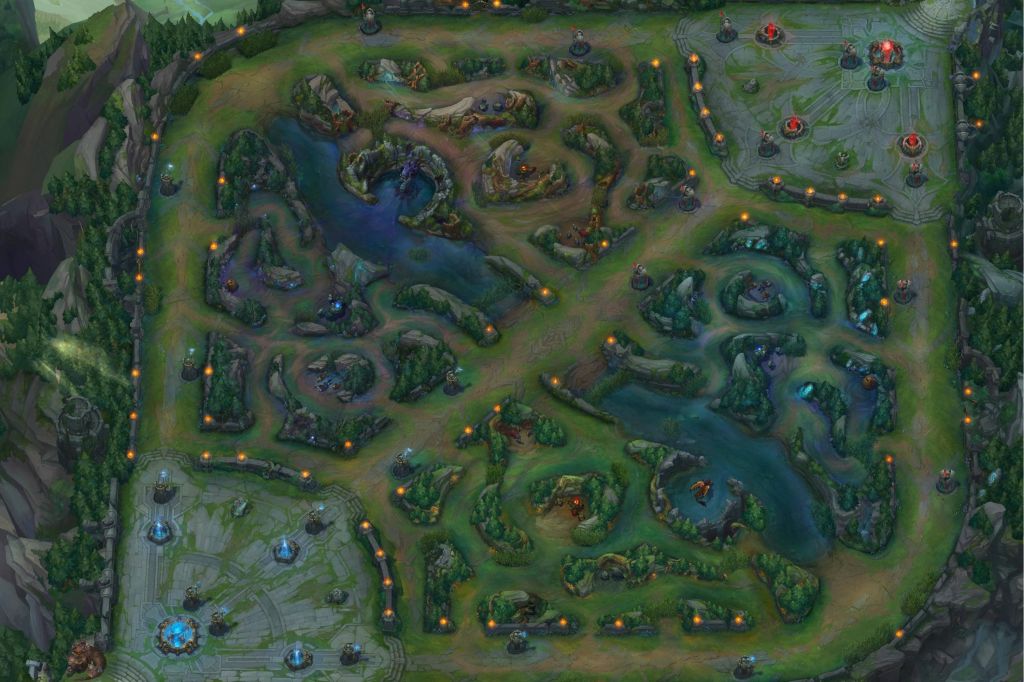
League of Legends is a 5-on-5 squad-based game, but it’s not a shooter. It takes place on a map called ‘The Rift’, and it’s an arena battleground, not a huge map. This is what it looks like from overhead:
At the top-right, there’s a red-side base, and on the bottom-left, there’s a blue-side base. Each base has a ‘nexus’, or the glowing thing closest to the top-right and bottom-left corners. The objective is to be the first team to blow up the other team’s nexus. There are three lanes with minions to kill for gold, and each lane gets the same number of minions, so both teams get the same opportunity for the same amount of gold. (Though they rarely end up killing the same number of minions, and that differential is a crucial stat.)
Let’s break the map down into sections.
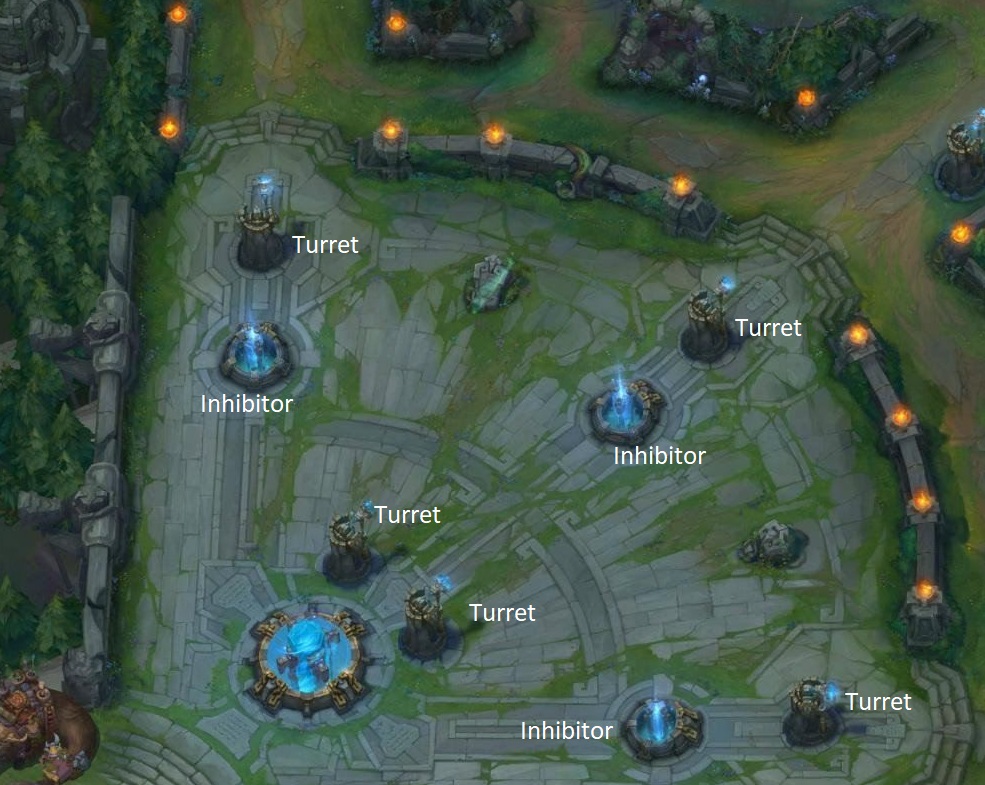
As mentioned, each team has their own base. In their own base is three turrets protecting the three inhibitors, and two more towers protecting the nexus. In order to blow up the nexus, at least one of the inhibitors needs to be destroyed. To do that, the opposition needs to blow up the tower protecting the inhibitor, and so on out. This is what everything is called inside the base:
The turret/inhibitor placement is the same for both teams and bases. If an inhibitor is destroyed, the team that destroyed the inhibitor gets ‘super minions’ in that lane for five minutes. Super minions are harder to kill and deal more damage than regular minions, which helps teams push towards the opposing base without doing anything.
Leading out from the base are the three aforementioned lanes. Along the bottom and right side of the maps is bottom lane, sometimes just called ‘bot’. Going diagonally up and to the right is mid lane, or just ‘mid’, with the final lane, on the left and top, called, well, top lane. Outside the base, there are two more turrets placed along each lane that teams can run to for protection, or opponents can blow up for gold.
Those turrets, by the way, have plates on them up until the 14-minute mark. Each turret has five plates worth 120 gold each, or 40 percent of a kill each. All five plates is worth two kills in gold, so the Rift Herald can be valuable early on (the Herald will be explained later). Teams get extra gold for destroying the first turret of the game, but they have to be in range of the tower to get the gold when it is destroyed. Trying to be the cool champion and walking away from the explosion can cost you.
Plates fall off at 14 minutes, and only the outer-most turrets have them. The inner ones do not at any point.
Players also get bonus gold for the first kill of the game, called first blood.
Readers will notice that there are five players per team, but only three lanes. We’ll get back to that.
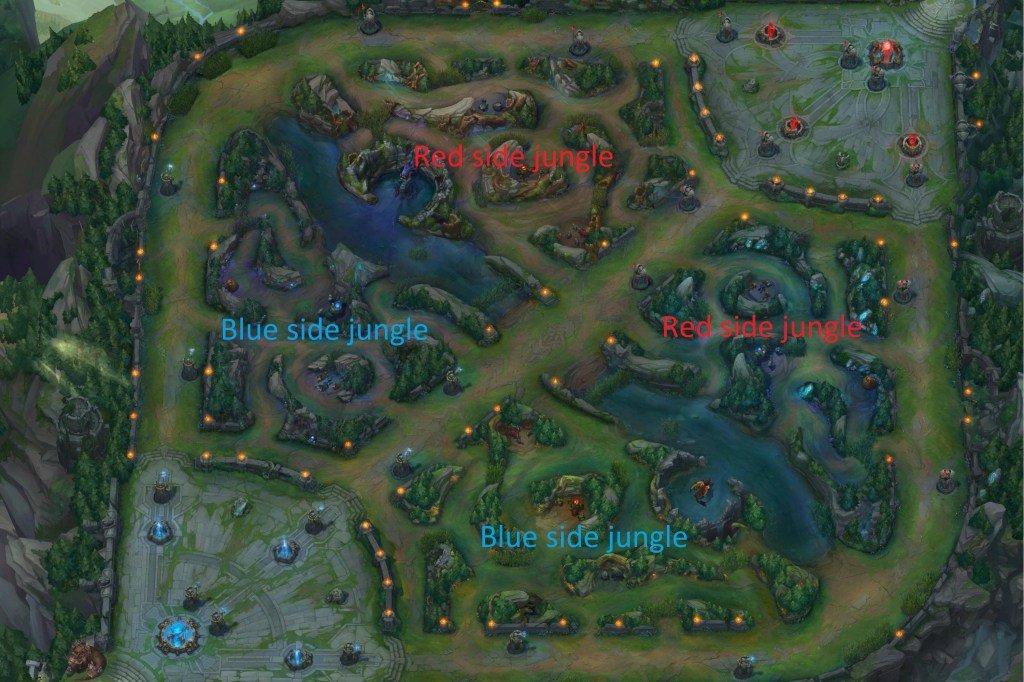
As for the rest of the map, the entire middle of the map, between bottom lane and top lane, is called the ‘jungle’. The jungle is broken down into four quadrants:
The water running through the middle of the jungle, perpendicular to mid-lane, is called the river. It’s the mid-point of the map, and players on the opponent’s side of the river need to beware.
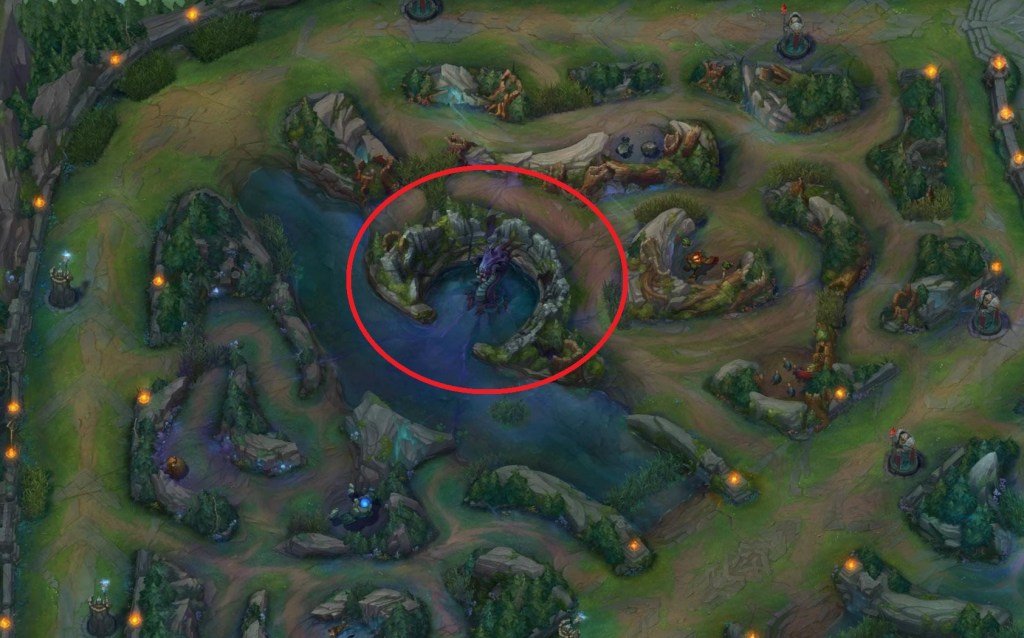
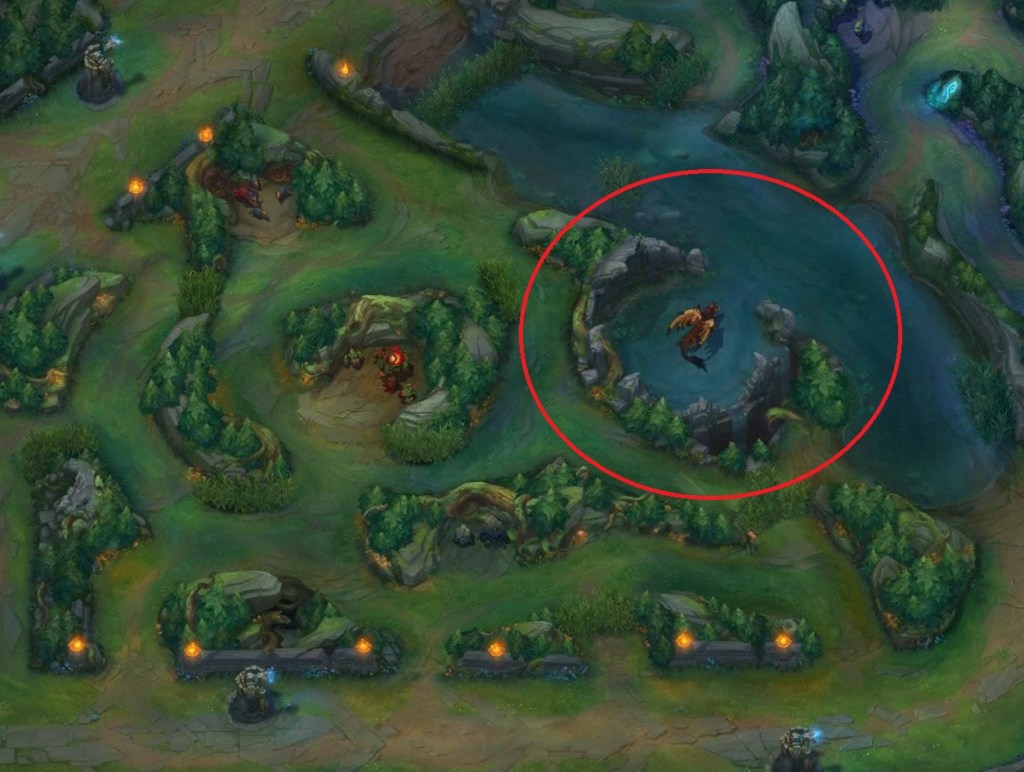
There are three major monsters in the jungle that players need to know. The first is Baron Nashor, usually just called Baron, and infrequently called Nashor or Nash. He is located here at a place called the Baron Pit in the river on the left side:
The Baron only spawns at the 20-minute mark and is very hard to kill. One person can’t do it, two people can sometimes do it later in the game when champions are strong, but it usually takes three or more (often the whole team). It’s a pit with walls around it, so even if you kill it, you could be trapped by the opponent, and that can make it a dance, of sorts. Killing the Baron gives your team a ‘buff’ for a few minutes, and that buff makes it very hard for opponents to kill your minions, making it easier for the team with the Baron to push into the base. In that sense, killing the Baron can end a game if a team gets a good push going with the Baron buff, so the Baron is often contested.
When a team kills the Baron, only the players alive at the time the Baron dies get the buff. If a player on a team with the Baron buff dies with the buff active, they lose it. In order for the minions to get their super powers, a player with the buff needs to be nearby. Thus, even if a team kills Baron, it’s important to get as many people out alive as possible. Killing Baron, but only getting one person out, is basically breaking even in gold immediately when considering kill and assist money, and then with the players off the map, the healthy team can take even more off the map in terms of minions, jungle monsters, and towers. It’s why teams usually won’t go for Baron unless they have a combat advantage (an opposing player or two dead, or a big item advantage).
Before the Baron spawns, there is something called ‘Rift Herald.’ It’s a monster that spawns at the same place as the Baron, and one that teams can kill, but it does much less damage than the Baron, so a single champion can kill the Herald by themselves. The purpose of killing the Rift Herald is that the team to do so gets a beast that charges into towers, causing significant damage to them. It helps blow up towers, providing gold, and which in turn gives the team (and specifically the lane opponent) more room to roam without the fear of taking hits from the turret.
The third monster to know is the dragons. They’re located here:
Dragons are also much weaker than the Baron, so one player can kill them fairly early in the game. There are four types of dragons: mountain, ocean, infernal, and cloud. Each gives different boosts to the team, such as speed, damage, regeneration, or armour. Kill four of them, and you get a ‘Soul’, which is an extra powerful buff with even more speed, damage, regeneration, or armour. They are very powerful buffs that last for the rest of the game, so we see a lot of team fights around the dragon. Each ‘soul’ changes the layout of the map automatically, as ocean soul will sprout more brushes, mountain soul more rocks (barriers), infernal soul destroys some walls, and cloud makes it quicker to walk through certain portions of the jungle. The map effect is for both teams, though the soul’s actual buff will only go to the team that gets the fourth dragon.
In the jungle, there are ‘creeps’, or monsters that a player can kill for experience and gold.
Champions, experience, gold, and items
Wait, experience and gold?
Yes. Each player, before the game, selects their character, or ‘champion’. Each champion has unique abilities and skill sets. Those champions need to acquire gold and experience throughout the game to get stronger base stats, while buying items to make them more durable, damaging, or somewhere in between.
Some champions can pack on lots of health and armour, providing a tank with low damage, or what is sometimes known as the ‘front line’, while others cast magic spells but have little health or armour. Some are a mix of high health and armour (though not as much as tanks) with damage, while others are long-range marksmen. Some of the damage-dealers (like marksmen) do physical damage, while spell-casters (or mages) do magic damage. Different types of damage require different kinds of armour (or resistances).
Finding the right mix of champions is crucial; too little damage with too many tanks means you’ll never kill the opponent, while too much damage with no tanks leaves everyone vulnerable to be decimated quickly. Having armour instead of magic resistance leaves a player vulnerable to mages, while having magic resist instead of armour leaves players vulnerable to marksmen.
Early in the match, from each of the three inhibitors, little monsters called ‘minions’ spawn. They spawn in groups of either six or seven, and they’re most players’ early source of gold and experience. However, to get the gold, the champion needs to ‘last hit’ the minion to kill it. What that means is that the player has to kill the minion to get the gold. If the minion dies to an opposing minion or a tower, then the player gets no gold. In that sense, being able to last-hit efficiently is one of the most important skills in the game. If a player can’t do that, they’ll fall way behind the gold matchup early, and then they’re basically useless.
Players get gold from minions, monsters in the jungle, killing the opponent, assists on kills, and blowing up towers. More gold means more items, which makes it easier to kill the opponent, and gain more gold, and on and on we go.
But there’s only so much gold on the map, right? If three players are all killing the same minion lane, they just split the gold, and then no one gets ahead. That’s why the teams (mostly) split up their champions.
The top lane will get one champion, usually someone who has both health and damage, because they’re often by themselves.
The mid lane gets one, and it’s often some sort of spell caster because in the middle of the map, all of your teammates aren’t far away to help, so they don’t need as much health and armour. Relying on teammates to react in time, though, is another matter. Such is the nature of the position.
There is one player who roams the jungle, but there’s less gold there, so you’ll see them attack in lanes with their teammates to kill the opponent and help get everyone ahead.
That leaves two players, and they both go bottom lane. One is usually some kind of marksman, and the other a ‘support’. The support can be either a quasi-tank, a player who can help with shielding/regeneration, or some sort of weak fighter. Again, all five champions have to mesh well together, the support among them.
That’s basically the entire premise of the game. I’ll review briefly:
It’s a 5-on-5 game with each player controlling a unique champion.
Teams have to destroy at least one inhibitor to attack the nexus. Destroying the nexus wins the game.
One player from each team goes top lane, one mid, two in the bottom lane, and one in the jungle.
Players level up with experience and purchase powerful items with gold. Gold and experience come from last-hitting minions or jungle monsters, killing opposing champions or towers, or small other boosts in the game.
There is obviously a lot more to the game. Strategies about which champions work best with which (there are over 100 of them, so), knowing when to attack a lone enemy and when not, knowing when to push for a team fight or not, knowing which items to prioritize by purchase order (and possibly changing your build path depending on what the opponent does), knowing when to attack Baron/Rift Herald/Dragon and when to back off, and on and on the list goes. Despite there only being one map with the same monsters, no two games are the same.
It’s a fun game to watch once you can grab the basics, and once you understand the strategy, it gets really fun to watch. It can be slow at times as teams seek out gold for items rather than attack each other, but with the Baron and dragons providing huge advantages, those areas are often contested, forcing the teams to fight.
Feel free to reach out if anything is confusing here.
I thought I would add a glossary of common terms you may hear on a broadcast.
Ace – when one team completely wipes out the other team. That often can lead to the game flat-out ending, if not a major deficit.
Buff – these are powers given to a player or team for completing an objective, or as part of an item’s power. Buffs include the Baron and dragons, but there are also blue buffs (mana regeneration) and red buffs (extra burn damage) in the jungle. Certain items can buff up a player or team as well.
Brushes – Around the map, there are small brushes players can hide in to surprise their opponents.
Cooldown – Most champions have four abilities (we’ll get to that in a second), and after being used, abilities have a period of time where they cannot be used again. Depending on the ability, it could be anywhere from one second to dozens of seconds. Obviously, those with longer cooldowns typically have much larger impacts. It’s about balance. Players can also buy items that reduce cooldown time.
Crowd control – usually just shortened to ‘CC’, it generally means an ability that can, wait for it, control a crowd of opponents. It usually means a stun or slow ability that impacts an area. You’ll often see teams chain two or three CC abilities together on a single opponent in order to remove the opportunity for escape and ensuring the kill, while dissuading the opponent’s teammates from engaging.
Dive (or turret/tower dive) – When a player is pinned under a turret trying to kill minions for gold, sometimes the opponent will ‘dive’ or ‘turret dive’ to go for the kill and get out before the turret (or opponent) can kill them. It often requires at least two, if not three people to pull off.
Elder dragon – after the teams get a soul dragon (which usually happens at the 25-minute mark, give or take a couple minutes), the Elder dragon spawns in the dragon pit. It’s usually after the 30-minute mark, but it provides a big damage buff to all living members. It can help end the game quickly.
Engage or Initiation (reliable or unreliable) – this is basically how teams start fights. There is reliable engage, sometimes called hard engage, and unreliable engage, or soft engage. The first kind (reliable) usually means some sort of point-and-click that takes no skill and can stun an opponent, leaving them vulnerable to further attacks. Soft engage usually takes some skill to pull off, and may not stun the opponent, which could allow them to escape. Different types of engage work with different types of champions, but not having reliable engage makes it very hard to start team fights, and that’s a problem late in games.
Fog of War – it’s where your team cannot see. When watching the game as a spectator, we can often see everything happening on the map. Players in the game, though, see considerably less (only where there are teammates, turrets, minions, or wards), and that’s the fog of war.
Freeze – without making this 500 words, there are ways to manipulate the timing of when you kill the opposing minions, and that pushes the minions (collectively called the wave) either towards your turret or towards the opposing one. A ‘freeze’ is a manipulation to leave a group of opposing minions near your turret. The purpose is to use the turret as protection while killing minions for gold. The added bonus is it leaves a lot of territory behind the opponent, making them susceptible to a jungler or mid-laner moving up/down behind them, trapping the foe between the two. Which brings us to the next term…
Gank – when players go to a lane that is not theirs (say, bottom lane to mid), to help their teammate kill their lane opponent. It’s basically a surprise attack (though sometimes it’s not such a surprise). It is also one of the main functions of the jungler in the early portions of the game.
Lane swap – sometimes, if a particular lane is falling way behind, that team could swap two lanes (often bottom and top, or bottom to mid) to give the player(s) that is (are) behind a chance to catch up with either the help of teammates, or absence of the opponent as they respond to the swap by swapping themselves.
Laning phase/mid game/late game – there are three general sections of the game. The first 15 minutes (give or take), is called laning phase. It’s basically just people trying to kill minions in their lane (and junglers killing monsters in their jungle) and gain as much gold as possible as quickly as possible. There are often ganks, but rarely full 5-on-5 team fights; teams are just too focused on gathering gold in their lanes. The mid game is usually the time after laning phase (sometime around the 20-minute mark) but before the 30-minute mark. This is when teams start fighting for control around Baron, and this is when team fights start to happen. The late game is exactly that, it’s when players start to have four or five items and are approaching full builds (champions max out at six items, so at a certain point, gold stops mattering). This is basically all about controlling vision and team fighting. You won’t see true laning in the late game.
Priority – your minions are generally your vision line. They’re programmed to just march forward if nothing impedes them, so the further they can march, the further your team can see (and the less the opponent can see). Thus, sometimes, pushing your minions past the mid-point of the map, or towards the opposing turrets, is called gaining ‘priority’. A champion that has killed their lane’s minions, while the opposing champion that hasn’t, has the priority because of how far up they can move up their vision line, and they can also go look around the jungle to find someone and catch them out. Pro teams place a lot of importance on priority. Well, the good ones anyway.
Q-W-E-R – the key binds that come with the game attach QWER to an individual champion’s abilities. So if people hear “so-and-so’s Q”, that means the ability attached to the Q key. And onward down the line.
Recall/shop – players need to recall to get back to their base without walking the whole way, but recalling requires them to stand still in one spot for eight seconds. It can be a one-way ticket to the death realm if not recalling in a safe area. After they’ve recalled, players can shop for their items in their base. When they recall, they regenerate quickly both their health and mana.
Roam – when a player moves to a lane that is not theirs, often to help a teammate falling behind, or to kill the opposition. It can be just to place wards (which are discussed below), so that’s what makes it different from ganking. Supports often do this early in the game.
Skill shot – some abilities are point-and-click, while others take aiming with the mouse. The latter is called a skill shot.
Smite – teams that last-hit a dragon or Baron get the buff of the dragon or Baron. Attacks can be champion abilities or basic attacks, but the jungler has a special smite ability. It gets stronger as the game goes on, but it’s basically a massive amount of instant damage only to jungle monsters. It cannot be applied to an opposing champion. However, it’s so powerful that if a jungler dies later in the game, the team is at a significant disadvantage around Baron or dragon. It replaces one of the summoner spells, which is in this glossary.
Spawn time – a player respawns in their base after they die. However, the length of time they remain dead gets longer as the game wears on. For that reason, even losing two or three members later in the game can cause a massive shift as all the Buffs are available and opponents are off the map for 45 seconds. That’s more than enough time to run roughshod on the map. Deaths around the Baron pit sometimes end the game, regardless of who actually killed the Baron.
Summoner Spells – usually just called summoners, they’re abilities standard in the game. Each champion gets to pick two before the game, and they range from healing/speed boost, to flashing a short range which can help escape the opponent (this is popular), to a teleport ability, providing swift aid in a team fight (also popular). They have very long cooldowns, especially early in the game, and can be very powerful when used properly. Forcing the opponent to use them recklessly can provide a team with a summoner advantage. This is a very good situation, as it typically allows the team with the advantage to dictate the pace.
Ultimate (or ulty) – the champion’s ‘R’ ability is called an ultimate and can do devastating damage in the right situation. A few champions don’t do damage with their ultimate, but rather shield or heal teammates, or provide great disruption to the opponent (also called engage).
Vision – simply what a team can see. Gaining priority can help establish deeper vision, giving your team a better idea of what’s going on behind enemy lines.
Wards or Warding – some players have wards in their inventory, and sometimes they have to buy them. Some are invisible to the opponent, some are not. Either way, they help establish vision, or perhaps check the Baron to see if the opposition is trying to kill it. When a player – usually the support or jungler – goes around the map placing wards for vision, it’s called warding.
Westworld is bleak. For fans of the show, it surely isn’t the first time reading a sentence to that effect, but it’s a popular refrain for a reason. The wealth and depth of themes are scattered all through the show, be it the nature of humanity as both creator and destructor, the illusion of free will, how people are shaped (or not) by their relationships, and the list goes on, but very few of them are hopeful. There is no shortage of literature on any number of themes or symbols offered in the show, and that makes for a robust online community. Almost regardless of the theme, the outlook of humanity is the same: doomed for self-destruction because, simply, that’s our nature.
Perhaps the most prevalent, and important, theme we have is how people make choices/decisions, how those choices/decisions affect their behaviour, and the cascading effects that result.
It’s crucial to distinguish between what is a choice and what is a decision. While those terms might be used interchangeably in everyday conversation, they’re not really the same thing. Decisions, generally speaking, are influenced by external forces, while choices stem from true freedom.
The distinction is important. We like to think we all have freedom. No one likes to think our lives are beyond our control. But think of everything we do on a daily basis, as human beings, and ask whether we’re really free to make these choices:
A lot of people drive to work. Very few people drive to work down the wrong side of the road. That’s not really a choice, because we know doing so would likely result in property damage and injury, and potentially even death. To avoid those negative outcomes, we make the decision to drive down the correct side of the road.
That’s obviously an extreme example – most people don’t have a particular hankering for driving into oncoming traffic – so let’s think of something a lot of people have experienced:
An undergrad gets out of university and has a hard time finding a job. In the meantime, student loan interest is accumulating and bill collectors are calling. After six months, they get an interview for a job for which they’re wildly overqualified and will be underpaid. Does the person keep letting the bills pile up and look for a better offer elsewhere, or do they take this job because they need the income immediately? Many (most?) people would choose the latter.
This undergrad made the decision to work for the company, not a choice. They needed the money and the stability to satiate their finances and self at the time. Now, can they keep looking for another job? Of course, but the decision to take the first job has already been made.
We can say this person has a choice; they could simply let the bills pile up in search of a better opportunity. But what if they have a spouse, or a child, or an elderly family member they’re looking after? Do they let them go without food, without shelter, without medicine? Of course not. They are not really free to pursue their dream job, regardless of their desires. (We could argue for days whether those are external forces, or whether the desire to care for our family is an internal expression of will. We’ll get back to that.)
That decision, in turn, will affect this person’s behaviour. After months of being unemployed, now they have to get up at 6:30 AM every morning, they have to go to bed earlier every night, they have at least appear to be cordial with colleagues, they have to dress appropriately, and so on. And then there’s the cascade effect beyond that: do they look for another job, or stay there and hope for a quick promotion? Do they get a second job to supplement income? Do they save for a house, or save for retirement? There are also the micro-decisions that come with that particular job when it comes to transit routes, favourite lunch places, joining a company gym, or any number of other decisions people make daily without really thinking about it. From one decision to take a job, where the person didn’t really have the freedom to make a choice, a host of new behaviours and new decisions are introduced that were not previously considerations. That person’s future has been fundamentally altered forever.
It’s a fundamental ‘Westworld’ question: do we really have a choice? In fact, William (The Man In Black) asks this exact question in the penultimate episode of season 2:
What is a person but a collection of choices? Where do those choices come from? Do I have a choice? Were any of those choices ever truly mine to begin with?
As we ponder what William means here, let’s remember how his story, as we know it, began. He hopped off the train on his first visit to Westworld, and early in his visit, he picks up a can of food dropped by Dolores, the future de facto leader of the host revolution. At the time, it was simply William being William; he’s described as a kind and caring person earlier in his life. He was just picking up something a stranger dropped and returning it to them, like a good person would.
Was it his choice to make, or was Dolores directed by her masters to be in the street, loading her food on the horse at the exact time William himself would be in the street, thereby ensuring their ‘chance’ encounter? If it’s the latter, was it still William’s choice to make? Remember, he’s described as someone who cares for others. Extrapolating from that, we can assume that William wouldn’t walk by a stranger who had just dropped their groceries. If it’s in his nature to help people who need it, and Dolores was programmed to be in need in William’s view as he’s roaming Sweetwater, did he really have a choice?
From that point, the cascade of decisions follows: he starts to care for Dolores more than his betrothed back on the mainland; he helps her on her quest to get to the centre of the maze – which we would find out is a symbol for the hosts’ awakening consciousness – wherein he gets obsessed with the centre of the maze itself. That leads Williams on a lifetime of mass murder and abject cruelty of the hosts as he becomes fixated on beating Ford’s game. His nature and life completely change, and it all stemmed from the ‘choice’ 35 or so years ago to help Dolores pick up some dropped groceries.
(As a sidebar, one of the major themes of the show is how the Westworld park reveals a person’s true nature, which leads us to wonder if William was ever really a good person at all, or if it was a decision influenced by external forces like parents and teachers. It’s something his brother-in-law-to-be Logan brings up as well. It’s a fascinating topic but it’s for another day.)
That one small decision leading to large ripple effects is also often discussed. In the season 2 finale, Dolores has dialogue about replicating humans as hosts, and how a very small, almost indecipherable change in a human being’s personality or speech pattern has significant reverberations down the line. As Dolores says, “A tiny fracture that grows into a chasm.”
Do we really have a choice, or are we being thrust into a series of decisions? And do we understand all the consequences, intended or otherwise, that result from those decisions? The future is so murky for most people that it’s hard to predict what people may or may not anticipate, but it’s a chilling thought: are we really in control of our lives? If we’re not, are we solely responsible for the consequences of those decisions, or do our external forces share the blame?
These are not easy questions with which to grapple. Again, we all like to think we have some modicum of control in our lives, but do we really? Do we really have a choice about going to work at all for a month? Do we really have a choice of not feeding our pets? What about filling our cars with gas so we can get to a doctor’s appointment two hours away? How about simply buying groceries? We like to think these are all choices, but it’s not easy to say they are.
As Westworld is wont to tell us, the nature of the person determines their decisions. Would you or I have made the same decisions (choices?) as William when he first set foot in Westworld? I’d like to think I wouldn’t, but I’ve also never been in his situation. Regardless of that, even if we like to believe we have choice, if our very nature influences that ‘choice’, then is it really a choice? Or is our nature a force applying pressure on us to make a decision? Is that nature ‘our’ nature, or is it a conglomeration of teachings from parents, professors, peers, and other authority figures? If we never really have a choice, are we really responsible for the consequences?
Again, these are not easy questions to answer, but it does force the viewer to challenge their outlook on life. It forces us to think of what choices we make, whether they were really choices, and how much responsibility we should bear.
One last question: given how we’ve organized society, is having a choice ever possible?
It’s hard to be surprised by much anymore, isn’t it? At least in pop culture. The purpose of entertainment is to separate the audience from their money for their personal enjoyment. To do this, companies need to convince you why they are worthy of your $15 or two hours or whatever. That involves a marketing scheme, which in the social media era can be anything from a slow drip of trailers that reveal more and more information, interviews in the media, Easter eggs hidden in other forms of entertainment, or any other numbers of ways marketers are reaching their audience in 2020.
It’s their job to get us excited about movies and series that are coming down the pipe. This is, of course, a double-edged sword, whether the marketers realize it or not. When we are made aware of a future event, it’s natural to start forming pictures and ideas in our mind about what we want and hope to see. Let’s take a simple example: Game of Thrones Season 8. Now, no one was taken by surprise that we were getting an eighth season, but the nearly-two years between season 7 and season 8 allowed for a lot of speculation about what we’d see in the final six episodes. Personally, I thought there might be a fleet coming from the East with Daario Naharis at its head to help save the day. (We’re still wondering how he’s doing, by the way, considering the woman he and thousands of others swore to serve turned out to be a homicidal maniac. Ah well.) I also thought the Night King might pull a fake out and take Viserion to King’s Landing while The Others engaged with Winterfell. There were lots of other theories bounding around: Littlefinger pulled a double-switch with Arya’s faces at the end of season 7 and was still alive; Bran was the Night King; Jaime Lannister was the Prince Who Was Promised, among dozens of other theories. Of course, as those who watched the show are now aware, few of these dozens of theories came true. In fact, the final season was about as straightforward as it could be: the morally ambiguous ruler became a tyrant, the heroes prevailed, the family the fans care about the most ended up on the Throne, and most people who survived got a happy-ish ending. There was no double-meaning, there was no hidden secret. It just was.
And that we were let down because of this straightforwardness is no one else’s fault but ours. This was a massive television series that had about eight hours of showtime left to wrap the entire story. As illogical as parts of the final season were, if they tried to shoehorn some theories that didn’t have much in the way of prior hints in the show, most people would have just been confused.
Let’s take it to pro wrestling for a minute. Every year, the WWE’s Royal Rumble is arguably the most anticipated pay-per-view event by its fans. Sure, Wrestlemania is by far the larger event when talking revenues and media coverage, but for the fans, the Rumble is a magical experience. For those unfamiliar, the Rumble determines who will be challenging for the heavyweight title (both male and female) at Wrestlemania in April. It’s a 30-person wrestling match where two people start and then one person is added at regular intervals (90 seconds or two minutes). You are eliminated only by being thrown over the top rope and the last person standing wins. The reason fans love it is we get about half a list of the wrestlers who are going to enter the Rumble, but we don’t know who the other half will be, and we don’t know the order for the vast majority of the entrants. There are, ostensibly, 28 opportunities to surprise and shock the audience. Sometimes we get a legend walking through the curtain, sometimes it’s a prospect, and sometimes it’s a big-name signing of which the fans are not aware. Regardless, wrestling fans have an expectation for the event every year, and more often than not, WWE delivers (as they do less and less these days, but I digress).
Let’s run a thought experiment, and even if you aren’t a wrestling fan, put yourself in their shoes for a minute: what if our expectations, which had been established over years by the company whose product we consume, were not met? What if one year, WWE announced every single entrant, and the order they would enter? Not only would it take away the magic of the event, there’d be a revolt. People would boycott the show. It would be a disaster, and it’s why WWE has never gone that route (and why they will never, at least in the foreseeable future).
Let’s bring it back to the final couple seasons of GoT for a minute. Think of why you were disappointed… it’s probably because of unmet expectations that the show itself set for several years prior, right? It was that it took Dany three seasons to get out of Meereen, it took Tywin two seasons to set up the Red Wedding, it took six seasons for Jon’s journey from Night’s Watch pledge to being named King in the North, and so on. Even something as small as Tyrion’s relationship with Shae took parts of four seasons to resolve. The show had established its major plot points over multiple, sometimes several, years, and then the later massive plot points – the fight with the Night King and the undead, confronting Cersei, the Dany turn, Bran assuming role of Protector of the Realm – were all laid out and resolved in 13 episodes, often much less. Our expectations of a meticulous political thriller were completely unmet as the time crunch forced the showrunners to opt for a very straightforward finish. (I maintain that Dany’s turn was laid out for years prior to this and wasn’t as out-of-left-field as it seems but again, I digress.)
But that’s our fault, isn’t it? Our expectations had been set by the show, but we failed to alter our expectations in anticipation of the finish. We failed to realize the reason Dany took 35 episodes or whatever to leave Meereen was because they had the time to tell that story. By the time season 3 finished, they knew they had a hit on their hands, and they knew they could take years to tell that story. By the end, they told us there wasn’t much time left, but we still acted as if there were another 40 episodes remaining rather than 13, or six. At a certain point, we’re responsible for our own disappointment.
Let’s take a final example, and I’ll use a personal one this time. Despite 2019 featuring both Endgame and The Rise of Skywalker, the movie I was looking forward to the most was Rian Johnson’s whodunnit Knives Out. The reason is because whodunnit movies are my favourite genre. Clue: The Movie is my favourite movie of all time, I used to read the Clue books along with The Hardy Boys and Encyclopedia Brown as a kid, and I think I’ve seen every Agatha Christie adaptation possible (including the made-for-TV Hercules Poirot movies from the 1980s). I love problem solving (probably why I play/write about fantasy sports) and whodunnit movies are the epitome of pop culture problem solving.
I had a couple qualms about Knives Out but my big problem is it’s not a whodunnit, not really. We find out who did it about one-third of the way into the movie, and the rest of the movie is about the person evading detection, before we are eventually made aware that the killer actually didn’t kill anyone. It was a bait-and-switch of the whodunnit genre, a subversion. I am very much into subverting genres, and that’s one reason why I loved Johnson’s The Last Jedi. But I wasn’t expecting a subversion, I was expecting a classic, sharply-written take on a whodunnit, even if updated for the modern era. Something that I had grown up with and still enjoy to this day. Knives Out was not that.
As a result, I was disappointed and generally didn’t enjoy the movie, even as it’s being lauded by critics and moviegoers alike. But that’s my fault, isn’t it? I went into the movie with my own set of expectations despite having no real basis for these expectations, and they weren’t met. This movie that I was looking forward to more than any other in years, let me down. Reflecting on this, though, one thing becomes obvious: the disappointment is my fault, not Johnson’s.
This isn’t to absolve the showrunners from Game of Thrones, or any other series or movie. This is just to assert that maybe we should assume some responsibility of these letdowns. Part of fandom is immersing ourselves with others in the community, sharing theories, Easter eggs, fanfic, or whatever else. But that also sets expectations, and when expectations are set, disappointment is a possible result. When we don’t get what we expect to see, whether it’s Jaime Lannister taking down the Night King, ‘Stone Cold’ Steve Austin entering the Rumble at #30, or Knives Out not following a conventional whodunnit formula, we are going to be let down. And there’s no one to blame for our expectations but ourselves.
We’re into 2020, but it’s worth thinking about how crazy 2019 was in pop culture. We had the end of Game of Thrones, which may have been the most anticipated pop culture event of the year. That title could also go to Avengers: Endgame, which wrapped up a 23-movie anthology that spanned over a decade. And, finally, we had The Rise of Skywalker, which wrapped up its own nine-movie trilogy of trilogies that is in its fifth decade. When you figure that probably the two most popular film franchises, and most popular tv franchise, of the last 40 years both finished in the same calendar year, it seems like quite the anomaly. But it also allows us to compare the three, their approach to the end, and what it can teach us about the future of movies and television.
I’ll start with Endgame. Growing up, I read comic books, but I never really got into comic books. That is to say, when Iron Man was announced, I took it as another super-hero movie like we had seen in recent years with Batman and Spider-Man. I didn’t think it was be the start of the defining movie franchise of the century to date. But once the MCU got to the original Avengers movie, I was all in.
When I look back at the MCU, it’s amazing how little bloodshed there is basically until the final couple movies. Sure, there are the deaths of the villains and nameless/faceless civilians at large, but among the main comic book characters, there wasn’t many. It was basically Quicksilver in Age of Ultron, Yondu in Guardians 2, and Odin in Ragnarok. We can add Peggy Carter and Agent Coulson to the list as non-superheroes that died but really, that’s it. But once we get to Infinity War, and Loki is wiped off the board in the first few minutes of the movie, we understand that this is serious. We understand that if they’re willing to kill off Loki four minutes into what is effectively a 5 ½ hour two-part movie, then we’re going to lose a lot of favourites. That was paid off with Gamora’s death later in the movie, The Snap, and then both Black Widow and Iron Man in Endgame. The stakes earlier in the series were more existential and general – the fate of the universe – and while that obviously carries into Infinity War/Endgame, what gives those two movies their true emotional weight are the deaths of our heroes, the people we spent a decade getting to know. For as corny as it is, the, “I. Am. Iron Man,” line from Tony Stark is iconic not only because it’s his catch phrase, but because at that moment, knowing what the infinity stones have done to others wearing the gauntlet, we are made aware of Tony Stark’s fate. The face of the franchise is sacrificed to pay off the emotional weight of the entire series of movies, and whatever you may think of the Marvel movies, it’s a decision where the landing sticks.
When I think about how I got hooked on Game of Thrones, it was undoubtedly the ‘Baelor’ episode, season 1, episode 9. Anyone who’s watched the series knows what I mean. It set the stakes for us as viewers. We knew, after nine episodes, that this was a different world than what is normally presented to us in fantasy. This wasn’t a show where good deeds get rewarded and bad deeds punished; rather it told us it’s the inverse. I didn’t even start watching the show at the beginning, or initially read the books (I have since read the five offerings), I only started after the Red Wedding, and the fervour it caused on social media. That reaction led me to the show, and the ninth episode of the first season made me a fan for life.
At its essence, Thrones explained to us the world as it is, not as we want it to be. Yes, there is a struggle between good and bad, but it’s loaded with gray, and goes through painstaking lengths to show what the rich and powerful will do to stay rich and powerful. It’s a theme that transcends fiction and is part of what made it such a draw. But what it did was help set our expectations: good people die, and that can include your favourite characters. This was reinforced over and over throughout the series from Robb and Catelyn Stark, to Syrio Forel, to Hodor, to Oberyn Martell, to Ygritte, to Maesters Luwin and Aemon, to Shireen Baratheon, and however many others may have been favourites to some. The stakes were clear, and they were maintained throughout. Well, mostly, anyway, but we’ll get to that.
Now to The Rise of Skywalker, and I’ve been thinking so much about why the movie didn’t land for me. It goes beyond Rey’s parentage – I was a believer in the Rey Palpatine theory, so that didn’t bother me – and the Palpatine resurrection (though this should have been better explained, because there was no indication that this was a possibility beyond a Fortnite Easter egg, of all things). It goes beyond the clumsy handling of Finn and Rose, the MacGuffins, and whatever else. The reason this movie didn’t land for me is there was no emotional weight to it.
Whatever you might think of the new Star Wars trilogy, the heartbeat of the movies is the connection between Rey and Kylo. Strip away the nostalgia, and what you’re left with is a story about an orphan girl, a nobody, struggling to survive in a desert, a boy who is the literal progeny of royalty, the son of two military generals, who is deeply aware of his Force abilities at a young age, and how those two diametrically opposed poles can develop a profoundly deep connection. And for the most part, be it through JJ Abrams’ or Rian Johnson’s vision, that connection plays extremely well on our screens.
I said for the most part just now because Kylo’s death scene got my theatre audience laughing. Literally laughing. What was supposed to effectively be the climax of the entire series – Kylo reviving Rey, sacrificing himself so she can live – got nothing but laughter. It was the way she leaned in for the kiss and then he just crumpled immediately like she was Poison Ivy. What was supposed to the defining scene of a multi-billion-dollar trilogy that was part of a multi-billion-dollar movie franchise was met with nothing but laughter. And scouring social media, my theatre wasn’t the only one where this happened.
Then there was the death of Leia. As sad as it is to say, had Carrie Fisher still been alive, her on-screen death would have carried (seriously, no pun intended) a lot more weight. Unfortunately, her on-screen death was expected because of what happened in real life. It’s not to say it wasn’t sad – Chewie’s reaction certainly helped convey the moment when he found out – but when you go into a movie/TV show expecting a death, and then it happens, there’s not as much emotional weight.
Let’s go back to Thrones for a second. There was a lot wrong with season 8, but one of the things that bothered me so much was how little emotional payoff there was, especially in episode 3. The series spent nine years building up the White Walkers and their army, and what happened when they attacked Winterfell? Nearly every one of our human heroes lived. This is who died:
Edd – a good friend of Jon’s but always in the background and more for comedy relief than anything. Most fans couldn’t name him.
Lyanna – this one hit harder than any other, admittedly.
Beric – did anyone care about Beric?
Theon – this was probably cheered.
Melisandre – did anyone care about Melisandre?
Jorah – the guy who betrayed his Queen?
It’s clear they were hoping the deaths of Lyanna, Theon, and Jorah would be enough. Lyanna certainly had lots of fans, but she came late in the story, and I believe people generally didn’t care about a guy who betrayed the Starks, and a guy who betrayed Daenerys Targaryen. So this White Walker army, which had been built up for eight seasons, which decimated the entire Dothraki horde in 30 seconds, which overran the castle and had everybody pinned down in a courtyard, only managed to kill one person that fans would universally care about? I remember going into that episode with a running list of people I expected to die. I knew the confrontation with Cersei was coming, so a few key people had to live, but I thought any of Arya, Pod, Brienne, Sansa, or Tyrion would be taking a dirt nap (and likely more than one). But they all lived? This series, the one that hadn’t been scared to kill off anyone at any time, goes through its most harrowing sequence and basically one fan favourite (and one that wasn’t in the show for the first five years) out of a dozen is killed? It felt like such a cop out; that there would be this huge backlash if a fan favourite died. Stakes had been set that one small mistake meant someone losing their head at any point and now that a castle is overrun with hundreds of thousands of zombies, they make it through mostly fine? It was such a letdown emotionally.
Now back to TROS for a minute. What were the emotional scenes of this movie? Rey supposedly killing Chewie was definitely one, though they walked that back a few minutes later. C-3PO having his memory wiped so they could access the necessary information was built up as this great heroic sacrifice and then a few minutes later we get hit with the “j/k lol.” We’re basically left with three scenes: the arrival of the fleet in Exogul, Kylo’s death, and Leia’s death. I already mentioned how the two death scenes fell flat, so let’s talk about the fleet arriving in Exogul.
To be clear: when the entire galaxy arrives to help our heroes, it’s a genuinely great moment in the movie. I got literal goosebumps and there was even a smattering of claps in my theatre. It was awesome. And it often gets compared to the scene in Endgame when the un-Snapped heroes arrive to help Thor, Iron Man, and Captain America. When you hear “Cap, on your left” and then see the yellow portal open, it’s another goosebump-inducing moment. But it’s not the same as the one in TROS, not by a mile. While both great moments in the movie, the arrival of all the superheroes in Endgame is a true holy shit! moment in pop culture at large. When they show up, the sheer enormity of the accomplishment is laid bare on the screen: we wove together 23 movies over 12 years featuring dozens (hundreds?) of characters and did it mostly flawlessly (especially post-Avengers). When the fleet shows up in TROS, it’s “wow what a cool movie moment!” but when the heroes show up in Endgame, it’s “holy fuck I can’t believe they pulled off this entire saga.”
And that’s basically why I found The Rise of Skywalker lacking. I can overlook MacGuffins and plot holes; what I can’t overlook is a series-defining movie that doesn’t pay off our emotional bonds to the movie(s). For some, the ‘Star Wars’ franchise has been a part of their lives for over 40 years. For those younger like me, it’s been a part of your entire life, and the five moments that were supposed to pull at heartstrings were:
Leia’s death – obvious
Kylo’s death – drew literal laughter
Chewie’s death – syke
C-3PO’s memory wipe – syke again
Fleet arriving – cool movie moment, pales in direct comparison to Endgame months earlier
It’s the same reason (well, one of) that Thrones season 8 fell flat: the most existential threat ever faced, and we lose a couple people who betrayed the characters we care about? It’s something you can pull off if you haven’t spent a decade establishing life-or-death stakes with every micro-decision. It’s not something you can pull off when you have.
It’s just the landscape of the movie/tv media industry now. You have to cross-promote as much as you can, which is why the Palpatine resurrection was intimated in Fortnite. (And it’s something that pervades other areas of pop culture, like wrestling, and is something I think is a harbinger of things to come. Media companies seem to care more about hardcore fans who seek everything over casuals. It’s the 80/20 rule playing out in internet content.) You have to have Kylo basically stitch his mask back together so his likeness can be used on Disneyland rides. And you can’t kill off fan favourites for any number of reasons not limited to merchandising, future injection of nostalgia in series offerings, or internet backlash in general. TROS seemed to hold back for all three reasons, while GoT was just the latter.
Thrones set up their own stakes and then failed the rules miserably while The Rise of Skywalker was clearly afraid of its own fans. Whatever the reason, both properties failed in sticking the landing emotionally while the MCU did it very well (even if I didn’t like Endgame as a movie as much as recent MCU offerings, it was a great finish to the franchise). There’s probably a lesson in here, but if I know anything about media companies, it’s that they’re far too concerned with earning gobs of money over coherent storytelling. And as everything gets condensed to four or five streaming options, options for boycott will be limited.
 Cliffy's hell-hole