The 2023-24 Ottawa Senators, Joonas Korpisalo, and Penalty Killing

It was another disappointing season for the Ottawa Senators in 2023-24 and while those things always have multiple causes, a big one for this team was the penalty kill. Despite ranking 15th by shots allowed per 60 minutes while short-handed, the team was 30th by goals against per 60 minutes, and closer to the putrid Anaheim Ducks’ PK goals-against rate than they were to Toronto’s bad-but-not-awful PK (per Natural Stat Trick). Ottawa finished dead last by PK save percentage at .826 with no other team below .830 and the median being around .863. The difference between Ottawa’s PK save percentage and the middle of the league cost them 13 goals, and that’s a lot.

I was curious why there was such a massive discrepancy between shots and goals against, so I went back and watched every power play that resulted in a goal against Ottawa netminder Joonas Korpisalo this season (there were 39 of them). Here is what I found with thanks to Instat for their services on the video.

Games With Multiple PP Goals Against

In December, Ottawa went to Colorado and lost 6-4, giving up four power play goals against. It is one of those games where if the PK goes 4/5, rather than 1/5, they might have actually won, but they didn’t, so they didn’t.

The first goal against resulted from a lost faceoff draw following the penalty. Colorado whipped the puck around, completing multiple seam passes which, to be fair, they do a lot against even the best penalty-killing teams. The problem was that Korpisalo seemed to have trouble tracking the puck. The sequence that led to the goal saw Cale Makar pass to Nathan MacKinnon, moving the puck from the blue line to the faceoff dot. MacKinnon one-touched the puck to the middle, and Korpisalo could clearly see this happening:
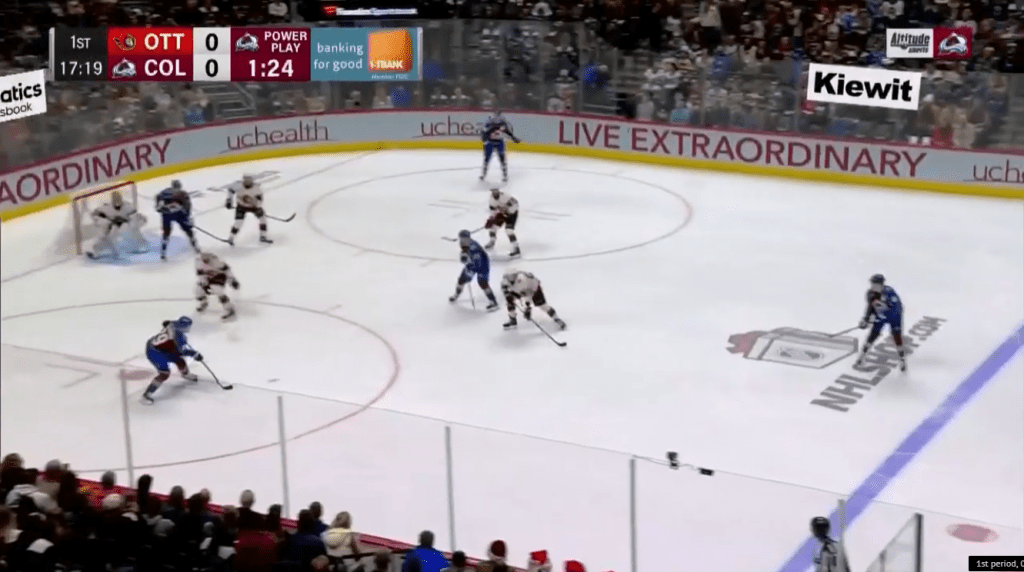
However, Jonathan Drouin one-touched the puck back to MacKinnon, and Korpisalo was still looking for the puck in the bumper – partly thanks to the screen from Valeri Nichushkin right in front of him – even as MacKinnon was about to slap home a one-timer for the goal:
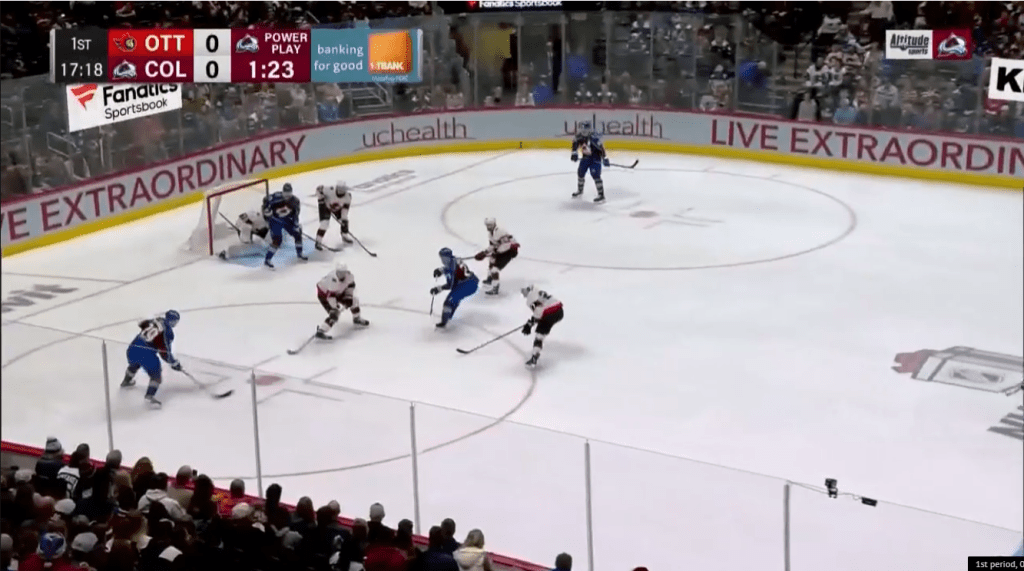
Maybe Korpisalo should have tracked that puck better, but we just saw this exact same thing happen over and over to Connor Hellebuyck in Winnipeg’s playoff loss to Colorado. This is technically an unscreened goal, but it may not have happened without the screen shielding the passing play to begin with.

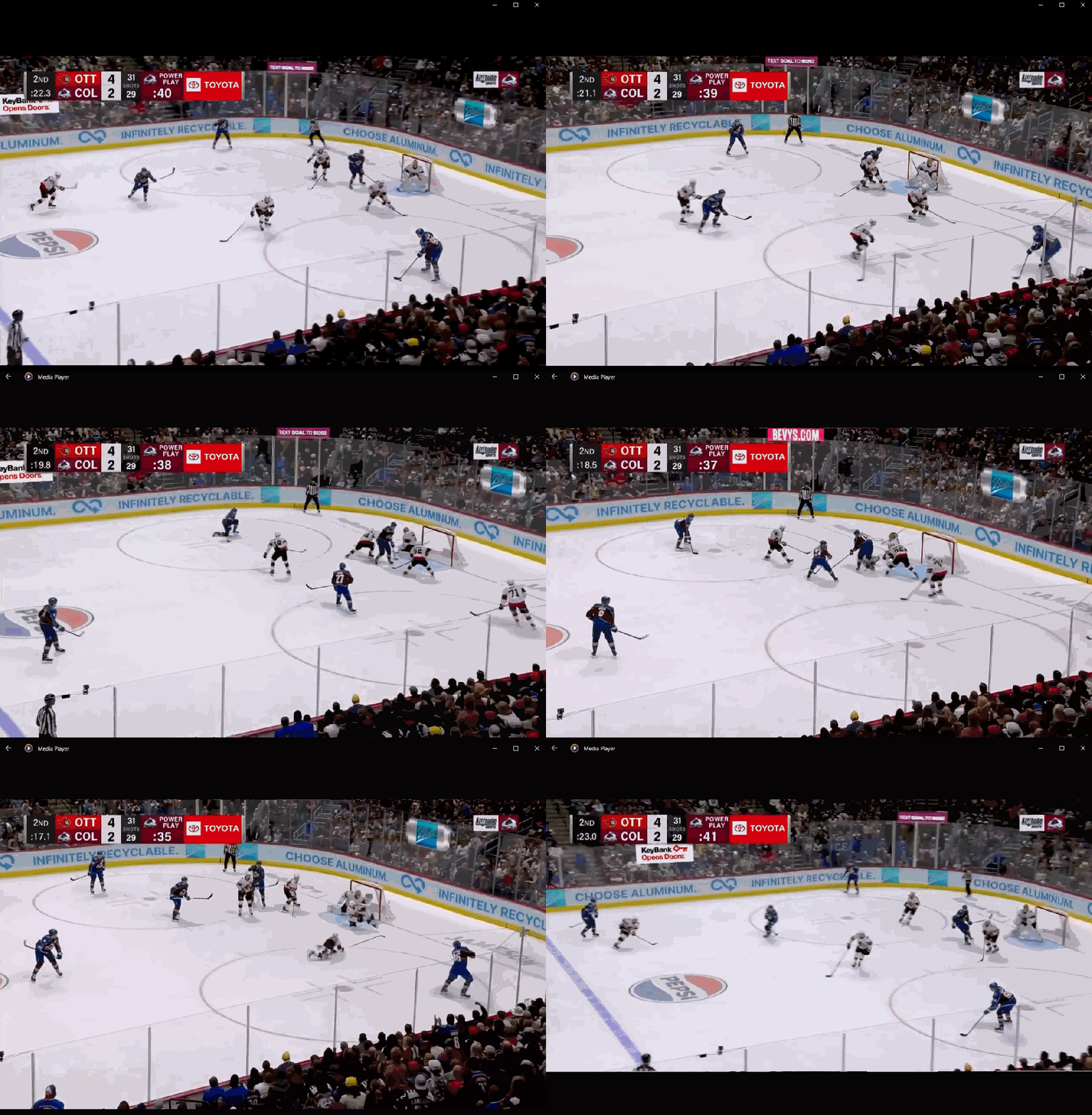
The second goal against was pure fatigue. Senators forwards Tim Stützle and Ridly Greig both jumped on as the second unit with about 1:15 left in the penalty kill. The puck was in Colorado’s zone, so they had to skate back to their end, but an Avalanche turnover led to Stützle and Greig having a 2-on-1 back the other way. They didn’t score and had to skate back to their end of the ice, making it three trips to one end of the rink or the other in about 25 seconds. Ottawa was gassed and couldn’t apply pressure, the Avalanche threw the puck around a bit, and that led to another MacKinnon cross-seam one-timer. Korpisalo actually saved that, but when defenceman Jacob Bernard-Docker tried to clear the rebound, he just passed it right to Mikko Rantanen, who fired it home into a mostly-empty net:
The third goal against was a back-breaker allowed by Korpisalo. There were fewer than 14 minutes left in the game, Ottawa was up 4-3, and half the penalty had already been killed. The Senators had cleared the puck down the ice three times already on this PK, and denied the Avalanche zone entry twice. If they could kill the final 45 seconds, they would have a lead with about 13 minutes left in the game.

Narrator: they did not kill the final 45 seconds.

There wasn’t anything fancy about the goal. MacKinnon got the puck at the left faceoff circle, double-clutched, and Korpisalo was in perfect position to make the save on the incoming shot:
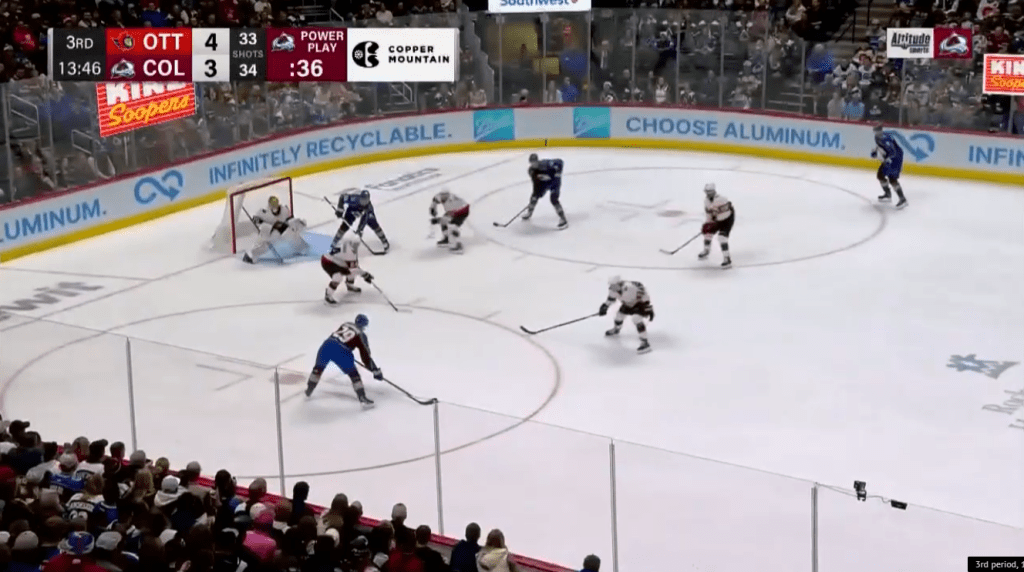
Of course, he didn’t make the save, and MacKinnon ripped it low blocker, which was the exact same spot he scored his first power play goal. That is a must-have stop, and Korpisalo just missed it.

Things went from bad-to-worse as Ottawa challenged that goal for an offside, lost the challenge, and went back on the PK as a result. Rantanen scored from the bottom of the faceoff circle on a redirection and while I don’t know a lot about goaltending, I don’t think a goalie is supposed to have one-third of his body in the net, turned sideways, on a redirection from five feet in front of the goal line:
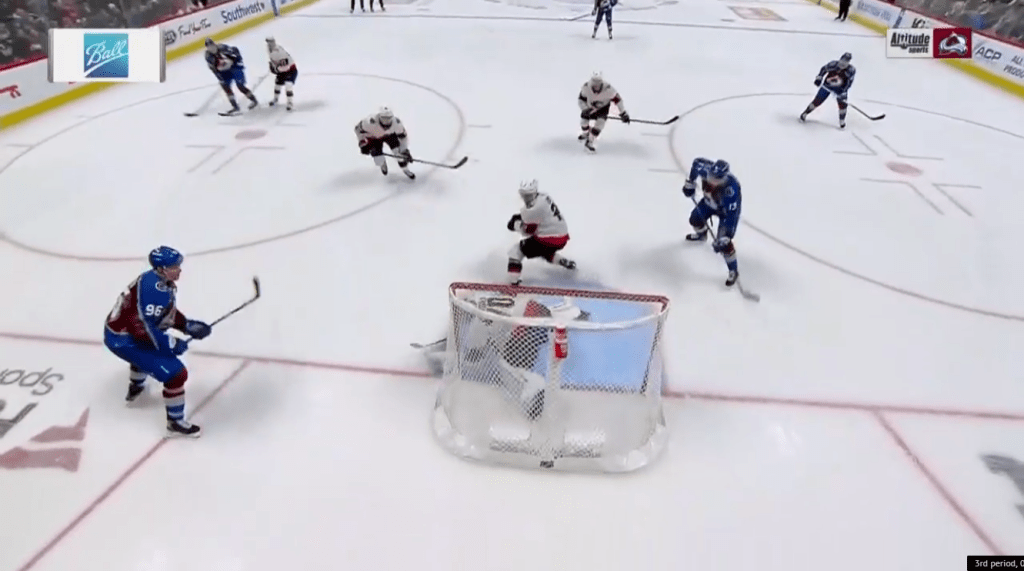
In fairness to Korpisalo, the way Colorado had been moving the puck on the PK basically all game, it’s fair that he thought that was going to be a one-touch pass across his crease. But it wasn’t, and this didn’t look great.

Back in October, Ottawa went into Detroit. Things were going well as Ottawa was up 1-0 with a 14-2 shot advantage and 1:50 left in the first period. A very marginal call against Greig put Detroit on the power play and this is a dandy of a complete breakdown in about 10 seconds.

Dylan Larkin wins the faceoff to Moritz Seider, so Mathieu Joseph rushes out to put on pressure. Claude Giroux follows the supporting Detroit forward, who promptly makes a pass deep into Ottawa’s zone to his supporting forward. He one-touches it to Larkin and in a span of literally five seconds, Detroit has completely broken Ottawa’s PK ‘structure’ to create a 2-on-1 down low, which is a one-timer promptly fired home by Shayne Gostisbehere:
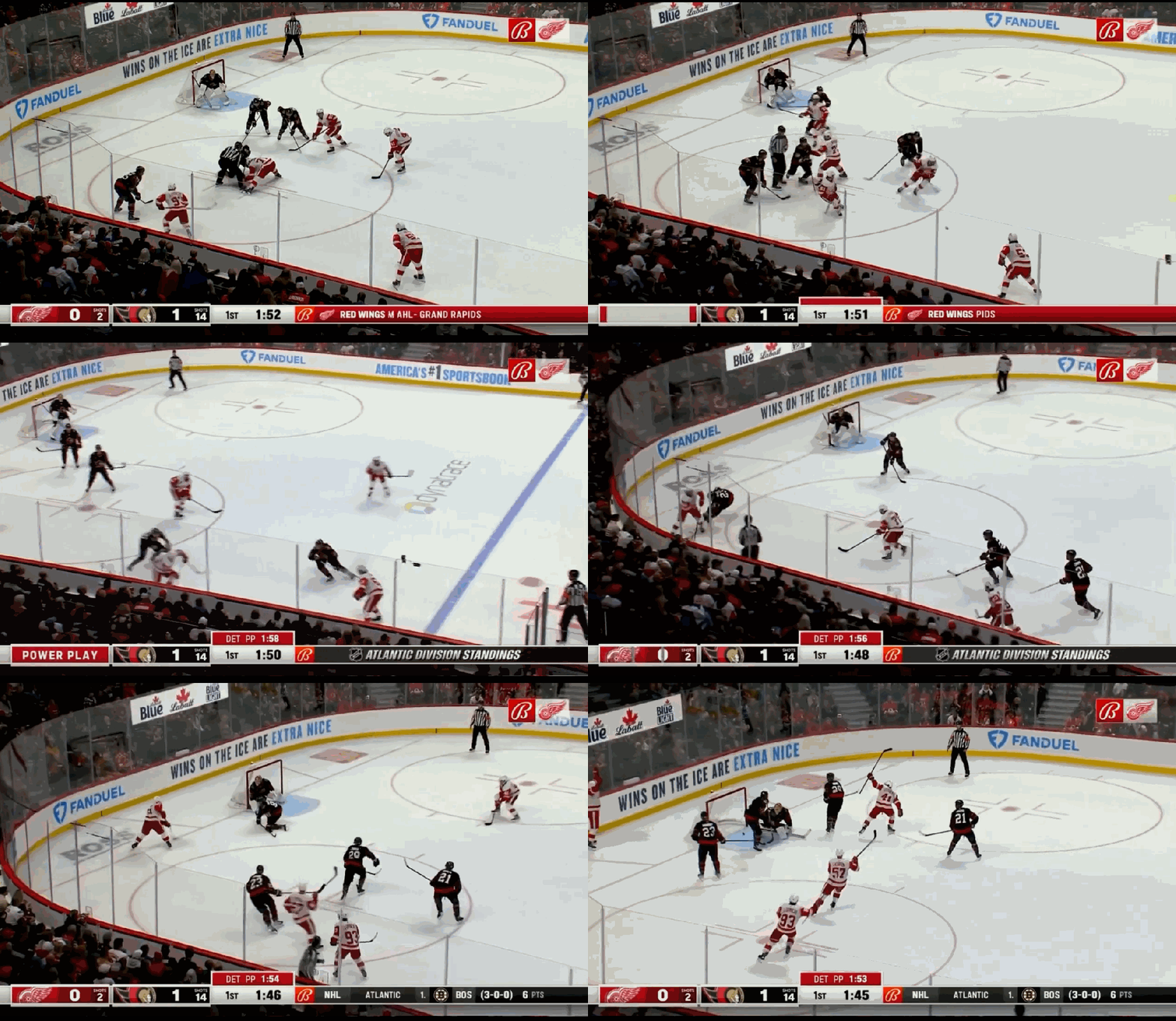
Tough to blame Korpisalo for his team falling apart like this.   

The next goal against is with Erik Brännström patrolling the front of the net. David Perron is standing about three feet away and after Brännström stuffs the initial shot, he lets Perron take another instead of tying up his stick or taking the body or literally anything but what he did:
That snapshot is Brännström preventing the first shot. Perron takes another one fractions of a second later to go top shelf on the short side. Again, hard to blame Korpisalo for that one if his defenceman is going to allow his mark to take multiple shot attempts from about 10-12 feet away.

Detroit’s third power play goal of the game is one of those plays where a minor detail led to a goal against, and effectively sealed the win for the Red Wings.

Seider has the puck at the blue line, having just received a pass from Alex DeBrincat. Ottawa’s Parker Kelly had pushed out to DeBrincat for pressure, so Kelly switches to Seider after that pass is made. At this point, Kelly is now responsible for cutting off the passing lane back to Seider, which he does, and Seider passes to Gostisbehere on the halfwall. However, as Ottawa’s Rourke Chartier turns to pressure Gostisbehere, he leaves his stick to the right and in the passing lane going back to Seider instead of to his left and in the lane going to the middle of the ice:
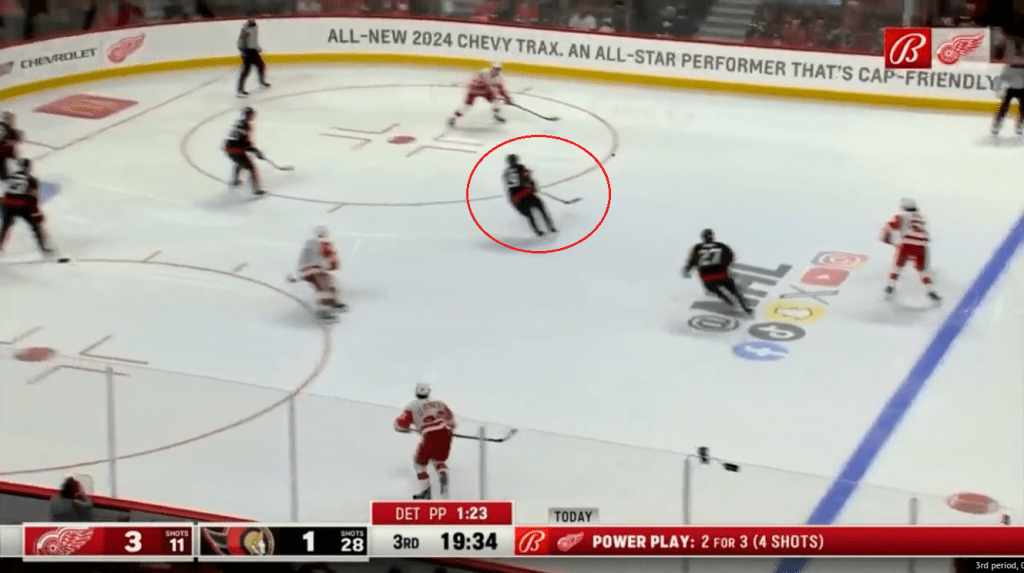
That leaves an 18-wheeler-sized hole in Ottawa’s PK structure, and guess where the puck goes next thanks to a one-touch pass:
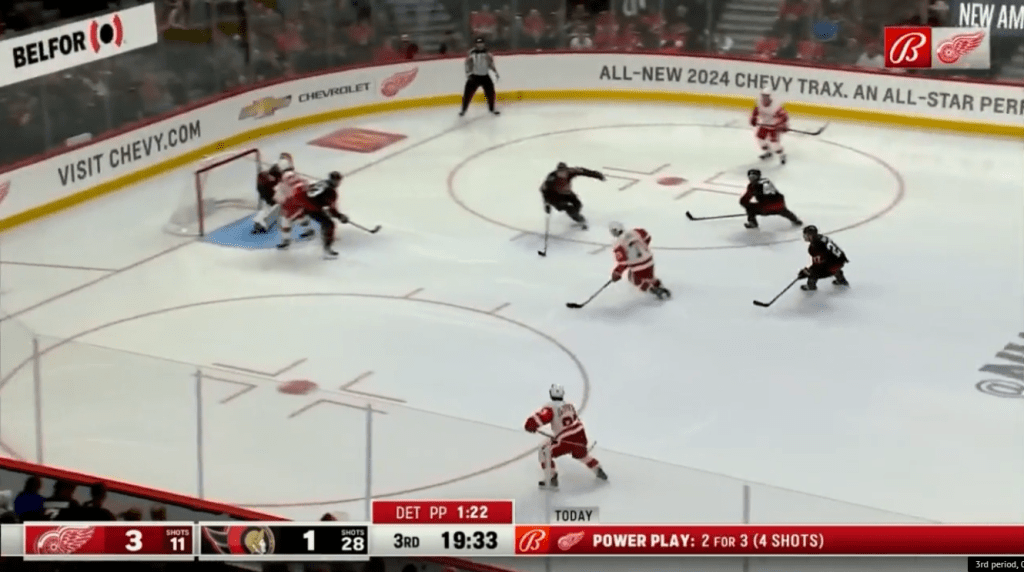
I surmise that leaving a clear passing lane to the slot for a clean 20-foot look from Dylan Larkin isn’t in the game plan.

Three goals against in this game: one was a complete breakdown in about five seconds, one was allowing the same player multiple shot attempts from maybe 12 feet away, and one was a missed detail that led to a high-end scorer having a clean look from a prime scoring area. Ottawa would probably like Korpisalo to stop at least one of them, but it’s hard to hang any of those on him, either.

Alright, let’s get to another game that saw three PK goals allowed, this time in Florida at the end of November.

The first goal against should have never happened. Ottawa wins the faceoff and Artem Zub has the puck behind the net in this spot:
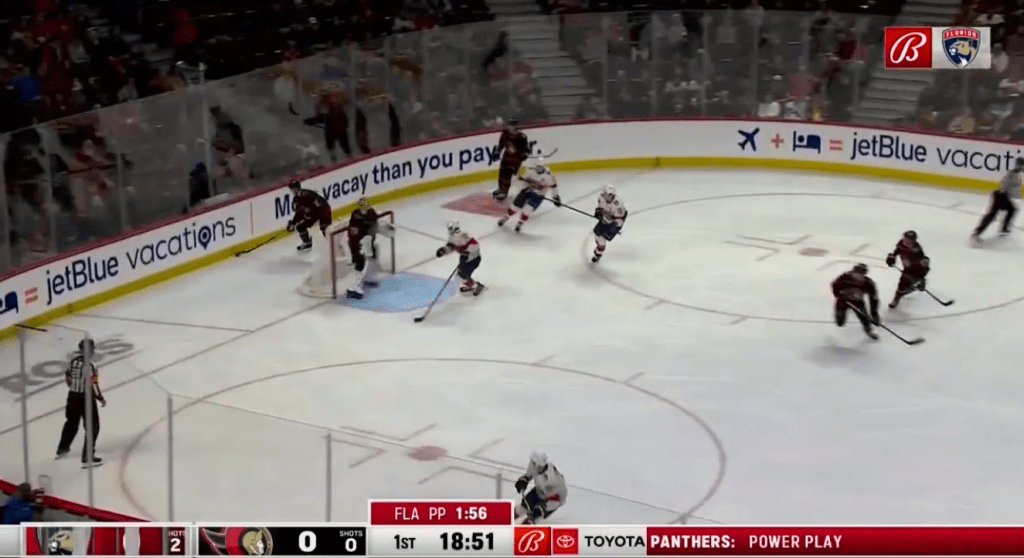
Not only does that puck not get cleared, but he mishandles it, and Florida is able to instantly put pressure on behind the goal line. If that puck is cleared – and it should have been – then none of what happens next actually happens.

To make matters worse, Ottawa compounds that Zub flub with more mistakes.

Aleksander Barkov has the puck on the half wall. There is no cross-seam pass available to Sam Bennett, there is no real lane for a pass to Sam Reinhart in the middle of the ice, so the options are back to Brandon Montour on the blue line or down low to Matthew Tkachuk:
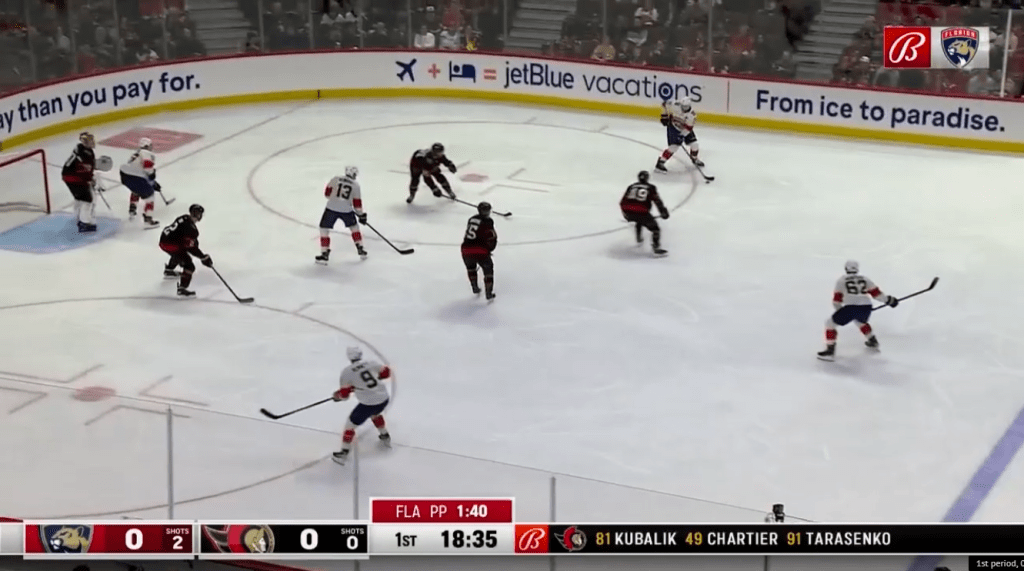
It all looks fine, right? Well, Jake Sanderson leaves his feet moments later and as soon as he does, Barkov goes down low to Tkachuk. Because Sanderson left his feet, he can’t get back in position to take away the pass to Reinhart in the middle, who eventually scores the goal:
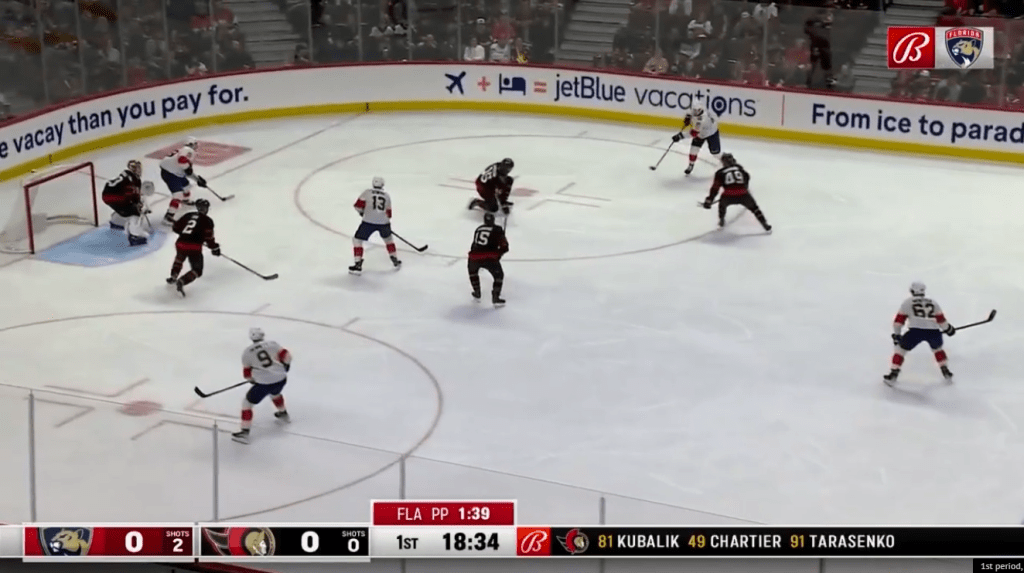
Clean one-timers from 15 feet away is a tough way to live on the penalty kill.

The next goal allowed is an interesting one. Florida rims the puck in from just inside Ottawa’s blue line, Korpisalo goes behind the net to stop it but it jumps over his stick. Reinhart picks up the loose puck and wraps it around and in the net before Korpisalo can get back in. It looks like a bad goal on the goalie, without question.

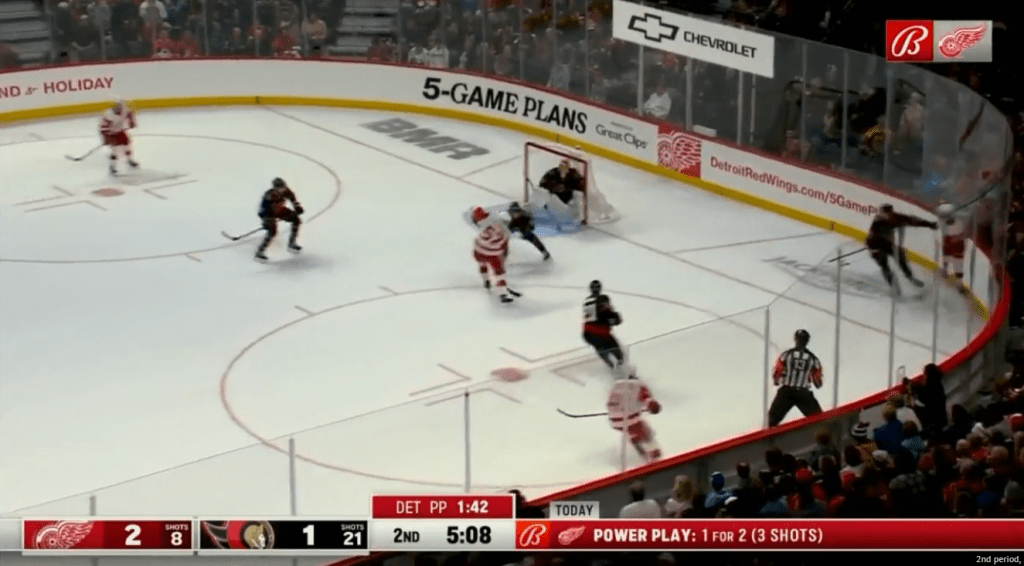
The interesting part is that this is the second period, so there is a long change. Ottawa had cleared the puck seconds earlier, but it only gets to the red line rather than deep into Florida’s Zone. Claude Giroux goes for the change seven seconds after a face off (?) but because it’s a long change, and the puck only gets to the red line, Barkov can whip the puck across the ice to the area left empty by the changing forward. It is hard to see behind the logo on the top right, but you can see the change happen as Barkov circles with the puck:
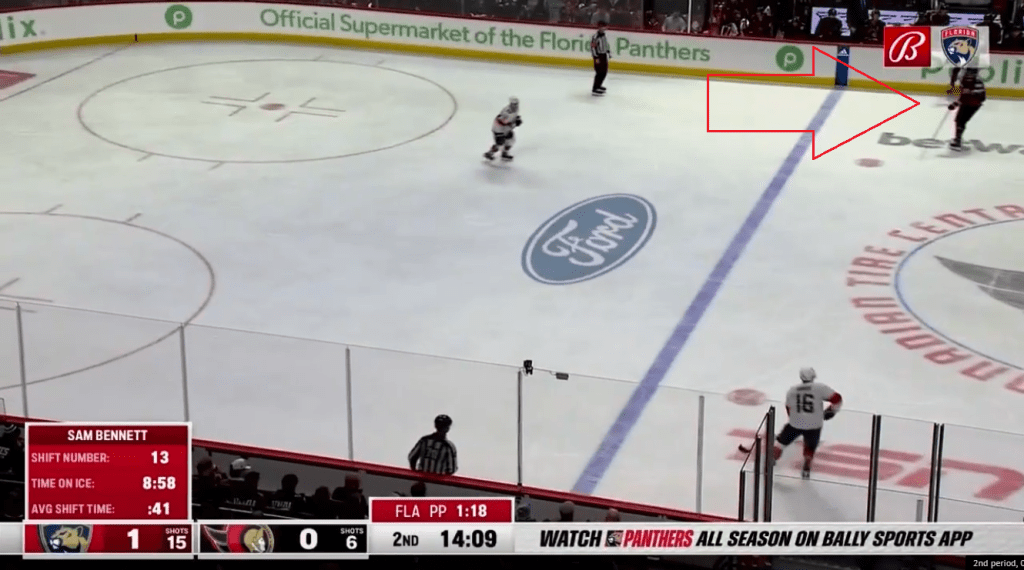
That puck goes to Sam Bennett, who is able to delay long enough at the blue line to let his wingers catch up on the far side. Because that was an easy cross-ice pass for Barkov, and Ottawa doesn’t want to let Bennett just walk to the top of the circle with the puck, the Ottawa defenceman puts pressure on Bennett. However, the changing forward is also coming from the bench to put pressure on Bennett, which leaves just two Ottawa defenders (one of them a forward) to guard about 98% of the defensive zone:
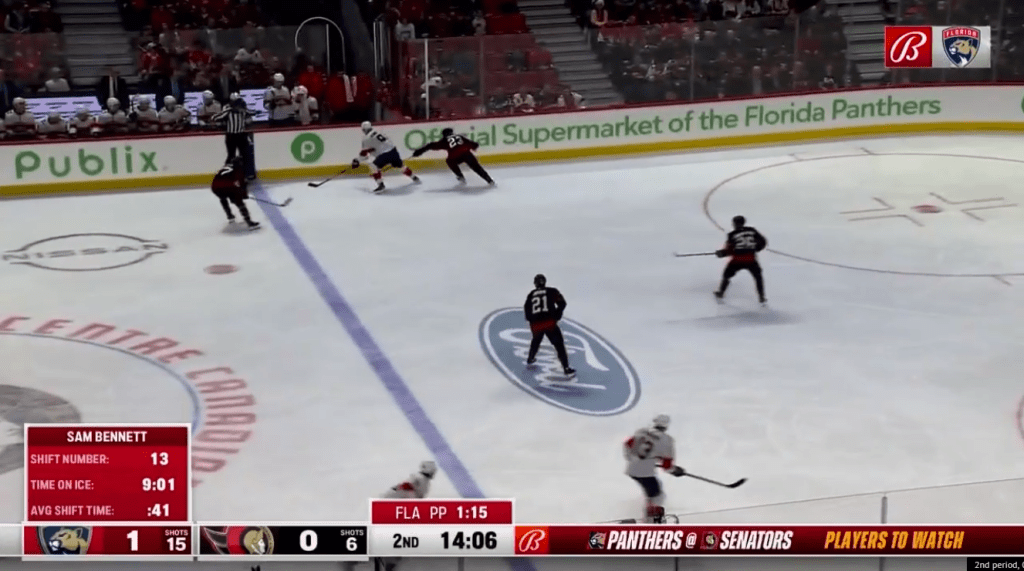
Now, Korpisalo doesn’t stop the puck behind the net, and that allows Reinhart for a wrap-around goal. However, because the forward changed with the puck still at the red line, there was a clear cross-ice pass open for Florida. Because that cross-ice pass happens, the Ottawa defenceman has to pressure the recipient of that pass to ensure he doesn’t have a clear lane to a good shooting position. But because that changing forward is behind the play, and that defenceman has to step up, Florida has a 3-on-2 from the hashmark and below. Any sort of pressure on Korpisalo would give Reinhart not only the chance to wrap the puck around, but pass to the slot to Barkov, or across the seam to Tkachuk:
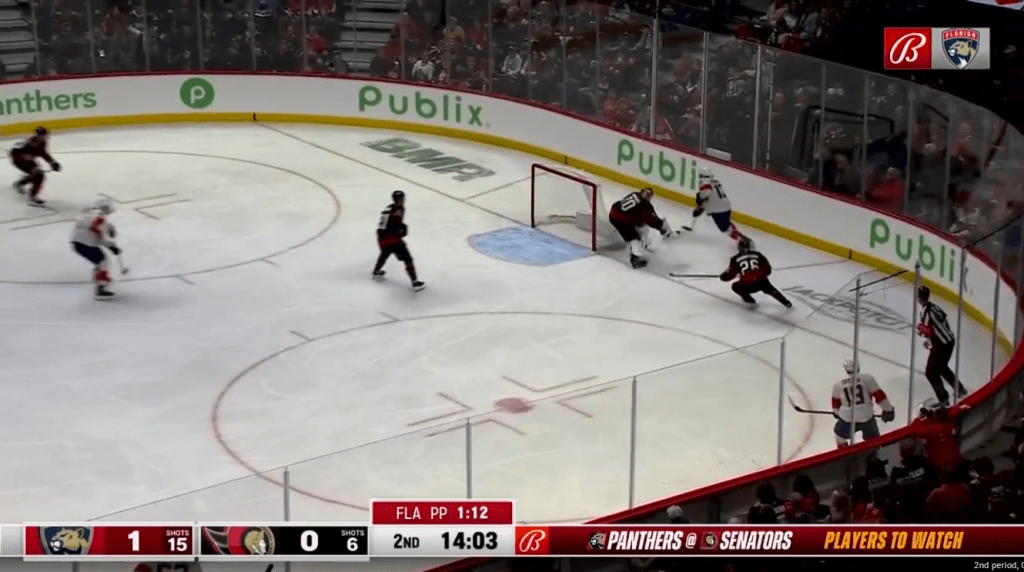
If Korpisalo stays in his net, maybe none of this happens, but it shows how one mistake – a bad change mere seconds after a face off – snowballs into a goal against that should have never happened for one reason or another. I have a feeling this will become a theme, if it hasn’t already.

Florida scores another power play goal 1:10 later because Ottawa challenged that last one for an offside, lost, and got penalized for delay of game (again!). That power play goal is scored because Travis Hamonic gets absolutely walked by Bennett despite Ottawa having done a good job of containing and clearing. This:
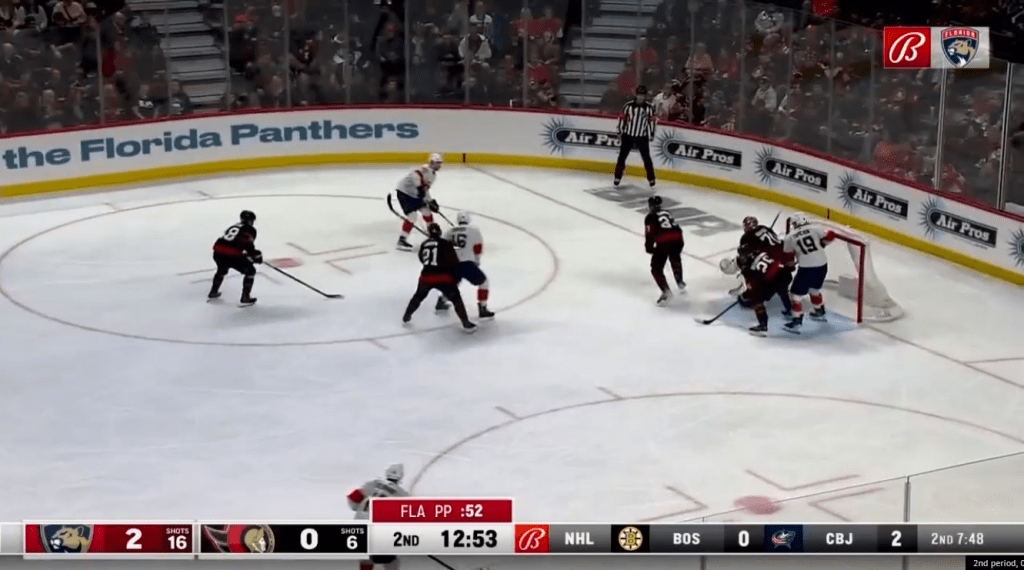
Turned into this:
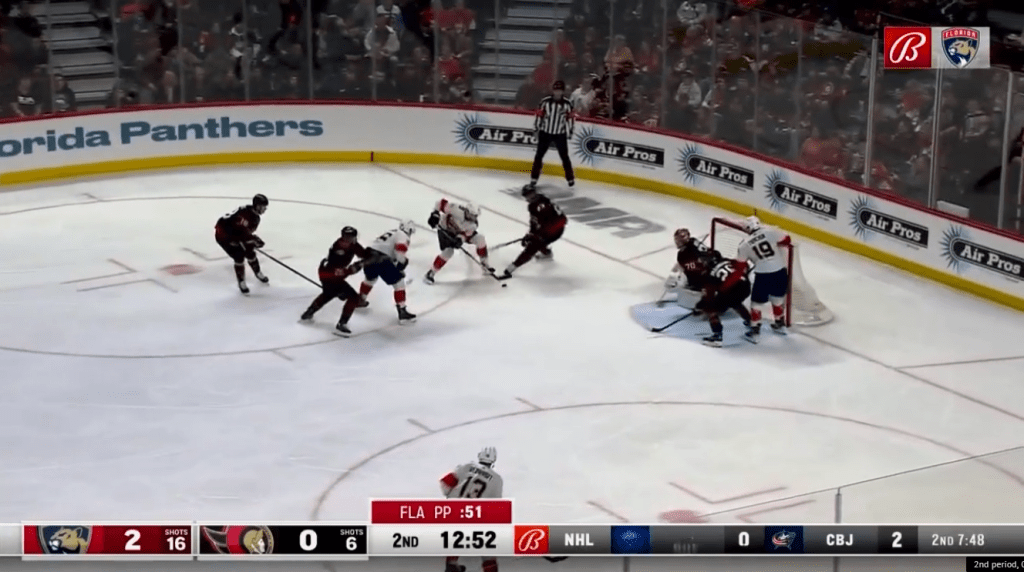
Not sure what Korpisalo is supposed to do here but yell at Hamonic.

This was a game where Ottawa allowed three goals on the PK, and maybe one is on Korpisalo for leaving his net and not stopping the puck, but there were Senators breakdowns on all three goals: an open passing lane to the slot, a long change moving everyone out of position, and a defenceman getting danced around. Those are a lot of brains farting.

At this point, we’ve only covered three games but 10 power play goals against. Of those 10 goals, four were off of seam or behind the net passes and one was a clear screen. In other words, at least half the goals are not really attributable to Korpisalo, which should start to turn the conversation a bit.

On December 1st, Ottawa allowed two power play goals against Columbus (ouch). The first was an interesting screen from Jackets forward Boone Jenner as he was skating from the boards to the net front as Patrik Laine was loading up for a shot at the top of the circles:
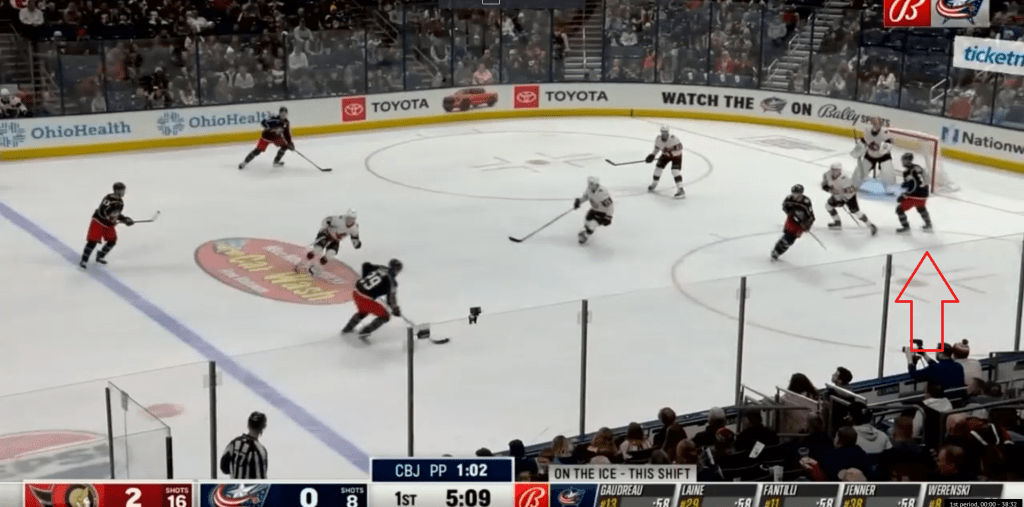
Jenner gets right in front of Korpisalo as Laine is about to shoot:
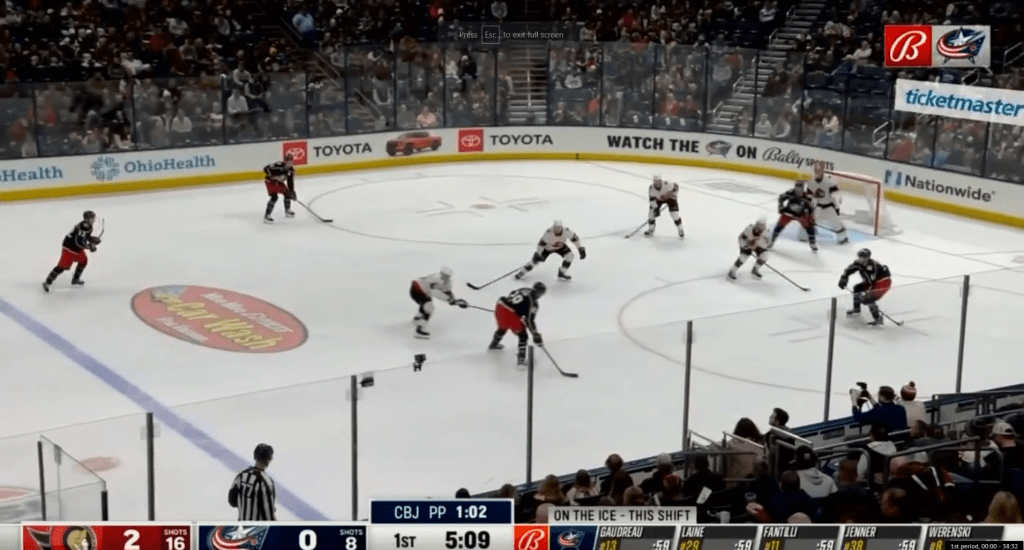
And then he gets out of the way the instant Laine takes his shot:
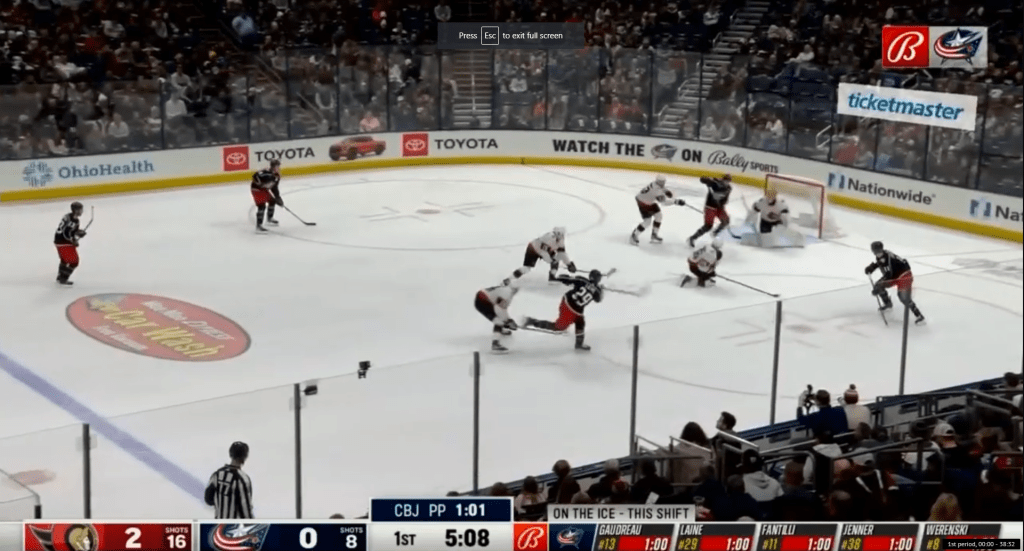
That is a great moving screen from Jenner and it’s hard to fault Korpisalo for giving up a 35-foot Laine wrist shot off the post when he was screened at the time of release.

The following play didn’t result in a goal against, but here is Zach Werenski being contained by three Ottawa penalty killers. Literally two seconds later, Werenski has a clean shot from the high slot:
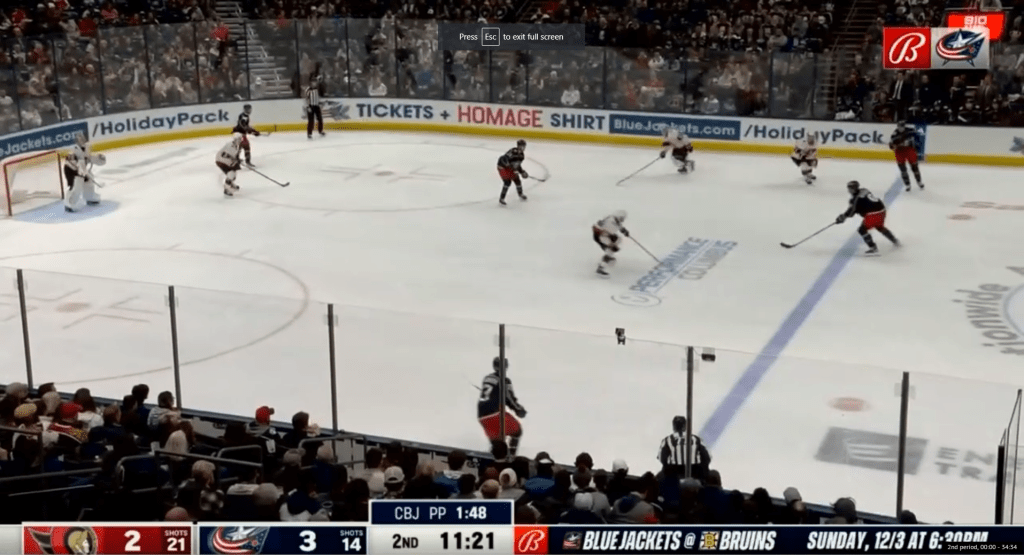
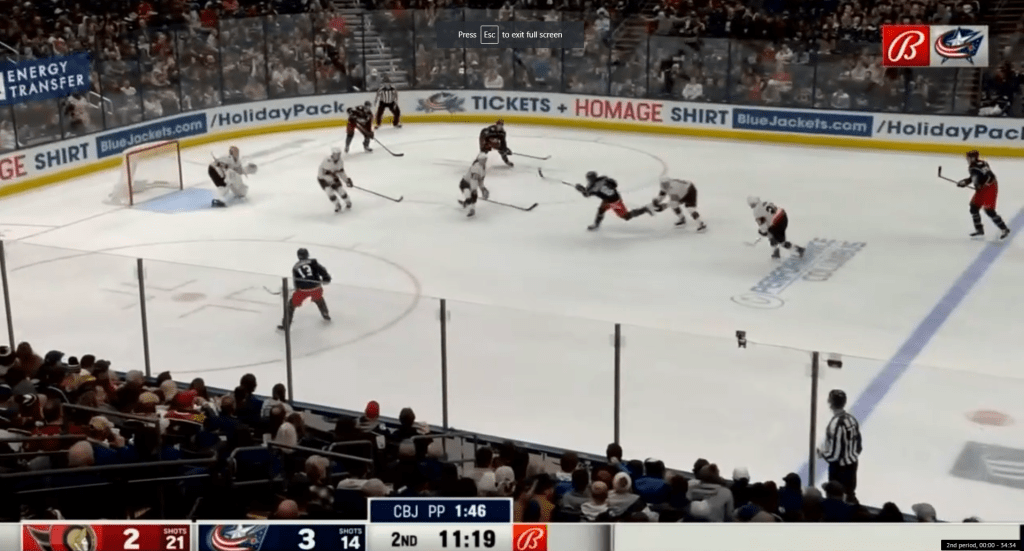
Suboptimal? Let’s go with that.

About 12 seconds later, a point shot from Werenski results in a deflected goal from Jenner, who was basically responsible for both of Columbus’s PP goals.

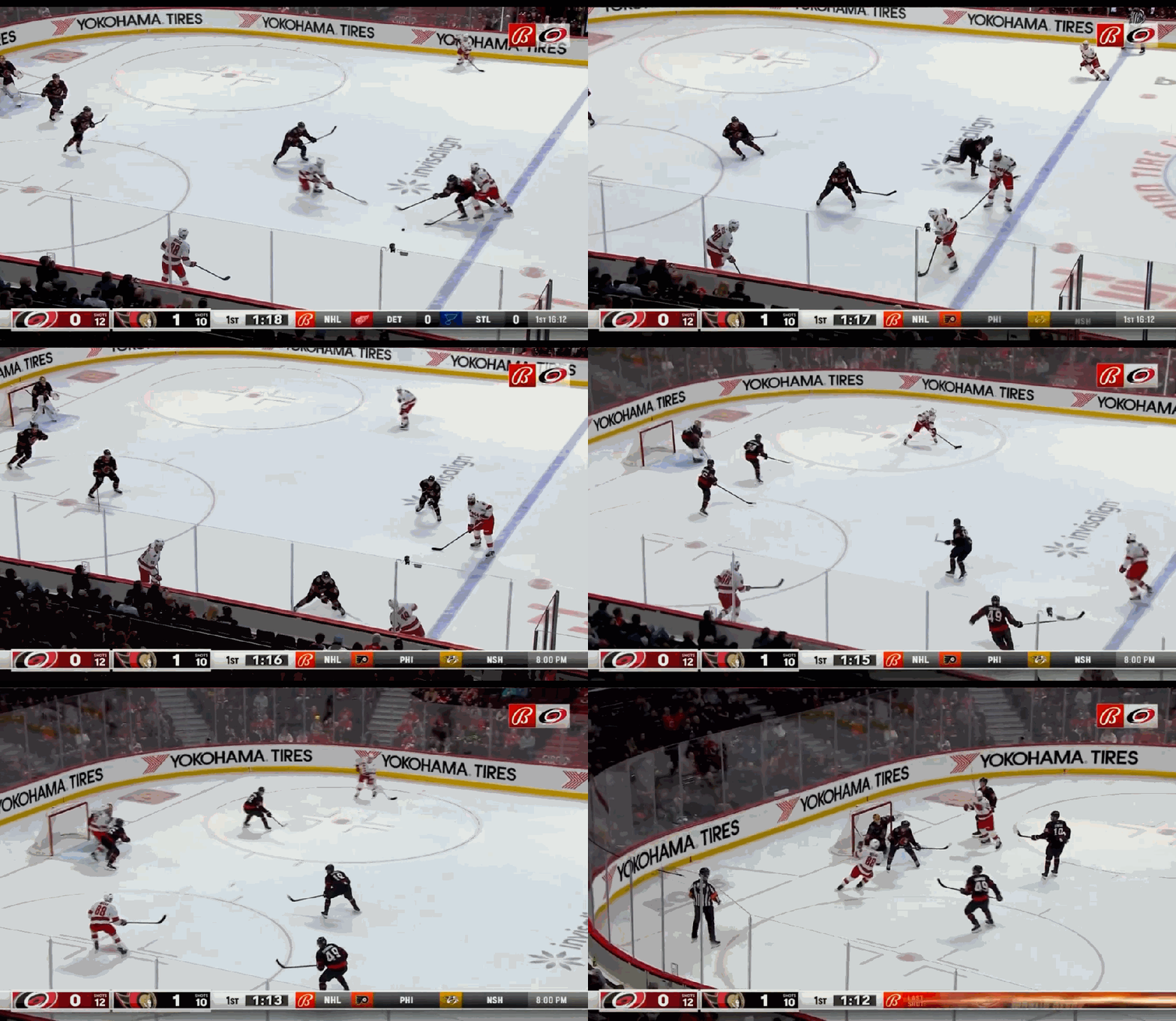
A couple of weeks later, Ottawa was at home to Carolina and gave up two more goals against. The first one was a case of over-aggression as Carolina had a fumble at the blue line, and that got two Ottawa Senators forwards chasing towards the neutral zone. That left two-thirds of the offensive zone wide open:
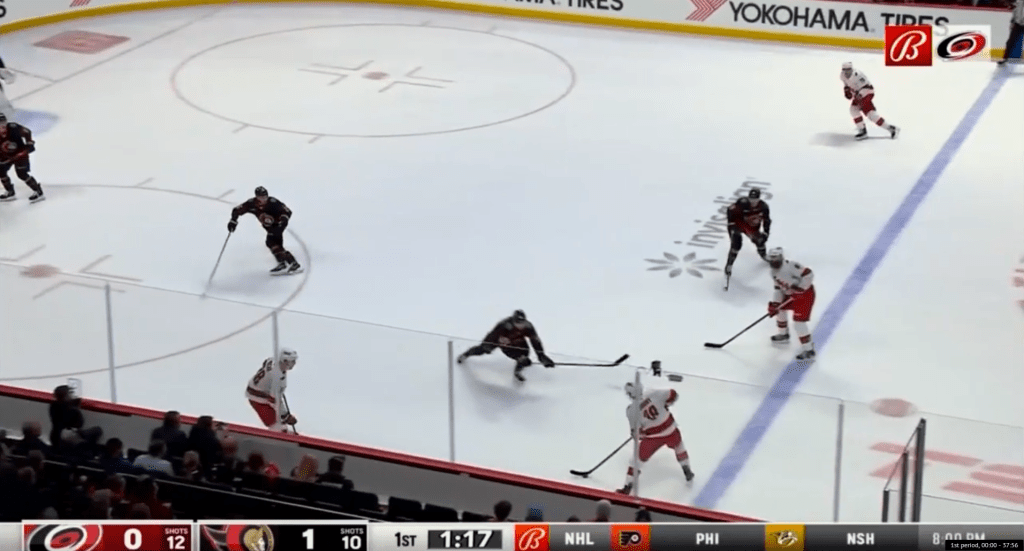
Two seam passes later, and the puck was in the net:
The second PP goal against that game was another shot from the top of the circle and another great screen, this time by Seth Jarvis:
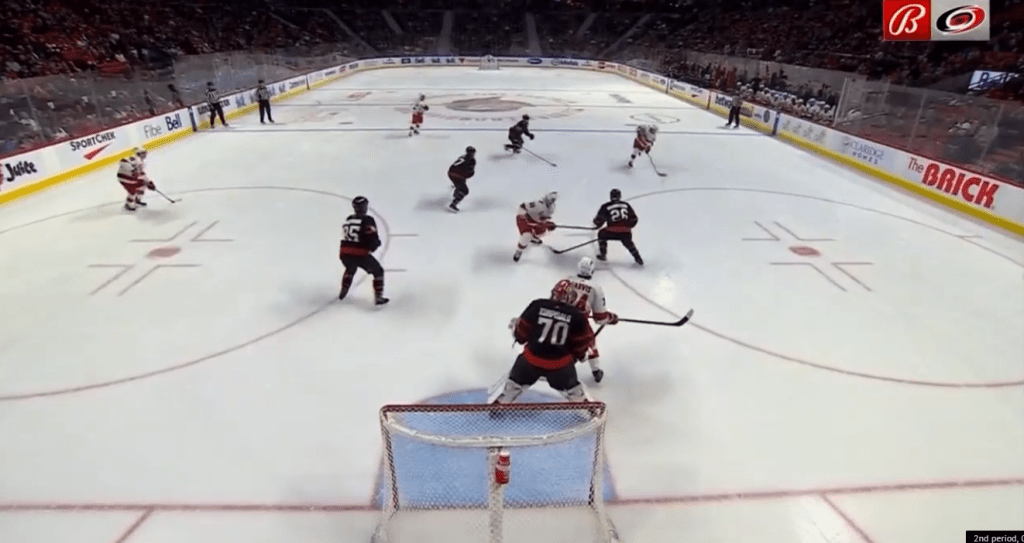
An assist should have been handed to Brännström for his screen, too.

A few days later, Ottawa was in Vegas and things didn’t go well by giving up two more power play goals against in a 6-3 loss. The first was a wild one as Ben Hutton was bringing the puck up the ice and the *entire way* he’s starting down Nicolas Roy:
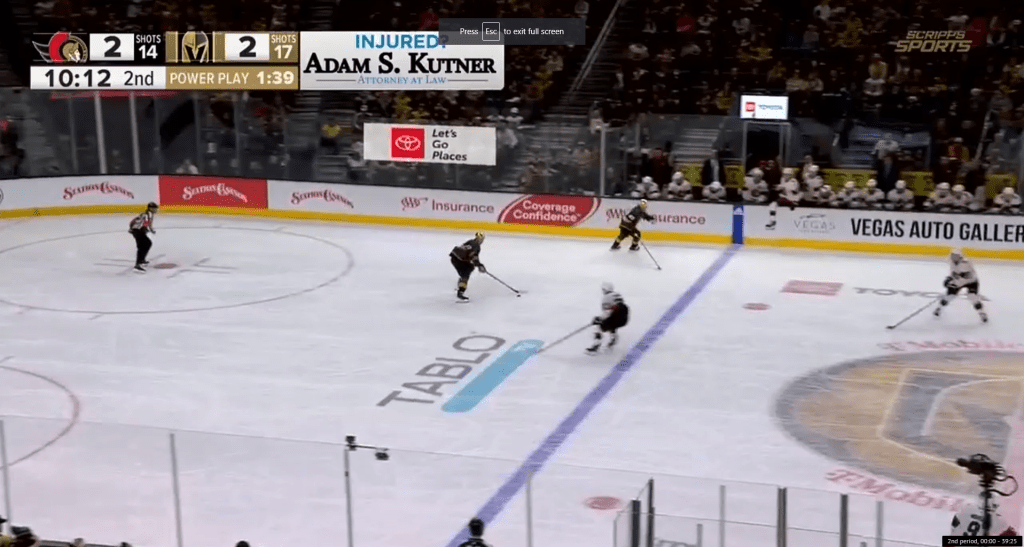
And this happened two seconds later:
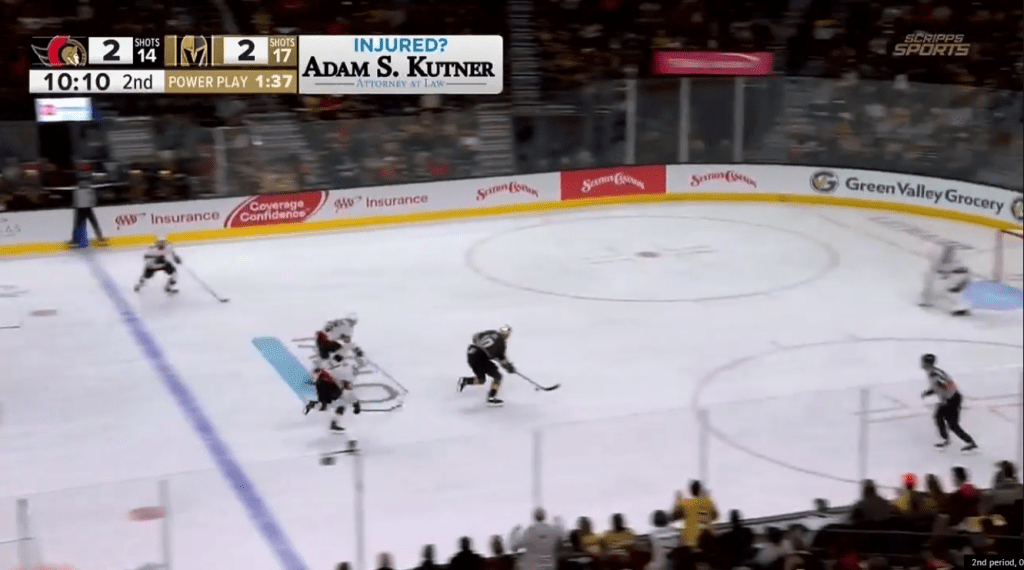
Allowing Ben Hutton to give Nicolas Roy a clean power play breakaway? The bingo card is getting full.

The next goal is something to behold on Claude Giroux’s behalf. He is basically stationary in the slot for a few seconds, and then chases out to the blue line after Alex Pietrangelo (?). Not only does that leave a clean seam pass across the zone to Jonathan Marchessault (which isn’t what happens), but it allows Mark Stone to leak out to the slot for a very clean look from about 20 feet. William Karlsson then has two cracks at the ensuing rebound:
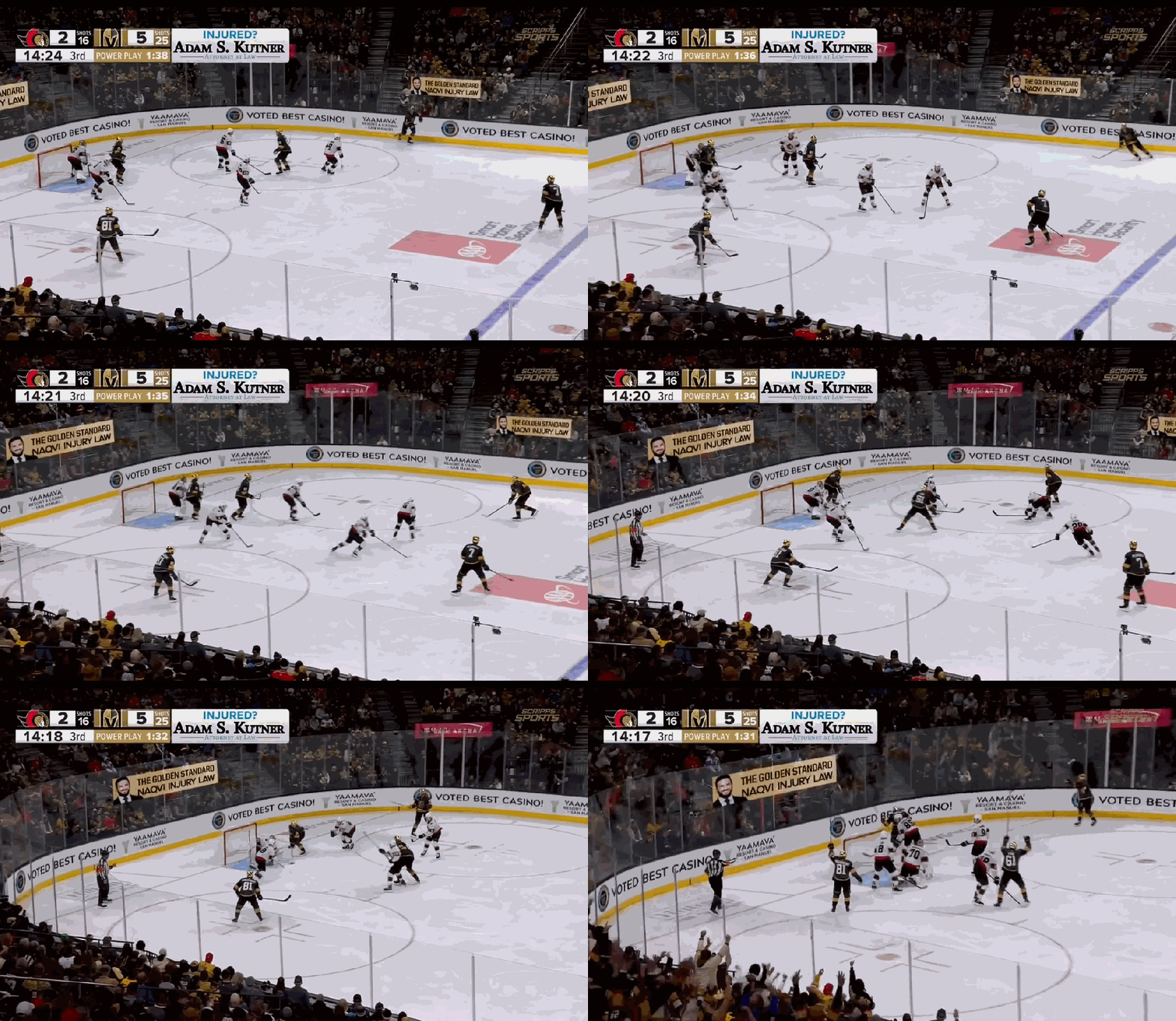
This type of wedge PK is common, but the point is that the second forward isn’t supposed to chase to the blue line when the first forward is already out there. Their role is to work in tandem with the defencemen to prevent the exact types of passes left open by Giroux’s puck-chasing when the first forward is hunting the puck. Maybe the first forward should have settled into the slot and let the defenceman push out to the wing, maybe not, but it’s clear there was a miscommunication somewhere. In other words, what in the Cinnamon Toast Fuck was that?

The next game we’ll show is the end of December, a 6-2 loss to New Jersey when Jacques Martin has fully taken over behind Ottawa’s bench. Ottawa again allowed two PP goals against and the first is on a moving screen like we saw from Boone Jenner in Columbus a couple of games ago:
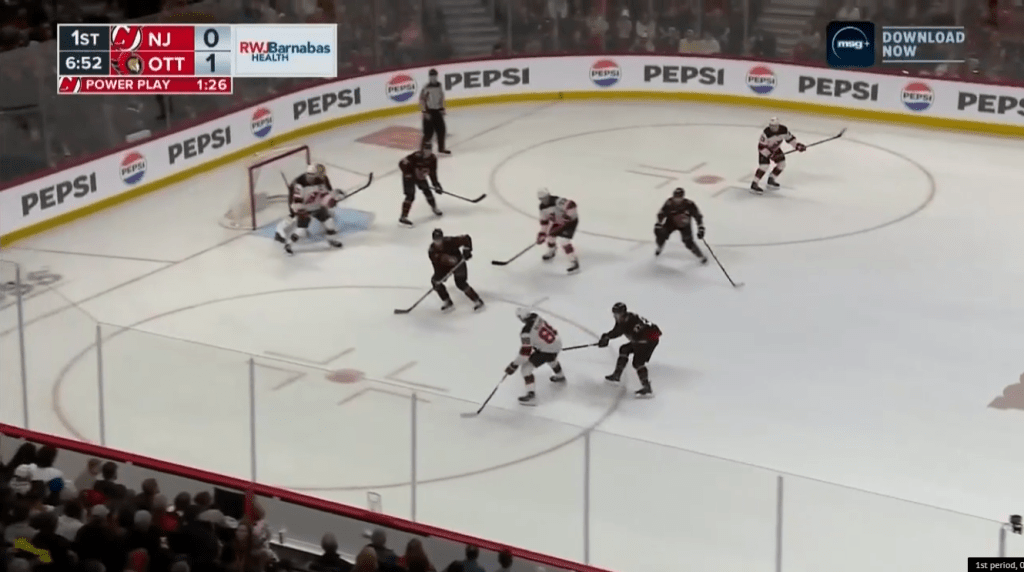
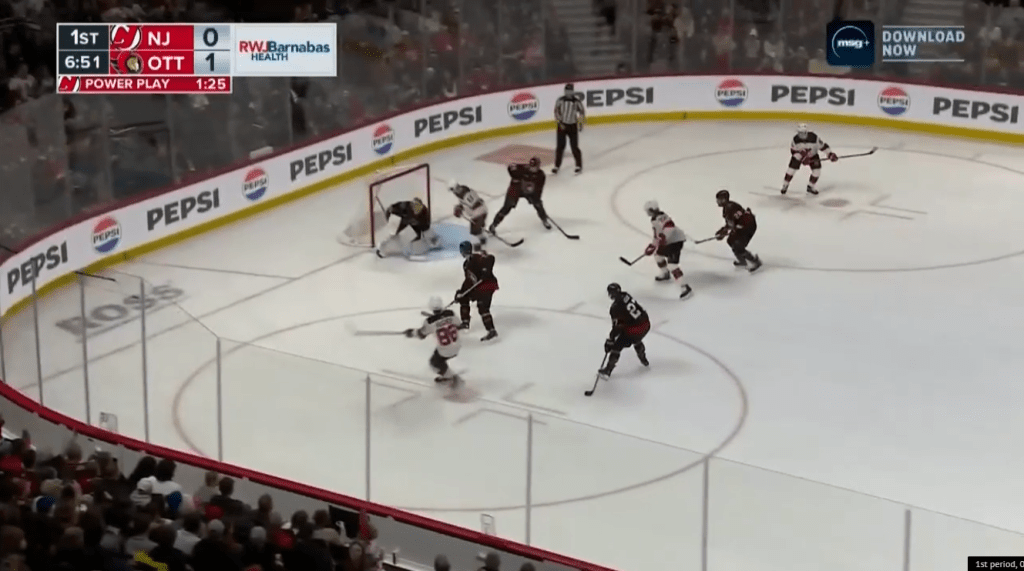
It is a nice screen from Nico Hischier, but good on Jack Hughes for recognizing that Korpisalo was looking in the direction the shot was going to go as he slid across the other way in anticipation of a short-side shot:
The Devils scored later in the first period as Ottawa has very good chances to get the puck out and fail to do so. The first is Stützle failing on this backhand:
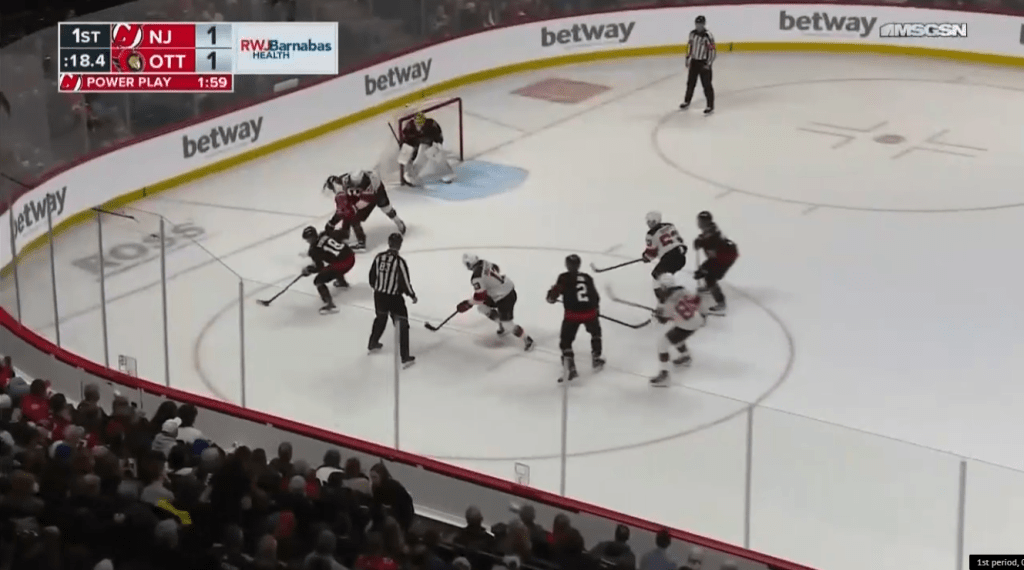
And a couple of seconds later, Greig has an even better chance on his backhand, yet this doesn’t clear the zone, either:
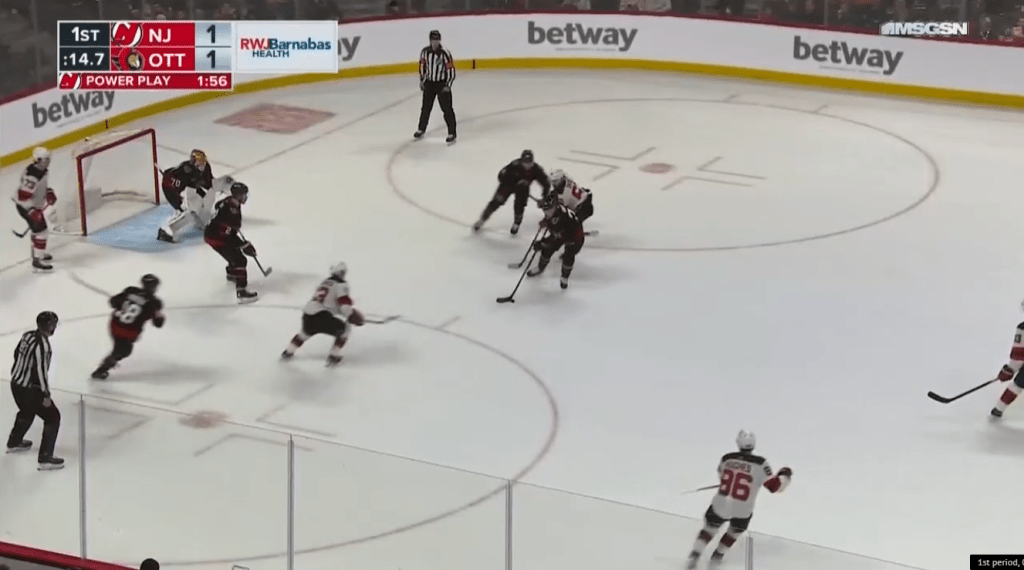
The ensuing scramble gives Jesper Bratt a clean look from the dot even as he has passing options, but he finishes it by going bar-down on the far side:
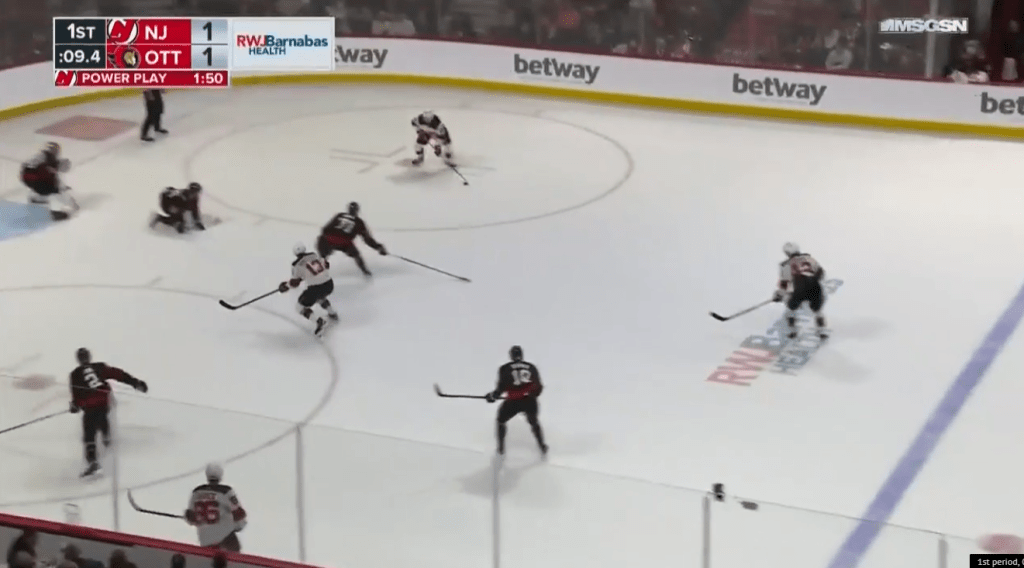
Probably a goal Korpisalo should have had, but the only reason Bratt was in that position to begin with was a complete failure by two different Ottawa penalty killers having two clean looks to clear the zone, and neither could manage it. And even if Bratt doesn’t shoot, he has great passing options. Just clusterfuckery of the highest order.

Moving ahead to February, we have a 5-1 loss at home to Anaheim where Ottawa gave up two more PP goals against. The first one is one of those Tip The Cap-type of goals as Frank Vatrano pounded home a one-timer from about 25 feet, going bar-down. No one was saving that and there wasn’t anything that stood out as a problem from a defensive perspective.

The second goal was firmly on Korpisalo as Cam Fowler scored on a point shot that snuck under his arm. Sometimes, the goal against is just bad.

Next up is a 2-1 loss in San Jose where both goals against were on the penalty kill. Double ouch.  

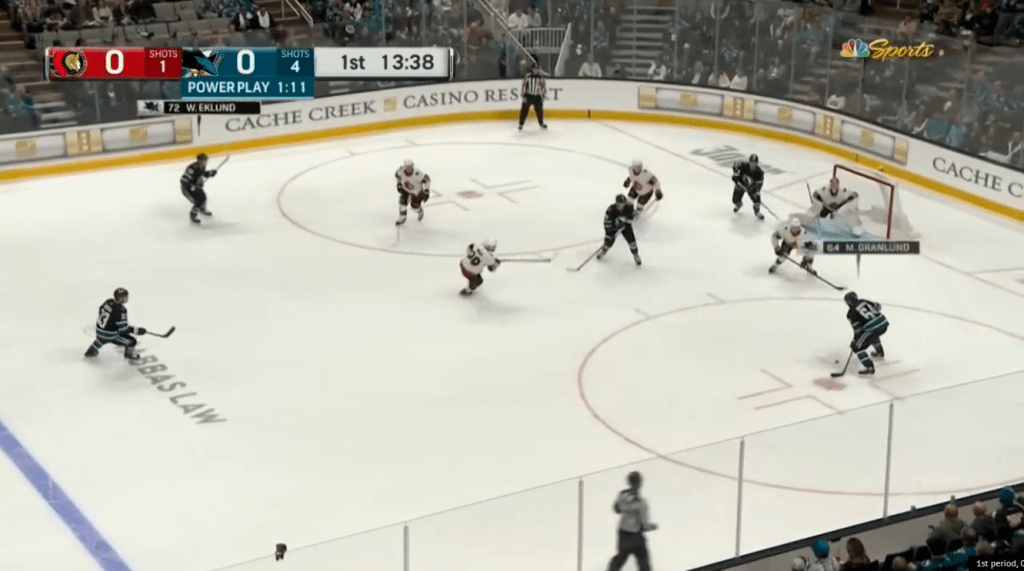
For the first goal against, and stop me if you heard this before, but Giroux was slow cutting off the pass from the half-wall to the middle and the puck was in the net within two seconds (Thomas Bordeleau deflected the slot shot):
For the second goal against, and stop me if you heard this before, but the Senators had a chance to clear the puck and failed to do so:

The Sharks get the puck behind the net and I have no idea what is going on with the Senators here. Why is Artem Zub facing the crowd?
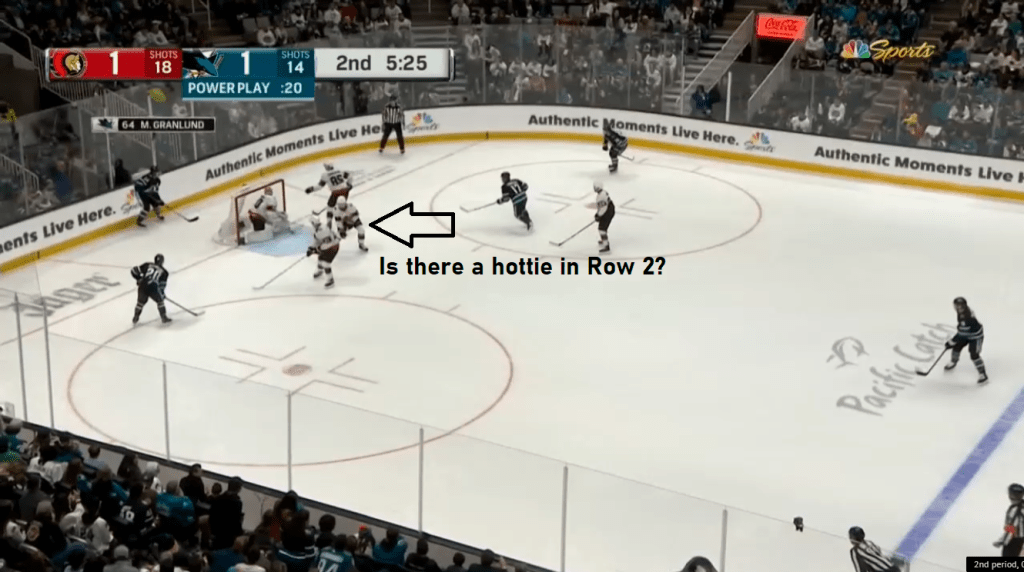
Anyway, Bordeleau opens up for a pass from behind the net and buries the one-timer. There are two Sens penalty killers standing in the crease and no one within five feet of Bordeleau. New coach, same habits.

Ten days later, Ottawa was in Boston and got their brains beat in 6-2. The first goal against was from Justin Brazeau, who was standing in front of Korpisalo for the screen. He has time to corral the rebound, shift to his forehand, and bury the puck:
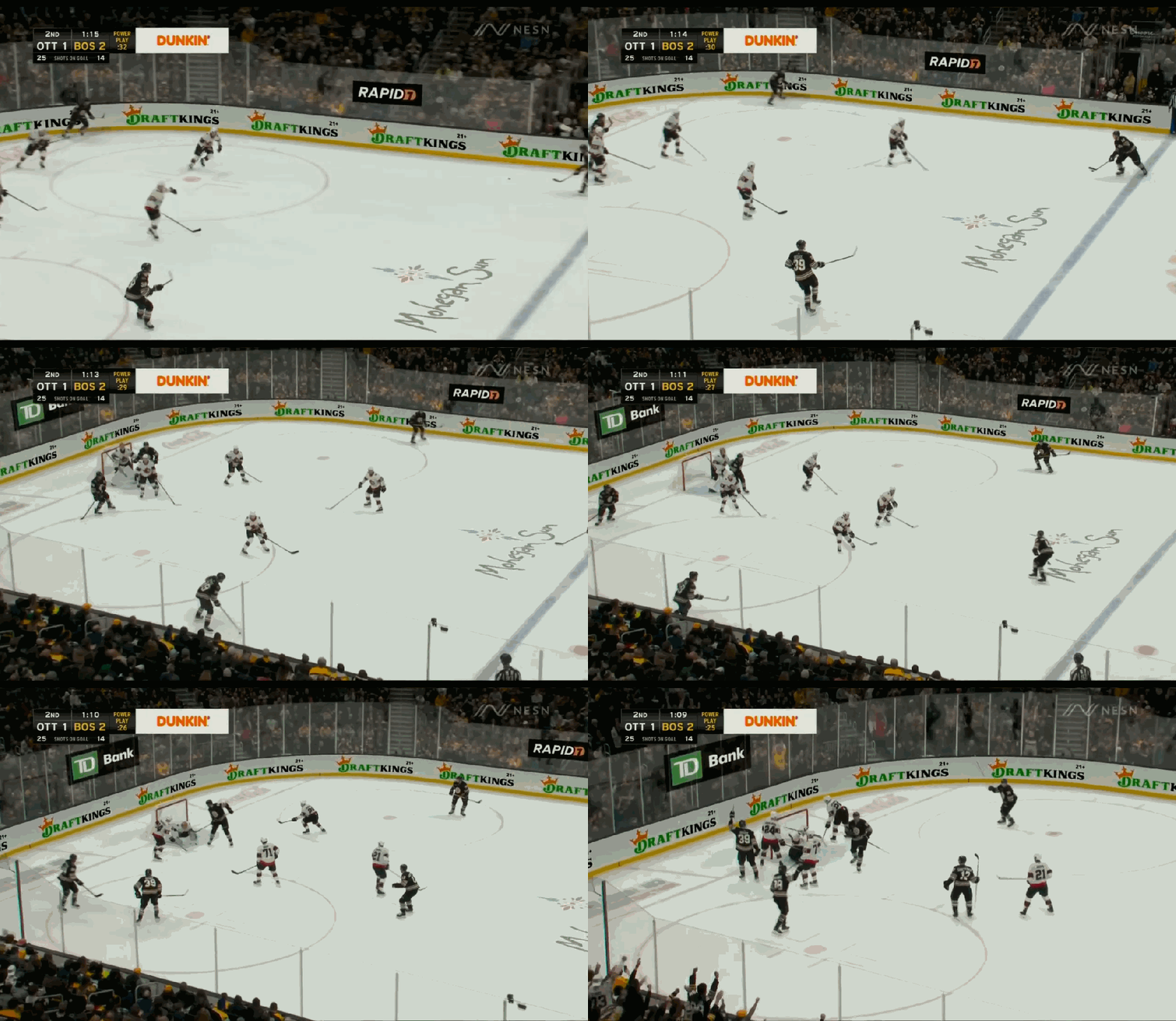
It is wild how often opposing PP forwards are not only left alone in front of Korpisalo, but there is no penalty killer in range to close out on the rebound. That positioning is fine as long as the penalty killers are in position to close on the rebound if there is one, but it’s clear they struggled completing the second half of that task quite often.

As for the second goal against, Ottawa gave up a 2-on-0 earlier in the penalty kill, which wasn’t a great sign. They had a clean chance to clear the puck, and didn’t (quelle surprise). But they again let a player walk to the front of the net with the puck and bury it. It was Brazeau again, and it’s safe to say things aren’t going well when you give up two PP goals in the same game to Justin Brazeau:
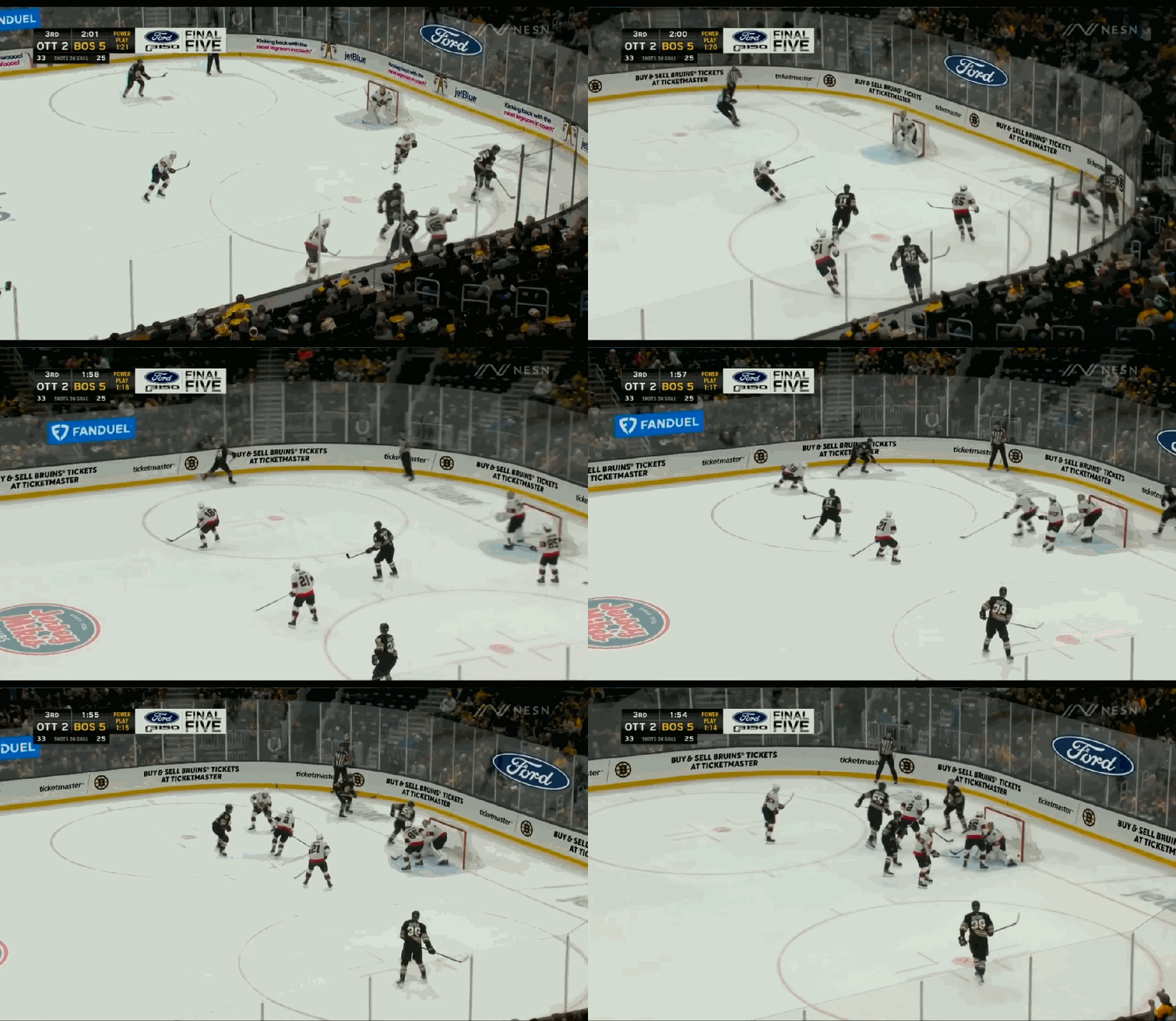
The game was all but over by then, but holy hell.

Finally, we reach the end of the two-PP-goal-against portion of this article with a game against Edmonton. The Senators actually won that one at the end of March 5-3, but Oilers did what they do and that’s produce on the man advantage. The first was Leon Draisaitl scoring a one-timer from his usual spot, and that doesn’t need dissecting.

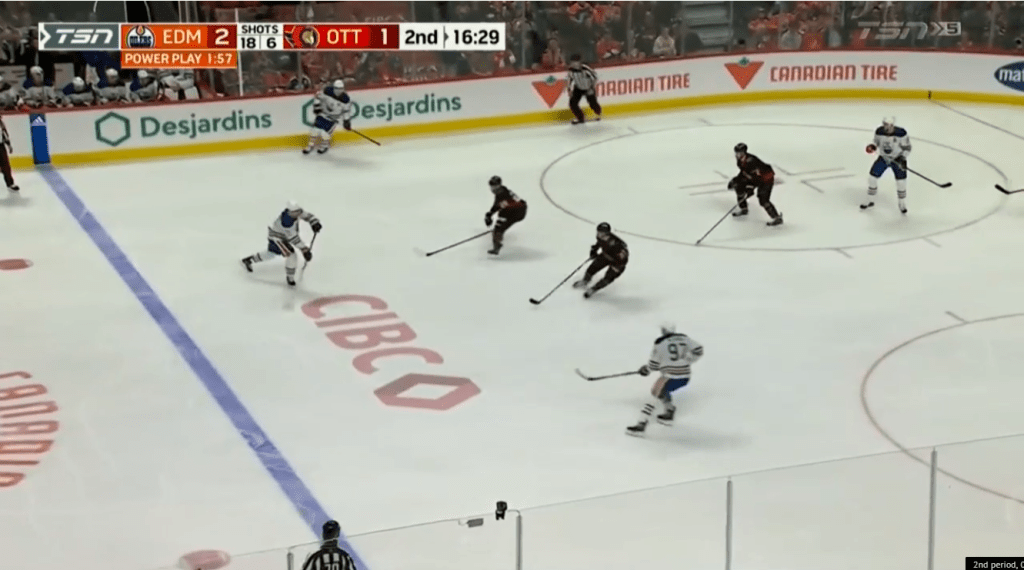
The second goal against is a recurring theme and it’s two forwards chasing the same defenceman to the blue line. Here, the Oilers win the faceoff and both PK forwards push out to him, leaving Connor McDavid wide open to receive a pass as he’s moving down to the circle:
Ottawa’s weakside defenceman had a moment of hesitation towards the blue line, and that left Leon Draisaitl and Zach Hyman in front on a 2-on-1. Probably not an ideal situation:
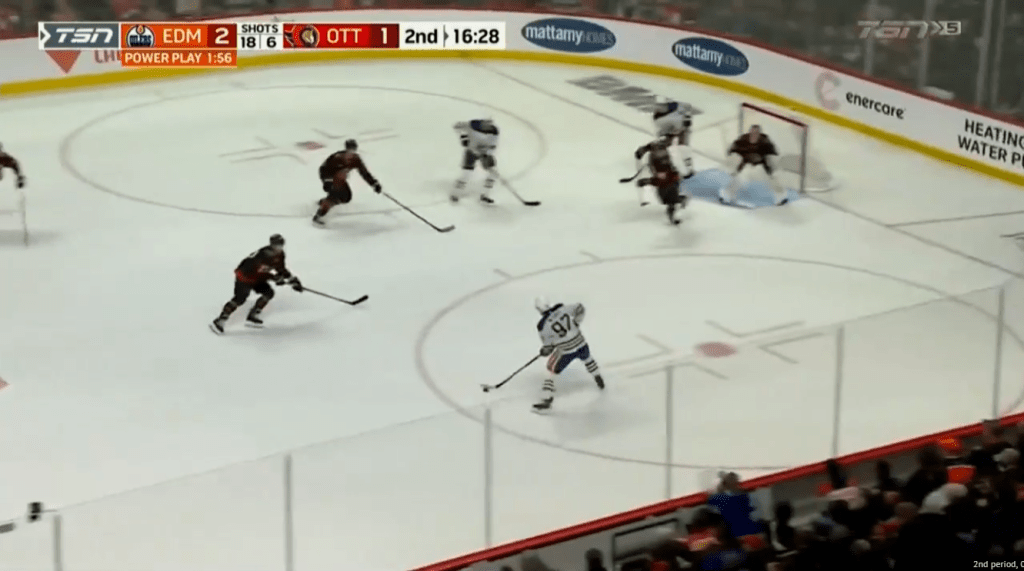
Hyman wound up being the one to score here, tapping in the backdoor pass.

We have seen complete breakdowns, failures to clear the zone, over-chasing a defenceman, and just bad decision-making. However, this goal highlights one additional issue that is recurring: indecisiveness. There were a couple times where just a quick feint towards the wrong player left an Ottawa penalty killer one step behind where he should be, and with the talent in the league being where it is now, being one step behind leaves open passing lanes leading to easy goals. That indecisiveness crops up again and again and is a symptom of having an aggressive penalty. It is good to be aggressive – Carolina has thrived for years doing that – but failing to make any decision at the right time can be as detrimental as making a bad decision. That indecision opens lanes that shouldn’t be open, and leaves the goalies hung out to dry.

We’ve reached the end of the games where Korpisalo allowed at least two PP goals against. Those games resulted in 26 goals against, and 16 of them have been on clean seam passes, a screened shot, or a deflection. Those are the kinds of goals that are tough to lay at the feet of a goaltender.

Games With One PP Goal Against

Moving on to the single-goal games, we have the very first game of the season, a 5-3 loss to Carolina with DJ Smith behind the bench. In this sequence, Korpisalo has already made a few saves, including a pair of rebound saves with Carolina having free reign to whack at the free puck. About 30 seconds later, we get this from Ottawa:
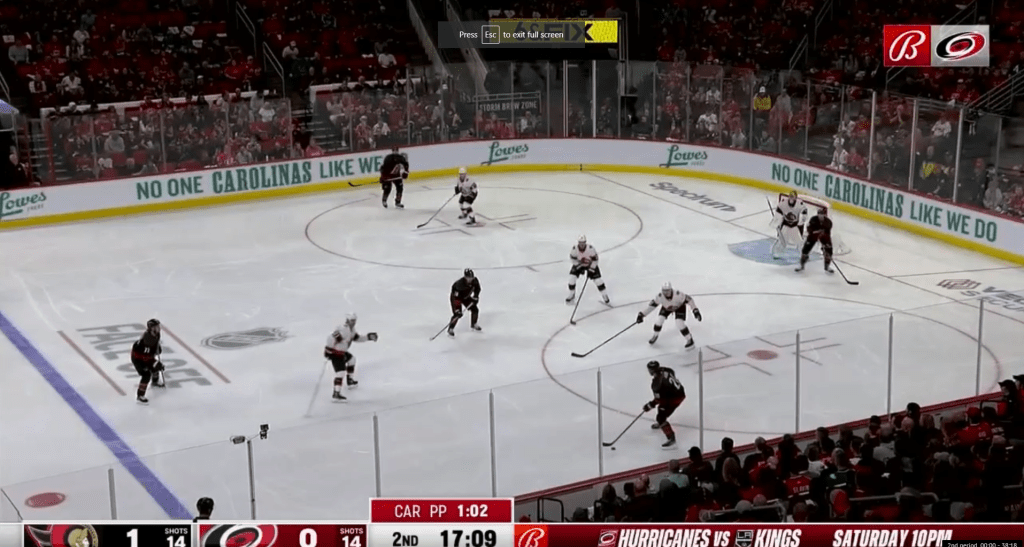
It is safe to say that the Senators failing to have any skater within 20 feet of the lone Hurricanes skater in front of the net, and also not even having a stick in the passing lane to said player, is not optimal penalty killing. Sebastian Aho makes the very easy pass down low to Michael Bunting, who eventually makes it to the other side of Korpisalo to slide the puck in. Look how much time he has:

That basically functions as giving up a breakaway, which is hard to manage when you have four defenders in the defensive zone.

Later in October, Korpisalo gives up a PP goal against the New York Islanders that he should have had. He coughs up a rebound on a clear wrist shot from the top of the circle and Bo Horvat slams home the puck. It is a goal where maybe Travis Hamonic should have had better stick control of Horvat, but it’s a rebound goal that should have never happened to begin with.

A week later, Los Angeles is in town. Early in the game, the Sens go on the penalty kill and Korpisalo has already had to make a couple of nice saves in addition to Kevin Fiala hitting a post. Los Angeles’s second PP unit hits the ice, and a nice passing play leads to Phillip Danault having not one, but two, clean swipes at the puck from the net-front area. It is another case of clear miscommunication because Ottawa’s weakside forward has recognized the backdoor pass and has dropped down below the hashmarks to cut it off. However, Tyler Kleven stays right in front of Korpisalo, leaving Danault wide open about 15 feet from the goal line:
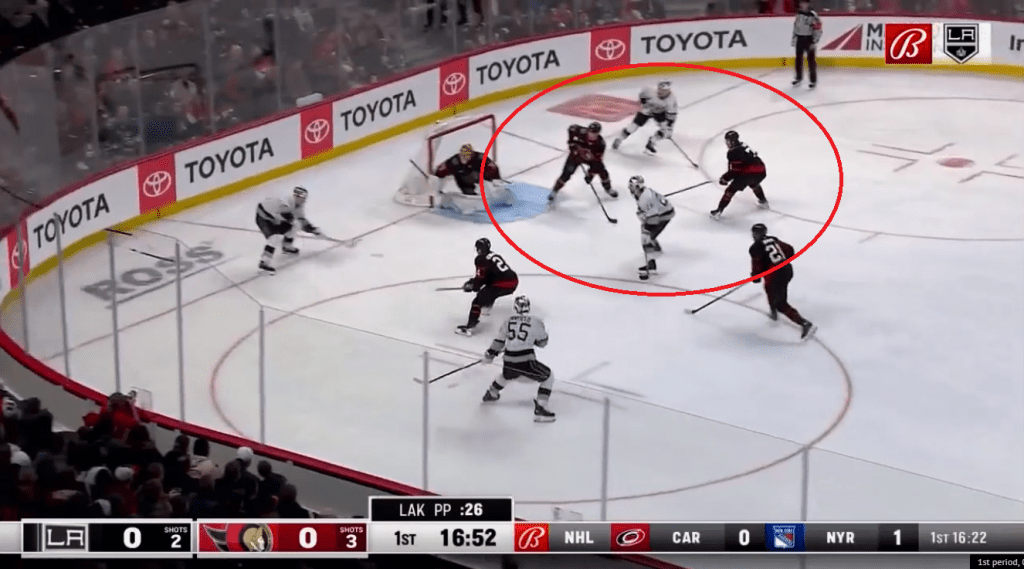
Danault gets a shot here and follows up his rebound as Kleven is flailing his stick around. It is just very poor decision-making from at least half the PKers.

A week later in Toronto, Ottawa loses the faceoff and no one gets out to William Nylander in time, who fires it home from the middle of the ice:
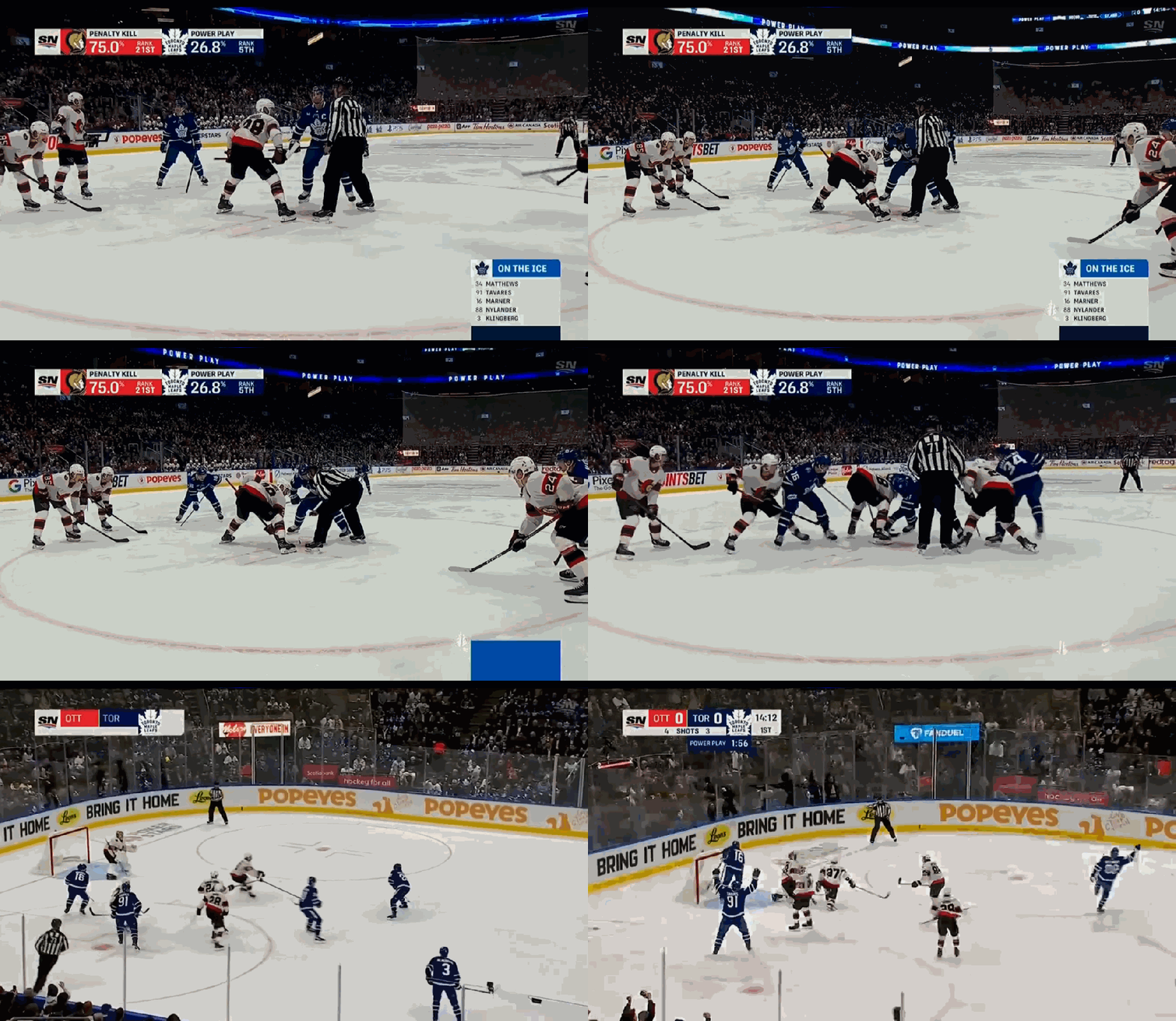
One thing did make me laugh though. As the scramble for the faceoff is going on, Parker Kelly (#27) goes to dig out the puck, but it kicks out to Nylander. Watch Kelly slide on his stomach to cut off a potential pass to Mitch Marner. It’s pretty good.

Not long after, Anton Forsberg got a lot more starts so our story picks back up in December where Ottawa takes a 5-1 win at home to Detroit. The lone goal was a PP goal against, and it was a 4v3 goal where Patrick Kane ripped home a shot from the circle. It is a goal Korpisalo probably should have had as it snuck under his glove on the short side.

In early January, Ottawa lost 6-3 in Vancouver, giving up five first-period goals. Elias Pettersson ripped home a cross-ice pass from JT Miller, and it’s yet another case where an Ottawa penalty killer has his stick in the passing lane to the defenceman rather than the shooter in the circle:
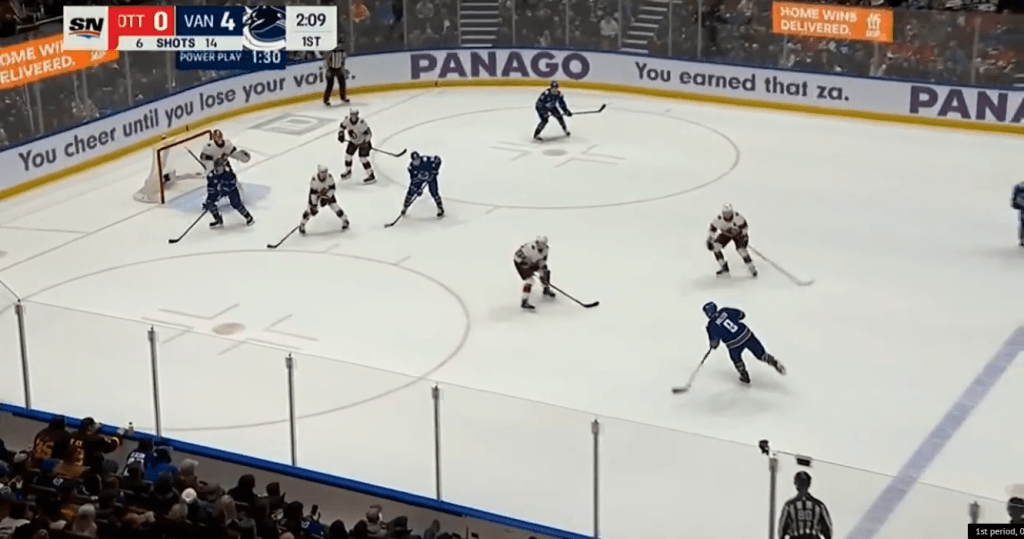
This lack of identifying the dangerous passing lane keeps happening over and over, and it seems to be happening a lot to Claude Giroux. Pettersson’s shot also deflects off an Ottawa defenceman, just for added hilarity.

A week later is a 5-3 loss to Buffalo, and Tage Thompson scores a PP goal because Ottawa allows him to walk into a shot from about 25 feet away completely unchallenged:
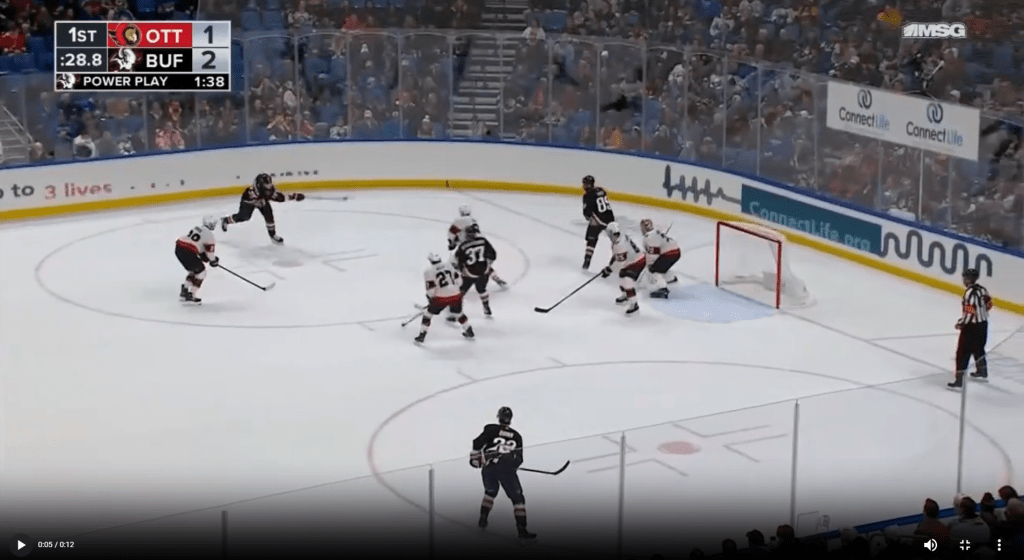
Maybe one Korpisalo should have had, but this is starting to be a lot of goals from about 20-30 feet where the shooter has a clear lane to the net. Goalies stop most of those, but not all of them, and giving clean 20-foot shots to 40-goal scorers is going to end poorly once in a while.

Just before the All-Star break, Ottawa loses 3-2 to Boston and Korpisalo gives up a PP goal to David Pastrňák on a one-timer from about 45 feet. It is genuinely a goal Korpisalo should have had, and he just straight whiffed on.

In February, a 4-1 loss in Nashville had one PP goal against and it’s another goal where the Ottawa skater in front of the net does all of the following: doesn’t take a man, doesn’t block the shot, and provides a screen. It truly is something to behold, and this is how point shots find their way to the back of the net:
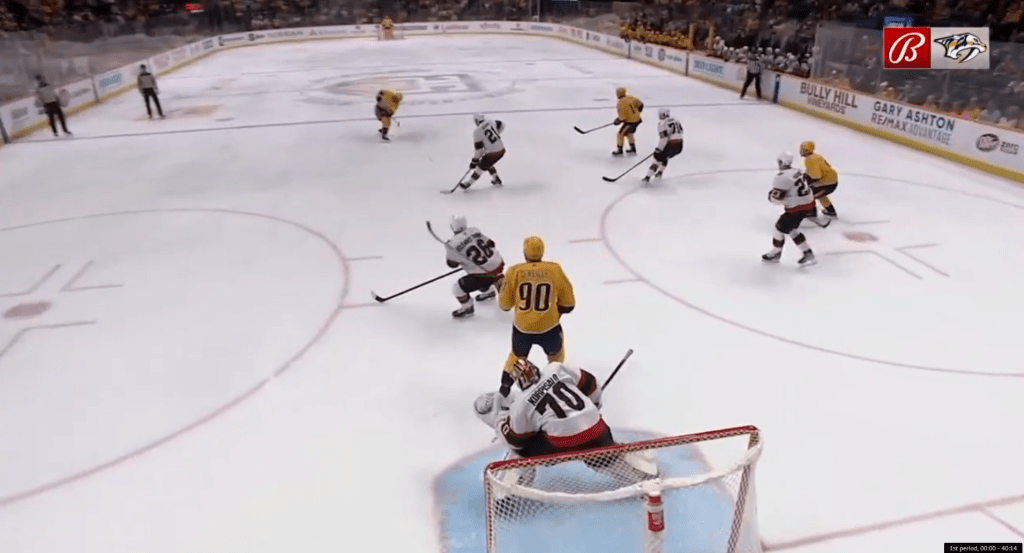
Allowing 55-foot goals is never ideal for a netminder, but when his defenceman is acting as a second net-front forward for the opposition rather than a defender, he can be excused once in a while.

The next PP goal against was a 6v4 at the end of a win against the New York Islanders where the Islanders pulled the goalie for a two-man advantage late in the game. It ended up tying the game and it was a Horvat one-timer that was going wide deflected off Kelly and in the net. A tough break where you can’t really single out one or two bad decisions; sometimes the team on the power play just deserves credit or gets lucky (or both).

Late in March, Ottawa gives up a PP goal to Winnipeg, and Mark Scheifele in particular. Before that goal, there are a number of things that highlight the team’s PK problems all season long, regardless of the coach behind the bench.

Early in the power play, Ottawa clears the puck, but Winnipeg gets back in the zone with control thanks to a chipped area pass. After a bit of a bobble, things start to get scrambly, and decisions are certainly made. Here, we have Parker Kelly circled. He has his stick in the passing lane for a seam pass, which is usually a good idea except there is no one there for the seam pass:
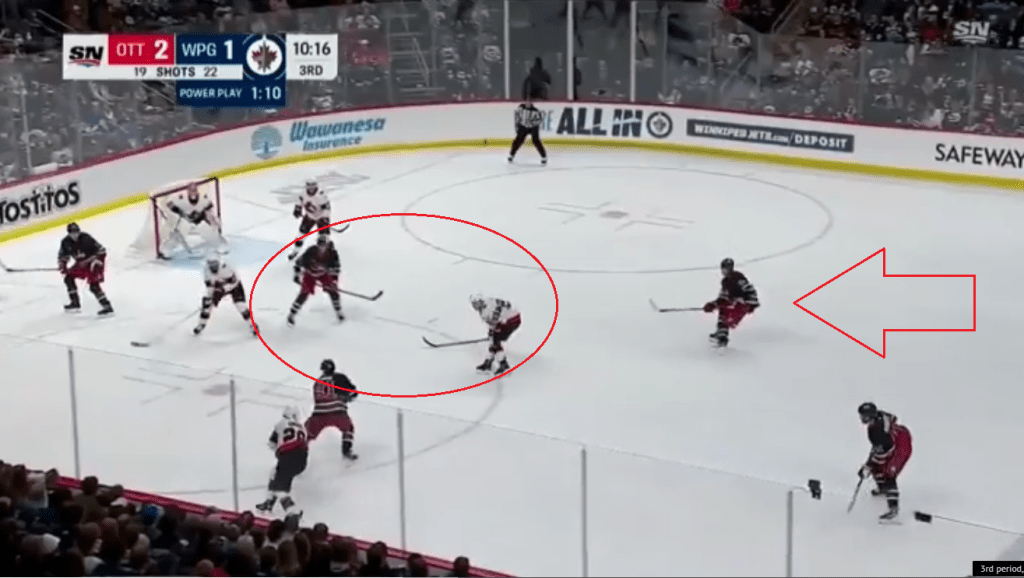
There is someone about eight feet in front of him, and it’s hard to tell in a still photo, but the Winnipeg player that is in the circle is skating away from the Ottawa net. He is in no position for a one-timer, and at best will one-touch the puck to the point or down low. If he decides to cradle the puck and try to shoot, Kelly is already moving in that direction to disrupt the shot. In other words, taking away the passing lane to the middle isn’t really adding any value; he’s taking away a shot that isn’t there because the only decision the Winnipeg player has time to make is a one-time pass to a non-dangerous area. However, that stick positioning leaves Scheifele (the guy with the arrow) with a clean lane to receive the pass, and his eventual shot goes in off Artem Zub:
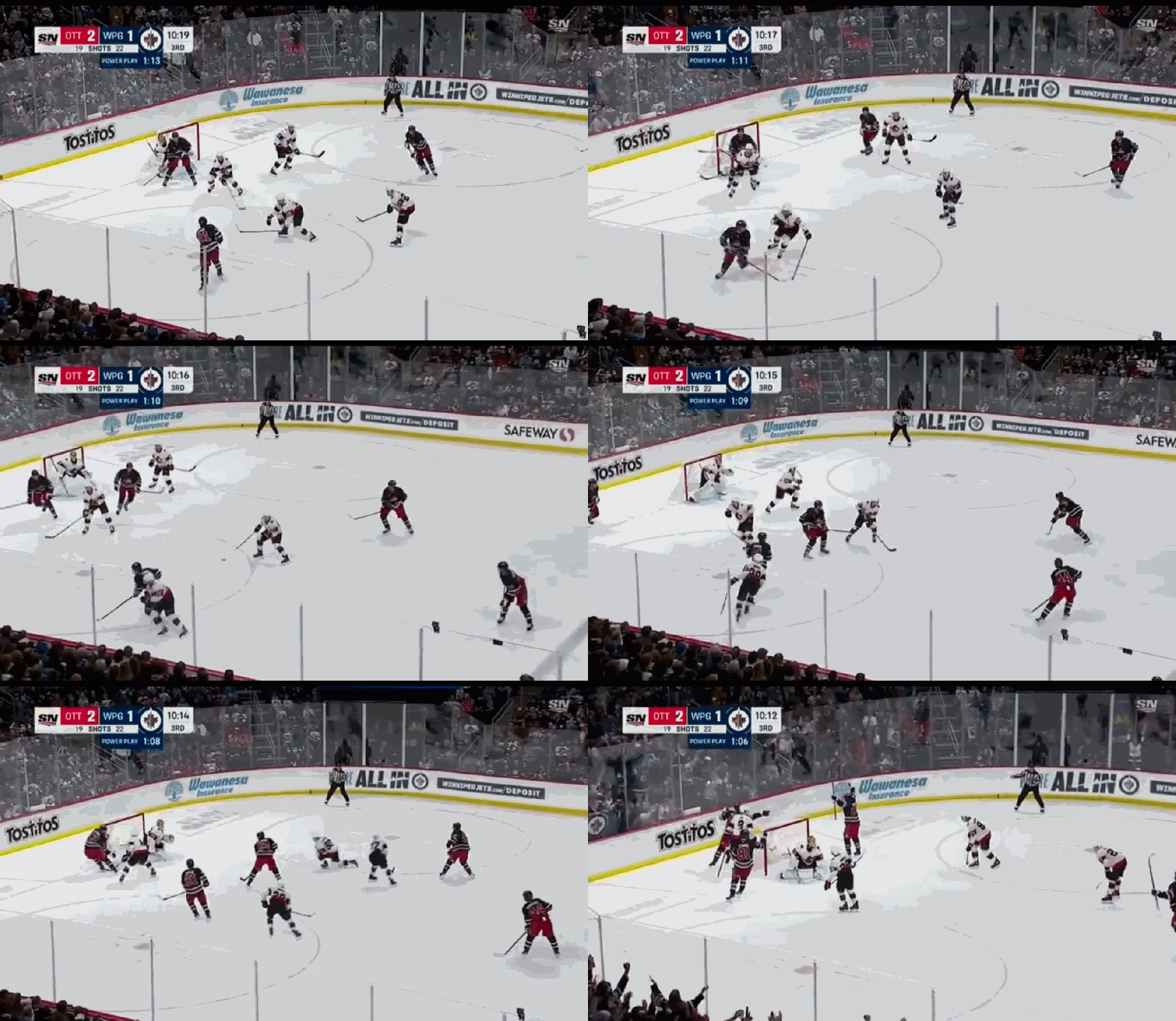
Stick positioning is so, so important on the penalty kill and the Senators fail to make the correct decision repeatedly. To this point of our venture, it has cost them several goals.  

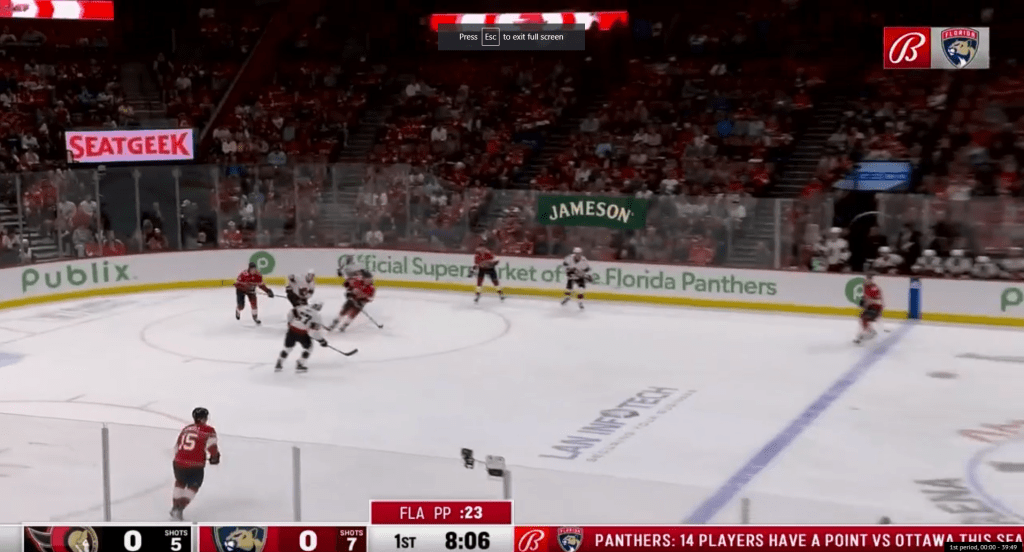
Towards the end of the season, Ottawa had a 2-0 loss in Florida. On a penalty kill about halfway through the first period, the Senators are running around. Korpisalo has already had to make three saves (two of them off passes from behind the net or through the seam) and is looking good. The second Panthers PP unit hits the hits with about 50 seconds left on the PP. Ottawa clears the zone with about 25 seconds left on the power play and then arguably the funniest PP goal against of the season happens.

Here is Ottawa clearing the puck all the way down the ice with 23 seconds left on their penalty kill:  
And here is Anton Lundell in on a clean breakaway literally five seconds later:
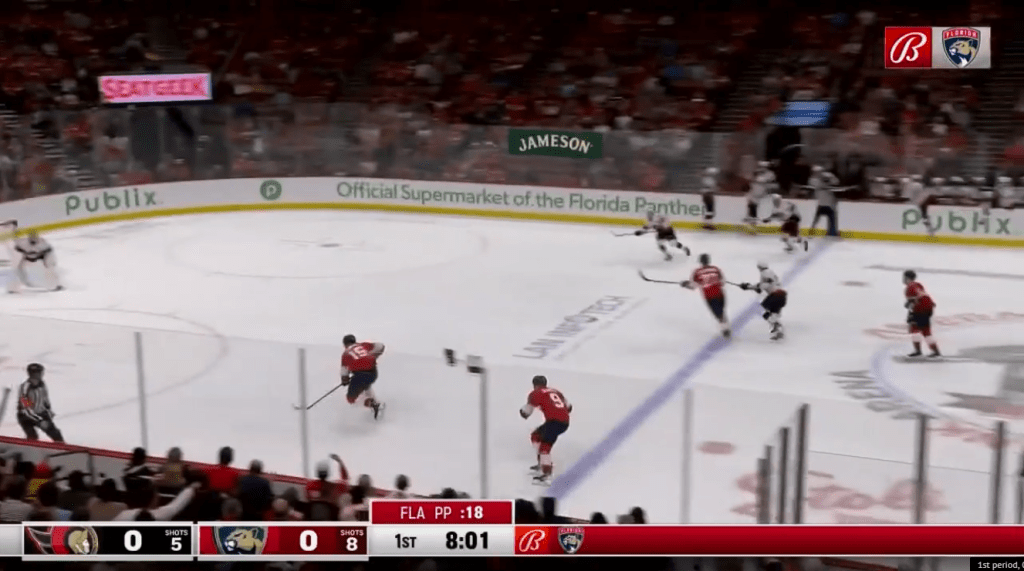
Shout out to Sergei Bobrovsky on a great pass from his own goal line, but that is an all-time-bad line change – slow to get off and slow to get on. Just another in a long line of terrible decisions made all season long by the penalty killers.

The last goal we’ll look at is something we’ve mentioned often, and it’s the Ottawa penalty kill hitting the trifecta of not blocking a shot, providing a screen on Korpisalo, and giving up a good look to a good goal scorer. The funny thing is that a split second before Cole Caufield rips the puck top corner, we have this screen shot: the goal scorer (Caufield) is with the puck at the top of the circle but has a viable passing lane to the left of Korpisalo, which would leave a 2-on-1 down low for Montreal:
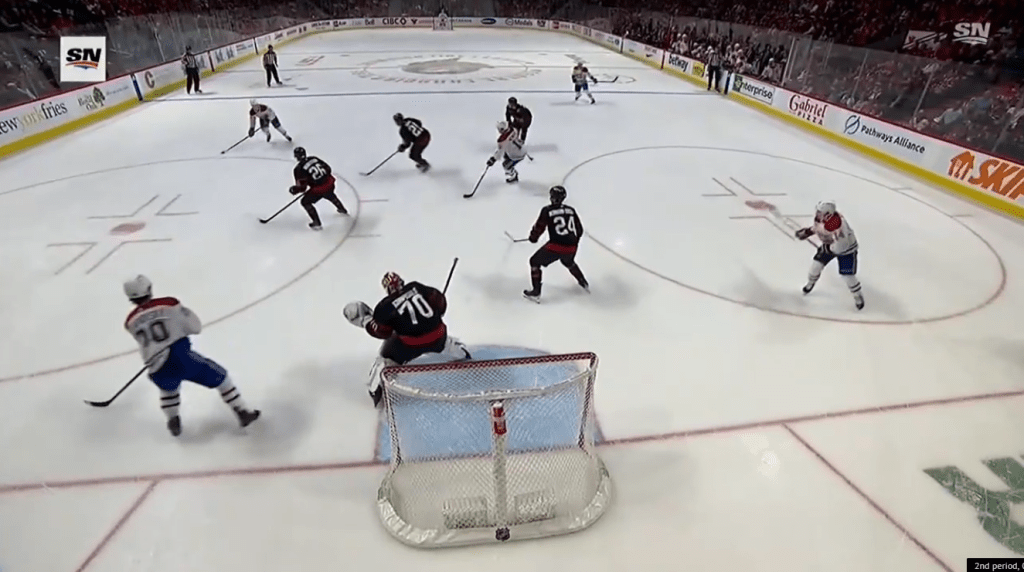
Caufield is the one that scores here on a straight shot, but he had options, and one of them was to create an odd-man chance down low because Ottawa abandons the front of the net. It is more over-aggression masked as aggression that is taking players out of place and not really doing a whole lot. Maybe Korpisalo should have had this shot, but one clean pass down low creates an advantageous situation for Montreal so even if Caufield doesn’t take the shot, a quick pass gives them a high-danger look at the net. It is truly unbelievable that this keeps happening over and over, but it’s starting to get very believable.

Summary  

Those are the 39 PK goals against allowed by Korpisalo this season. Early in the article, we said that if Korpisalo had a median save percentage on the PK, it would have led to 13 fewer goals against. Well, I classified all 39 goals into seven categories:

  1. Seam/Behind The Net Pass
  2. Screened Shot
  3. Odd-Man Rush
  4. Deflection/Tip
  5. Unscreened Shot
  6. Rebound/Scramble
  7. Other

The first four categories are goals we shouldn’t really hang on Korpisalo, there were two unscreened shots he maybe could have saved but a pass would have resulted in a dangerous chance against regardless. Also, one of the ‘other’ goals was that Boston goal where Brazeau had all day to walk to the front of the net (which happened more than once). These are the goal totals by category:

  1. Seam/Behind The Net Pass (10)
  2. Screened Shot (8)
  3. Odd-Man Rush (3)
  4. Deflection/Tip (3)
  5. Unscreened Shot (10)
  6. Rebound/Scramble (3)
  7. Other (2)

The first four categories – goals we can’t blame Korpisalo for – comes to a total of 24 goals against. Add two unscreened shots where it was a complete breakdown by the Ottawa penalty killers plus the net-front walk by Brazeau, and that’s 27 goals where we can’t really say Korpisalo was the problem. If just one-third of them are cut down by better decision making, Korpisalo’s PK save percentage is near the middle of the league rather than in the bottom-5.    

This isn’t to say Korpisalo was good or didn’t have his own issues; there were a number of times where he lost track of a puck he shouldn’t have, flubbed the handling, gave up a juicy rebound, and things of that nature.

All that aside, it is shocking the number of bad decisions we see from the Ottawa PKers that led directly to goals against. Failing to clear the puck, sticks in the wrong passing lanes, indecision about which player to cover, leaving no one (quite literally) within 20 feet of the net even when the other team has possession, and on and on the list goes. One of my pet theories is that Ottawa is a skilled team that consistently makes bad decisions, and that was certainly the case on the penalty kill.

As for what new coach Travis Green should do, the answer is both simple and unbelievably complicated: get the penalty killers to make better decisions. A stick in the right passing lane rather than the wrong one saves goals, but ensuring that players make that right decision over and over is no simple task. It is what gives them hope because they are good at limiting shots and their aggressiveness puts opponents to a decision, which can work out very well. That is a double-edged sword, though, and the team got cut by that sword over and over in 2023-24.

2024 Alternative Academy Awards

The 2024 Academy Awards are here and while they will spark a lot of debate about who should/will win, Oppenheimer is on a path of award-show destruction that will leave a trail of film canisters in its wake. That movie will win at least a half-dozen awards, no fewer than three major awards, and might push to double-digit wins. It is going to steamroll the competition, and there will be no mercy.

To make things a bit more exciting, here are some alternative awards to hand out. It is a chance to highlight very good-to-excellent movies that either won’t get much shine at the Oscars, or none at all. Most of the movies are the types frequently overlooked at the Academy Awards like action and horror, but there are movies from all genres included.

** Spoiler Warning. An effort will be made to avoid spoiling too much of the movies, but considering there’s one specific award for movie endings, it will be hard not to spoil significant plot points from many different entries. This is a fair warning for anyone that did not see a lot of offerings from 2023. **

Now that everyone has been properly warned, let’s get to this year’s alternative Oscar awards and highlight some really cool shit. The attached clips will include a lot of violence and gore, so maybe don’t watch them with your three-year-old looking over your shoulder. Or do, who am I to tell you how to parent.

‘Trust Me’ Award for Best Set Piece

Which movie did the best pulling together its actors, its stunt actors, and its director, and made for thrilling action, tense drama, or repulsive horror? Well, here we are.

Nominees:

Mission: Impossible Dead Reckoning Part One – Train Escape Sequence

The complaints I saw about how this played out was that it played very closely to a sequence in the video game ‘Uncharted 2’. You can look at the scene from the game here:

And, yeah, there are a lot of similarities. The sequence from the movie is also on YouTube:

There are differences – there are two people escaping instead of one and the movie plays a bit more into the comedic side – but the complaints aren’t unwarranted. To the complaints: I really don’t care. This scene rocked when seeing it in theatre and it was something I had never seen in a movie before. Did it get pulled directly from a video game? Probably. Did it also fucking rule? Definitely.

John Wick 4 – Dragon’s Breath Scene

Most of this category can be put in the ‘I have never seen that before’ column, and the apartment sequence in John Wick 4 that uses the incendiary shells also qualifies.

In this scene, Wick is making his way through an apartment building, and it’s shot by director Chad Stahelski as if it’s one long tracking shot (it’s really not but it plays that aspect well). However, unlike most tracking shots we may be familiar with from, say, ‘Game of Thrones’, this one is shot overhead like a video game, giving the audience an omniscient view of what’s ahead and behind as Keanu Reeves makes his way through the apartment. There are also exploding shells that set guys one fire, so that doesn’t hurt:

This will not be the last time John Wick 4 appears in this article, but in a movie filled with incredible set pieces, this one stood out.

Saw X – Bone Marrow Kill

Somehow, the 10th ‘Saw’ movie was not only released in 2023, but also might be the best one since the first one. That is up to the individual, but this entry was very well done.

Of course, a Saw movie is not a Saw movie without some gruesome kills. Having seen so many horror and action movies at this point of my life, there’s not a whole lot that makes me feel uncomfortable sitting in my chair, but the first woman to die in Jigsaw’s trap is in the following situation:

  • Tied to a bench with her hands free but unable to escape (of course)
  • A wire saw about six inches from her neck
  • Another wire saw next to her right hand
  • A tube connected to bottle connected to a scale

In short, this trapped woman has to saw her own leg clean off through the femur, stick the tube into her bone marrow, and collect enough bone marrow to tip the scale far enough to shut the machine off, preventing her decapitation. It is on YouTube, but a fair warning, this is beyond gruesome:

Again, at this point of my movie-watching life, not a whole lot makes me squeamish, but this is a scene that had me muttering, “holy fuck, holy fuck, holy fuck” under my breath. That is a job well done.

Napoleon – Battle of Austerlitz

How good a movie ‘Napoleon’ is will vary wildly from person to person, but one thing cannot be taken away: The Battle of Austerlitz is absolutely magnificent. It looks great on screen, it’s well-choreographed, it uses as many practical effects as possible (for some reason it’s illegal to shoot cannon balls at people riding on horses; we used to be a country), and it’s frenetic as all hell. We won’t link the entire scene, but this should whet the appetite:

Oh yeah, Ridley Scott was cooking with this one. Was he cooking with the non-set piece scenes? Well, who cares because this battle was incredible.

Ferrari – Mille Miglia Race

While it’s interspersed with in-between character scenes from those not actually in the race itself, this plays out as one very long sequence and it’s phenomenal. There is only so much that can be done without CGI, and some of that does detract, but they use as many practical sets as possible, they use stunt people in the crowds to ensure there are actual crowds lining the race and not computer-generated crowds, and the finish is something that literally made me stop breathing for about eight seconds. The entire race isn’t on YouTube, but there is a featurette of how it was made, and it’s very well done:

This won’t be the last time ‘Ferrari’ is listed, either.

And The Winner Is… The Dragon’s Breath sequence from John Wick 4.

There was a lot of cool shit that happened in movies this year, and a lot of sequences that really grabbed your attention for minutes on end, but this was something else. It combined great directing with great choreography, the incendiary shells add a lot of flash (quite literally), and it is a scene that will be remembered for a long, long time from a movie with a few scenes that will be remembered for a long, long time.

‘I Know Kung-Fu’ Award for Best Fight Sequence

Best Fight Sequence differs from Best Set Piece in this way: a lot of the combat is hand-to-hand rather than at the end of the barrel of a gun. It’s the difference between the fight between Neo and Morpheus from The Matrix and the lobby scene with Neo and Trinity in the same movie. Clear? Great.

Nominees:

Kill Boksoon – Kitchen Fight

If there’s one thing that can elevate any fight scene, it’s when the protagonist uses their surroundings to their advantage. A kitchen? Oh buddy, there are lots of things in a kitchen that can kill you. The full sequence isn’t on YouTube, but this is a good snippet, and Jeon Do-yeon is working these clowns:

That her daughter is trying to call her during the scene adds a bit of levity, and the whole thing was very well done.

Ballerina – Convenience Store Fight

Any good action movie has to make us believe that the main character is someone who is a bad ass that can easily handle opponents that think they’re tough. The opening scene from Ballerina involves our hero wrecking a convenience store, and the attackers in that store, with a can of pineapples:

That, right there, is the good stuff.

John Wick 4 – Sacré-Coeur

For our second entry from John Wick 4, it’s a scene that will probably get the most recognition in years to come as a perfect example of how to not only create a phenomenal action sequence, but have that sequence serve as an important plot point for both the movie and the character’s development. For readers that haven’t seen it, just go watch the movie. Here is the first half of that sequence, though:

Again, if you like action movies and haven’t seen this one, rectify that immediately.

Sisu – Plane Fight

In a movie that is more about its set pieces than actual fight scenes, the fight at the end of the movie stands out for a number of reasons. First and foremost is just how he got on the goddamn plane to begin with (it’s one of those ‘if you know, you know’ things), but it’s really just how beat to shit our main character is and he still fights back.

Is it over the top? Yes. Does it kick ass? Also, yes.

No Hard Feelings – Beach Fight

While not a great hand-to-hand fight scene, obviously, the beach fight from the rom-com No Hard Feelings is absolutely one of those ‘oh man I’ve never seen that before’-type scenes. Not only do a bunch of people get the piss beat out of them, but it’s by a buck-naked main character who, at times, is using beach-related toys to beat up the dickheads trying to steal her clothes. Of course, with all the nudity, there’s no clip to share, but suffice to say that it’s a scene that stands out from many others in 2023 for more than one reason.

And The Winnger Is… John Wick 4 – Sacré-Coeur

Not sure if any explanation is necessary as to why this takes home our award, though there were many worthy nominations.

‘Shoot ‘Em Up’ Award for Most Gonzo Movie

Quite often, the most entertaining movies are the ones that know exactly how ridiculous they are and lean into that so hard they almost tip over. Pushing the boundaries of ridiculousness is a fine line to walk, but when it’s walked appropriately, the product is a movie that we’ll return to over and over late on Saturday nights after nine Molson Canadians.

Nominees:

Sisu (Streaming on Prime and Apple)

A revenge movie.

A revenge movie against Nazis set at the end of World War II.

A revenge movie against Nazis set at the end of World War II where the main character is a Finnish gold prospector.

A revenge movie against Nazis set at the end of World War II where the main character is a Finnish gold prospector who used to be a commando from the war between Finland and the Soviet Union and went on a legendary killing spree after his own family was murdered.

How about all that and then things get over-the-top? Yes, it’s as awesome as it sounds. A YouTuber was kind enough to clip nine minutes of a bunch of wild stuff that happens in this movie:

I really recommend watching the whole thing. Those nine minutes are awesome and still cannot do the whole thing justice.

Mad Heidi (Streaming on Prime)

Have you ever wanted to see a Swiss movie where Switzerland is a narco-fascist state only instead of producing and selling drugs, they produce and sell cheese, and a woman’s boyfriend is killed, and she goes on a bloody, murderous revenge tour? If the answer is yes then boy are you in luck.

That is just the trailer because this movie, and a particular scene, will be featured later, but it is so much fun.

Cocaine Bear (Streaming on Prime)

A full-grown American black bear cannot stop doing cocaine and killing people in gruesome ways. Sometimes, a premise just works, you know? A lot of scenes stand out, but the ambulance chase is near the top of the list:

That, my friends, is the good stuff.

Saltburn (Streaming on Prime)

The three movies already mentioned are completely ridiculous, but Saltburn is a bit more serious, even if there are a lot of comedic scenes and undertones. Regardless, there are a number of truly W T F moments in this movie, not the least is the lead character having sex with dirt:

Lots of people say “fuck the world” but few people actually follow through with it. Points for dedication to the bit.

They Cloned Tyone (Streaming on Netflix)

This probably doesn’t make the cut if not for Jamie Foxx’s character, but his character steals the movie, and it fits the ‘gonzo’ theme not only for an outlandish premise, but for outlandish characters and scenes. Remember in ‘The Usual Suspects’ when Chazz Palmentieri’s character drops the coffee mug when he starts piecing it all together? How about Foxx’s character doing the same, but it’s with fried chicken:

It is very ridiculous with a bit of poignancy. That is what makes the whole movie so good.

And The Winner Is… Mad Heidi.

Maybe it’s because I just stumbled onto it, having never heard of it before, but it’s the perfect encapsulation of how I want to spend 90 minutes while just zoning out. It was crowd-funded and low-budget, which makes it even better. Full marks for Mad Heidi.

Bohemian Rhapsody Award for Best Use of A Song

The right song at the right time can really make a scene, or sometimes an entire movie. Needle drops are getting a little overplayed – we really need to slow down on how much Beastie Boys we get in movies these days – but that doesn’t mean there wasn’t a lot of superb use of well-known songs in 2023.

Nominees:

A Tribe Called Quest – Can I Kick It? (Teenage Mutant Ninja Turtles: Mutant Mayhem)

In a movie filled with solid-to-great needle drops, ATCQ stands at the top of the pile for what serves as the outro. A great movie, a great group, and a great song all come together to get itself on this list.

50 Cent – P.I.M.P. Instrumental Version (Anatomy of a Fall)

Sitting in the theatre for this movie, I genuinely thought they put the wrong movie on. Knowing vaguely what the movie was about, I couldn’t understand why the instrumental version of a rap song from 20 years ago was playing very loudly at the start of a French courtroom drama. Believe me, it makes sense eventually, and it’s fucking incredible.  

Rush – Tom Sawyer (Iron Claw)

Sometimes, I wonder how many people didn’t bother to see Iron Claw because it’s a movie based on pro wrestlers from the 1980s and 1990s. That is a mistake, because it’s one of the best movies of 2023, and it includes a training/wrestling montage featuring ‘Tom Sawyer’, which is about the most perfect mash-up imaginable:

Please see this movie whenever you can. It is very, very good, as is the use of this song at this point of the film.

Matchbox 20 – Push (Barbie)

Whatever feeling people may have on the movie itself (it’s very good), the use of this particular song at this particular moment made me laugh until I had tears in my eyes. It’s so good:

All the Kens playing the same fucking song sitting around a campfire? It’s incredible.

Avril Lavigne – Complicated (Bottoms)

What plays as, more or less, a breakup scene set to Avril Lavigne? Basically, it’s catnip for me.

And The Winner Is… P.I.M.P. inAnatomy of a Fall

Listen, it was a great year for needle drops but this wasn’t necessarily a needle drop. That the instrumental version of 50 Cent’s P.I.M.P is an integral part of a 150-minute French drama that is nominated for Best Picture at the real Academy Awards is one of those sentences that no one ever thought they’d write. And that is why it won my fake award.

‘Oh What A Lovely Day’ Award for Best Line

Great lines can be funny, sad, biting, tragic, heroic, cheesy, or a bunch of other descriptors, and often more than one of them. Remembering all those lines is a whole other matter, but here are five that really stood out in 2023.

Nominees:

He’s A Good Father – Joy Ride

For those that haven’t seen Joy Ride, it’s probably the funniest movie of 2023. In this particular scene, one woman is chastising her friend because she doesn’t hit on/have sex with Asian men. The following exchange was absolutely fucking priceless (apologies for the quality, I took it off my phone):

The immediate snap back of “HE’S A GOOD FATHER” is note-for-note perfect.

Friendship Means Little When It’s Convenient – John Wick 4

A much more serious line than the one above, a lot of the John Wick franchise revolves around the idea that Wick has friends all over the world that seem to owe him their loyalty for one reason or another. For some of those friends, it leads to their death. Hiroyuki Sanada delivers the line perfectly:

Another great moment from an incredible movie.

With All Due Respect, Brittany – American Fiction

For those that haven’t seen it, American Fiction stars Jeffrey Wright as a Black author and professor whose books are critically lauded but aren’t commercially successful. The introduction of the movie is him in his class with the n-word written out in full on the white board, and it leads to this perfect exchange with a White student:

One of the best movies of 2023 and it opens with an iconic line.  

What Difference Does That Make – Mission: Impossible Dead Reckoning Part One

Listen, I’m a sucker for cheesy lines that land well because of who is delivering them and the context of the scene. In the latest Mission: Impossible movie, Tom Cruise’s character is trying to recruit Hayley Atwell’s character to their team, which is more a family than a squad of super spies. He makes that point crystal clear in this exchange:

Yes, it’s cheesy. It is also a heartfelt message that hopefully resonates with part of the audience because it’s a crucial life lesson.

Yodel Me This – Mad Heidi

Sometimes, it’s nice to be at home to watch a movie so you can rewind something you thought you heard or saw but aren’t quite sure. We have talked about Mad Heidi and how utterly insane it is, but a fascist soldier getting stabbed in the groin by a Swiss woman saying, “Yodel me this”? To me, this is cinema:

Again, I cannot recommend this movie enough.

And The Winner Is… Yodel Me This.

Sorry, I don’t care if few people have seen this movie. It is hard to imagine a better line to use when stabbing someone in the dick with a seven-foot halberd.

The Spinning Top Award for Best Ending

Movies can, quite often, be made or broken by their ending. A bad ending leaves a foul taste in the mouths of the audience, but sticking the landing is not easy. Here are the ones that did just that.

Nominees:

Past Lives

Years of watching rom-coms had me bracing for a happy ending. I suppose it depends on your reading of the movie and the ending itself, but this was crushing.  

Silent Night

Sometimes, you can envision how a movie is going to finish but you cannot imagine that the director and producers will follow through with it. They absolutely followed through with it here.

Ferrari

You’ve either seen the end of this movie or you haven’t. Those who saw it in theatres: did it get pin-drop quiet in your theatre, too? Because I could have heard a mouse fart in mine.

BlackBerry

A common (and correct) complaint I see a lot is how a lot of things are slowly getting worse; cheaper consumer goods break faster, bare-bones internet services infrequently work, and so on. If you subscribe to that belief (and I do), the ending of BlackBerry is the perfect encapsulation of how this was allowed to happen.

The Zone of Interest

Mileage may vary on the movie itself, but the last five minutes of The Zone of Interest is gutting. It blends the descent to Hell for the main character with a dash of “how far have we actually come” for the audience very, very well.

And The Winner Is… Ferrari.

Listen, there were a lot of great endings to a lot of great movies from this year. Not only the ones listed but we could go two-dozen deep here. It isn’t often that I’m in a theatre with 50 people and you can hear them fumbling around with a popcorn bag, digging through a jacket, or making a comment to their friend and everyone immediately stops everything in shock at what’s happened on the screen.

Benoit Blanc Award for Absolutely Going For It

Sometimes, an acting performance can not only enhance a movie, but carry it. Also sometimes, there are people whose performance is not only great in an acting sense, but over-the-top in the best way. Here are some from all those categories.

Nominees:

Alice Lucy as Heidi (Mad Heidi)

This movie has appeared a few times already, so there’s not much introduction needed. Mad Heidi doesn’t work if the lead doesn’t play it quasi-straight with a ridiculous script as everything else around them is absurd.

Emma Stone as Bella (Poor Things)

Not only a great acting performance in and of itself, but so over-the-top that it comes all the way back around to appear normal in the settings of this particular cinematic experience. It is an acting performance that will be talked about for decades to come.

Bradley Cooper as Leonard Bernstein (Maestro)

This wasn’t a movie I particularly liked, but it’s a movie where Cooper carries the whole goddamn thing from start to finish. He is the biggest reason to ever see it, and other than some very well-shot scenes, he might be the only reason.

Jamie Foxx as Slick Charles (They Cloned Tyrone)

Every once in a while, an actor plays a role, and you think to yourself, “No one else could have pulled this off”. That is what Foxx does as Slick Charlies in a sci-fi movie about human cloning where he’s a street pimp. It is truly one of the best comedic performances of the last few years. The movie would still be very good without him, but his performance takes it to another level.

Iman Vellani as Kamala Khan (The Marvels)

Another superhero movie that wasn’t great but could have been had the fucking producers just left the creatives alone and let them make their own movie rather than edit it down to a sequence of cut-scenes rather than a coherent narrative, but I digress.

If there is a reason to see The Marvels, it’s Vellani taking the dial to ‘10’ in everything she does. Not only is she the heart of the movie, but she’s the comedic relief, and she does both exceptionally well.

And The Winner Is… Emma Stone as Bella

I meant it when I said it earlier: the performance from Stone in this movie is absurd, but also incredible, and it would not have worked anywhere near as well without her. Her deadpan comedy is arguably the funniest of the year, and it’s not really a comedy movie. The script helps, but she’s a supernova, and will go down in the pantheon of incredible acting performances of this century.

There we have it – our alternative Academy Awards have been handed out. Not everyone will like every movie on this list, agree with the winners, or even the nominees, but I think that also highlights just how great a year 2023 was for movies. The movies listed above don’t even include all the other fantastic entries like Oppenheimer, Godzilla Minus One, Across The Spider-Verse, How To Blow Up a Pipeline, Killers of the Flower Moon, Skinamarink, Thanksgiving, May December, Guardians of the Galaxy vol. 3, Asteroid City, The Burial, The Killer, or The Holdovers. While Stone’s performance in Poor Things is going to stand the test of time, the unbelievable run of movies we got in 2023 will do the same.

Sami Zayn vs. Roman Reigns, One Year Later

Earlier this week was the one-year anniversary of Sami Zayn vs. Roman Reigns at the 2023 edition of the Elimination Chamber. That event took place in Montreal, not far from Sami’s hometown, and it was the first WWE pay-per-view I had ever attended. There have been lots of wrestling shows in my past, and a handful of Raw/Smackdown events, but I had never been to a PPV.

From where I live, it’s about an eight-hour drive to Montréal. On the Friday before the show, I drove up, and it took me about 15 hours to get there because the first 400 kilometres was all freezing rain. The next 200 kilometres was a blinding blizzard. I saw dozens of cars off the road along the way, and three different pileups before I had gotten even 50 kilometres outside my hometown. They even had to shut down the highway outside of Québec City, forcing all traffic to pull over, because visibility was horrific, and the cars were literally piling up. I took a picture of my side-view mirror when we were stopped to give an idea of the ice buildup all over my car:

I ended up missing Friday night’s Smackdown, but somehow arrived safely very late Friday night. All this is to say: I was incredibly invested in the Sami/Roman main event, and Sami’s story overall. Given we knew that everything was building to a Cody Rhodes-Roman Reigns main event at WrestleMania 39, we also knew Sami wasn’t winning the title. There is always hope, and a dozen cans of Molson Dry had me believing a win was possible but Sober Me always knew he wouldn’t. Of course, Roman won, Sami got hometown-cheered in defeat, and that was that.

That loss for Zayn is something that is both still hard to believe and yet the most believable thing they could have done.

Let’s give some context here. Wrestling fans always have their own favourite wrestlers; it’s what makes fandom a lot of fun. When we see the wrestlers we’ve followed succeed, it brings us into their success even if we’re just faceless human beings standing in the crowd cheering a scripted television show.

To that end, Sami Zayn was never one of my favourite wrestlers. In WWE, I always preferred Sami’s long-time real-life friend Kevin Owens, and others like Seth Rollins and Sasha Banks. Sami could put on great matches – his match vs. Shinsuke Nakamura is available in full on YouTube and it’s incredible – but he was never really someone that made me tune in.

Once Sami got involved in The Bloodline story, though, he hooked me. I even wrote about it last year in the week following his loss at the Chamber; he created a multi-layered story, told over several years, about a rising star that never reached his potential on the main roster, became a side act, and wound up a broken man. WWE themselves even put that into Zayn’s video package to hype up the Zayn/Reigns match. He turned to Roman Reigns and The Bloodline for acceptance and the bully started to use him in the ways all bullies do before Zayn finally found the courage to stand up to him. It led to incredible moments, not the least of which was Zayn slamming Reigns’s back with a chair, which led to one of the loudest pops you’ll ever hear:

As outlined in the article linked just above, when you’re telling a bully vs. bullied story, the bullied person needs to win. Unless you’re aiming for a very depressing ending, the person being bullied needs to win. Of course, that didn’t happen, and Reigns walked out with the title.

The match itself didn’t need to be a title match. This wasn’t about Roman Reigns’s title – this was about Sami standing up to Roman on his own two feet and bringing him down. It could have been a non-title match but because WWE dug their heels into the sand about Roman’s wining streak, they ended the story in the worst way imaginable.

That is the difference between Zayn and Reigns’s current opponent Cody Rhodes. Rhodes needs to win the title, Zayn doesn’t (and didn’t). He just needs to beat Roman, and those aren’t the same thing. One is about the recognition of your own value, and one is about the recognition from your peers.

So, the bully wins and time rolls on. Now we sit about six weeks away from WrestleMania 40. What, exactly, the main event will be is a bit muddled, but the frustrating part as an outsider that hasn’t watched WWE TV in nearly a year is seeing Rhodes being paralleled to Daniel Bryan’s underdog run 10 years ago. It is so mind-bendingly stupid that it’s hard to ignore.

Rhodes has won the last two Royal Rumbles, only the fourth wrestler in WWE history to win two in a row, and the first since Stone Cold Steve Austin in 1997-1998. At the risk of pouring cold water on this: a guy winning two Royal Rumbles in a row, giving him an accolade not seen in 25 years since the biggest star of the last 30 years accomplished the same thing, is not an underdog story. Rhodes has been pushed to the absolute moon since returning to WWE, whereas Daniel Bryan was wrestling 5-minute matches on the mid-card a year before his WrestleMania run. Bryan’s one world title reign ended in a 10-second squash match (Kofi Kingston-esque, in that sense). Those aren’t remotely comparable situations.

WWE had its underdog story a year ago and shot that underdog behind the barn to push the guys that they wanted to push. They had no intention of telling a good story, and for all the ‘Sami will end The Bloodline’ nonsense fans were fed, a year later The Bloodline is still a thing. I mean, holy fuck, they just added The Rock (for however long that lasts). The best story that WWE told in a decade ended as soon as the referee’s hand hit the mat for the three-count when Roman beat Sami.  

One year since that Elimination Chamber, Reigns is still champ, The Bloodline still exists, Rhodes is still being pushed to stratospheric levels, and Zayn hasn’t won a televised singles match in over six months. (He has one televised singles win in the last calendar year and it was against JD McDonagh in August, the fifth-most important member of a five-person faction.) It is always a story they can come back to, but they didn’t pull the trigger at the right time, and it’s extremely clear what they think of all the people involved. The Underdog From The Underground was buried, and the whole ordeal remains an all-time storytelling fuck-up.  

The NHL’s All-Underrated Team

Figuring out who is and isn’t underrated can be a fickle process. Fans and analysts of specific teams can shout ‘you clearly don’t watch this player enough’ when that is definitely not the case. On top of that, highlighting players that are thought to be underrated might, in fact, be properly rating them. Either way, there are players that do not get the coverage they should and that’s what this is for.

Off the top, we’re not including Aleksander Barkov. He is a tremendous player and has been on underrated lists for years. He has four top-5 Selke Trophy finishes over the prior six seasons, including one win during the Patrice Bergeron-Anze Kopitar-Ryan O’Reilly era. We can let that sleeping horse lie. Same with Brayden Point, Joel Eriksson Ek, Jared Spurgeon, and Jaccob Slavin.  

As for the roster itself, we’re constructing a normal NHL roster with 12 forwards – preferably at their correct positions – six defencemen, and two goalies, and we’ll do an honourable mentions portion at the end. Recent history will factor in, not only the 2023-24 season. Let’s not waste time and just get to it.

The Locks

There are guys that have to be on this list because they are so tremendously talented/effective but rarely get recognition for it. These will be established players and not rookies having a good half-season, and are as follows:

Brandon Hagel – Since the start of the 2022-23 season, there are 27 forwards that have posted at least 0.8 goals/60 minutes and 0.8 primary assists/60, and Hagel is one of them. Of those 27 forwards, only 15 also have an Evolving Hockey expected goal rate-adjusted plus/minus (xG RAPM) over 0.2, or the 83rd percentile, and that includes Hagel. Finally, of those 15 players fitting the primary points criteria with an 83rd percentile xG RAPM, just 11 are also higher than 0.15 goals for/against per 60: Nathan MacKinnon, Auston Matthews, Elias Pettersson, Connor McDavid, Roope Hintz, Jason Robertson, Matthew Tkachuk, Sidney Crosby, Nico Hischier, Jesper Bratt, and Hagel. Look at that list again and see which players are superstars, and aren’t on the same team. Hagel might be the most underrated player in the league.

Carter Verhaeghe – Playing on a team with the Perennially Underrated Aleksander Barkov is likely to leave an excellent player also being underrated, and that’s what’s happened with Verhaeghe. He is top-10 by 5-on-5 goals/60 over the last three seasons, top-12 by 5-on-5 points/60, but has poor defensive metrics. For a scoring winger, we’ll take that.

Jared McCann – Over the last 2.5 seasons, there are nine forwards with at least 10.0 expected Wins Above Replacement, per Evolving Hockey, and McCann is one of them (the rest of the list are basically the superstars of the league). He is also top-25 by Wins Above Replacement in that span while ranking third (!) by goals/60 at 5-on-5, behind only Matthews and David Pastrňák. He was once traded for Erik Gudbranson.

Phillip Danault – This is a selection of a player that is often on the underrated lists, but the lack of raw production (one 20-goal season, zero 60-point seasons) merits his inclusion. Over the last six seasons, his xG RAPM is in the 95th percentile of the league while his on-ice goal differential is 88th percentile. His closest comparable in these regards is Sean Couturier. So… yeah.

Travis Konecny – This may be the last season Konecny is on the Underrated Roster because an All-Star game nomination and near-certainty of back-to-back 30-goal seasons will push him over the top. Over the last two seasons, his primary points/60 at 5-on-5 rates higher than names like Ehlers, Robertson, Kucherov, and Aho. Over those two seasons, he is the only regular penalty killer in the league with a goal share over 35%, which (roughly) means for every two Flyers goals against when he’s on the ice for the PK, Philadelphia scores one. An incredible player.  

Joel Farabee – One of the closest comparable players at 5-on-5 to Hagel over the last two years is Farabee, who has produced similar goals/60 and primary assists/60 rates. For overall points/60 at 5-on-5, his last three seasons have produced a higher rate than Aho, Andrei Svechnikov, Dylan Larkin, and JT Miller. The defensive issues are what keep him below Hagel, and he’s not the goal scorer that Verhaeghe is, but he is a very, very good offensive player.

Warren Foegele – Over the last two seasons, Foegele has similar goals/60 and primary assists/60 rates to Hagel and Farabee, which warrants his inclusion on this list. He also is inside the top-20 by xG RAPM among regular forwards, but the goal differential suffers because of porous goaltending behind him and the lack of turning his expected goals into actual goals. A fun note about those last two seasons: in the 410 minutes Foegele has skated with Leon Draisaitl at 5-on-5, the team has a 61% goal share (!) and 58.7% expected goal share. Those numbers are worse – especially the goals for/against – for both players when they’re not on the ice with each other. Paging Knoblauch.

Vincent Trocheck – Going from a team with Aleksander Barkov and Jonathan Huberdeau (when he was good) to a team with Artemi Panarin and Adam Fox is likely to leave a player overshadowed. Despite that, the last three seasons have him as 1 of 35 forwards to average over 0.1 xG RAPM/60 and 0.1 goals-for/against/60 at even strength. The last two seasons have him with a higher primary assists/60 at 5-on-5 than names like Kevin Fiala, Robert Thomas, Nikolaj Ehlers, and Nikita Kucherov.

Radko Gudas – There are seven defencemen over the last three seasons averaging over 0.2 xG RAPM/60 and 0.15 goals-for/against/60 at even strength. That list includes a number of players typically thought of as underrated – Toews, Slavin, Spurgeon – one Norris Trophy winner (Adam Fox), one future Norris Trophy winner (Charlie McAvoy), and one name we’ll see later on. The last name is Gudas, who has been a tremendous defensive option for years now. Truly one of the more underrated defencemen of the last decade.

Jake Walman – It may not take long until he graduates to ‘properly rated’ but over the last two seasons, Walman leads Detroit’s blue line in both xG share and goal share at 5-on-5, and he leads all defencemen by goals/60. Over the last three seasons, his xG RAPM is 32nd among regular defencemen, or easily a top-pair rate, and easily the rate of a high-end number-2 defenceman. He was once traded for Nick Leddy.

Gustav Forsling – Players put on waivers often won’t matter, but sometimes they do: Paul Byron, Mike Hoffman, and Eeli Tolvanen are some names that come to mind. Gustav Forsling is another as he was grabbed from Chicago (lol) in January of 2021. Over the last three seasons, Forsling is one of six defencemen in the league with a goal share at 5-on-5 over 60% while ranking in the 91st percentile by points/60 at 5-on-5. He was free!

Sam Montembeault – Maybe he’s starting to catch the league’s eye now, but Montembeault has been solid for a while. His last three seasons total have produced a Goals Saved Above Expected/60 at even strength higher than Jacob Markstrom and Jake Oettinger. His GSAx/60 at evens is in the top-third of the league’s regular goalies in that span. It is a wonder what his boxcar stats will look like once (if) Montreal’s defence improves.

Alright, at this point, we have our locks, and this is what the roster looks like so far:

Brandon Hagel – Phillip Danault – Travis Konecny

Carter Verhaeghe – Vincent Trocheck – ???

Warren Foegele – Jared McCann – ???

??? – ??? – ???

Gustav Forsling – Radko Gudas

Jake Walman – ???

??? – ???

Sam Montembeault

???

We are short five forwards, three defencemen, and a goalie. Let’s look into some younger players. The qualification for ‘young player’ will be anyone who has appeared in at least three NHL seasons but is 25 years old or younger. 

The Young Stars

JJ Peterka – Though he has just 68 career points, only eight of those have come on the power play. Over the last two seasons, Peterka’s 2.15 points/60 at 5-on-5 is tied with Brock Boeser, a shade behind Mathew Barzal and Sebastian Aho, and a shade ahead of Joe Pavelski and Tyler Toffoli. That span has his xG RAPM at a second line rate, and similar to names like Nazem Kadri and Bryan Rust. He will not be on the underrated list for long.  

Owen Tippett – Proving that his 2022-23 season wasn’t a fluke, Tippett’s 82-game pace is for 31 goals and that’s with little power play production. If the Flyers had a good power play, he could push 40 goals this year. The last two years have seen his expected goals-for play driving rank in the 87th percentile of the league. He isn’t stellar defensively, but there’s more than enough of that in the rest of the lineup.

We’ve added a few more names to the list and this is what the lineup looks like now:

Brandon Hagel – Phillip Danault – Travis Konecny

Carter Verhaeghe – Vincent Trocheck – JJ Peterka

Warren Foegele – Jared McCann – Owen Tippett

??? – ??? – ???

Gustav Forsling – Radko Gudas

Jake Walman – ???

??? – ???

Sam Montembeault

???

We need our fourth line, a pair of defencemen, and a goalie.

The Bubble Inclusions

Alright, let’s get to the guys we have on the bubble. There were five centres that popped up as our potential fourth-line option. When looking at the five options, one player led them by expected WAR/60, actual WAR/60, goals-for/against plus/minus, points/60 at 5-on-5, and goals/60 at 5-on-5 over the last three seasons. With due respect the other four, our last centre is:

Brock Nelson – It is really hard to comprehend the career of Brock Nelson. He never had more than 26 goals in a season until he turned 30 years old, and then had back-to-back seasons of 37 and 36 goals. This season, he’s on pace for 34. Again, this is all after turning 30 years old. He led the other four contenders in all the stats listed in the previous paragraph, so he gets in.

Conor Garland – It came down to five wingers for our final two wing spots. Of those five, Garland leads the group by points/60 at 5-on-5, primary assists/60 at 5-on-5, primary points/60 at 5-on-5, WAR/60, xWAR/60, goals for-against/60 at even strength, and was second by xG RAPM. Since getting to Vancouver, he leads their forwards – including Pettersson, Miller, and Boeser – by on-ice expected goal share and actual goal share at 5-on-5. He is tremendous and is on the team.

Nino Niederreiter – This was the toughest cut to make because it came down to Niederreiter and a great young forward, but the latter is considered a cornerstone of his franchise’s future while Niederreiter has played for three teams in three seasons somehow. Despite that, Niederreiter is in the 88th percentile by goals/60 at 5-on-5 over those three seasons, 96th percentile by xG RAPM at even strength, 86th percentile by goals-for/against/60, and 85th percentile by xWAR/60. The one knock is he’s not a good power play option, but he wouldn’t need to be on this roster.

Dylan DeMelo – Joining Niederreiter from the current Winnipeg roster is DeMelo. He is a right-hand shot, which we need, but he’s also very, very good. His points/60 at 5-on-5 over the last three seasons is in the thick of the other options – a second-pair rate – but his defence is tremendous. His xG against/60 at even strength over the last three seasons is second (!) in the league, behind only Spurgeon, and the actual goals against/60 rates in the 87th percentile. The offence is passable, but the defence is extremely good, so he’s on the team.

Marcus Pettersson – It came down to Pettersson and our last left-handed defenceman in consideration – we’ll discuss him in a bit – and the tie breaker was this: one of these guys has earned Norris Trophy votes in two different seasons and one hasn’t. Pettersson hasn’t, so he’s on the list. He is 92nd percentile by WAR/60 over the last three years, 76th percentile by points/60, and often takes shutdown matchups. He has significant positive impacts on both goals and expected goals at both ends of the ice, so he’s on the team.

Matt Roy – Our final skater spot came down to Roy and a younger option who has played low third-pair minutes his entire career. Considering Roy has been tasked with shutdown minutes at times, and has excelled over the last year with Vladislav Gavrikov as his partner, he makes the list as our final right-hand defenceman. He has positive impacts, both on goals and expected goals, at both ends of the ice, and his WAR/60 was in the 85th percentile or a high-end number-2 rate. His xWAR/60 is borderline 75th percentile, or easily a top-pair option.

Connor Ingram – At 26 years old, he just missed the young stars list, and his 2023-24 season has made him more of a household name, but he’s definitely getting included here. Over his three seasons, he is 12th in the league by goals saved above expected/60 at even strength, just behind Juuse Saros, and in the 75th percentile of all regular goalies. That puts him as a mid-level starting goalie, and on the All-Underrated Team.

Alright, that rounds out the squad. Including the bubble players, this is what we’re looking at:

Brandon Hagel – Phillip Danault – Travis Konecny

Carter Verhaeghe – Vincent Trocheck – JJ Peterka

Warren Foegele – Jared McCann – Owen Tippett

Conor Garland – Brock Nelson – Nino Niederreiter  

Gustav Forsling – Radko Gudas

Jake Walman – Dylan DeMelo

Marcus Pettersson – Matt Roy

Sam Montembeault

Connor Ingram

I will say that in doing all this, the goalies were the hardest. At any given moment, there are only 64 of them in the league, and the ones that are playing well get praised and the ones that aren’t, well, don’t. Demko is probably too known of a quantity now but the options were limited. If not him, we’re still talking guys like Jakob Markstrom or Thatcher Demko. With that in mind, let’s go over the honourable mentions quickly.

HM Centres

JT Miller – He was in line for one of the final forward spots, but he didn’t quite get to the level of Nelson in a number of key areas that were highlighted so he was left off.

Charlie Coyle – This is a player whose estimation should be rising but too much time spent playing behind Patrice Bergeron (and David Krejci) hurt his case. He also didn’t rate near as high as Brock Nelson or either of the next two names.

Mikael Backlund – He probably would be the fifth centre, and the healthy scratch. The defence is superb but third-line production hurt his case, as did his lack of power play ability.

Nic Dowd – Everything that was just said for Backlund can be repeated for Dowd. Still a tremendous shutdown centre in the vein of Jordan Staal.

Robert Thomas – Considered and discarded because he’s been getting hyped by the local market and while he isn’t widely known, it just felt a little to ‘properly rated’ right now.

Nicolas Roy – A very good player whose offence isn’t as good as the metrics make it seem. He would be on our second-team All-Underrated roster.

HM Winger

Seth Jarvis – If Backlund were the fifth centre, Jarvis would be the ninth winger. The metrics are great, but it also feels like he’s starting to get some notoriety, too. It’s like he’s too good to be underrated but not good enough to be considered a bona fide star. You hate to see it.  

Mathieu Joseph – A good defensive winger who probably needs help to really contribute offensively. It’s like if Niederreiter couldn’t score, which is why he was cut rather than Niederreiter.

Pierre Engvall – He gets a bad wrap but just look at some of Toronto’s bottom-6 mainstays since Engvall was traded and look at how he’s helped New York’s second line. He just isn’t as good offensively as his metrics would suggest which is what lifted Garland over him.  

Nils Höglander – He could find his way here in a year’s time, but averaging 12:10 a game over the last three seasons just doesn’t show us enough of what he can really do.

Troy Terry – A year ago, he’d probably be on this list but it’s hard to truly call him underrated after signing a $49M contract for seven years.

HM Defence

Esa Lindell – The last spot on the roster came down to Pettersson and Lindell, and Lindell would be our seventh defenceman. He is tremendous defensively and is better offensively than he gets credit for.

Adam Pelech – Had Pelech been healthy (and good) this season, or if this list were being done at this time last year, he’d be on the team. But he hasn’t been healthy, and that has caused a downturn in his play, which is the cause for his exclusion. He could be back on the team a year from now, though.

Juuso Välimäki – Speaking of defensive play, over the last three seasons, the expected goals against play driving from Välimäki is top-10 in the league and in line with Gudas and Slavin. His overall xG RAPM is also in the top-10. There isn’t much offence, though, so there’s no real reason to include him over Pettersson, who has also been excellent and has played tougher minutes.  

Jalen Chatfield – This was the last right-hand defenceman in consideration to get cut. He has produced positive impacts at both ends of the ice over the last three seasons, but in a sheltered third-pair role on a perennial Cup contender. That hurt his case a lot.

Alright, that’s it. Again, the three skater cuts we made were Backlund, Jarvis, and Lindell while the final goalie was Demko, who is getting too much attention to be considered underrated anymore. How’s it look?

*Data from Natural Stat Trick and Evolving Hockey

Best Pre-2023 Movies I Watched in 2023

There is a difference between “favourite” and “best” movie. For me, the former indicates some form of emotional or psychological attachment to something, while “best” attempts to separate those emotions from objectivity. When discussing movies, objectivity is virtually impossible, but it’s at least an attempt to get away from what is familiar to enjoy something that is not.

If I could put it in sports terms, as a hockey fan, it’s like this: the Montreal Canadiens are my favourite team because I followed them as a kid, have continued to follow them into adulthood, and root for them regardless of if they’re good or bad. However, they’re not the best team, nor even the team I enjoy watching most right now, given how bad they are. Does that make sense? I hope so.

We have a repeat from my favourites of the pre-2023 variety that I wrote about recently in Raging Bull. (I also wrote about my favourites from 2023 only here, and the best of 2023 only here.) Again, I am embarrassed I had never seen Raging Bull until this year. It’d be on the Best Of list were it not already on my Favourites Of list.  

Contact (1997)

Director: Robert Zemeckis

Starring: Jodie Foster, Matthew McConaughey, James Woods

The way I would describe it is this: it’s a movie with science at the heart of it, but the actual mechanics of that science don’t really matter because it’s really a movie about faith. It isn’t necessarily religious faith, though that is part of the story beats, but it is about faith in other human beings. That may not be something that appeals to a lot of people, but the way this story is told makes it both heart-wrenching and heart-warming at different times, all within a context of people having faith in each other.

Though it isn’t overwhelmingly well-received on some critical platforms, I would say a lot of people are wrong about this movie. It isn’t perfect, but the idea of religion and science co-existing to achieve greater things as a species seems awfully fucking prescient at our given moment in time. The story is solid enough to be held up by an immaculate performance from Jodie Foster, and it’s easy to see why this is a favourite from some people of my generation.

A science movie that isn’t about science might not have broad appeal, but this one really hit me at the right time. It might not be on the Best Of list in a year’s time, but it’s how I feel right now.

Anastasia (1957)

Director: Anatole Litvak

Starring: Ingrid Bergman, Yul Brenner

A movie that is somewhat based on real life, when the real story is unknown, is hard to pull off, but Anastasia hit the bullseye. It takes place in the 1920s after the Bolshevik Revolution that saw Russian Emperor Tsar Nicholas, and his family, all get executed. There were rumours that one of his daughters escaped the executions and Bergman plays Anna Koreff, one of the notable people that came forward to claim rights to the family throne. The twist is that she has amnesia and because it’s been a decade, there are few people left who remember what Princess Anastasia looked like.

Full disclosure: I spent a couple weeks this summer watching Bergman’s movies. By my eye, this was her best performance (all due respect to Casablanca and Gaslight). It also doubles as a real-life parallel as Bergman was excommunicated from Hollywood in the early 1950s and this was her return to American cinema. Maybe she had a bit of extra to give for this performance because she carries the movie. The sets are predictably beautiful, though, and her conversations with her ‘grandmother’ are outstanding.

This isn’t my favourite movie of Bergman’s, but it is still excellent. The nature of identity and self-identity are at its core, and it’s something society is still grappling with nearly 70 years later.

Million Dollar Baby (2004)

Director: Clint Eastwood

Starring: Clint Eastwood, Hilary Swank, Morgan Freeman

Since this movie’s release, all I heard about it was the twist about halfway through the movie. I was wondering what kind of twist could possibly justify nearly two decades’ worth of chatter, so I finally sat down to watch the Best Picture winner from the 2005 Oscars. Let me say this: I did not see that twist coming in any way, shape or form. If you’ve seen it, you know. If you haven’t, rectify that as soon as possible.

Without giving away that twist, Million Dollar Baby functions as two separate movies. The first half is about giving people who have never had the opportunity a real chance at success, and the second is about what to do after that success has been achieved. It is much more complicated than that, but the second half gives it emotional weight that was there in the first half but certainly not to that degree. It isn’t hard to see why this was the Best Picture winner.

All three leads are fantastic, but Swank carries the emotional baggage with ferocity. Again, it’s easy to see why she won Best Actress and was one of the biggest names in Hollywood for the rest of the decade. This is a boxing movie but like Contact, it isn’t about that subject, particularly. It mixes in real-life themes seamlessly and might be Eastwood’s best movie of the 2000s (Mystic River and Gran Torino still hold up extremely well).

Unbearable Weight of Massive Talent (2022)

Director: Tom Gormican

Starring: Nicolas Cage, Pedro Pascal

Maybe the reason I skipped over this is that good Cage movies have been very few and far between over the last 15 years. And a movie that effectively doubles as a biopic for Cage’s career over the last two decades? It didn’t tickle my particular fancy. Big surprise, but I was wrong.

This movie deserves all the accolades thrown its way. Not only is it a good homage to Cage’s career, but it is very heartfelt for most of the runtime. Pascal shines alongside Cage and how they play off each other with Cage being Cage and Pascal being a billionaire with too much money to spend is a dynamic I did not expect to love, but did. Whether the LSD scene or Cage grappling with his real-life legacy, there is comedy throughout that plays so well against the absurdity of the premise.

In 10 years, this feels like one of those movies we’ll look back on and ask how in the hell it avoided Oscar contention completely. That there wasn’t even a nomination for acting or screenplay is a crime. For anyone looking for a very funny movie that has heart to it, look no further.

The Deer Hunter (1978)

Director: Michael Cimino

Starring: Robert De Niro, John Cazale, Christopher Walken

Ever watch a movie that you know is excellent and your first thought is “well, I’ll never watch that again”? That is how I feel about The Deer Hunter. A story about factory workers from Pennsylvania that shows their bond and how it was transformed by their experiences in the Vietnam War feels like essential watching to better understand the experiences of millions of Americans before, during, and after that war. There are numerous great Vietnam War movies but this might be the best of them. When considering options like Apocalypse Now, Full Metal Jacket, or Platoon, that is a high bar to clear. It is incredibly depressing, in its way, and is a reason why I’ll not be revisiting it anytime soon.

Aside from all that, it’s a movie that hits you time and time again with its themes. Whether it’s the Russian Roulette scene, or the God Bless America scene at the end, there is no shortage of moments that are either thrilling or devastating, and sometimes both. De Niro shines, as he often does, but both Cazale and Walken are phenomenal as supporting actors. Also, that this is a three-hour Vietnam War movie that only spends about one-third of that time in Vietnam highlights the importance of how everything changed from before to after. It is a turning point that you can feel ripple across the entire country through this three-hour classic.

Anyone that hasn’t seen it, it could not be recommended enough. It can be a tough watch at times, but a necessary one, and it’s easy to see why it’s held in such high regard even 45 years later.

Favourite Pre-2023 Movies of 2023

There is a difference between “favourite” and “best” movie. For me, the former indicates some form of emotional or psychological attachment to something, while “best” attempts to separate those emotions from objectivity. When discussing movies, objectivity is virtually impossible, but it’s at least an attempt to get away from what is familiar to enjoy something that is not.

If I could put it in sports terms, as a hockey fan, it’s like this: the Montreal Canadiens are my favourite team because I followed them as a kid, have continued to follow them into adulthood, and root for them regardless if they’re good or bad. However, they’re not the best team, nor even the team I enjoy watching most right now, given how bad they are. Does that make sense? I hope so.

For a few years now, I have been making an effort to go back and watch acclaimed movies that didn’t see at the time of release or that were released before I was born. It isn’t to say that classic movies weren’t a part of my movie-watching experience – the classic Hitchock movies and the older James Bond films were a staple of my childhood – but there is a whole world of cinema that remained out of my purview. Along with staying current on what is available each new year, taking in revered films from prior years has been part of my cinematic diet.

With that in mind, let’s go over some of my favourite pre-2023 releases that I watched in 2023, focusing on what made them special.

Raging Bull (1980)

Director: Martin Scorsese

Starring: Robert De Niro, Joe Pesci, Cathy Moriarty

It feels embarrassing to say that this was one of the movies missing from my repertoire, but here we are. Raging Bull is in the middle of Scorsese’s early directing run and it’s the best movie I saw in 2023. Based on the memoir of real-life boxing champion Jake LaMotta, is a biographical look at LaMotta’s life in 1940s/1950s New York, his rise to prominence in the boxing world, and his personal life that devolved into violence. Shot in black and white, it feels like a vestige of the Golden Age of moviemaking. It provides commentary on the people we hold up as heroes and the violent environment surrounding violent men. The way Scorsese handles the camera often makes it feel as if we’re the ones about to get their jaw broken by LaMotta, and his use of lighting with the black-and-white choice is truly masterful.

As good as Scorsese is here, it is the three leads (and De Niro, mostly) that are the standouts of the movie. De Niro does a fantastic job at making LaMotta someone the audience can root for, at times, while showing his nature as a person that can’t help but be violent, even towards those that love him most. The jail scene (if you’ve seen the movie, you know what I mean) is one of the best scenes De Niro has ever had on camera.

Raging Bull is cinematic excellence in every aspect and it’s easy to see why this movie is held up on the pantheon of great films post-1970. If you haven’t seen it, rectify that as soon as possible. It is the best movie I saw in 2023.  

Some Like It Hot (1959)

Director: Billy Wilder

Starring: Marilyn Monroe, Tony Curtis, Jack Lemmon

In short, Some Like It Hot is a comedy that has Curtis and Lemmon witness a murder which forces them into hiding. To get out of town, they dress up as women and join an all-women’s band en route to Florida. That women’s musical troupe is headed by Monroe’s character and, because this is 1959, the two men start fighting over Monroe. Can’t blame them, honestly.

When thinking about comedies, the one thing that always stands out is absurdity. Taking a somewhat common situation and pushing it to the extreme is a cornerstone of good comedy. In Some Like It Hot, there’s a scene where Lemmon’s character visits Monroe’s character’s bunk on a train at night and convinces her to (quietly) have a drink with him. He’s trying to hit on her, she just wants some company, and then things spiral out of control. One person shows up and climbs into the bunk, and then another, and then more people bring more liquor bottles and what was a quiet one-on-one in a train bunk has turned into a 10-person party while confined to one bed. The absurdity of it all makes for an all-time comedic scene – one of the extra girls brings a giant stick of salami? – and it’s just one of many in the movie.

Golden Age movies aren’t for everyone, but this comedy is legendary. All three leads have fantastic timing and chemistry with each other, and the laughs are there through the whole thing. There isn’t a movie that made me laugh harder more often this year.

Narvik (2022)

Director: Erik Skjoldbjaerg

Starring: Kristine Hartgen, Carl Martin Eggsbø

To put it simply, this is my favourite war movie in quite some time. It is based on the real-life story about Narvik, Norway, which was the biggest port for iron that was under control by Nazi Germany. The amount of ore passing through the town made it a vital resource area for the Nazis, and the film is about the locals (with help from the British Army) in their resistance of the Nazis. Stories of small, over-powered resistance groups making a big difference in the outcome of World War II are always fascinating.  

What stands out is that it’s a movie about choices. Whether we like to admit it or not, we always have a choice. There may not be a ‘good’ choice to make, and sometimes we’re choosing the least-bad option, but there are always choices. The highlight scene involves a mother having to choose between her child’s life and exposing the resistance that has built up in Narvik which, if exposed, would lead to the death of hundreds (or thousands) of Narvik villagers and Norwegian/British soldiers, including her husband. That kind of dilemma – the human heart at conflict with itself – is what makes this movie really stand out.

Some audiences can be put off by subtitles, but this was outstanding. Even the handful of action scenes were harrowing as the cinematography was exceptional. It is still on Netflix, for anyone interested.

Police Story (1985)

Director: Jackie Chan

Starring: Jackie Chan, Edward Tang

If I can be a negative for a minute, one thing that really bothers me about most modern movies is the amount of computer-generated images we get, even for scenes that don’t really need them. Rather than doing a real-life stunt, we get someone swinging on a rope against a green screen in an Atlanta warehouse. It just detracts from the moviemaking aspect and turns it into a video game.  

Anyway, here’s a scene from Police Story involving two cars barreling through favelas with real people having to jump out of the way as everything gets destroyed:

At one point (the 1:21 mark), two guys are sitting on the roof of a garage as the car goes through it and it starts to collapse on itself just as the camera cuts away. I wonder how they made out.

While we don’t need to endanger lives to make movies, having real action scenes during an action movie is something that separates the recent, great action movies (the John Wick and Mission: Impossible franchises) from the awful ones (just about every Expendables movie). Jackie Chan is both charismatic and thrilling as the lead, and this movie shows off his absolute best. Police Story is in the “will re-watch soon” pile, and likely won’t leave anytime soon.

Hell House LLC (2016)

Director: Stephen Cognetti

Starring: Ryan Jennifer Jones, Danny Bellini, Gore Abrams

This is a found-footage horror movie and while that specific type of horror has been repeatedly visited, few have been able to live up the original The Blair Witch Project. While Hell House LLC doesn’t, either, it is just a step below.

We begin with a group of friends/businesspeople that open a haunted house called Hell House and then things go horrifically wrong at the house’s opening, resulting in the deaths of over a dozen people. One of the survivors had her camera rolling and that footage is what takes us back to the start of the whole ordeal. There are very few horror movies that can make modern audiences afraid of what’s around the corner, but Hell House LLC is tremendous at doing exactly that. There is always something a little off about every scene inside the hotel-turned-haunted house, and all those little things pile up to the aforementioned massacre. It’s a constant barrage of “that mannequin wasn’t there before” moments that make it a thrilling movie from start to finish.

Whether people dig this movie as much as I did is up to the individual. But this was a genuinely scary horror movie that built itself up slowly to its apex, something very few modern horror flicks can pull off. It is up there with Skinamarink for the best horror movies I’ve seen in recent memory.

Five Best Movies of 2023

There is a difference between “favourite” and “best” movie. For me, the former indicates some form of emotional or psychological attachment to something, while “best” attempts to separate those emotions from objectivity. When discussing movies, objectivity is virtually impossible, but it’s at least an attempt to get away from what is familiar to enjoy something that is not.

If I could put it in sports terms, as a hockey fan, it’s like this: the Montreal Canadiens are my favourite team because I followed them as a kid, have continued to follow them into adulthood, and root for them regardless if they’re good or bad. However, they’re not the best team, nor even the team I enjoy watching most right now, given how bad they are. Does that make sense? I hope so.

To start with, we have a couple repeats with Killers of the Flower Moon and May December. Not only did I personally love those movies, but the critical reception was raucous, and they are likely going to have multiple Oscar nominations whether for Best Picture, Best Director, Leading/Supporting Actor and Actress, Adapted Screenplay, Cinematography, or whatever else. They were discussed in the first post of favourite movies from 2023, so we’ll leave it at that. Let’s talk about some of the best movies of the year.

*Note: There are some movies I still haven’t had a chance to see – American Fiction, Poor Things, and The Zone of Interest – that may make it on here eventually. I injured my back and can’t get to a theatre but these are all highly-acclaimed recent releases.

Across The Spider-Verse

Director: Joaquim Dos Santos, Kemp Powers, Justin K. Thompson

Starring: Shameik Moore, Hailee Steinfeld, Brian Tyree Henry

In a year with many bad superhero movies and television offerings, one bright light was the second Spider-Verse entry. Focusing mostly on Miles Morales and Gwen Stacy, it expands the array of Spider-Verse characters to include some memorable alternate Spider-People, including the true star of the movie in Daniel Kaluuya’s Spider-Punk. Earning nearly $700M worldwide, along with critical acclaim, it was truly one of the standouts of the year in most ways, superhero movie or not.

One of the strong points of the movie is the animation. There are several styles of animation used seamlessly in the movie and while I am the furthest thing from an animation expert, they made each character and location feel special. Whether combining Mumbai with Manhattan, varying the colours in Gwen Stacy’s world based on mood, the chaotic style of Spider-Punk, or simple Lego animation, it all blended together for a fantastic movie-going experience.

There is great character progression from Miles who goes from a young kid in the first Spider-Verse movie to a more mature (though still a kid) teenager in this one. That maturation is reflected in his tone, his actions, and his motivations. Those are the things missing from a lot of live-action superhero cinema/television of late.

Though not one of my personal favourites of the year, it was undoubtedly a massive achievement, animated or not. It will be interesting to see if it garners anything at the Oscars outside of its animation accomplishments.

Asteroid City

Director: Wes Anderson

Starring: Jason Schwartzman, Scarlett Johansson

The one thing that can be a drawback from some Wes Anderson movies is just trying to figure out what the fuck is going on. Subsequently, that is also what often makes them great; once the formula is derived, what ensues is among the best cinematic experiences anyone can ask for.

Asteroid City is much in this vein. It is a movie about a documentary about a play about a fictional city. Got that? Great. To quickly summarize: a group of people are invited to a desert town called Asteroid City for a youth astronomy convention. And then aliens arrive. And then quarantines start. But this movie is not about astronomy, or aliens, or a fictional town, or anything like that. It is about how lonely people navigate the world and try to find order in moments of absurdity, like when aliens arrive, or sadness, like when family members die. (It is about more than that but it’s how I read the movie.)

On a screen, the movie is beautiful to look at. The pastel colours that were prominent in the 1950s are what bring the movie sets to life, and it truly feels as if we’re watching a colour movie from 70 years ago, but with the technology of today.

Johansson and Schwartzman both give phenomenal performances, Anderson is in his bag with the way the movie is shot and looks, but the dialogue (along with what is left unsaid) carry this incredible piece of art from the beginning.  

How To Blow Up A Pipeline

Director: Daniel Goldhaber

Starring: Ariela Barer, Kristine Froseth, Lukas Gage

Had it not been for the recent release of May December, this probably would have ended up on my Five Favourites of 2023 list. Either way, this was one of the best movies of 2023.

In comparison to Asteroid City, this movie has an easy premise to figure out – it’s right in the title. Though not a true guide like The Anarchists Cookbook, it follows a group of young adults trying to figure out how to blow up a pipeline.

Sometimes, simplicity is what is most effective. There is a scene where the group, intent on blowing up an oil pipeline in Texas, runs into problems. They are trying to fix a barrel of explosives to the pipeline itself and it ends up one of the most harrowing scenes of the year. It truly is nothing more than a group of college-aged people trying to tie a barrel to a pipe that is 4-5 feet off the ground, and it is excruciating to watch.  

Of course, this movie isn’t really about blowing up a pipeline, even if its most iconic scene is doing exactly that. It is about the anxiety the youth (and many older people) feel about the impacts of man-made climate change. It is about what people are willing (or not willing) to do about it. It is also about the legacy that is left behind when acts of violence/terrorism are committed in the name of the greater good, especially for a problem that isn’t necessarily immediate, like death squads roaming Warsaw in 1941.  

How to Blow Up a Pipeline isn’t a fun movie, but it is a great movie, and it’s one of the best of the year.

Barbie

Director: Greta Gerwig

Starring: Margot Robbie, Ryan Gosling

At the risk of sounding far too normal, sometimes you just have to give it up for the smash hit. While not all of Barbie works well – the stuff with Will Ferrell and Mattel could have been left out – what does work well is extremely good. There is a tremendous amount of both humour (I see Matchbox Twenty in a completely different light now) and heart as America Ferrera (as Gloria) gives a performance worth of an Oscar nomination.

Sometimes, subtext works best, but sometimes you want to flash that shit on Main Street, and Gerwig did exactly that with Barbie. The themes of masculine dominance, the unique problems women face, and of men defining themselves by the women they attract are all right on the surface. Even Gloria’s speech of the fine lines women have to walk in the modern world (and any world, really) is loud and obvious in a good way. It reminded me of what Lana Wachowski did with the most recent Matrix instalment.

All of this doesn’t work unless the dialogue is razor-sharp, which it is, and the performances are outstanding, which they are. The sets look incredible, Robbie and Gosling are beyond magnetic, and the script is outstanding. If they aren’t forced to include the stuff about the Mattel corporation – which was almost assuredly part of the deal of getting to make this movie – it’s probably on my favourites list, too. 

Oppenheimer

Director: Christopher Nolan

Starring: Cillian Murphy, Emily Blunt, Matt Damon, Florence Pugh

The other half of the Barbenheimer phenomenon is going to have a long list of nominations come Oscar season. From the very opening where Oppenheimer thinks about poisoning his professor right through the end of the Trinity test, it’s expert filmmaking. It looks beautiful on screen, Murphy is outstanding as the titular character, and the first two acts of the movie are near-unimpeachable. I know there were detractors about the sex scenes, but my view is that was very intentional because this was not a man whose focus was on the beautiful woman in front of him.

The movie falls apart a bit for me in the third act when the courtroom/meeting room scenes are abundant. Perhaps on rewatch it will improve, but that’s where the biopic-ness of this biopic was glaring. J. Robert Oppenheimer’s story can’t be told without it, but it just seemed to be part of a different movie. Even still, the performances within those scenes were still so good that it made them engrossing, and Robert Downey Jr. and Cillian Murphy are a big reason why.

Even with a third act that didn’t work as well for me, personally, this movie was acclaimed for everything from its sets/locations, to its performances, to its cinematography. And, let’s not forget they denotated a simulated atomic bomb for this thing. They built a real bomb! That alone makes up for any shortcomings. It may not be the absolute best movie of the year, but it’s absolutely one that will be discussed for decades to come.

Five Favourite Movies of 2023

There is a difference between “favourite” and “best” movie. For me, the former indicates some form of emotional or psychological attachment to something, while “best” attempts to separate those emotions from objectivity. When discussing movies, objectivity is virtually impossible, but it’s at least an attempt to get away from what is familiar to enjoy something that is not.

If I could put it in sports terms, as a hockey fan, it’s like this: the Montreal Canadiens are my favourite team because I followed them as a kid, have continued to follow them into adulthood, and root for them regardless of if they’re good or bad. However, they’re not the best team, nor even the team I enjoy watching most right now, given how bad they are. Does that make sense? I hope so.

Anyway, let’s get to my favourite/best movies of 2023. These will be separated into four categories of five movies each:

  • Favourite releases from 2023 alone
  • Best releases from 2023 alone
  • Favourite releases from prior to 2023 that I had never seen
  • Best releases from prior to 2023 that I had never seen

If there is any overlap, the movie will be mentioned but another will take its place.

Let’s not waste any more time, and these movies are in no particular order within their group.

*Note: two movies I haven’t seen that I plan to before the year is out are Poor Things and Past Lives. Both have been heralded, so this list may change, but this will be updated if necessary.

Favourite Releases of 2023

Killers of the Flower Moon

Director: Martin Scorsese

Starring: Leonardo DiCaprio, Robert DeNiro, Lily Gladstone

There are times in a Scorsese movie where he’s not very subtle; that’ll be explored later in a different movie on a different list. There are times where he is subtle, though, and that subtlety will knock you on your ass when it happens.

Flower Moon is the story of the indigenous Osage Nation in Oklahoma after World War I. They were a people that had a lot of oil wealth on their land, and the murders committed by the White Americans around them for that oil wealth are the focus of the story.

Part of that story is how White Americans were put in charge of the money that could be accessed by members of the Osage that had oil on their lands. In other words, they were stewards of the wealth that the Osage possessed, but they weren’t Osage, and could dictate when or how much money could be withdrawn by the people who actually owned the land. One of those stewards was a character named Pitts Beaty. Beaty shows up early on in the movie when a member of the Osage goes to his office to ask to withdraw their own money.

Beaty shows up again later, though. He is marching in a parade through town and gets a wave from DiCaprio’s character. That parade is for the Ku Klux Klan, by the way.

Later in the movie, Beaty is shown on the jury for the trial of a person that is charged with the murder of a member of the Osage Nation. Though he doesn’t get many lines, and only appears a handful of times, Scorsese uses the same character as a steward of Osage wealth, as a proud member of the KKK, and then as part of a trial jury. There isn’t a big deal made of it in the movie; it plays like it’s the normal course of business. And it is, but there’s absolutely nothing normal about that arrangement.

There is so much to dissect about Flower Moon that this could run 10 000 words and we’d just start scratching the surface. While the criticisms of the movie are fair – it is still a non-Osage person telling the story of the Osage – it is clear that Scorsese took his time to get the story as correct as possible, significantly veering off from the novel it was based on. Something as simple as Beaty’s character shows the structure that was designed to dispossess the Osage, and eventually just murder them. It is truly a masterpiece and my favourite movie of the year.

May December

Director: Todd Haynes

Starring: Natalie Portman, Julianne Moore, Charles Melton

Full confession: I am not a big fan of true crime documentaries/podcasts/stories. It is not any sort of moral objection (though maybe it should be) but it’s just not something that overly interests me.

May December rips directly from the Mary Kay Letourneau case where an older teacher has sexual relations with a grade school student and is sent to prison for statutory rape. In this movie, Moore’s character of Gracie has sexual relations with then-13-year-old Joe and goes to prison. The two are, in a very fucked up way, in love, and they marry when he comes of age (and she’s out of prison). Moore’s character is even impregnated by Joe in that encounter, and she has the child while in prison; Joe is a father in grade nine. The catch is that Portman’s character (Elizabeth) is cast to play Gracie in a movie about this entire affair (in every sense of that word), and the movie follows her following Gracie, how Gracie and Joe fit into their community, how Gracie’s families interact (she was married with children before she married Joe), and Elizabeth’s journey getting to know this entire situation.

All the complexities aside, this is an unbelievable portrayal of the rot of true crime when they hurt the families they’re based on, what can actually be learned about a character like Gracie when you’re not asking the right questions, and the conversations people should be having but never do. A lot of this movie plays as a comedy but there is a dual darkness that goes with that levity. The performances are Oscar-worthy, the subject matter is broached with the right touch, and there are a number of unforgettable scenes. It came around late in the year but hit me like a Lennox Lewis right cross.  

John Wick 4

Director: Chad Stahelski

Starring: Keanu Reeves, Donnie Yen, Bill Skarsgard

Ask three different people what their favourite scene is from any John Wick movie and there’ll probably be three different answers. That is what makes these movies so special – there are intimate action moments that draw the viewer in and then spectacular action sequences that are among the best for the genre this century. John Wick 4 is no exception.

The movie picks up where we left off in John Wick 3, which is John must run for his life (again) and try to take down the nebulous High Table so he can, eventually, stop running. The scene on the stairs at Sacré Coeur or the cars around the Arc de Triomphe are standout scenes, but it’s the overhead view with the incendiary shotgun shells that stand out. It looks like a top-down video game but much of it is one long tracking shot which requires a lot of great stunt coordination. It is unlike anything we see in action movies and is absolutely breathtaking even when watching it a second or third time.

Even non-action fans can appreciate this movie of a man looking for absolution in a world where he won’t get it until he dies. They delivered on the action again and gave us some of the most memorable scenes of the year.

Skinamarink

Director: Kyle Edward Ball

Starring: Lucas Paul, Dali Rose Tetreault

Two brief sidebars.

First, I am old enough to remember the release of the original Blair Witch Project. I was 12-13 years old at the time and the internet was a thing, but even in the late 90s, it was nothing like it is today. All this is to say that until I saw the actors on the Jay Leno show, I really didn’t know if it was real or not. ‘Found Footage’ horror movies have been popular since, but none have been able to recreate that moment since (though one was excellent and will be featured on a different list).  

Second, this year I became aware of a book called House of Leaves. It has a complicated story, but it boils down to this: it’s a story about a family that move into a house and the house is changing on them. Literally. There are days when the house itself is a bit smaller, or random hallways appear, or windows disappear, and so on. It’s a book I’m going to get to soon, but it was a cult hit earlier this century.

Skinamarink was made on a budget of $15 000 and shot entirely in the childhood home of director Kyle Edward Ball. It is all shot as ‘found footage’ but it’s also shot from the angle of the four- and six-year-old children that are the stars of the movie. In other words, all the camera angles are about three feet off the ground, making everything in the house larger and, because this is a horror movie, scarier.

The hook of the movie is this: four-year-old Kevin and six-year-old Kaylee return home with their father and Kevin has a bandage on his head. We see a family photo with their mother that is no longer in the home so, presumably, there has been some sort of accident where the mother died, and the son was injured. The kids go to bed and wake up when their father leaves the house. He has abandoned them in that house, never to return.

From that point, it’s a 75-minute white-knuckle experience. The kids hear the father leave the house and when they go downstairs, they can’t open the door. They go to open the living room curtains and the windows have disappeared. They can’t get out of the house, and then the voices/sounds that a child of that age would fear when walking around a house in the dark start flooding the speakers with regularity.

There isn’t a lot that scares me in horror movies these days, but this movie certainly did the trick. Shooting everything from the perspective of a four- or six-year-old changes the entire experience, and it’s hard, as a viewer, not to think of times we were scared at that age. It may not tickle the fancy of everyone that watches it, but for me, this was easily my favourite horror movie of the year.  

Mission: Impossible – Dead Reckoning Part 1

Director: Christopher McQuarrie

Starring: Tom Cruise, Hayley Atwell, Simon Pegg

Without spoiling anything, there was a scene near the end of the movie involving a train coming apart that was among the best scenes of the year. Was it ripped directly from a video game? Sure, but it was also unbelievable to see on screen and it’s part of the magic that Cruise can conjure with this franchise.

Plot doesn’t really matter here, but it’s about Cruise’s Ethan Hunt character retrieving two keys that are necessary to stop an Artificial Intelligence program named Entity. It gets a bit convoluted, but it doesn’t really matter. The connection between Hunt and the rest of his team, the callbacks to earlier franchise instalments, and his chemistry with an outstanding Hayley Atwell made this about the most fun to be had over a 2 ½ hour span this year.

This may not be the best of the franchise, or even one of the best, but the bar is so high that we can’t fault the movie for that. Whether the on-foot chase scenes in the airport or through the streets of Venice, the car chase where Cruise and Atwell are handcuffed together, the motorcycle jump off the cliff, or the train sequence itself, there is a lot here that ranks up there with the best from John Wick 4. One of the best movies of the year, it is not. One of my favourite movie-going experiences of 2023? Absolutely.

You Will Be Missed, Bray

Pro wrestling, and specifically the WWE, has been a part of my life for as long as I can remember. One of the earliest memories I have at all is my older brother renting WrestleMania 6 – the one in Toronto with Hulk Hogan facing the Ultimate Warrior in the main event – and watching it at home. That isn’t to say I have watched WWE for as long as I can remember, though.

The Ultimate Warrior is who drew me into wrestling, Bret Hart kept me around through the 90s, and the Attitude Era made WWE and WCW impossible to ignore. Once the mid-2000s rolled around, though, my interest waned. I’m not sure if it was the product itself or not, but I was getting towards the end of my fourth year of university, and it just became unimportant. From 2007 through the early 2010s, it was only the Royal Rumble and WrestleMania that would catch my attention.

In 2013, a friend that I watched wrestling with back in my university days and had similarly stopped watching called me and said I needed to start watching Raw again. There was this team called ‘The Shield’ that had the appearance of the new nWo, but with young stars rather than established veterans. He was right; I was hooked on WWE again.

That time in WWE coincided with the rise of Daniel Bryan, but it wasn’t something I was overly interested in. Just watching the product weekly was a recent development and a personal relationship with Bryan’s emergence, bolstered by his run in the independent companies, didn’t resonate. ‘The Shield’ was great, and I still go back to watch their matches, but they were made men. They were on the way to the main event, and nothing could stop that. Combine all this with John Cena’s turn into a PG superhero and I needed to find a reason to keep watching.

It’s a funny thing, to love an entertainment product that you don’t particularly enjoy. It’s like being a real sports fan; a lot of time is spent watching the people you root for lose and fail. Part of it is also nostalgia, harkening back to the days when your biggest concern was securing a TV to watch WWF Superstars at 11 AM on a Saturday morning. But when you don’t get enjoyment out of it, it leaves you in a sort of limbo. You’re rooting for it; you want to see the magic that they have created in the past. But it doesn’t happen, and you wonder why you’re still there. (In fairness, the Bryan ‘Yes’ story was phenomenal – it just caught me at the wrong time as I was getting back into things.)

But then Bray Wyatt and his Wyatt Family came in as foils for Bryan, Cena, and The Shield and, taking his group from Duck Dynasty look-a-likes to something out of the first season of True Detective. You could see it in real time. From the muted reactions to thousands of cell phones in the air in homage to Wyatt during his entrance, it took no time for the creative wizard to get over with the crowd. His personal feud with Cena and the Family’s feud with The Shield cemented him as a star, and the Wyatts/Shield 3-on-3 matches remain among the best of the era. It also elevated his stable mate Luke Harper a.k.a. Brodie Lee, who also tragically died nearly three years ago.  

Turning his character into The Fiend later in his WWE run created the best character the company has done since The Undertaker. Every on-screen talent is a character to some degree, but this was a complete transformation of a person playing a cult figure to a monster out of a Wes Craven movie. The entrance, the music, the accessories, all of it. There was nothing about his presentation or in-ring work that wasn’t near-perfect. From the swampy cult, to the Eater of Worlds, to the Fiend, the constant evolution of the character felt like a natural progression of the person behind the character. It is what made him magnetic to watch; everything we saw on screen came out of his mind and that helped blur the line between reality and fantasy, even with a character such as this.  

Wyatt’s second feud with Bryan remains one of the best WWE has managed in the last decade. The way they played off each other with Wyatt as the menacing but convincing villain and Bryan the object of a cult-like surge in popularity years earlier, was a perfect pairing of two of the best pro wrestlers on the planet. It was Wyatt’s last major feud before the pandemic started, which means it remains basically his last great feud.

Back in 2013, one team got me re-invested into something that has been part of my life for 33 out of my 37 years. But it was one man that kept me invested for years to come, and it was one of the most brilliant minds of the modern wrestling era. If he hadn’t been as good as he was, it’s unlikely that my interest in wrestling would be sustained. It would have been easy to check out by the mid-2010s, but he was a reason to watch every week right up until 2020.

This sucks. There is no way around it. His death hurts a lot of people and thoughts are with his family and friends. I didn’t know him personally, but I love pro wrestling, and he’ll always be one of the most impactful pro wrestlers I have ever watched. The grappling world is a much less creative one today than it was yesterday.

FTR, Randy Orton, Hikaru Shida, and Attention to Detail

There was a spot about 9-10 minutes into the MJF/Adam Cole vs. FTR tag team championship match on the July 29th edition of AEW’s Collision that stood out. It wasn’t because of a crazy stunt – though the setup was very nice – but because of a very simple thing: FTR’s Dax Harwood kicked out as if his life depended on it.

The spot was Harwood coming off the second rope and getting caught by an Adam Cole superkick. Harwood went straight to the mat, Cole rolled him over, and Harwood played as if he was out cold. With the referee’s hand on the way down for the three-count, the tag champion shot his right arm up and the count was stopped.  

It wasn’t just the superkick, or the dramatic rollover, or the standard wrestling three-count that made it special. It was Harwood paying attention to the smallest detail – he never looked at the referee.

Shout out to Hikaru Shida, too. In her World Title match on Dynamite on August 2nd, she did the same thing after taking Toni Storm’s ‘Storm Zero’ finisher. The audience both in the arena and watching at home had every reason to believe Storm was going to retain her title, and Shida kept up that appearance with the same aplomb as Harwood. It kept the drama and made for an incredible moment when she kicked out of Storm’s finishing move at the final split-second. That layer of drama made the title change feel even bigger.

Wrestling is at a point where everyone over the age of six knows that it’s a scripted show with choreographed wrestling moves. A lot of what we see is called in the ring by the wrestlers, but the outcome is predetermined, and they are usually comfortable enough (or professional enough) to make most matches look like they’ve been rehearsed for hours. The audience of today is not the audience of the 1970s or 1980s.

For pro wrestling to still work, the audience needs to be sucked into the drama. Whether it’s through inter-character tension, intra-character growth, or just good ol’-fashioned deathmatch stunts, the audience needs a reason to be hooked because we know the people powerbombing each other through tables are all friends outside of the ring (or mostly, anyway). To achieve this, details matter. Small things like worked punches that look like they land flush on the jaw or submissions that appear to be ripping a joint out of its socket are necessary.

More than the punishment aspects, it’s the in-between moments that matter. One wrestler that is great at this is Randy Orton. Just watch any match of his from the last decade-plus. Whether it’s rolling a downed opponent over or picking up an opponent to roll them into the ring from the outside, he makes it genuinely look like he’s struggling to pick up 260 lbs. of dead weight. Rather than the downed wrestler getting up, more or less, on their own, Orton makes it look like he’s picking up a lifeless corpse. On a live television show about people fighting, that kind of detail matters when trying to hook an audience into your drama.

Listening to a ‘Cheap Heat’ wrestling podcast a few months ago, Peter Rosenberg and his co-hosts were talking about wrestlers kicking out of a pin, and who is really good at it. It is an interesting conversation because it doubles as a “who pays attention to details” argument. The wrestlers that excel at holding the dramatic tension to the final split-second are the ones that pay attention to those details. It helps create a whole story rather than appearing like a sequence of events. (Movies are starting to have the problem of feeling like sequences stitched together rather than a whole concept playing out on screen, but that’s for another day.)

That brings us to kickouts in general. Personally, there are few aspects of modern pro wrestling more frustrating than when a performer is getting pinned, and they immediately look towards the referee to keep track of the count. It ensures they kick out at the right time, but it gives away the game. If they look to the ref as soon as they’re on the mat, the audience knows a kickout is coming. Otherwise, why would they need to keep track of the 3-count? It is impossible to see live unless a fan is within the first few rows of the ring, but it’s clear as day on a television screen. If there’s a dramatic 30-second sequence leading to a potential pinfall, but the person being pinned is very clearly keeping track of the referee’s hand, it takes away from the drama of the outcome. On a show where we root for winners and losers, knowing someone won’t lose because they’re watching the referee’s hand takes away some of the excitement.

We know why they do it. Live audiences can get very, very loud between just cheering or counting their own “1-2-3”. Wrestlers can lose track of the count depending on the audience, the referee’s position, and sound cues they heard while they were getting pinned. It does help these wrestlers not leave their shoulders on the mat for a second too long, which is an obvious gaffe that will make a match look bad. On the flipside, it also takes away from the match they’re in, and the outcome of that match. Seeing a wrestler fixate on the referee after taking a finishing move just kills any tension.

It brings us back to Harwood who took that superkick, had the referee’s arm coming down for the three-count, and managed to still do this:

He either has his eyes still closed as he’s shooting his right arm up, or they’re nearly closed. Either way, after taking the superkick and appearing to be unconscious, Harwood kept up the ruse right until the final moment before he kicked out. That type of detail helps maintain believability, and it’s why almost every FTR match is excellent – their attention to detail can keep fans hooked from the first to the final bell.

It might just be a veteran wrestler thing because it is FTR, Orton, and now Shida that stand out in this regard, but it’s something that matters when trying to keep audiences engaged. Those four wrestlers are all considered among the best in the world at what they do. There is a reason for that, and it’s not because they can hit springboard moonsaults at will.