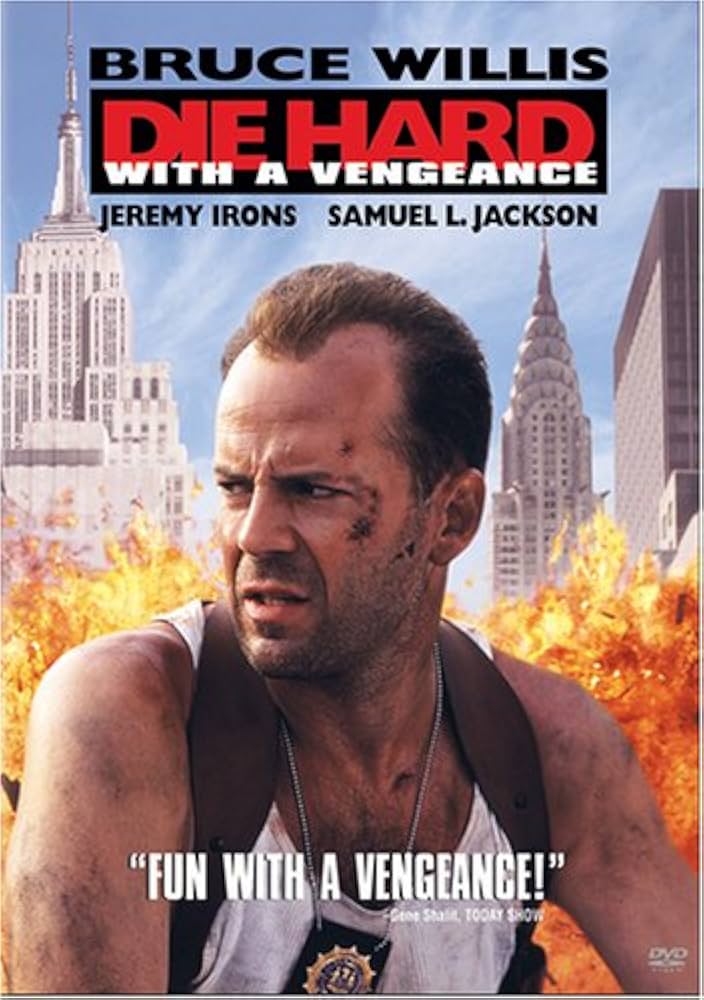
Die Hard With A Vengeance, Jurassic World Rebirth, And Trusting The Audience

Successful movies strike a balance between letting the audience know what’s going on through things like exposition or internal monologue and trusting the audience to figure things out. And, as an audience, we also want both. We want to be told where the story and characters stand, and what the rest of the film might hold. But we also want to feel like we’re participating in the movie. It is the magic of a genre like ‘whodunit’ murder mysteries: We are trying to solve the case alongside, and hopefully ahead, of the investigator.

It is easy to throw the balance off. The right amount of exposition or internal monologuing contrasted with character building gives us a glimpse into the future, but because we’ve figured it out for ourselves, we’re excited to find out if we’re right. People love being right. Too much exposition or internal monologuing doesn’t just give away what we’re yet to see, but it makes us feel stupid, talked-down to, or both.

We do have to give writers a bit of slack here because striking that balance can be hard, especially with a modern audience that is constantly checking baseball scores or Twitter during the movie. Large blockbusters also have to appeal to countries outside of North America, so using certain slang or phrases common here would miss the mark in audiences from Czechia to China.

Watching Die Hard With A Vengeance a few days ago, one scene really stuck out to me as something that builds anticipation and trusts the audience to figure it out. It isn’t even complicated, but when the payoff hits, it hits in a big way.

For anyone who hasn’t seen the third Die Hard movie in a while, our heroes are John McClane (Bruce Willis) and Zeus (Samuel L. Jackson). The hook of the movie is that the villain is making John and Zeus solve a bunch of riddles in locations all around New York City, and any failure to comply results in bombs detonating. One is a word riddle as follows:

As I was going to St. Ives,

I met a man with seven wives,

Each wife had seven sacks,

Each sack had seven cats,

Each cat had seven kits:

Kits, cats, sacks, and wives,

How many were there going to St. Ives?

It isn’t a math problem, it’s a word problem, and they figure out it’s just one person (the very first line). We are being primed by the writers that this isn’t necessarily a full-blown action movie, but one that requires some mental dexterity. Not long after is the second puzzle, which is a math problem, and something they also solve.

At this point, McClane figures out that the villain isn’t just messing with him, but distracting the cops from the real purpose, and that’s a gold heist from the Federal Reserve in New York. The villain and his group are all European (many/most former East Germans) and of the ones we do meet, it is obvious that English is their second language. At this point, we know the following:

  • McClane not only is a shoot-‘em-up cop, but one with mental acuity.
  • The writers are encouraging us to solve the problems alongside McClane.
  • American English is not the native language of our bad guys.   

That’s what makes the scene where McClane goes to investigate the Federal Reserve so smart.

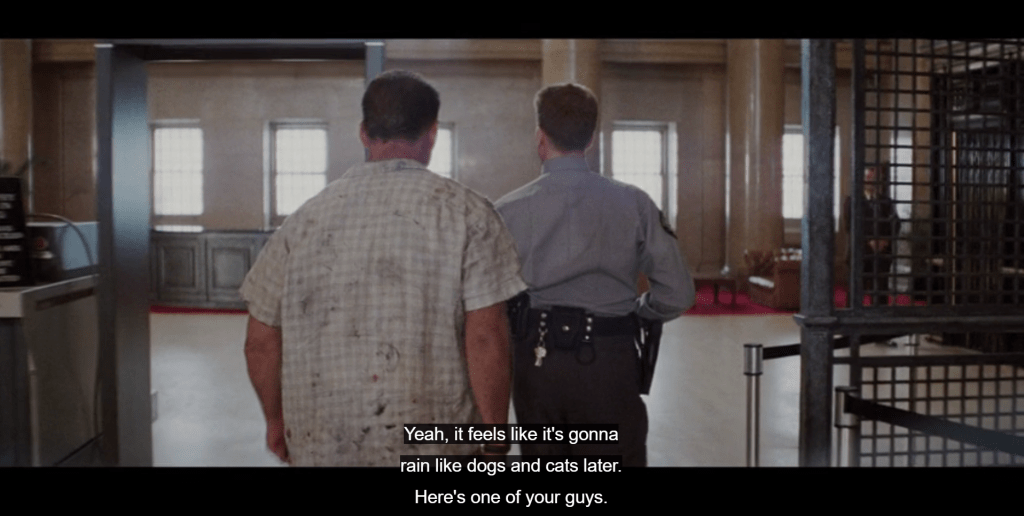
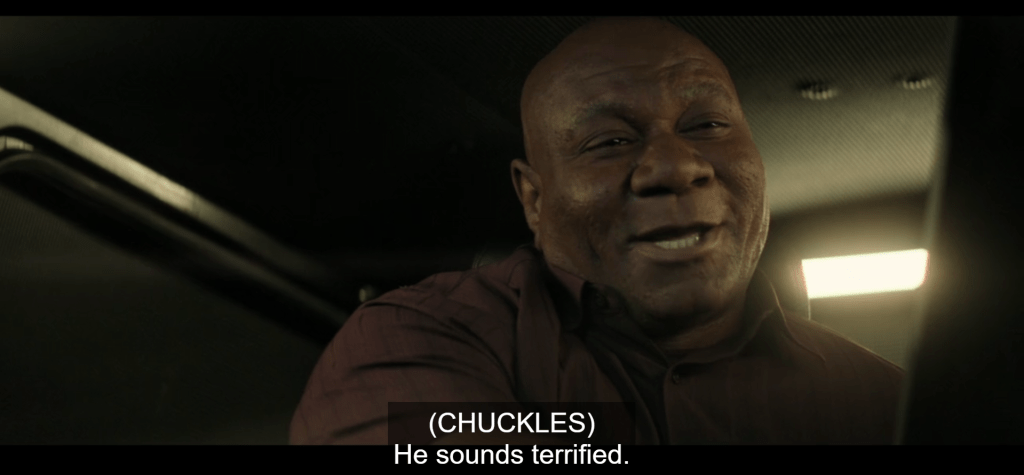
The villains have taken over the Federal Reserve (all the cops in New York are searching for bombs), so the security at the front desk is one of the bad guys pretending to be security. He offers to show McClane the basement to investigate (they are planning to kill him, of course), which McClane accepts. As they’re walking to the elevator and making small talk, the bad guy says this about the weather:

Of course, anyone with American (or Canadian) English as their first language knows the expression is ‘rain like cats and dogs’. The villain reverses the two animals, and that’s the first giveaway.

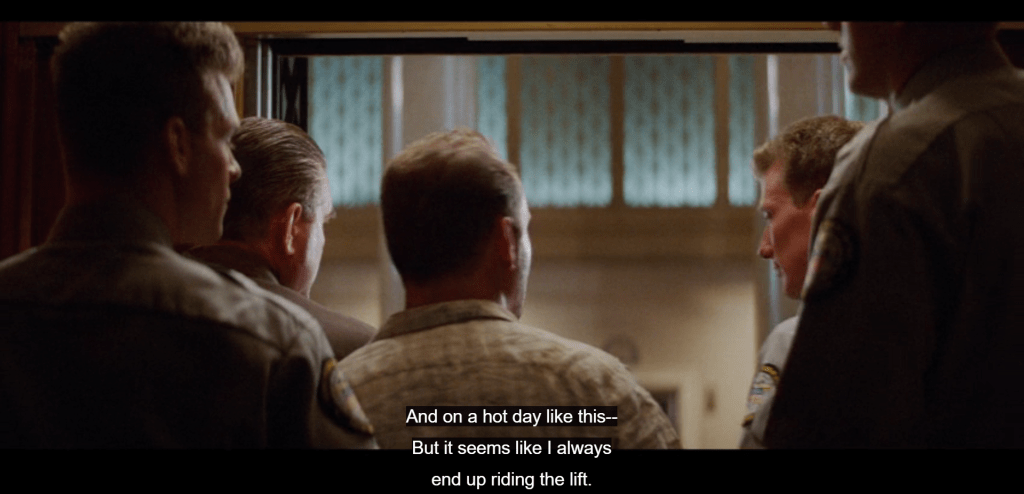
Once they get into the elevator, and the small talk continues, the same bad guy mentions he avoids taking the stairs on a hot day like they’re enduring, followed up with this:

‘Lift’ is the term used in the United Kingdom to describe the elevator. Almost anyone watching this movie in 1995 in North America would not use the word ‘lift’ to describe an elevator. They would just say elevator. That the bad guy uses the term ‘lift’ is another clue for McClane that this security guard isn’t from the Bronx.

The final clue is the badge number from one of the bad-guy cops as it’s the same badge number from someone McClane met earlier in the movie, and this isn’t him. But because of the first two English slip-ups, we already know what McClane knows, and then the action portion of this scene begins.

This isn’t complicated. It is one idiom expressed in an incorrect manner and one word that is a synonym for elevator but would not be used by an American-born security guard in New York. Those two bits of information allow the audience to solve the puzzle ahead of McClane, make us feel smart, and build anticipation for the ensuing gun fight, all while allowing McClane to use his mental sharpness to figure out what’s going on before pulling out his gun.

This is in direct contrast to Jurassic World Rebirth, which came out this past week. To be clear: I enjoyed myself watching the movie and thought some of the dinosaur scenes were very, very well done. The acting from most of the cast is great, too.

But the ending is infuriating. Without spoiling anything, our lead character is Zora Bennett, played by Scarlett Johansson. She is a mercenary who is hired to retrieve dinosaur DNA. The first act of the movie goes to great lengths to show us that she’s about getting paid, and not about morality. But this is a Hollywood movie, so she goes on an arc to go from a mercenary focused on finances to a person trying to uplift the world around her.

The final scene involves her making a decision that would hurt her financially but help people around her. As an audience, we just spent two hours with her and watched her go on this journey. We know what decision she’s going to make. But the final bit of dialogue in the movie is her saying out loud, and quite clearly, exactly what she’s going to do. It is completely unnecessary. We have seen her eschew her cold, calculating, dollar-driven persona in the first act and evolve to the person she is in the third act. There is no reasonable interpretation of what decision she’s going to make at the end other than she will help people. AND YET, for some reason, she has to say it out loud for everyone. Maybe things in blockbuster movies have to be, for lack of a better word, dumbed down to appeal to as many people as possible, but it’s hard to imagine that if they left that line of dialogue out that there would be any noticeable percentage of the audience assuming that the Zora Bennett character would just fuck everyone over. It is insulting to anyone who just spent their money and took hours out of their day to enjoy the movie.

And it is an enjoyable movie. There are things I don’t like about it other than that bit at the end, but by and large, it’s a fun movie to sit down with for two hours. But that ending feels like something a host would say at the end of a TV program for 3-year-olds. Studios, writers, and filmmakers need to trust their audience, or they risk losing them in the future.   

‘The Last of Us’ Finally Feels Like a Video Game Adaptation

The first season of The Last of Us was truly a marvel. It earned an 83 rating on Metacritic, which is tremendous for any television or movie property (Everything, Everywhere All At Once won seven Academy Awards, including Best Picture, and has an 81 rating), while earning 24 (!) Primetime Emmy nominations. It is a standard ‘Lone Wolf and Cub’ story with Pedro Pascal’s character (Joel) being a father figure to Bella Ramsey’s character (Ellie). It is a post-apocalyptic road trip with the two that goes deep into their individual characters, their relationship, as well as the world around them – the third episode with Bill and Frank, two older men who find love with each other in this utter hellscape, is one of the best episodes of television this decade.

For all those reasons, expectations were high for Season 2 and a large part of the season delivered extremely well. The second episode – the attack on the town of Jackson – is a breathtaking 60 minutes from start to finish. The fifth episode – which shows the depths of Ellie’s descent – is a wonderful performance from Ramsey. The sixth episode – the flashback with Joel and Ellie – is both crushing and darkly hopeful.

Despite the few great-to-incredible episodes in the second season, the finale felt like a letdown. For a series that went through painstaking lengths to develop inter-personal relationships and take its time with critical set pieces, it felt rushed. There were also some puzzling decisions from Ellie, who is now our main character. A lot of it felt grating, and it took me a couple days to figure out why that was, and then it hit like a lead pipe to the knee: This is a video game adaptation.

Violent video game adaptations like The Last of Us bring a problem specific to that genre of movie, and it’s that the main characters can’t die. Well, they can, and Joel has a golf club sticking out of his neck to prove it, but all the characters can’t die, because that just ends the show. In a video game, if you die, you restart at a checkpoint or, at worst, at the beginning of the game. Unless your television show involves some magical elements, which The Last of Us does not, then your main character can’t die. It changes the equation. In a video game, you may die a handful of times trying to beat a particular level. You make uninformed or stupid choices, get your throat ripped out, start over, and try to advance a little further the second time. That process is repeated until you beat the level, and you start again at the next one.

Television shows like this cannot operate like that. Every decision is life-or-death for the characters because there are no continues, there are no revivals, and there are no time rewinds. While video game players need to continually learn to advance in the game, they can play the characters in a way completely different from how characters in a TV show.

And that brings us to Ellie. By this point in the story, she’s 19 years old. While we shouldn’t expect optimal decision-making from a 19-year-old, it isn’t as if people that age are incapable of learning lessons. In fact, that’s one of the most important aspects of being that age. And it also isn’t as if the fungus-fueled apocalypse just happened a month ago – Ellie has lived her entire life under these circumstances. She had to grow up a lot faster than most 19-year-olds in TV shows, and she also had a mentor in Joel (as well as some others around Jackson).

That is why writing Ellie as just a bumbling dumbass was unbelievably frustrating to watch throughout the season. Once Joel is killed by Abby, here is what Ellie does:

  • Lies in her plea the Jackson council to send a group of people after Abby to get their revenge. This plea comes after the town of Jackson has been decimated by an attack by the Cordyceps.
  • Is ill-equipped and without a plan to get to Abby in Seattle, both of which are supplied by Dina.
  • After finding out Dina is pregnant, she continues with Dina rather than just leaving Seattle altogether.
  • Agrees to take a shortcut to the hospital with Dina through an area they know will have infected inside rather than taking time to look for a long way around. Mind you, this is after she finds out Dina is pregnant.
  • Wants to try to save a Seraphite boy from six armed WLF soldiers in the middle of a warzone.
  • Jumps into a small boat during a low-grade hurricane to navigate her way to the Ferris wheel (Abby’s supposed location). After her boat flips, and Ellie barely makes it to shore, she’s kidnapped and about to be murdered by some Seraphites. One deus ex machina later, and Ellis is freed. She then finds another boat and gets right back on the water.
  • She gets the drop on two of Abby’s co-conspirators in Owen and Mel. Owen makes a movie for a gun, Ellie shoots him dead, but the bullet goes through him and strikes Mel in the neck, and she slowly bleeds out as we and Ellie find out Mel is pregnant. This leads Abby back to Ellie, and Abby kills Jesse.

All that is the problem. Yes, Ellie is 19 years old and immune to infections. In a way, she’s designed not to die in this kind of show. And making bad decisions that hurt people around you while on a revenge quest is a very common trope. None of that is the issue with Season 2, and the finale specifically.

It is the sheer volume of monumentally stupid decisions that is the problem. It isn’t that Ellie is an unlikeable character (those are some of the best characters on TV) or that she’s hell-bent on revenge (that is a tried-and-true genre). It isn’t as if she lacks training because she got that both with Joel and other people around Jackson. It is that Ellie repeatedly makes idiotic choices as if she’s a person controlling a character in a video game and not a young adult who has lived her entire life in an apocalyptic hellscape where any number of things can kill her, or the people she cares about, at any given moment. It is truly some late-season Game of Thrones ‘Dany kind of forgot about the Iron Fleet’-type of writing that torpedoed what is otherwise a tremendous television show.

What the ‘Mission: Impossible’ Franchise Tells Us About Tom Cruise, Filmmaking, and Movie History

With Mission Impossible: The Final Reckoning being released this weekend, now is a good time to go through the entire series. We aren’t doing a recap, review, or analysis of the series, though. Not really. What we’re doing instead is following along the entries in the franchise, ranging from 1996 to present day, and how they tell us all we need to know about the career of Tom Cruise, the character of Ethan Hunt, and Hollywood cinema writ large.

Mission: Impossible (1996)

The original in the franchise, or the reboot of the TV show anyway, was released in May of 1996. It was a monster box office hit, finishing third that year in domestic gross at nearly $181-million, or more than double that in present-day value. It also feels like both the end of an era and the beginning of the next one.

To be clear: this is an excellent movie that holds up very well. As an espionage thriller, it does have its humour (especially in the first 15-20 minutes) with great action set pieces, but it nears the end the star-driven drama or thriller in Hollywood. Cruise had done a bunch of those (both The Firm and A Few Good Men were released 3-4 years earlier) and those genres were successful vehicles. Just from the 1993-1995 era alone, even aside from those aforementioned Cruise movies, there were entries like The Fugitive, Indecent Proposal, In the Line of Fire, Clear and Present Danger, Forrest Gump, Apollo 13, and Crimson Tide which all finished top-10 at the domestic box office in their respective years. Put Harrison Ford, Tom Hanks, or Demi Moore in a drama/thriller, and you probably had a box-office smash on your hands.

That ended after 1996. Once we get to 1997, the box-office smashes that get closest to those genres are Air Force One or Face/Off, which could qualify, but also lean more towards shoot-‘em-up-action. (Sidebar: in the first M:I movie, Cruise doesn’t shoot a gun at any point. As with all good espionage thrillers, this is a movie about relationships and brains over brawn.) There were a couple big successes before the end of the century – Titanic especially, and Good Will Hunting as well – but by the time we get to 1999, there is a Star Wars prequel, an Austin Powers sequel, and a Toy Story sequel in the top-4 at the box office. The successful original stories bent more horror (The Sixth Sense and The Blair Witch Project) or comedy (Big Daddy and Runaway Bride). Once we get to the early 2000s, it’s Harry Potter, Spider-Man, more Star Wars, and kids movies. There is still a successful drama-thriller entry here and there, but the mid-90s gold rush is gone.  

While 1996 can be used as a delineation point in the types of movies audiences will abandon or consume in the coming years, it’s also about this time that the use of computers/technology comes to the forefront. It isn’t as if movies had never focused on computers – hell, WarGames came out in 1983 – but they were infrequent, and the use of computers as an integral part of everything starts at this time. In 1995, we got Goldeneye, and in 1997 we got Men In Black. Before the century was over, The Matrix was released and the technology floodgates really opened.

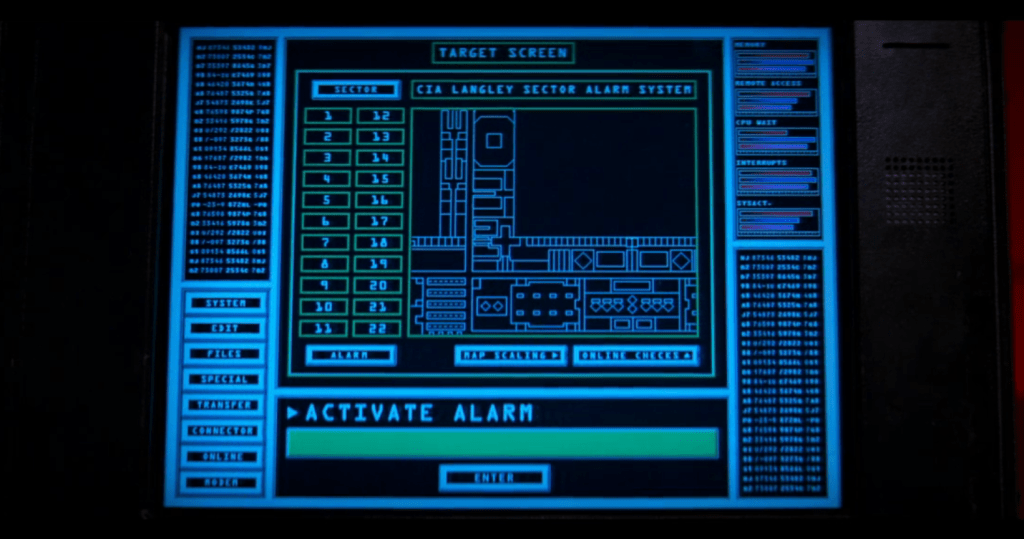
That is why it’s cheesy, in a way, to return to this Mission: Impossible entry. Hollywood was still figuring out how computers were actually going to be used in their movies, and how to present that to an audience that was largely still learning to use computers themselves. It is why we have scenes like the fake fire at CIA headquarters where Ving Rhames’ character (Luther), the greatest hacker in the world, has to type ‘ACTIVATE ALARM’ on the screen to let the audience know what’s happening:

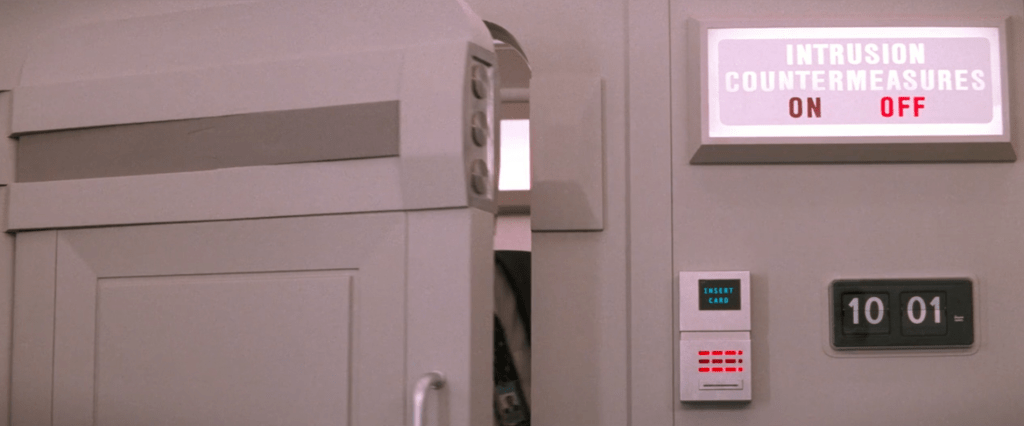
There are a bunch of scenes like this: Ethan Hunt typing ‘Job 314’ as a search string; Luther typing ‘SEND JAMMING SIGNAL’ in giant letters on his laptop to jam phone cells, and so on. I mean, there is even a giant ‘INTRUSION COUNTERMEASURES’ sign inside the CIA vault:

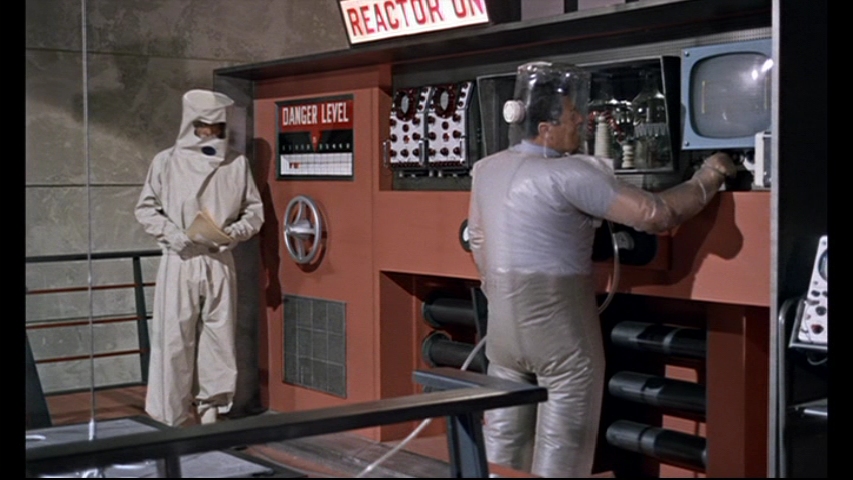
This is very reminiscent of Dr. No, the first James Bond movie released 34 years earlier:

I would say the sign in the CIA vault is an homage if it weren’t for all the instances of very obviously and clearly displaying on computer screens what the person at the computer was doing. As cheesy as it is, it does allow the audience to clearly follow along with what they’re seeing, a point we’ll return to later.

The next 10 years sees Hollywood not only adjust what kinds of movies are made, which is why this first M:I movie is a vestige of a long-gone era, but marks the start of the decline of Cruise as the vehicle of a drama/thriller. Cruise stars in Jerry Maguire later in 1996, which is a hit, but he spends over a year filming his next movie (Eyes Wide Shut) and the landscape has changed by 1999. In fact, after Jerry Maguire and until Top Gun: Maverick in 2022, the only Cruise movies that finish in the top-20 by domestic box office are Mission: Impossible sequels or directed by Steven Spielberg (Minority Report and War of the Worlds).

All this makes Mission: Impossible one of the most fascinating movies of the last 50 years. Not only for the movie itself, but what it tells us about movie-making and movie-viewing shifts in English-speaking countries generally, and Tom Cruise’s career specifically.

Mission: Impossible II (2000)

By the time we get to the second M:I movie, it is four years later. Cruise started filming Eyes Wide Shut in late 1996 and it didn’t wrap until March of 1998. As we just outlined, in the interim, there were rapid changes in both audience viewing habits and the way movies were being made, so this was Cruise doing his first post-drama/thriller movie. And we can all say this about the second Mission: Impossible: it was certainly a movie that was made and released.

This one was directed by John Woo, and he had just had a couple of big successes with Face/Off and Broken Arrow. And the action sequences in this movie are still good, but it’s the story and the writing that makes it suffer, which is why it’s at the bottom of the list for the franchise. What made the first movie so special was the espionage-thriller aspect, showing Hunt’s strategic thinking, which was complemented by a couple of great action sequences. Neither of those are really apparent in this movie. This is more, ‘What if Jean-Claude Van Damme spoke perfect American English and was in a Fast And The Furious movie’ and less, ‘this is a movie about the world’s greatest spy’. It is a Cool Guy Slowly Walks Away From Explosion-type of movie, considering there’s a literal slow-motion scene of him driving a motorcycle through the wreck of a car that just blew up:

But, like the first film, it’s an important entry because Cruise very quickly moves away from being that type of action star. In his future action movies, he either gets his ass kicked often (the M:I entries) or is the quiet badass (Jack Reacher). It takes a bit more time, but this marks the end of him being the Arnold Schwarzenegger-type of action star and more the Bruce Willis-type of action star.

The same thing is going on in Hollywood, generally speaking. The last of the Pierce Brosnan-led James Bond movies is released in 2002 (Die Another Day). It is generally panned and doesn’t crack the top-10 at the domestic box office. This forces the Bond creative team to re-think their approach, hire a new Bond, and take the franchise in a fresh direction. We get a reboot with a grittier Bond (we’ll get to that in a second) and it’s a resounding success. Schwarzenegger has moved to politics as that style of action star goes away – same with Sylvester Stallone. Audiences don’t want the super-cool action hero who always does everything right, and the second Mission: Impossible movie is the last time Cruise will inhabit that type of role for at least 20 years, if not forever.

Mission: Impossible III (2006)

Depending on who you talk to, this is the best of the original trilogy, though I’m still partial to the original. At the time of release, it has been a full decade since that original, and it’s very obvious how much has changed. The opening scene is from the back half of the movie, and has Hunt tied up in a chair across from Michelle Monaghan’s character (Julia), whom we learn is his fiancée, with Philip Seymour Hoffman playing the villain and threatening her life. The scene is taking place in a grimy industrial setting with a hand-held camera shaking like it’s attached to a bobblehead. The grit-ification of cinema in the 2000s – we already mentioned the Bond franchise, and the same happens with Christopher Nolan’s Batman trilogy – is readily apparent here. For the most part, it does work, so it’s not as if it is all for nothing.

This is also where, as mentioned earlier, the era of Cruise getting his ass kicked, or playing the quiet assassin/killer, is in full swing. It kind of starts with Minority Report in 2002, continues here, and extends to the present day. The action star of the 80s and 90s is not the action star of the 2000s, and Cruise makes that adjustment.

It also ties into his off-screen problems. Cruise, a longtime Scientologist, was caught up in controversy with a regular basis at this time:

  • In 2005, he got into a public tiff with Brooke Shields when Cruise criticized her for using anti-depressants to help with post-partum depression. Cruise also denigrated psychiatry in general, which seems to have led to a split with director Steven Spielberg.
  • After Cruise’s marriage with Nicole Kidman fell apart in a very public way, he started dating Katie Holmes in 2005. We all remember the couch-jumping incident on Oprah Winfrey’s show.
  • The nature of scientology itself were becoming more and more available to the public, which included mysterious deaths and disappearances.

All this was starting to make Cruise unlikeable to the public, so being an action star who makes all the right choices and never really loses wasn’t palatable. This third M:I movie features him being a guy who is constantly getting his ass beat until he triumphs at the end. That becomes a bit more typical of him for the next 20 years.

It isn’t dissimilar from what we see from Nolan’s Batman: Begins. In that movie, Bruce Wayne goes overseas for years, constantly gets beat during his training, and devolves so far as to be this-close to shooting the guy who shot his parents. He even has to be rescued by Alfred at one point after being exposed to a psychological toxin. That Bruce Wayne loses, or is lost, at nearly every turn until the final 30 minutes. The same is true for Ethan Hunt in Mission: Impossible III.

This is the end of the first half of Cruise’s career, especially after Paramount breaks away from him in 2006, and most of it is self-inflicted. He does a few smaller movies, tries a return in Knight & Day, but really the only thing that stands out from his next five years is his cameo in Tropic Thunder. Otherwise, the 2006-2011 period is Cruise receding into the background and starting his image rehabilitation.  

Mission: Impossible – Ghost Protocol (2011)

The fourth M:I movie may not be a favourite of franchise fans, but it does feature arguably his coolest stunt when he climbs the Burj Khalifa in Dubai (which he actually did). It also is very illustrative of not only where Cruise’s career was at that time, but where Hollywood was and is.

It is easy to forget how star-studded the third M:I movie is. There is Keri Russell just a few years removed from Felicity, there is Laurence Fishburne coming off his run in The Matrix trilogy, and Seymour Hoffman is coming off an extended late 90s-to-mid 2000s run of playing several excellent supporting characters (including 1999’s Magnolia with Cruise). With the rest of the supporting cast, it’s a true ensemble of great, notable actors.

That isn’t the case with the fourth Mission: Impossible movie while Cruise’s reputation is still being rebuilt. There is Jeremy Renner, who is on a very good run of movies at this time, but Simon Pegg is a returning character, Paula Patton was a supporting character in a couple of good movies but was nowhere near Keri Russell’ recognizability in the mid-2000s, while Michael Nyqvist and Vladimir Mashkov were unknowns to American audiences. This is not a cast that would have been in a Tom Cruise action movie 10 years earlier. Hell, the second movie had Anthony Hopkins!

Where the filming takes place is also key to the fourth movie. Here are the primary filming locations for each of the first four films:

  • One: England, Czechia
  • Two: Australia
  • Three: Italy
  • Four: India, Russia, United Arab Emirates

Interesting, yeah?

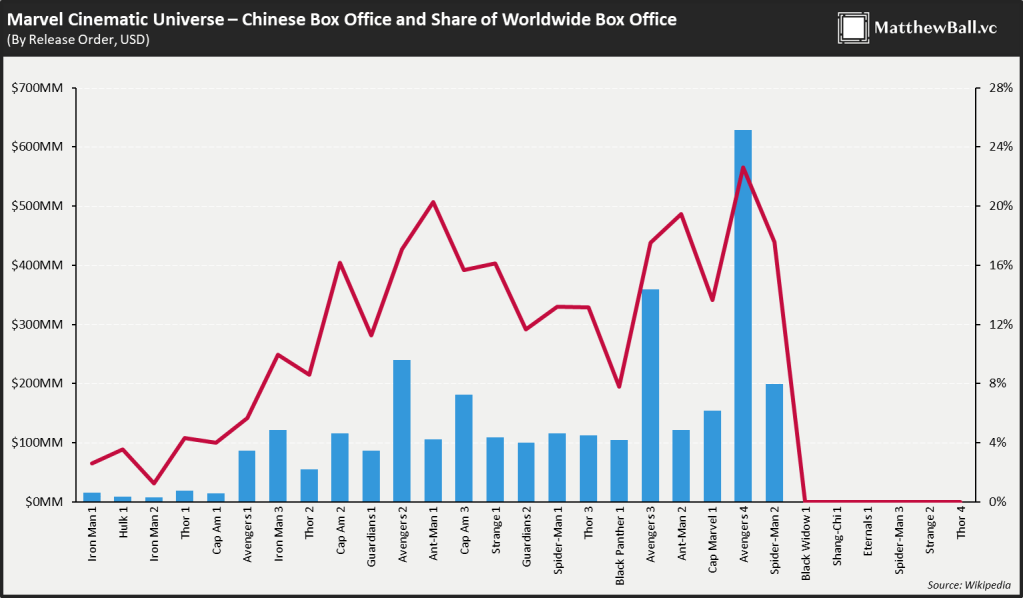
Aside from the 2010s being notable for the rise of the superhero movie, it is also notable for the rise in foreign influence on Western productions. China becomes a huge market for those superhero movies, to the point where Avengers: Endgame got a quarter of its total box office from that country:

As for this movie, specifically, it opened the Dubai International Film Festival in late 2011. It also reportedly got “… production support in the city equivalent to a financial rebate of some 30% of their local spending.” This type of financial incentive has always been around, to a degree, but it becomes more of a battle not only for places like the UAE, but Ireland, England, New Zealand, Canada, Eastern Europe, and on and on. That trend started around this time, and now top streamers like Netflix and Amazon have over two-thirds of their new movie/television productions being non-American productions.

The fourth movie is a success but is also the start of something new entirely. Cruise is no longer the suave action star of the 1990s and early 2000s, mostly because audiences won’t let him be that. It is the rehabbing of his image from someone who is promoting his very controversial religion, to the point where he’s essentially excommunicated from Hollywood, to where he’s today affectionately referred to as Mr. Movies. It also is a herald of movies featuring American actors, with American directors and writers, being filmed in, or partly financed by, countries that aren’t exactly staunch allies of America.

Mission: Impossible – Rogue Nation (2015)

The year is now 2015 and Cruise is a decade removed from the 2005 couch-jumping incident and most of the controversies that put him on a lot of shit lists. Since Ghost Protocol, Cruise has been in Jack Reacher, Oblivion, and Edge of Tomorrow. None are absolute box-office smashes, but their production budgets (per Wikipedia) amount to $358-million and the total box office take for those three movies is about $881-million. Even factoring in the hidden costs of marketing, they made money. What is also notable is that those three movies heavily relied on the international box office for success:

MovieDomestic BoxInternational BoxInternational %
Jack Reacher$80.1M$138.3M63.3%
Oblivion$89.1M$197.1M68.9%
Edge of Tomorrow$100.2M$276.8M73.4%

American audiences may not have been all the way back in on Cruise, but international audiences certainly were.

Those three movies, and then Rogue Nation in 2015, is a four-year run that culminates mostly in Cruise’s image rehabilitation. He isn’t back to where he was 15 years earlier (yet), but there are modest box office successes, one critically acclaimed movie in Edge of Tomorrow, and then Rogue Nation, which is a smash hit. It is arguably the best movie in the franchise to that point and gives us the Cruise he needs to be for audiences: The guy who is over-matched, gets his ass kicked, but pulls it off at the end. He is chasing a terrorist group known as The Syndicate, which was created by the English intelligence community but then went rogue. No one believes him, so it’s the belief in himself, and his team’s belief in him, that allows them to succeed.

This is all part of Cruise’s image rehabbing. He is telling audiences that he’s willing to get his ass kicked, and perform death-defying stunts, but they need to trust him to get the job done. It is very effective.

We also get the introduction of the most important non-Cruise character in this franchise, and that’s Rebecca Ferguson’s character of Ilsa Faust. She is an English spy working against Hunt but eventually falls for him and the way he treats his team. They are borrowing straight from The Fast and the Furious franchise here:  Hunt’s team aren’t co-workers, they are family. In this way, Ilsa Faust just isn’t a lethal, sexy assassin introduced to be a foe-turned-friend-turned-lover(?) of Hunt’s, but is a stand-in for the audience. If we chose to not let Cruise rehab his image and charm us back into our seats at the cinema, his movie career would effectively be over. But this is still Tom Cruise, so she falls for him, and so do we.

This movie also gets away from production in places like Russia and the UAE, returning to London while also going to Casablanca and Austria. They are globe-trotting, and this time it’s with countries friendly to the United States.

Mission: Impossible – Fallout (2018)

Cruise makes a few unsuccessful movies after Rogue Nation, but returns to Ethan Hunt in 2018’s Fallout, which is probably the best movie in the franchise (at time of writing, I haven’t seen Final Reckoning, but Fallout sports an 87 rating on Metacritic).

Gone is Jeremy Renner’s character, but all of Ving Rhames, Simon Pegg, Alec Baldwin, and Rebecca Ferguson are back. Sean Harris returns from Rogue Nation as the head of The Syndicate while Henry Cavill (Agent Walker) is introduced as the heavy, and Harris’ secret operative. There are also the introductions of Angela Bassett and Vanessa Kirby (White Widow), as well as the re-introduction of Michelle Monaghan (Hunt’s wife from the third movie). Tom Cruise is nearly all the way back, almost fully image-rehabbed from the mid-2000s, and this type of star-studded ensemble cast is more reminiscent of the second and third movies than the fourth and fifth movies.

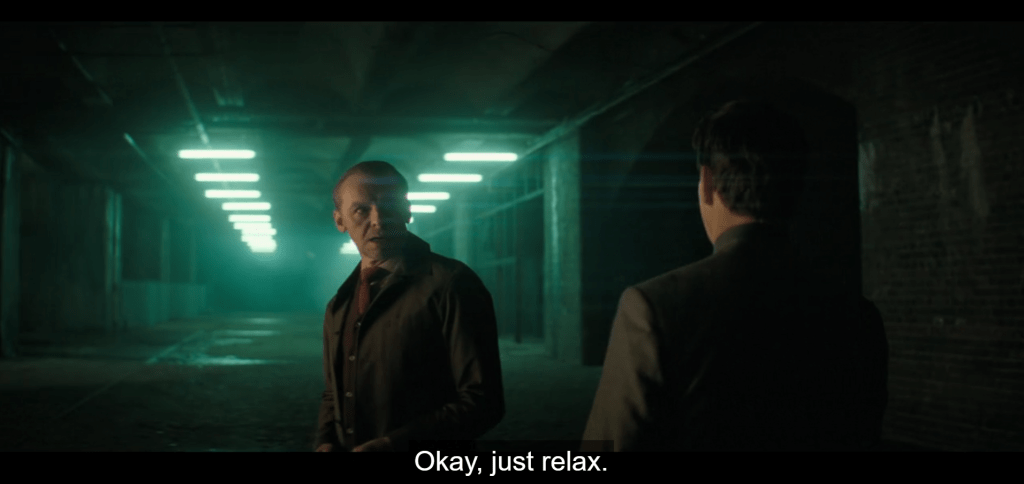
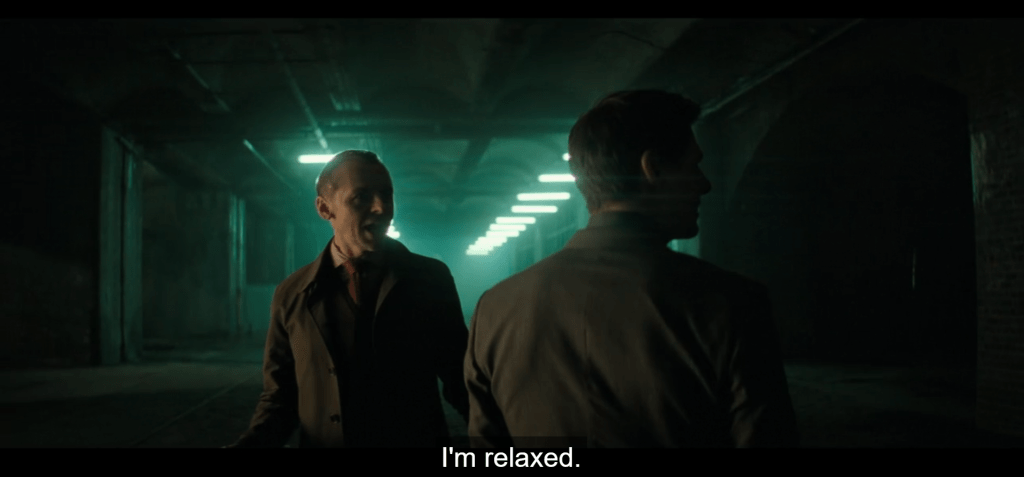
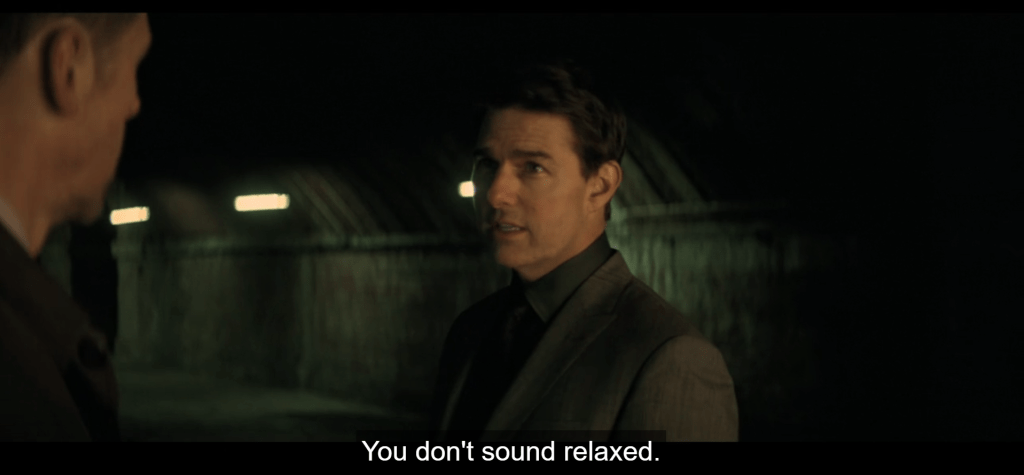
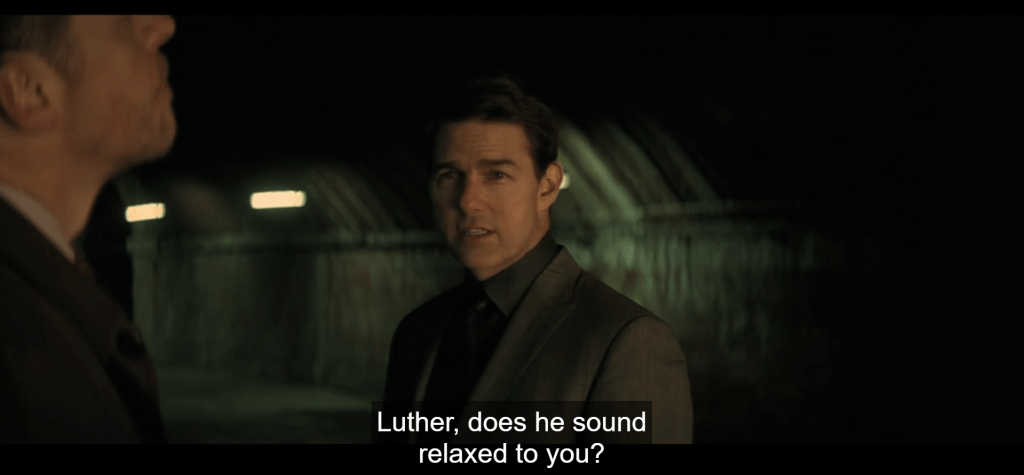
Also back in the franchise are the humour elements. While the previous couple of Mission: Impossible movies give us physical comedy from Cruise in the Wile E. Coyote kind of way, this brings actual dialogue humour. The second scene in the movie is Hunt and Benji looking to make an exchange with criminals, but gives us this exchange of Hunt telling Benji to relax:

It isn’t laugh-out-loud hilarious, but it is the writers knowing they can be a little more playful with Cruise. His image has improved to the point where audiences can laugh with Cruise, and not just at him.

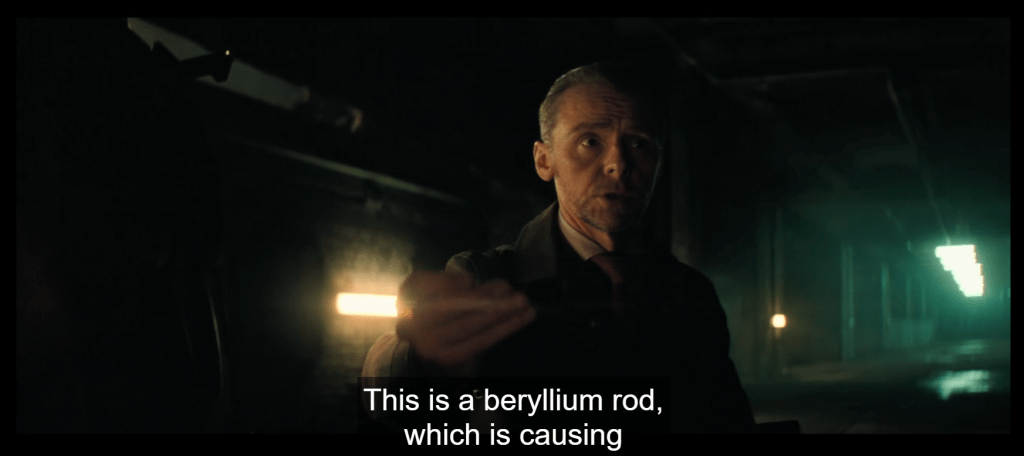
In its own way, Fallout is a kind of return to the very first movie. Remember how they had to type out ‘ACTIVATE JAMMING SIGNAL’ or have a sign that says ‘INTRUDER COUNTERMEASURES ON/OFF’ to help audiences follow along? While each movie does this to some extent, it is a frequent occurrence in Fallout, like later in the same scene just mentioned where Benji is testing plutonium cores to make sure they’re actually plutonium, and we can tell that’s what he’s doing, but he explains it anyway:

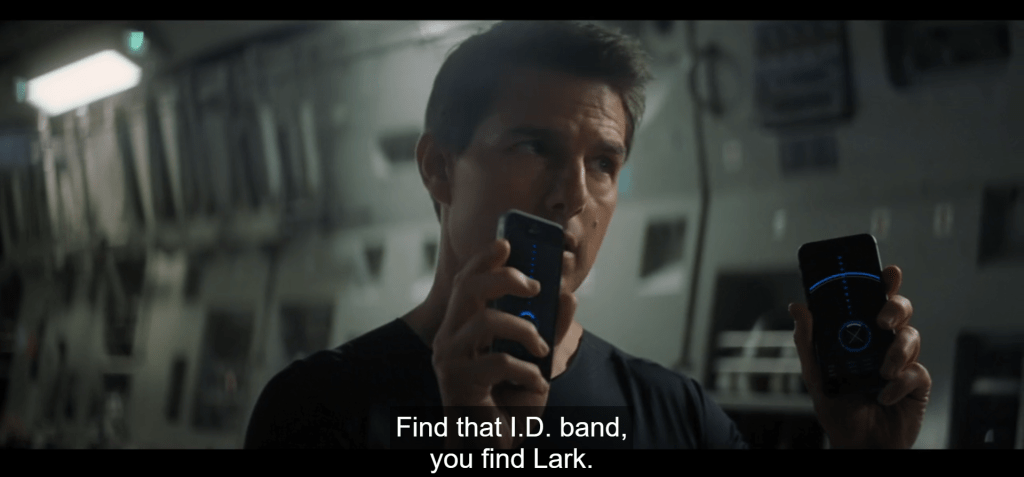
Then there is the scene in the plane with Hunt and Walker where Hunt is explaining that their target is wearing an ID band that they can track with their phones. Hunt then repeats that last point:

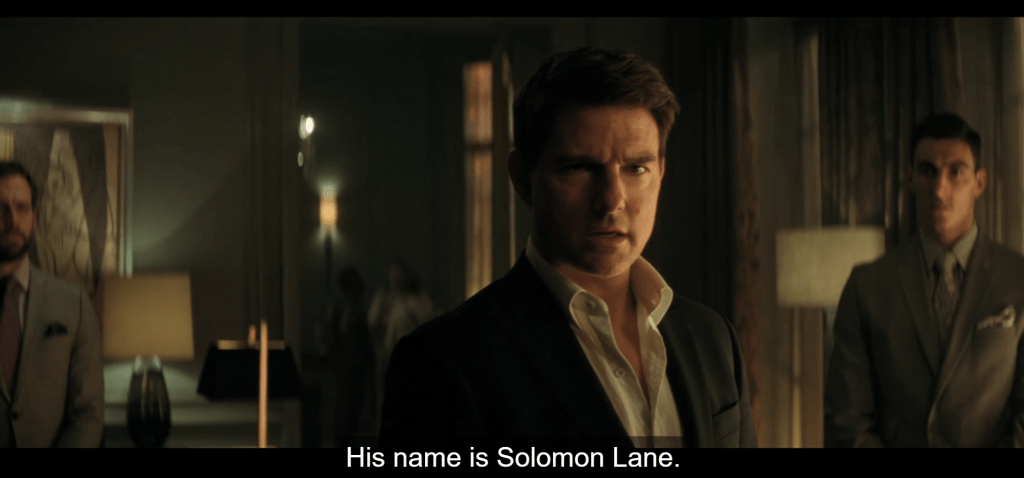
When Hunt meets with the White Widow later, she states the plan is for Hunt to jail-break Harris’ villain character from the last movie. There is an exposition scene telling us who Harris’ character is (Solomon Lane) even though he was the villain in the most recent franchise entry:

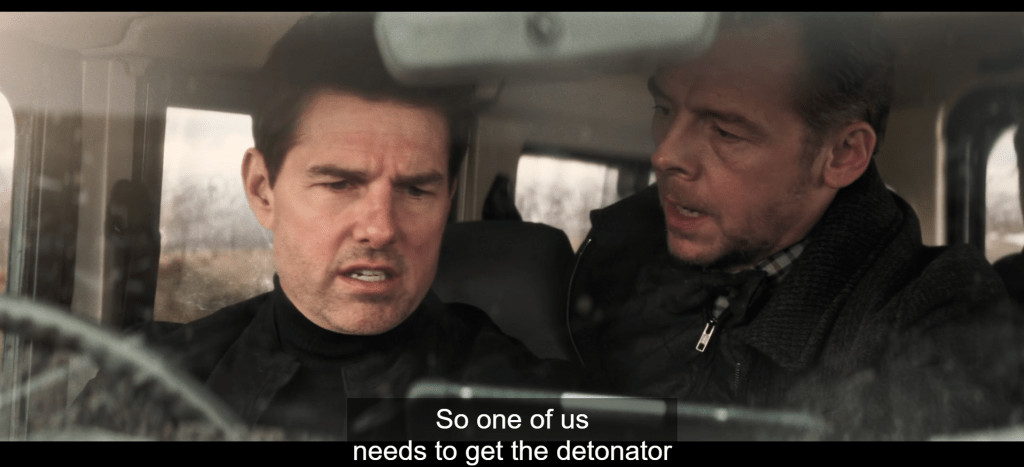
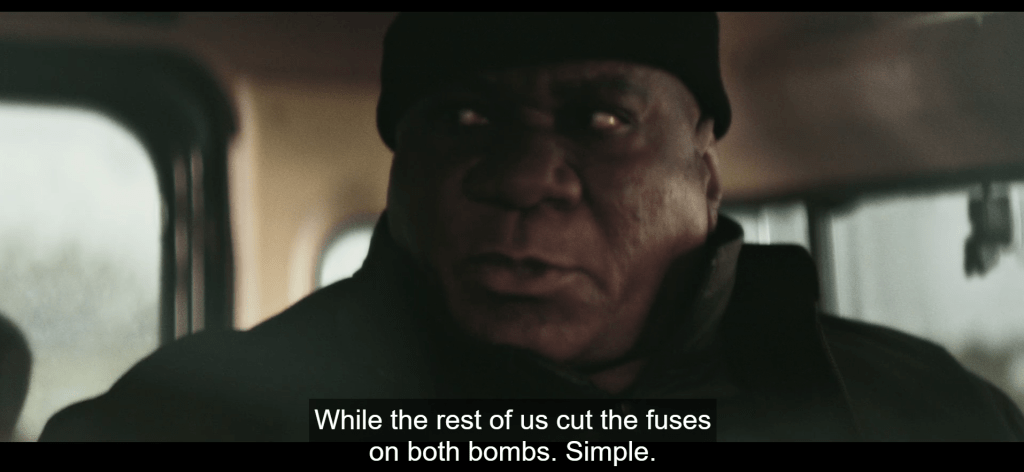
In the final act of the film, as the team is driving into the village to stop the nuclear bombs, Benji explains all the steps needed to deactivate the bombs. Then the team repeats the steps back so the audience can follow along:

One important thing Fallout does so well is that it demonstrates the IMF team is over-matched, but they have the smarts and the will to outwit and out-grit the villains. Those smarts are repeated on the screen to make sure the audience knows what’s going on, and that makes us feel smart. We feel as if we could be part of that IMF team because duh, of course that rod detects radiation or that ID band leads us to the target. We knew that. Of course we knew that. Because we’re smart.

This repetition of key actions is something modern blockbusters have all done, to some degree, but is critical to spy-thriller blockbusters specifically. What makes these movies special is the intelligence of the characters, because that’s what allows them to win the day, but if the audience can’t follow along with what’s happening, they will feel as if the movie is too high-concept. This way, the movie can show the characters be smart and make the audience feel smart without talking down to us. It is a brilliant piece of movie-making that can turn a spy-thriller like this be a box-office smash, even if the franchise has become known for its excellent action stunts.

Just think of the Marvel movies of the late 2010s. There were extended sequences or dialogue scenes that clearly explained how they’re going to go back in time, or prevent Thanos’ invasion, or whatever else. It demonstrates the intelligence of the characters while bringing the viewers along for the ride.

Mission: Impossible – Dead Reckoning (2023)

There is no need to go long here because by now, Cruise is fully back. Top Gun: Maverick released in 2022 and earned nearly $1.5-billion at the box office, the second biggest movie of the year, and was the sign that film-going had returned post-pandemic (using that term loosely here). It brings back old favourite characters, introduces new ones, and sets Hunt’s path for 2025’s Final Reckoning. The mid-2000s are a distant memory.

Some people call Cruise the last movie star, which may or may not be true. What is undeniable is that there isn’t another actor like him from the post-Classic Hollywood generation. So many stars of the 80s and 90s – Schwarzenegger, Stallone, Willis, De Niro – just never translated to modern audiences, at least not consistently. Cruise did, and he did it with a full, decade-long image rehab to climb back from effectively being a radioactive plutonium core himself to the avatar of blockbuster movies in the 2020s. Beyond that, the entire history of action-spy movies over the last 30 years can be told through the Mission: Impossible franchise, and a large chunk of the Hollywood story overall. The Marvel Cinematic Universe may have changed modern blockbusters, but the Mission: Impossible franchise clarifies those changes for the audience, something its best movies do individually. Even the history of the Mission: Impossible franchise explains the modern history of Hollywood blockbusters, so maybe there isn’t a more apt nickname for Cruise than Mr. Movies.

Far Better Than I Deserved: Visual Storytelling In John Wick

The signature Hollywood action movie series to debut this century (setting aside superhero movies, which are their own genre) is undoubtedly John Wick. The first in the franchise, released in 2014, was not only a financial success with $129-million in global box office against a $20-million budget, but a critical one as well: John Wick generated 77% positive reviews at Metacritic and holds an 86% at Rotten Tomatoes. While the action sequences are exceptionally well done, and the hallmark of the entire series, it’s what is shown to us before the titular character fires a single bullet that sets up the rest of the movie.

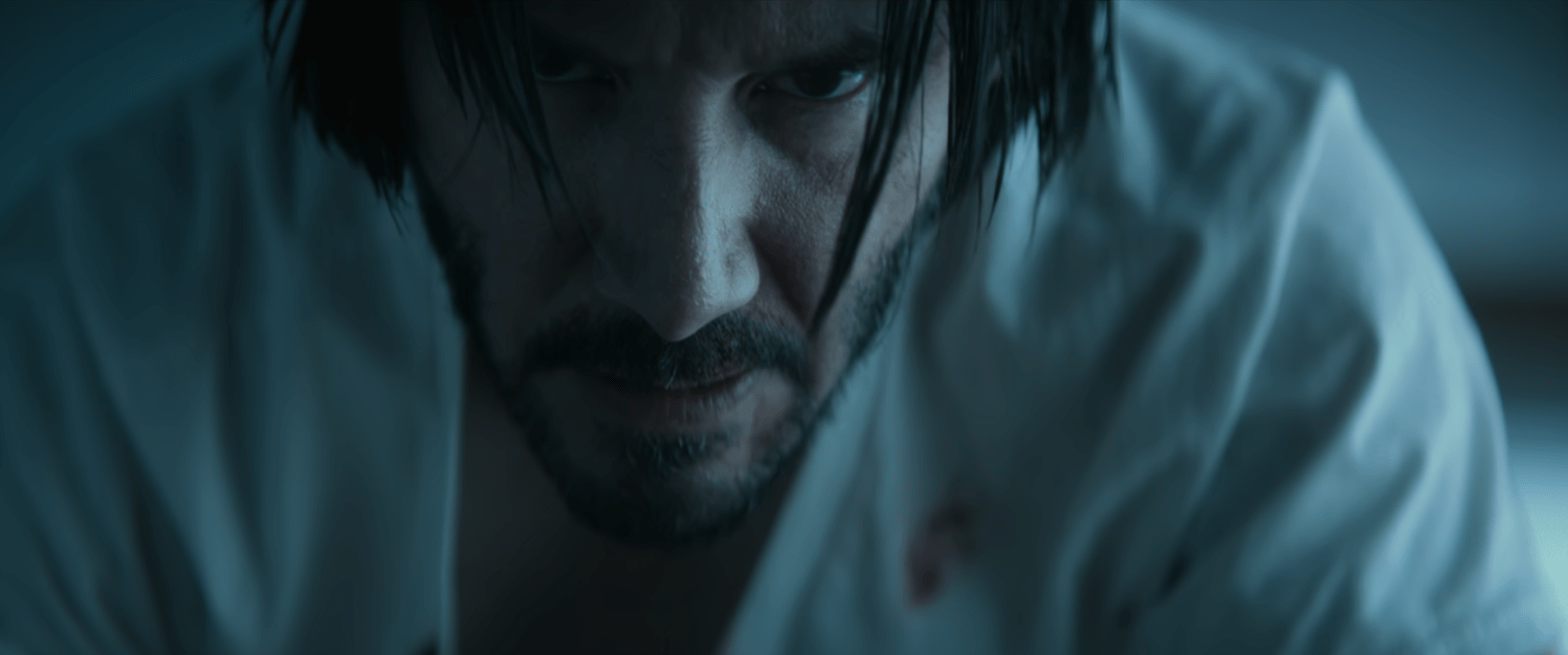
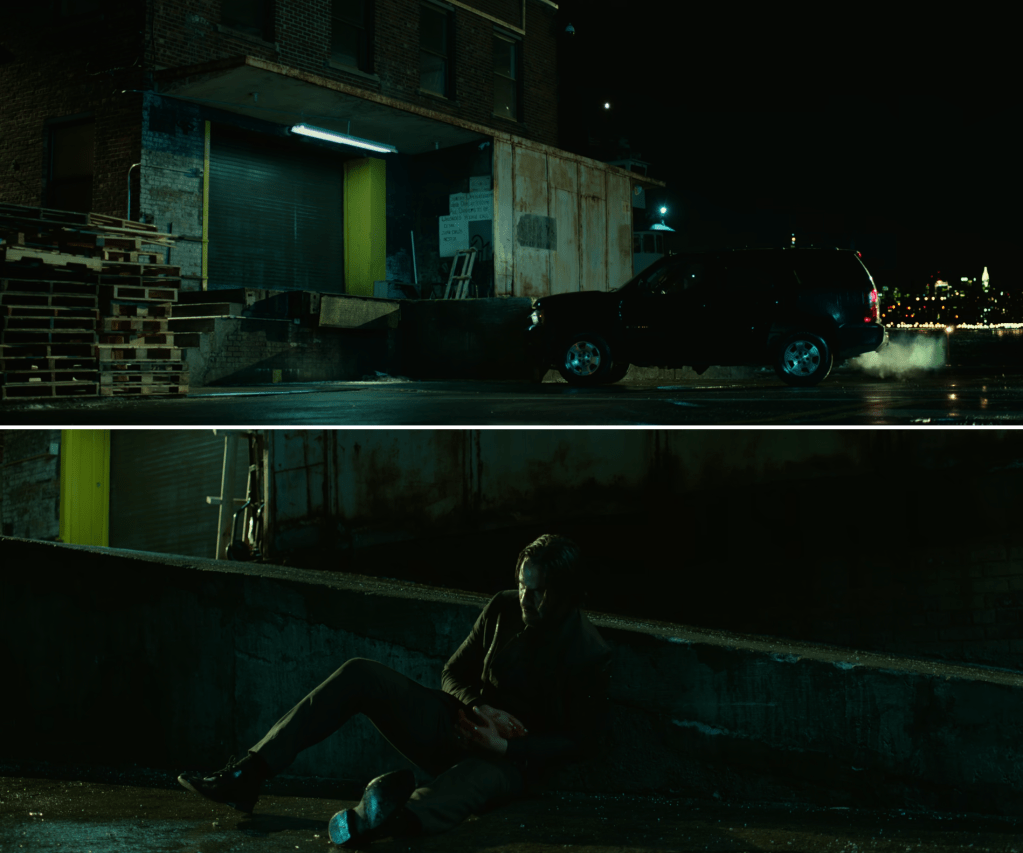
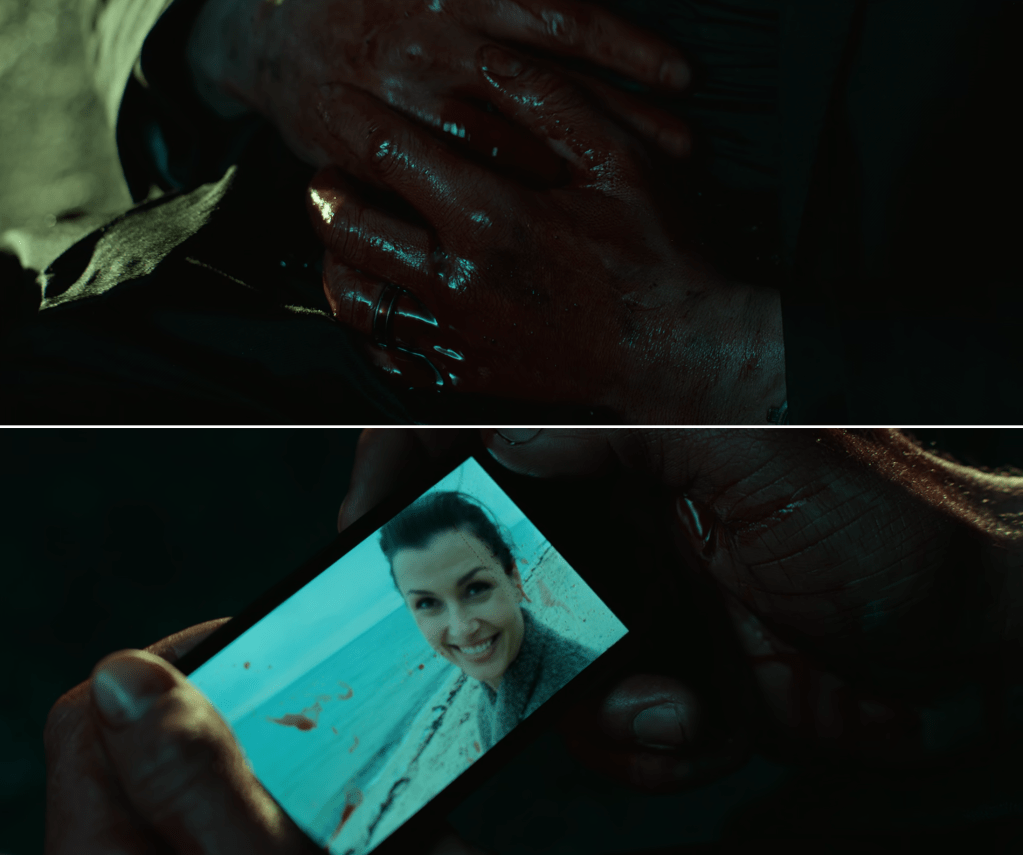
The movie opens with a slow-rolling SUV crashing into a concrete loading dock, and the SUV is absolutely mangled. Also mangled is Keanu Reeves, who crawls out of the vehicle wearing a suit that is covered in blood:

As this man is sitting up against the loading ramp, we get two shots that establish the foundation of our character.  

The first is a wedding ring on his blood-soaked left hand. Then the man takes a smart phone out of his pocket, and as he’s sitting against that ramp, presumably dying from his injuries, the one thing he does is watch a video of a woman on a beach:

Given that he seems to be bleeding out, we’ve seen the wedding ring, and he watches a video of the woman rather than call her, the implication is the video is of his wife and she’s dead. At one point in this video, she says, “What are you doing, John?” so we now have a good idea that this is our main character, John Wick.

From the first images of the movie to the moment he watches the video, a grand total of 41 seconds has passed. In those 41 seconds, we know (or have a pretty good idea) he’s been in a very violent fight (if it was just a car accident, he probably doesn’t drive away bleeding like that), that he’s slowly dying, and he was married but his wife is deceased.

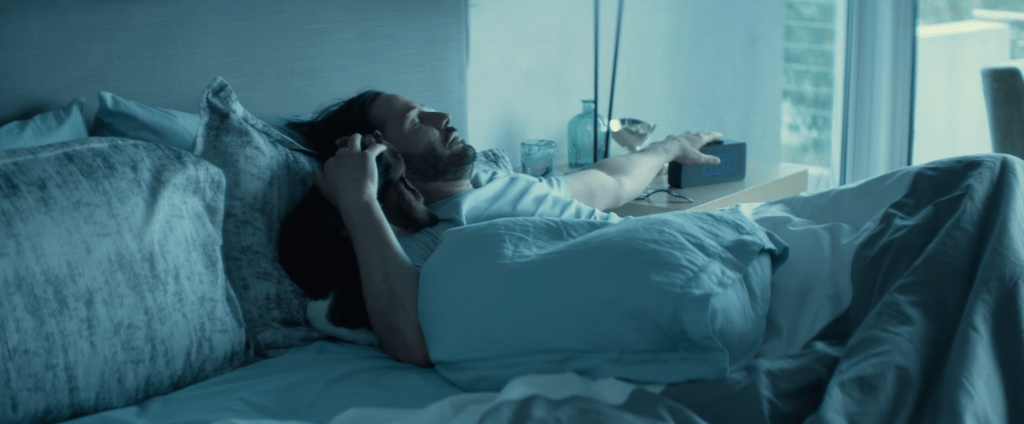
Wick slumps over and it cuts to the John Wick title card. During the title card, we hear a bedside alarm buzzing, which wakes him up and he shuts off. Then we get two more important shots. 

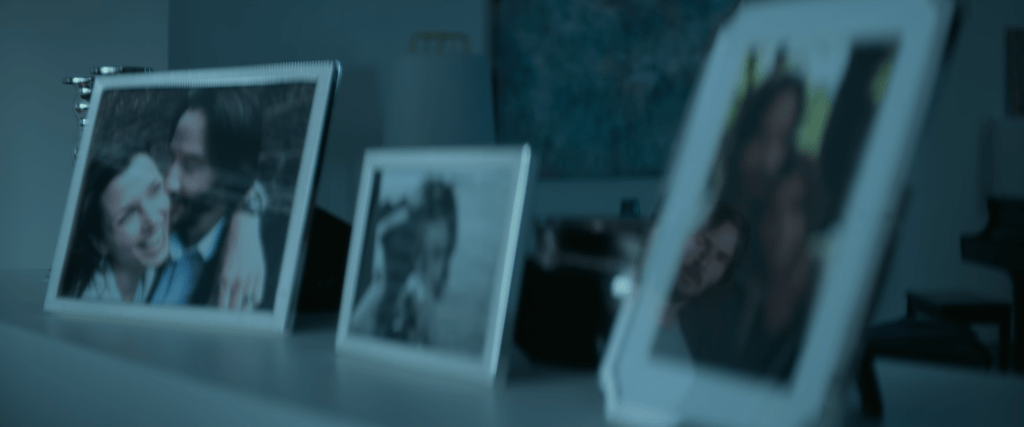
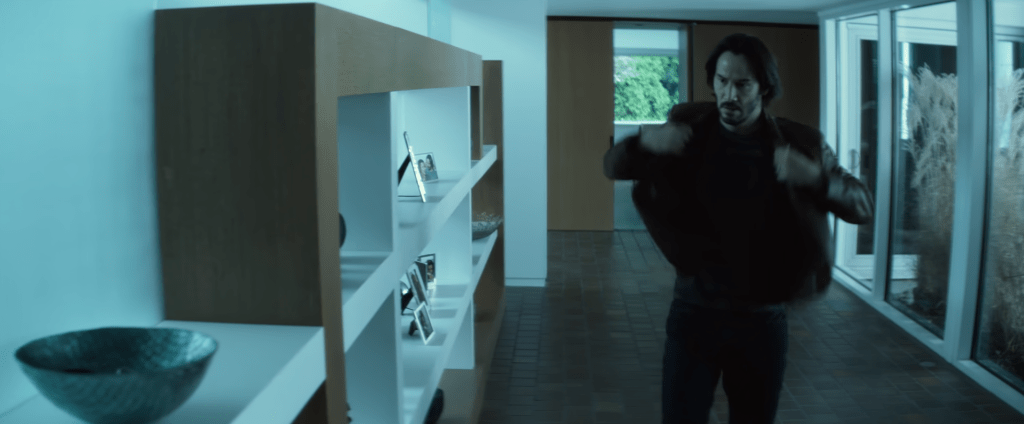
The first shot is photos of either Wick, his wife, or both in frames on a ledge that he passes on the way to the kitchen. Director Chad Stahelski makes sure to capture Wick’s face in the reflection as he walks by to tell us that he’s not only thinking about her, but he’s still trapped by those memories:  

When people lose loved ones, they often leave up photos of the deceased, so this doesn’t help illuminate exactly when his wife died. It is the next shot, when he goes to the bathroom, that provides more context.

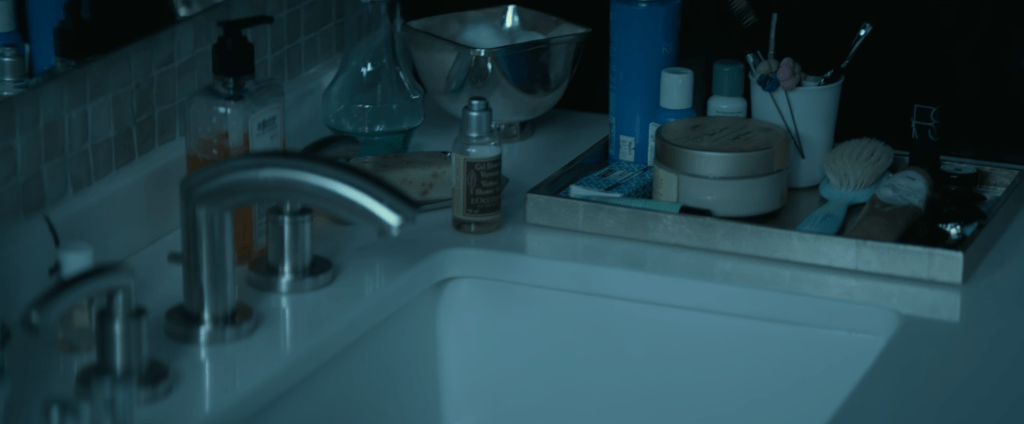
As he’s about to wash up, the camera pans over to the sink next to him and there is a brush, some cream and lotion, soap, and more:

Leaving photos up is one thing, but leaving his wife’s entire morning/nighttime routine next to the bathroom sink tells us hers was a recent passing. If this had been months, he likely would have cleared those away by now, so this grief/sadness is still very fresh for him.

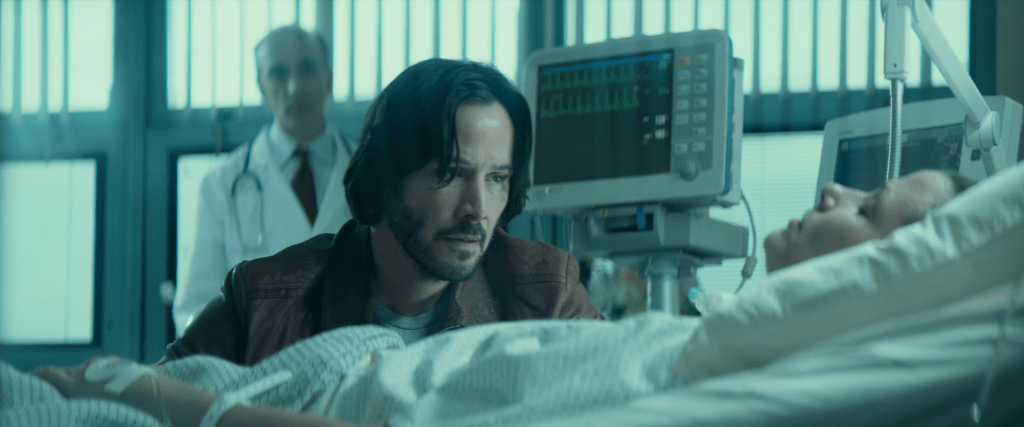
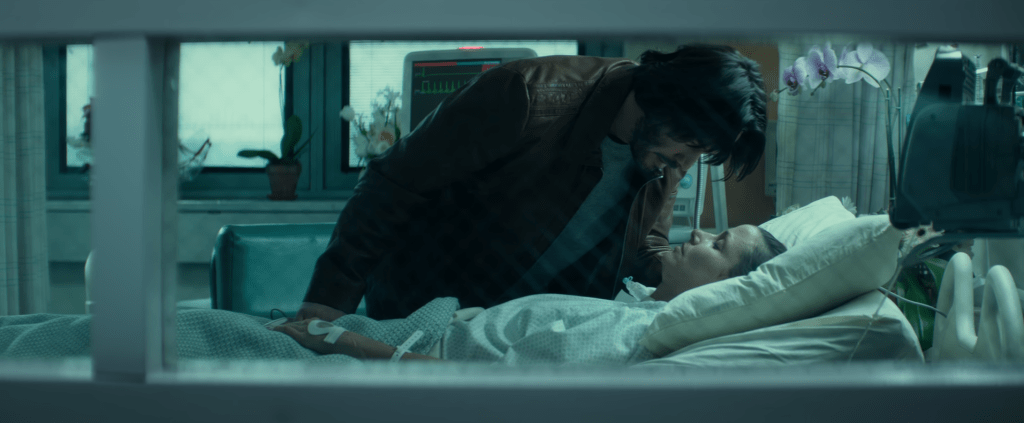
Now we get the full story. In a flashback after the bathroom scene, we hear a pinging sound while Wick and his wife are together somewhere on a boardwalk. She collapses and the scene cuts to Wick walking into her hospital room where she’s laying unconscious with the pinging sound being machines registering her heartbeat:

We don’t really need this, right? We know they were married, we know he loved her, and we know she’s dead. It is what happens next that makes this scene so necessary.

Wick leans over the hospital bed and kisses his wife on the forehead. After he does that, he looks over his shoulder at the doctor standing behind him, and the doctor gives him a nod:

The doctor then moves behind the machine that shows her vitals and seems to unplug something. A few seconds later, she flatlines and the alarm starts blinking red:

Not only did Wick lose his wife whom he loved very much, but he had to pull the plug on her. That is a whole other level of tragedy.

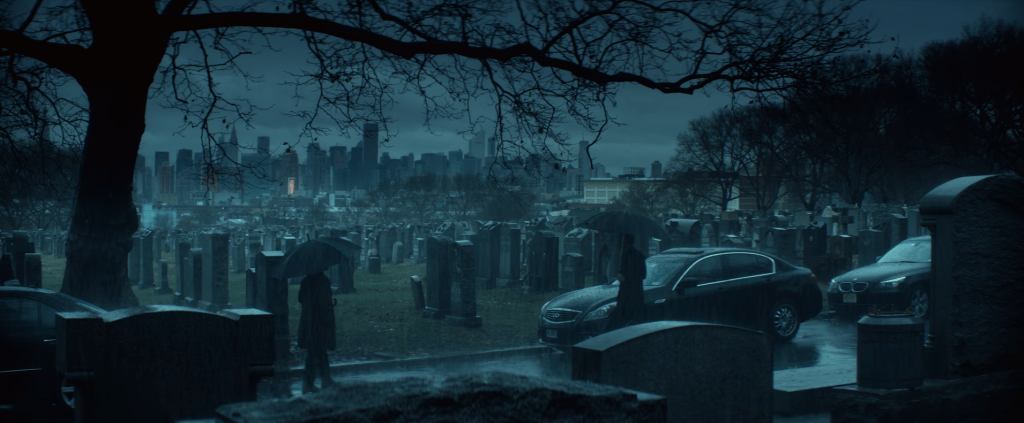
We are shown his wife’s funeral (on a rainy day, no less), and there’s a man standing at a distance after everyone leaves. John goes to talk to him:

This is the first time we have any character on the screen say a word. Given that this is his wife’s funeral, and that this man (Willem Dafoe) is the first person Wick talks to, it is safe to assume this is someone close to him in some way. After sharing condolences and a bit of wisdom on life, Dafoe says he’s, “Just checking up on an old friend.” They shake hands and part ways.

To this point, we haven’t seen Wick show much emotion outside of appearing to be crying the moment his wife flatlines. The way the scene is shot, though, his hair is covering his face and it’s hard to tell, so the message here is he’s trying to keep his emotions in check, or hidden, through the worst days of his life. 

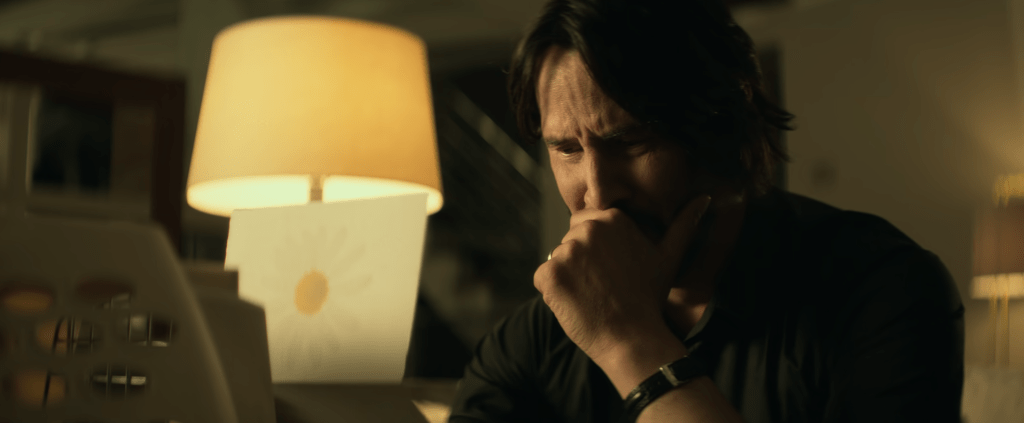
After a brief scene of the funeral reception, Wick gets a package at the door. Attached to the package is a note. The package and the note are from his wife, who prepared all this before she died. The note says that he still needs something or someone to love. There are two key points of this scene.

First off, this scene is lit up. It is nighttime, but there are bright lights on in the room:

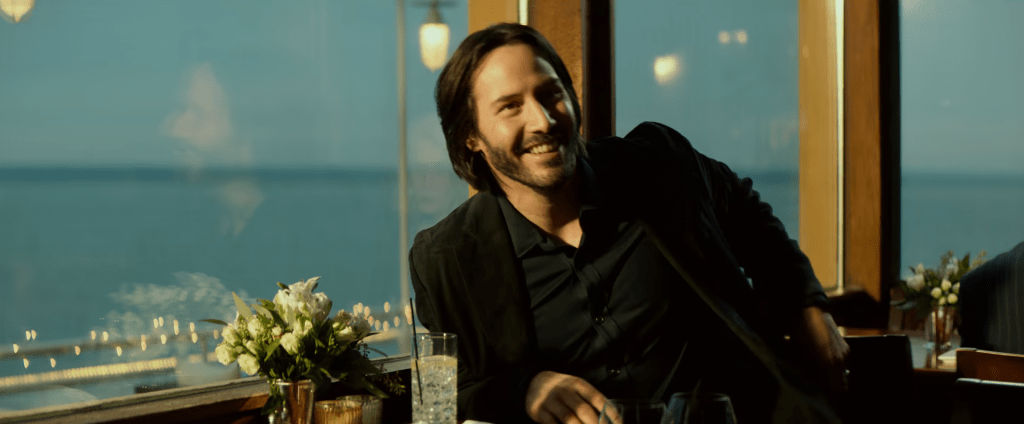
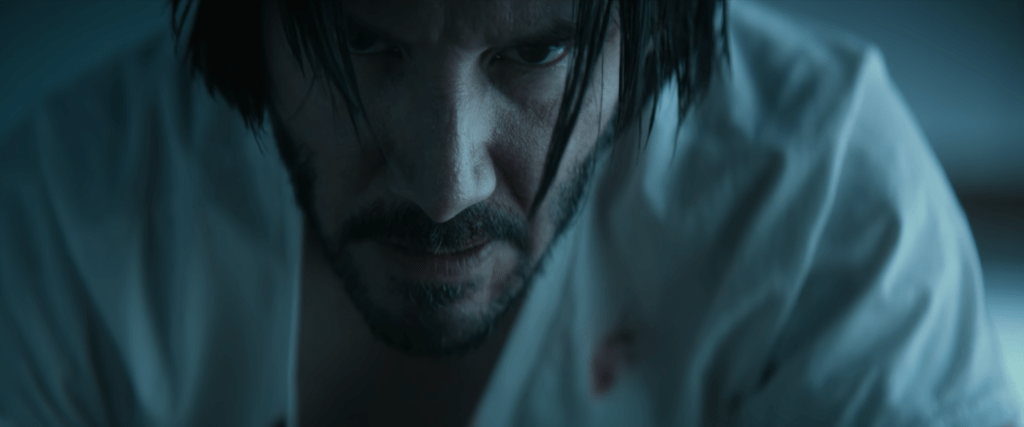
From the initial car crash scene to the bedroom/kitchen/bathroom scenes, to the hospital, to the funeral, it is all some variation of dark/grey/dull white. There is no colour outside of flashbacks of time spent with his wife, like this:

That we are only giving some brightness when he’s with his wife, or she’s trying to reach out to him in some way, only reinforces how much she really meant, and still means, to him.

The package delivered is a crate and in that crate is a puppy named Daisy. On the first night with the dog, Wick makes a bed out of a blanket on the floor for Daisy. The next morning, Daisy hops on the bed and starts licking his face. It is an adorable scene, but also one that helps drive home what his wife told him in the note she left: He needs something to love and take care of. We are told this by his wife, but not only does Daisy wake him up by licking his face, she does it a few seconds before his alarm goes off. It starts ringing as he’s about to get out of bed:

At the beginning of the movie, the first scene after the title card is Wick being woken up by his alarm. Now, he’s being woken up by something he cares about.

After feeding the dog and letting it do its business on the lawn, Wick gets ready for the day. There is another brief, but crucial, scene where he’s putting on his jacket and walking past the same ledge of photos shown earlier just after his wife died. Only this time, instead of Stahelski framing Wick’s face in the photos, when John was still weighed down by his grief, he is walking towards the camera, past the photos, and he barely glances at them:

This isn’t to say that he’s not thinking about his wife – no one moves on that fast. But he’s no longer trapped by grief. Daisy has now given something else to think about, to care about, and to love, and it’s not only something we’re told in the note but shown by the director.

From the moment we’re shown the car crash that opens the movie, to the time Wick is putting on his jacket as he walks past those photos, about nine minutes have passed. We get one brief conversation with Dafoe’s character at the funeral, John saying a few words to his dog, a voiceover of his wife reading the note, and that’s it. There are a handful of lines, but here is what we are told visually:  

  • A man, who falls out of his SUV after a slow-rolling crash, is slowly bleeding to death from what was likely a vicious fight.   
  • This man is John Wick and he was married. Watching a video of her as he’s bleeding to death tells us not only is she dead, and not only that they were married, but that he truly, genuinely loved her.
  • It isn’t as if his wife simply died from an accident, but Wick had to make the impossible decision to pull the plug on her.
  • Before the accident and after his wife’s death, John hadn’t been able to move on. He is still looking at photos of her and hasn’t cleaned her cream/lotion/soap from the bathroom counter.
  • The use of colour in various scenes indicates what his life is like when she’s dead and what his life was like when she, or some part of her, was still alive.
  • The dog that his wife gifts him has truly given him something for which to wake up in the morning, rather than being woken up by a ringing alarm.  
  • This dog has helped him not necessarily move on from his wife’s passing but give him some reprieve and companionship as he tries to make it through the next day.

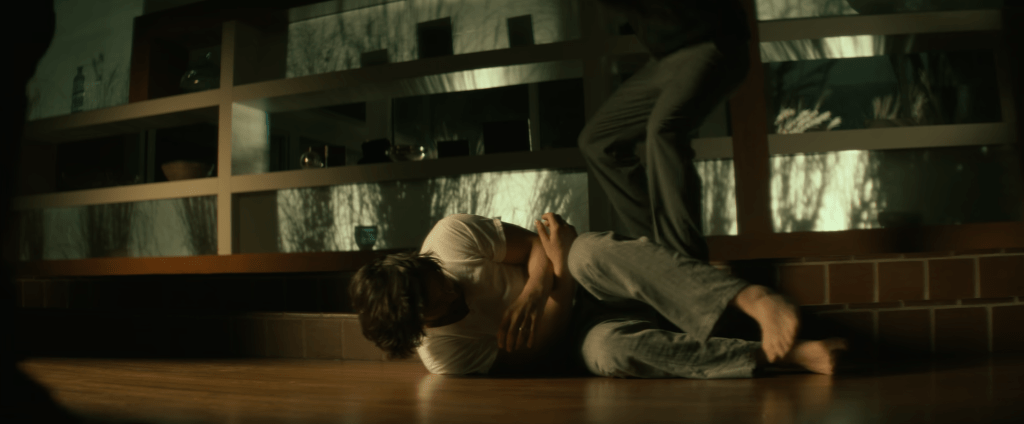
Finally, the use of colour comes into play one more time. Wick meets the Russian gangsters at the gas station and in the next scene, they break into his house, kick the shit out of him, and kill his dog. When this happens, there is still colour in the scene:

The next morning, after Wick buries Daisy, he is cleaning the blood off the floor. With that final remnant of his wife buried in the backyard, the colours are dulled once again:  

There is scene later in the movie when Wick tells the head of the Russian mob that when they killed his dog, they killed the only chance he had at an opportunity to grieve un-alone. That cements for anyone in the audience who didn’t pick up on this colour change an hour earlier, because that had been made clear to us.  

From here on out is where John Wick turns into the action movie we know it to be. There is still a lot of visual storytelling through action sequences, the way scenes are presented, and further use of colour palettes. The reason John Wick can give us 90 minutes of great action sequences is it takes the first nine minutes of the movie to tell us everything we need to know about our main character. The action scenes are what made the John Wick series an extremely successful franchise both financially and critically, but visual storytelling like this is what elevates it from a great action movie to a classic piece of modern filmmaking.

98 Seconds: Visual Storytelling in Rear Window

“Frankly, I hate dialogue.”

That is a quote from director Denis Villeneuve, who is currently on a five-movie run of Sicario, Arrival, Blade Runner 2049, Dune, and Dune: Part Two. He is one of the best in the world at what he does, and, for him, what is on the screen holds weight in a movie, not what is said. It is his opinion, he has certainly earned the right to say that, and perhaps the best movies bring both great visuals and great dialogue. All the same, movies are a visual medium, and dialogue is not necessary, or even desirable, to tell a story.  

Rear Window, the Alfred Hitchcock masterpiece from 1954, has held up for over 70 years for a number of reasons, and one of them is how Hitchcock uses visuals. It isn’t unique to this one Hitchcock movie, but it is one that stands out because of how efficient it is.

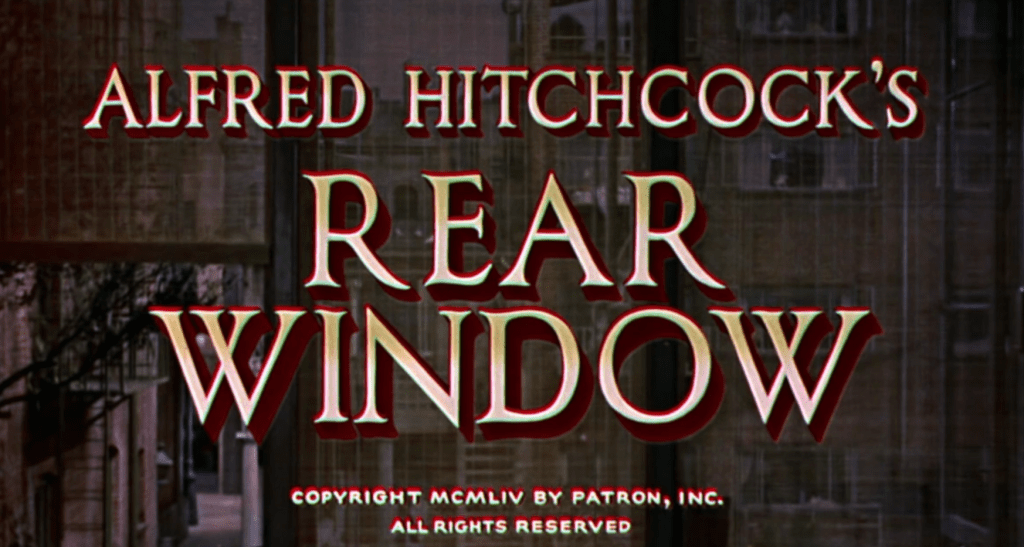
The movie begins with the credits over the titular rear window as the shades are being drawn open, telling us where the movie is taking place:

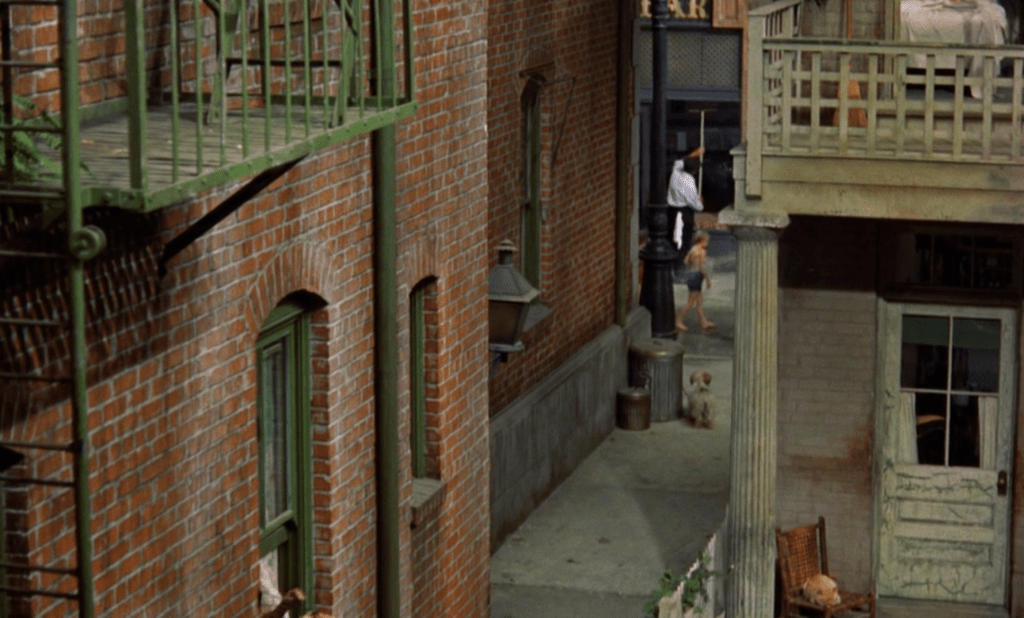
All the credits take a total of 65 seconds to get through, and then the camera slowly moves through the window and pans around the courtyard before bringing us back into the apartment. This takes 55 seconds and establishes both the audience’s point of view (the apartment/rear window) and the stage we’ll be observing (the apartment courtyard). What happens in the next 98 seconds sets up the entire movie. 

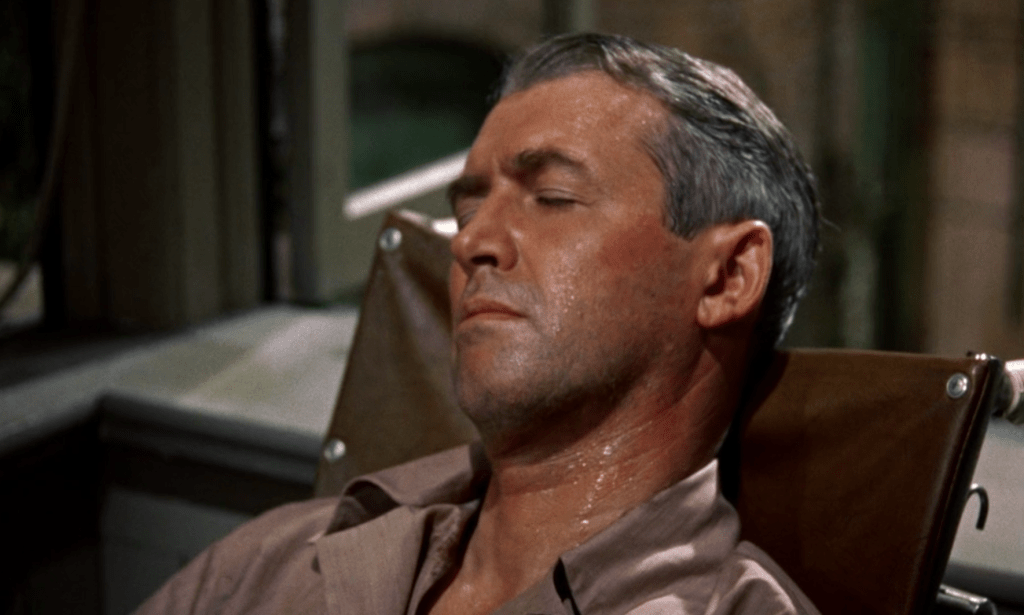
With the surroundings established, the very first shot is of a man who is sleeping with a lot of sweat on his brow:

The camera then cuts to the thermometer, which shows us that the temperature is in the mid-90s:

So, it is a very hot day. The importance is that we know this is a movie from the 1950s that will focus on the goings-on in the apartments surrounding the courtyard, so the neighbours will have their windows and curtains open.

Moving on, the camera pans up to an apartment with a man who is shaving while listening to the radio. On the radio is an advertisement where the voice says, “Men, are you over 40? When you wake up in the morning, do you feel tired and run-down? Do you have that listless feeling…” and then the man turns the dial:

This could just be a random advertisement on a radio that means nothing. However, the entire opening sequence to this point has had music in the background, and the music cuts out as we’re about to get our glimpse of the single man in the apartment.

The music from the soundtrack being cut forces the audience to listen to the radio advertisement, which means it is important to listen to. By the nature of the ad read, the man’s reaction to it, and Hitchcock cutting out the music to get us to hear it, we know this is a man in his 40s who is unhappy with his life in some way. Seeing as the first shot when panning around was of the man sleeping with sweat on his brow, being unhappy in his 40s could apply to him, too.

Moving on, we get to a sleeping couple waking up outside on the fire escape because of the heat:

While it could just help hammer home that it’s hot in the apartments – and it is – this also tells us it’s the morning. In other words, it isn’t mid-90s temperatures at 2 PM, but as the day is starting, so it’s going to get even worse.

After that, we move to the apartment with the blonde woman stretching as she’s making breakfast:

Hitchcock’s affinity for (obsession with?) blonde women aside, these few seconds lets the audience know this woman is at least a dancer of some type, if not a stage performer. Also, that her apartment is in the middle of the frame when looking out Stewart’s window tells us that a blonde woman is at the centre of his life.  

On the transition back inside, we get a quick glimpse of young neighbourhood kids chasing a water truck:

This helps reinforce how hot it is at the time of the morning, driving home that a lot of people in these apartments will have their windows – and thus their curtains – open most of the time.

Now we’ve moved back inside, and we see the same man we saw earlier, and he seems to be in a wheelchair:

Given we’ve seen this man twice, and the director is shooting everything from this apartment, we can assume that this is our protagonist (though anyone who knows who Jimmy Stewart is/was will know that anyway).

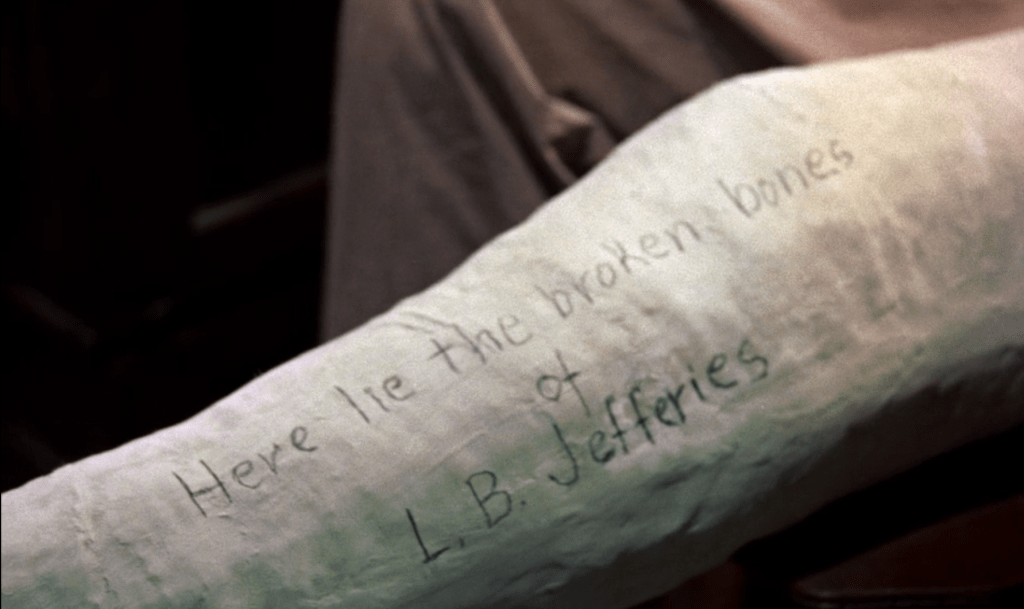
After showing us Stewart again, we pan down to see why he’s in the wheelchair:

That cast not only tells us why he’s in the wheelchair but his name: L.B. Jeffries. Also, because we know it’s the morning thanks to the couple sleeping on the fire escape, we know Jeffries slept in his wheelchair next to the window.

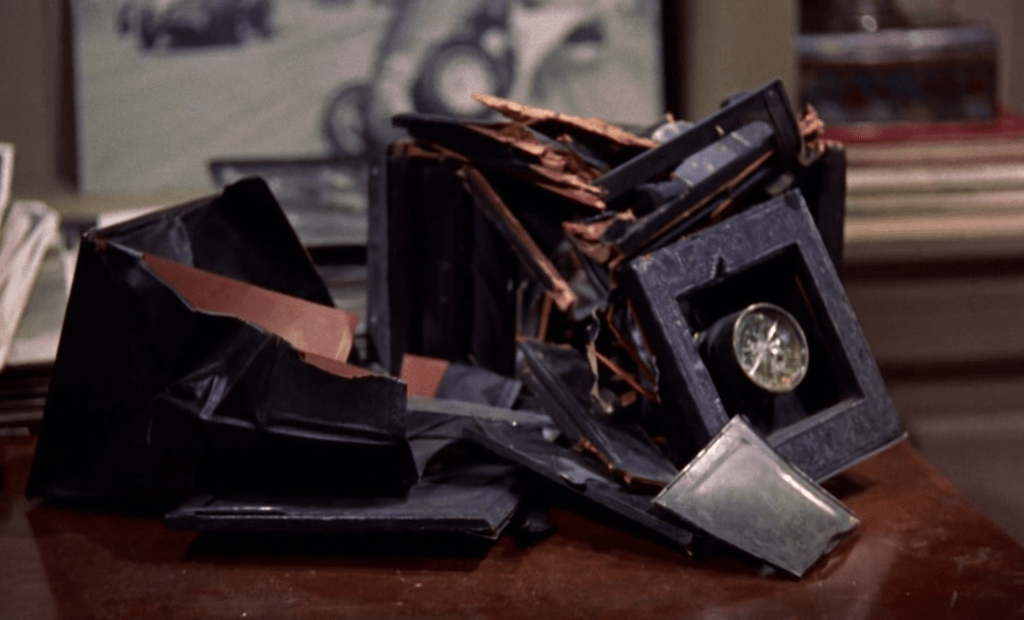
The very next camera movement by Hitchcock is to another camera, this one for photographs, and it’s smashed to hell:

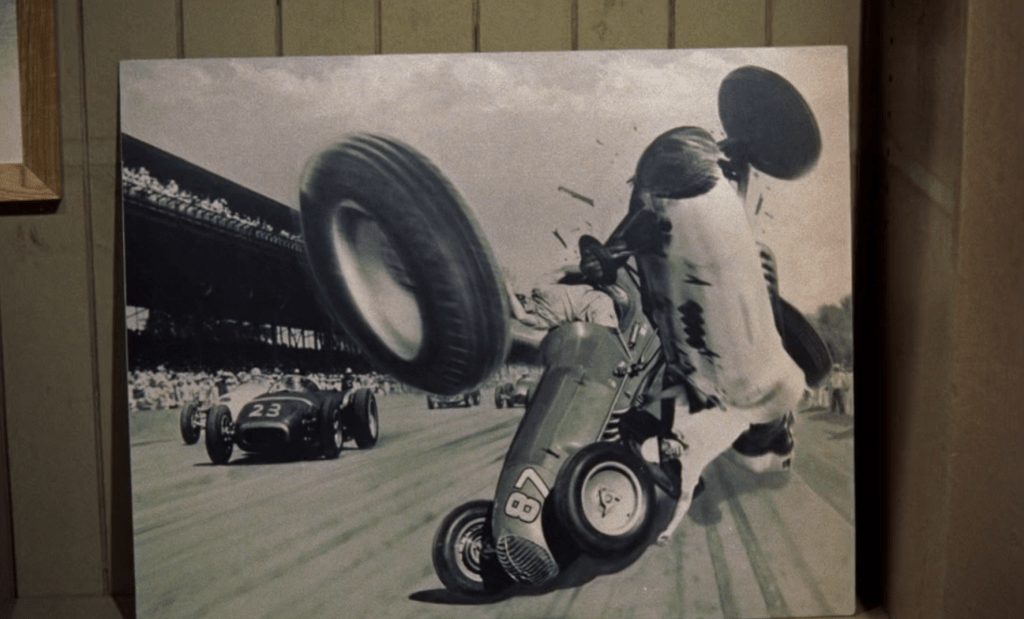
Hitchcock pans up a little bit and we see two racing cars in a mid-crash still shot: 

We have seen Stewart in a wheelchair with a cast on his leg, a broken camera, and a photo of two cars on a racetrack in the midst of a big crash. The inference is that Stewart is a photographer who gets close to the action but paid for it this time with a broken leg.

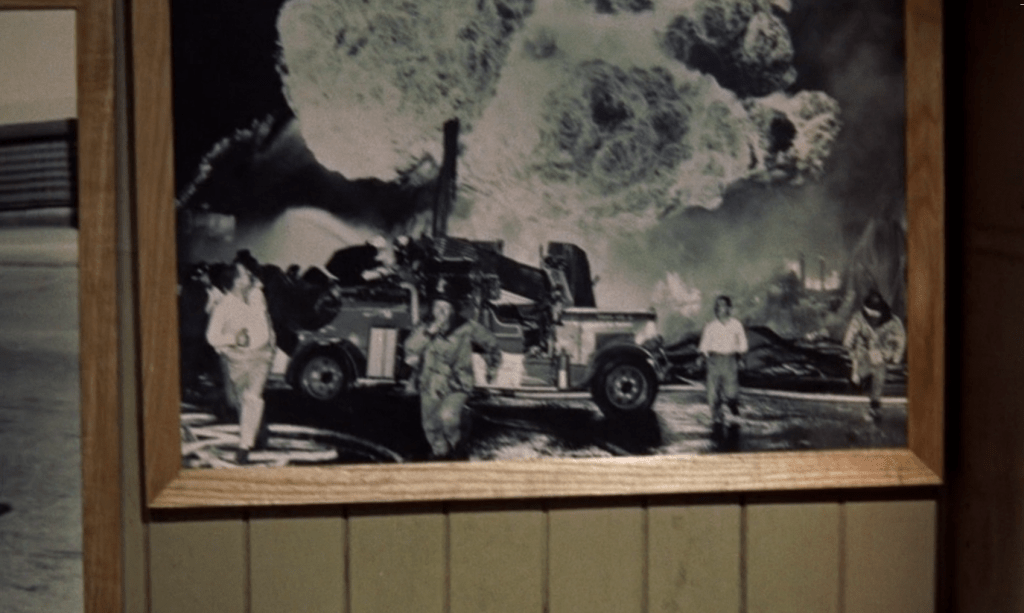
Hitchcock moves the camera upward and we see another photo, this time of a big fire/explosion from which people are running away while Stewart, now established as a photographer, is presumably taking the picture:

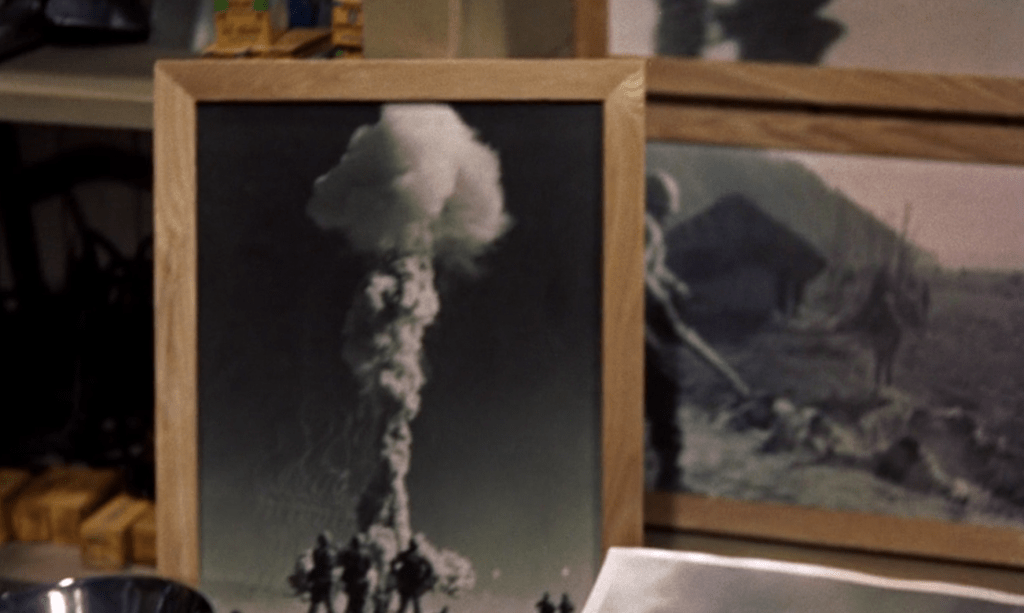
The camera keeps panning over more photos, this time giving us two in one shot with the one on the right being a war zone of some sort (given the era, either Korea or World War 2), and the one on the left appearing to be a bomb test:

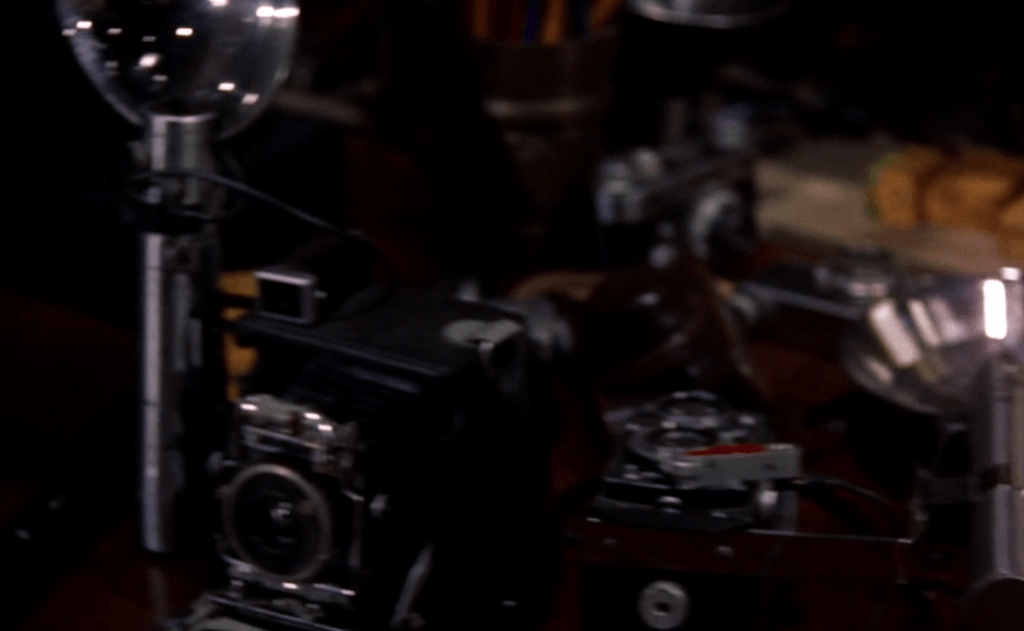
After showing us the photos on his wall, the camera pans over other photography cameras (including one that will show up later):

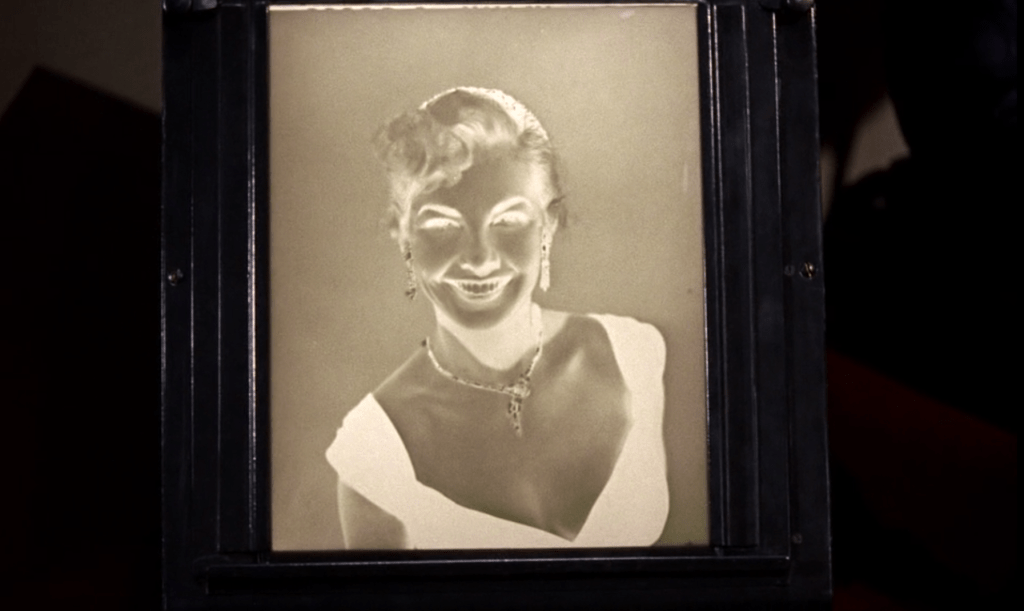
And then settles on the negative photo of a woman in a frame on his table:

All the photos we’ve seen up to this point have been on Stewart’s apartment wall, and all bunched together. This photo, of this woman, is by itself on his table. This photo of this woman isn’t just a snapshot that he took on assignment somewhere – this woman means something to him.

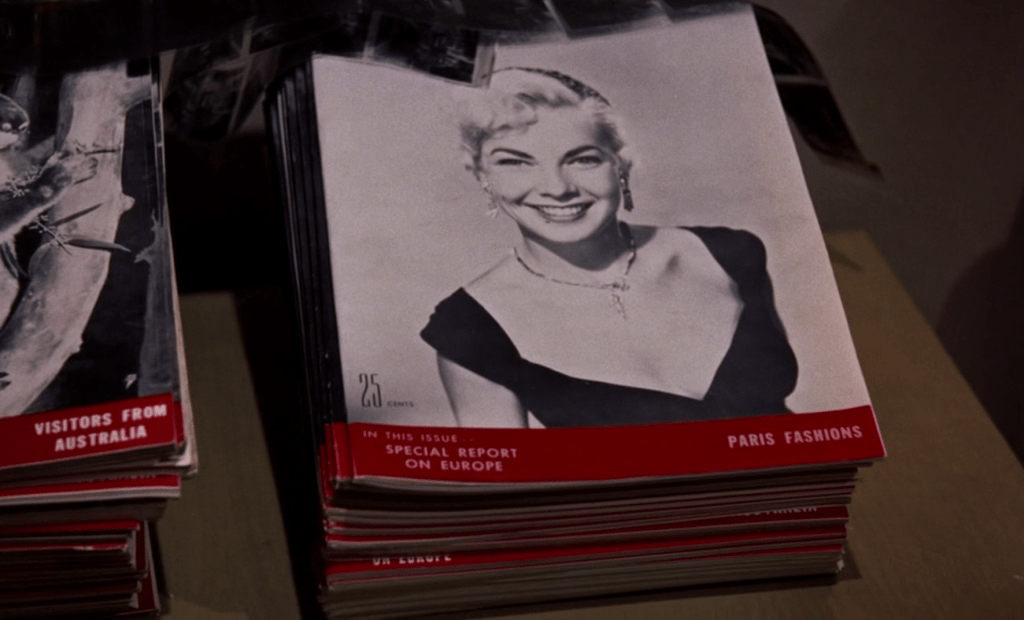
Finally, the next camera movement goes to a stack of magazines, the one on top with Grace Kelly on the cover and ‘Paris Fashions’ on the lower right-hand side:

The cover of the magazine lets us know the woman that we saw in the photo is Grace Kelly’s character (Lisa Fremont). Seeing as this is the 1950s and Stewart’s character is a photographer who likes to get close to the action, it seems unlikely he’d own a bunch of fashion magazines. However, that stack of fashion magazines with the woman at the centre of his life on the cover indicates that he’s buying magazines where she’s writing or contributing in some way.   

From the moment we see Stewart’s character for the first time with all the sweat on his face, to the moment we see Kelly’s character on the cover of the magazine, a total of 98 seconds has elapsed in the movie. Here is what Hitchcock tells us, with absolutely no dialogue from characters, in those 98 seconds:

  • It is blistering hot outside. Because these are small apartments in the 1950s, the people around the courtyard will have the windows/curtains of their apartments open.
  • The man listening to the radio in his apartment, judging by his reaction to the ad about men over 40 years old feeling down, is a man over 40 years old and feeling down. By extension, we can apply this to Stewart’s character.
  • A couple sleeping on the fire escape wake up to an alarm, so we know it’s early in the morning. That the temperature is around 94 degrees this early in the morning tells us it is going to be blistering hot all day.
  • The blonde woman making breakfast is stretching and very limber, so she’s a dancer or stage performer. But that her apartment is in the middle of all the apartments when looking out Stewart’s rear window lets us know a blonde woman is at the centre of his life and this movie.  
  • Stewart is in the apartment where the director’s camera is situated, so he’s our main character. He is also in a wheelchair with a broken leg and his name is L.B. Jeffries.
  • A broken camera with a photo on the wall of two cars in the middle of a big car wreck almost certainly means Stewart’s character is a photographer who was injured while covering that car race a little too closely.
  • More photos on the wall of explosions, fires, and war zones, on top of that car crash, tells us that Stewart’s character isn’t just a photographer who goes anywhere. He is someone who loves action and danger and is willing to put himself at great risk to take these pictures.
  • The lone photo on his table is a blonde woman who, judging by the stack of magazines next to her picture, is a fashion writer and is very special to L.B. Jeffries.

We find out that Stewart is an adrenaline-fueled photographer stuck in a wheelchair with a broken leg who probably isn’t happy with his life right now. He is almost certainly in love with a blonde woman who is at the centre of his life but by his very nature he can’t help but be interested in the strangers (and world) around him. It is also going to be a blistering hot day/week/weekend in the city, so it’ll be easier for Stewart, who is sleeping in his wheelchair at night, to spy on his neighbours.

All this in 98 seconds without a word from an on-screen character.

There is a lot of great dialogue in Rear Window, whether it’s Thelma Ritter’s massage therapist character talking about common sense, or the relationship between Stewart and Kelly itself. All that certainly crackles and helps elevate this movie to an all-time classic. But Hitchcock’s efficiency with establishing everything the audience needs to know about the main characters and the environment around them, in a span of 98 seconds, using nothing but visuals and one radio advertisement, is a big part of what makes this movie an all-time classic. That efficiency helps give room for the movie to breathe, for those subsequent dialogue sequences to be fully-fleshed out, and for us to jump right into the action. It is a movie that holds the audience’s hand and also trusts them to pick up on these visual clues. It has stood the test of time and is a gold standard in visual storytelling.

Five ‘Best’ Movies of 2024

Last year, there were four year-end movie posts on this blog: One for the ‘best’ movies of 2023, one for favourite movies of 2023, one for best pre-2023 movies I watched in 2023, and one for favourite pre-2023 movies I watched in 2023. We are doing the same thing for 2024, and today’s edition is the ‘best’ movies of the year.

When it comes to discerning between ‘best’ and ‘favourite’, there is sometimes an overlap. However, I think there are movies that are excellent (for technical reasons, for writing, for acting, or usually a combination of the three) that I likely wouldn’t spend a Friday night to sit down and re-watch, and those are the ‘best’. Then there are movies where I would absolutely throw on for a re-watch at midnight when I just want to enjoy relax, and those are ‘favourites’. Clear? Hope so.

The five ‘best’ movies released before 2024 that I watched this year was already covered, as was my five ‘favourite’ movies released before 2024. We recently went over my ‘favourite’ movies of 2024, too.

A quick note: there are a handful of movies I haven’t had a chance to see. The local movie theatre generally only shows blockbuster-type movies, so there a lot of smaller films that haven’t been sent to streaming/on-demand yet which I haven’t been able to enjoy. For example, The Brutalist and Sing Sing weren’t released here. This list is incomplete, but when it also gives them a chance to be recognized in next year’s column of pre-2025 movies.

Are we all set? Great. In no particular order, here are what I thought were the five best movies from 2024 with a handful of honourable mentions at the end.

The Substance

Director: Coralie Fargaet

Starring: Demi Moore, Margaret Qualley

This movie appeared in the ‘Honourable Mentions’ section of my favourite movies, but this was unquestionably one of the best movies I saw from 2024. As mentioned in that earlier post, this movie features Moore’s character (Elisabeth) as an aging TV star who is being replaced by a younger option. When in a hospital, she is told of a mysterious substance that can produce a younger version of herself. Elisabeth takes the bait, but what she doesn’t realize is the younger version is literally spawned from her own body, creating a duplicate. The two halves cannot exist at the same time, so they take turns as one lives in the real world while the other is locked in a bathroom just laying on the floor, alive but unable to move.  

As one can imagine, the tension grows between the two halves as both want to continue living their lives and that tension is what propels the movie. The overarching theme of beauty standards in Hollywood (and for women in general) is apparent throughout, but it also delves into what we do today borrowing from tomorrow, as well as the unceasing march of time. This is a body-horror movie, and a particularly gruesome one at that. It won’t play well for all audiences, but the directing, performances, and effects all align for a tremendous feature.

Major awards shows typically don’t favour horror movies, so this is unlikely to garner the attention it should, but there were very few movies that had an impact on me like ‘The Substance’ did. While this is from a woman’s perspective, there are themes that apply to everyone, and that’s what elevates it from a specific genre to a wide-audience appeal.

Red Rooms

Director: Pascal Plante

Starring: Juliette Gariépy, Laurie Babin

This was also in the ‘Honourable Mentions’ section of my favourite movies, and while I did enjoy it tremendously, the difficult subject matter is what kept it from being one of my truly favourite movies of the year. By the same token, that subject matter is what made it one of the best movies of the year, and one that cannot be recommended enough.

In this story, the characters of Kelly-Anne (Gariépy) and Clémentine (Babin) are two women obsessed with a murder trial in Québec, Canada. It is a particularly vicious murder trial as the accused is a man who abducted high school girls and then auctioned off internet streams of their severe torture and subsequent murder. The women both appear to think that the man is being falsely accused and there is a lot of tension between them and the case, the parents of the deceased children and those women, as well as within themselves. It is a brutal look at obsession and the disassociation that goes along with that level of obsession.

To be clear: Not everyone will appreciate, let alone enjoy, this movie. It is not an easy watch, and has a couple of scenes that will churn the sternest of stomachs. But it is incredibly well-made, well-acted, and has timely themes running throughout. It is a small, French-Canadian movie, but one of the best of 2024. 

Society of the Snow

Director: J.A. Bayona

Starring: Enzo Vogrinic, Matias Recalt

Society of the Snow was technically released at the end of 2023 but in a limited fashion before being released to the wider public on streaming in early January of 2024, so that’s why it finds its way here.

This movie is a re-telling of the Uruguayan soccer team whose plane crashed in the Andes mountains in 1972. Some people may be familiar with the movie Alive from 1993 which covered the same story, but this version takes it to a whole other level.

There are few movies that can pull off two polar extremes in the same film with such a deft touch, but this one does exactly that. It shows the extreme some of the players had to go through to stay alive in order to be rescued, and that includes cannibalism. It also shows them working together to try and survive, a remnant of their time together as sports teammates and friends. It doesn’t have its tougher spots glossed-up as can happen with Hollywood-produced movies, which is what makes this Spanish production a difficult, yet triumphant watch.

Another movie that falls in the “not for everyone” bucket, Society of the Snow shows the range of (in)humanity we possess in the direst situations, and the performances match that difficult theme. It is a long movie, but not a slow movie, and one of the best of the year.  

Dune Part 2

Director: Denis Villeneuve    

Starring: Timothée Chalamet, Zendaya

Sometimes, a movie with a big budget, marquee director, and great cast that makes a lot of money at the box office really is that good. We saw that with Oppenheimer in 2023, and we saw it again with Dune Part 2 in 2024.

Having re-watched this recently, what stood out was how it improved on everything the first instalment did well. The set pieces were bigger and more dramatic, the performances were tremendous across the board, the world was expanded, and it was visually stunning at nearly every turn. It told the story through what we saw on the screen, and not necessarily what was spoken by the characters, and that is the mark of a wildly successful cinematic experience. This was in my ‘Favourites of 2024’ column, and in it the part where Paul Atreides rides the sand worm was mentioned. That is still one of the best moments I’ve had in a movie theatre in recent memory.

Aside from what an achievement this was as a film, it will also be a movie that is looked back on in 20 years that announced the next generation of great actors. Chalamet, Zendaya, Florence Pugh, and Austin Butler were all outstanding, and it really does feel like a baton-passing moment for Hollywood. It sets a high bar for the third edition, whenever that comes, but this is a near-perfect movie on its own.

Anora

Director: Sean Baker

Starring: Mikey Madison, Mark Edelshteyn

This is another movie that updates a classic as Anora is a modern riff on Pretty Woman where Madison’s character (Anora) is an exotic dancer/sex worker who becomes entwined with a wealthy, young Russian man named Ivan (Edelshteyn’s character). One thing leads to another, they get married, and then things really take off.

While this may riff on Pretty Woman, this isn’t an early-90s rom-com. This is a movie that investigates a lot of themes, particularly for American audiences, ranging from foreign economic pressure, to the ability of the lower class to rise up the ladder, to internal desire for a change in circumstances (and all that goes along with following through), among others. It also does a very good job at blending genres, fluidly moving between a rom-com, a thriller, a drama, and often a meld of the three. Sometimes, small Movie Festival entries are overrated, especially to wider audiences – Anora is definitely not one of them.

The one thing that bothered me is that it is a 140-minute runtime and it’s clear where this is going about 30 minutes in. What helps me overlook that is that Madison’s performance is legitimately one of the best of the year, the middle-third of the movie plays almost like a slapstick comedy, and it is beautifully shot and written. It doesn’t feel slow at any point and is genuinely one of the best of 2024.

*

Okay, those are at the top, so let’s get to some honourable mentions.

Furiosa: A Mad Max Saga

Director: George Miller

Starring: Anya Taylor-Joy, Chris Hemsworth

To be clear: this is an expertly made film that has a few exhilarating sequences like the opening motorcycle chase, the attack on Gastown, and the War Rig fight. It is not a slow movie and Taylor-Joy and Hemsworth provide polar-opposite performances that complement each other very well. All the same, it’s hard to not compare it to Fury Road, which might be the most well-made movie of the 21st century. It is a notch below its predecessor, where Dune Part 2 improved on its first outing.

Juror #2

Director: Clint Eastwood

Starring: Nicholas Hoult, Toni Collette

It is a shame this was sent straight to streaming (it had an extremely limited theatrical release). It feels like a movie that is so good that it would have had legs for a long(ish) run in cinemas, but I digress. This is a different vision on the classic 12 Angry Men formula about how a single juror can change the mind of an entire jury, but the key twist is shown early on, and that provides the tension that is maintained throughout the film. This is truly one of the best dramas of the year, and one of Eastwood’s best movies since Million Dollar Baby.

The Fall Guy

Director: David Leitch

Starring: Ryan Gosling, Emily Blunt

Ever want to watch a well-made action movie that is funny throughout? This is the one. It plays as an ode to stunt performers and a lot of the stunts are practically done, which gives the film a feel that a lot of modern action movies do not. Add that to charming and funny performances from both Gosling and Blunt, and this might be the most enjoyable popcorn flick of the year. It is great to just throw on, enjoy for two hours, and then never think of again. I want to say that we should get more movies like this, but it’s hard to say if that’ll be the case.

Nosferatu

Director: Robert Eggers

Starring: Bill Skarsgård, Lily-Rose Depp

A re-telling/re-imagining/not-quite-either of the classic vampire movie, Nosferatu is a stunning movie. Everything from the performances from Depp and Skarsgård, to the way it’s shot by Eggers, to the switch of colour palettes, to the excruciating(ly good) sound design, this is a true cinematic experience. A bit of the story can fall a little flat, which is why this didn’t make it into my top-5, but it is unquestionably one of the best movies to see on a big screen from 2024. This would have made it to my honourable mentions list for ‘favourite of 2024’ had I seen it sooner than the very end of December.

Challengers

Director: Luca Guadagnino

Starring: Zendaya, Josh O’Connor

Sometimes, you do ‘have to hand it to them’. While romantic dramas are typically not my flavour of movie, the narrative structure of Challengers helps provide the tension that holds from beginning to end, and the performances from the three leads (the two named plus Mike Faist) carry an excellent film. The soundtrack is one of the most memorable of the year and helps provide another dimension to a movie that has a lot of them already. It was a good year for Zendaya, and it started with this.

Rebel Ridge

Director: Jeremy Saulnier

Starring: Aaron Pierre, Don Johnson

If Juror #2 is a successful update on 12 Angry Men, then Rebel Ridge is a successful update of Rambo. It features Pierre’s character (Terry) who heads to a small town with a bag of cash to post bail for his cousin. He is pulled over on his bike by the police, who seize his money in a civil forfeiture situation. After some shenanigans from the cops regarding bail and prison transfers, things eventually escalate to the point where Terry and the police are embroiled in a battle that goes far beyond just Terry’s current situation. It expertly covers a very real situation too many people find themselves in, and Pierre’s performance carries the weight of the movie.

Civil War

Director: Alex Garland

Starring: Kirsten Dunst, Cailee Spaney

This was included in my ‘favourites of 2024’, and it holds up as one of the best of the year, too. We won’t go long here because it was already covered in that prior post, but I think we’ll look back in 10 years and wonder why this movie didn’t get more love from both critics and audiences.

Woman of the Hour

Director: Anna Kendrick

Starring: Anna Kendrick, Daniel Alcala

This was also on the ‘favourites of 2024’ list so again, we won’t have a big discussion here. But this real-life story about the serial killer that went on ‘The Dating Game’ television show is a tense 90-minute thriller that was very well done. It is one of those movies that makes you want to see what Kendrick does next.

In A Violent Nature

Director: Chris Nash

Starring: Ry Barrett, Andrea Pavlovic

A third movie that was featured in my ‘favourites of 2024’ column, this is a Teenager Campers Get Terrorized And Murdered By A Supernatural Being movie. Those have been done to death (pun!), but this is a fresh twist on that familiar trope and is one of the best horror movies of the last couple of years.

Five ‘Favourite’ Movies of 2024

Last year, there were four year-end movie posts here: One for the ‘best’ movies of 2023, one for favourite movies of 2023, one for best pre-2023 movies I watched in 2023, and one for favourite pre-2023 movies I watched in 2023. We are doing the same thing for 2024, and today’s edition is ‘favourite’ movies of 2024.   

When it comes to discerning between ‘best’ and ‘favourite’, there is sometimes an overlap. However, I think there are movies that are excellent (for technical reasons, for writing, for acting, or usually a combination of the three) that I likely wouldn’t spend a Friday night to sit down and re-watch, and those are the ‘best’. Then there are movies where I would absolutely throw on for a re-watch at midnight when I just want to enjoy myself, and those are ‘favourites’. Clear? Hope so.

The five ‘best’ movies released before 2024 that I watched this year was already covered, as was my five ‘favourite’ movies released before 2024. Today, we’re going to cover my five ‘favourite’ movies from 2024 proper.

A quick note: there are a handful of movies I really haven’t had a chance to see. The local movie theatre generally only shows blockbuster-type movies, so there a lot of smaller films that haven’t been sent to streaming/on-demand yet that I haven’t been able to enjoy. For example, movies like Anora and The Brutalist weren’t/aren’t going to be released here, while there are a few that hopefully make their way in the next two weeks like Nosferatu, A Complete Unknown, and Babygirl. This list is incomplete, but when it also gives them a chance to be recognized in next year’s column of pre-2025 movies.

Are we all set? Great. Here are my five favourite movies from 2024 in no particular order.

Civil War

Starring: Kirsten Dunst, Cailee Spaney

Director: Alex Garland

In fairness, this was one of the movies I was looking forward to most in 2024, and it delivered. The short of it is that this is set in near-future America that has devolved into a civil war separated by territories like the West, a Florida alliance, an area that covers much of the north/northeast, and so on. It follows a group of journalists who make their way to Washington, D.C. in anticipation of the tyrannical government and President being deposed by these forces, and all the brutality that they see on their trip. It features arguably one of the most tense scenes in any movie this year when they stumbled upon a small cadre of soldiers who are literally filling up a mass grave.  

Once in a while, there is a movie that comes along that grabs you by the throat and doesn’t let go for two hours – Civil War is exactly that. It not only envisions what a breakdown like this would resemble, but also the role the media has in not only covering these events, but also feeding into the worst side of humanity while doing it. The connection, or, rather, the disconnection between the media’s humanity and their desire to cover such an inhuman circumstance is at the centre of this movie, and it’s hard to think of a recent example that does it as well as this movie does.

It isn’t a joyful experience, but it is an incredibly well-made, well-acted, and taught thriller/drama that keeps your nails dug into your seat. It is one of the few movies from this year that I’ve already made a point to re-watch and could see myself doing so again soon.

Alien: Romulus

Starring: Cailee Spaney, David Jonsson

Director: Fede Álvarez

The first Alien movie in seven years brings the franchise back to its roots, which is effectively a group of people in space trapped on a ship that has our titular aliens roaming about. This isn’t like recent Prometheus/Covenant entries that focus more on origins and existentialism, but simply plays more like a haunted house movie where a group of young people steal a ship to try and escape their dreary lives on a mining planet, and then find this ship has alien life forms that want to kill them all.

There are two things that work well about this movie. First, the fact that so much of it uses practical effects rather than leaning into computer graphics makes it feel grounded. It is easy for science-fiction filmmakers to get caught up in trying to look science-fiction-y and forgetting they are making a movie. The real sets, the (mostly) practical aliens, and so on make it feel like a true horror movie set in space rather than a computer game.

The second thing is the acting. Spaney is great in this, as she was in Civil War, but Jonsson is one of the stand-out performers not only of this movie, but of the year. He plays a synthetic robot/human, and he has to span a lot of emotions, ticks, and deliveries as his character (d)evolves. He brings the movie from Very Good to Excellent.

Romulus was a critical success, a commercial success, and an exciting re-entry to the Alien world. Some of the easter eggs/callbacks bothered some people, but not me because they largely served a purpose in the movie besides ‘hey did you see that in the background?’ From the directing, to the story, to the acting, to the effects, all worked together in a delightful, if terrifying, symphony.

Terrifier 3

Starring: Lauren LaVera, David Howard Thornton

Director: Damien Leone

The second edition of this series was in my column on favourite pre-2024 movies, and now the third one is feature here. For the uninitiated, Terrifier is a horror movie franchise that started as part of an anthology over a decade ago, but has now evolved into three films that have been growing in grandeur with each entry: The first movie was reportedly made on a budget of around $50,000 that was crowdfunded, the second had a budget of $250,000, and this third one was up to $2 million. The series has now grossed over $100 million at the box office in total.

Art The Clown is the villain of this movie, which is set at Christmastime as LaVera’s character (Sienna) is released from a mental hospital following her showdown with Art at the end of the second movie. The hook is that Art is a supernatural clown that takes great pleasure in not just murdering his victims, but torturing them both physically and psychologically, often to great lengths, and sometimes simultaneously. Each movie is wildly violent and frequently, erm, terrifying, and each movie usually features one set piece that really stands out from the rest in terms of its outlandish grotesqueness. Terrifier 3 might feature two of them, depending on what bothers you the most to see on a movie screen.  

Leone, as the director, clearly is saying something about the audience given the over-the-top violence perpetrated by a clown named Art, but the audiences love it, and so do I. This is definitely not a horror movie for anyone bordering on squeamish, but it is superbly made using mostly practical effects, which seems impossible with their level of financing, but they always pull it off – it looks like a $40 million horror movie on a fraction of the budget. The story is good, the acting is great, and the kill sequences are amazing. Not much more we can ask for from a horror movie.

MadS

Starring: Lucille Guillaume, Milton Riche

Director: David Moreau

Sometimes, a movie you’ve never heard of, thus for which you had no expectations, absolutely bowls you over, and that’s what MadS did to me. Maybe because it is a French film that went straight to streaming (I think it can be rented on Amazon but it was released on Shudder), it didn’t seem to get much traction online, but this was arguably the best, and my favourite, horror movie from 2024.

MadS was shot in one long, continuous 90-minute take with no cuts (for real). The entire film occurs in that 90-minute span, so it grabs your attention about five minutes in and holds your attention throughout.

It all starts with Riche’s character (Romain, a wealthy teenager) buying drugs from a dealer, and then driving off. A couple minutes later, he sees a woman on the side of the road who seems hurt, so he stops for her, and she jumps in the car. She is unable to speak, has a tape recorder on her saying she has some sort of virus, and is clearly in a lot of distress, but Romain is freaking out and doesn’t understand what she’s trying to explain. One thing leads to another, and she bashes her own head in until she dies, but Romain can’t go to the police because of the drugs in his car, so he goes home. The sickness is passed on to Romain and it acts as sort of a zombie-type virus. It takes time for the effects to present themselves, so Romain goes to a birthday party where he starts to lose his mind, growing increasingly agitated and violent, and he spreads the virus to other partygoers, including his ex-girlfriend. Things continue from there as the virus starts spreading around their town and the army gets called in, devolving into utter chaos.

It is hard to overstate how much I loved this movie. A genuine one-take movie that is so well choreographed, so tense, and so well-acted seems impossible, but Moreau pulled it off. One of the best horror movies of the last five years.

Woman of the Hour

Starring: Anna Kendrick, Daniel Zovatto

Director: Anna Kendrick

Rarely does a movie with a lot of hype live up to that hype, but Kendrick’s debut as a director does exactly that. Like MadS, it is a crisp 90-minute movie that doesn’t take many detours and that helps hold the audience’s attention from start to finish. There is no bloat here, or unnecessary flashbacks, or anything of the sort. Everything in the movie serves a purpose, so while it is short by contemporary standards, it is by no means unfulfilling.

Woman of the Hour is based on the true story of Zovatto’s character (Rodney) who was a serial killer in the 1970s and appeared on the television show ‘The Dating Game’. Yes, that really happened: A serial killer in the middle of his killing spree took some time to go on ‘The Dating Game’. It is a wild world in which we live.

Kendrick’s character (Sheryl) is an aspiring actress in Los Angeles who accepts a job to go on ‘The Dating Game’ as the woman interviewing the men. Long story short, but she makes a connection with serial-killing Rodney, and they go on a date after the show. The story revolves not only around Rodney’s killing/raping spree, but Sheryl’s experience trying to make it as an actress in the 1970s, and how all of this intersects. It is easy for a movie with these themes to feel heavy-handed, but Kendrick handles it deftly, which is why it works so well.

Using the true story as a base, while also expanding the themes, makes Woman of the Hour feel like a complete movie that is dramatic, tense, and has a point of view without coming off as preachy. If this is Kendrick’s debut as a director, it’s exciting to think of where she’ll be five movies from now.

Some Honourable Mentions

The movie year of 2024 was good, not great, but there were a lot of movies that stood out to me as both very good, and very re-watchable. Let’s touch on seven of those quickly.

The Piano Lesson

Starring: John David Washington, Danielle Deadwyler

Director: Malcolm Washington

An adaptation of a play from the 1980s that is set during the Great Depression, it is (mostly) a one-room drama about a Black family’s connection (or lack thereof) to a piano, and their family’s history. It isn’t a straight-forward drama that has been typical Oscar bait over the last decade (or more), which is why it stands out so well. The acting alone is worth the watch, and Deadwyler turns in one of the best performances of the year.  

Dune: Part 2

Starring: Timothée Chalamet, Zendaya

Director: Denis Villeneuve

This one probably doesn’t need much introduction as it was one of the biggest movies of 2024, and the second in a trilogy that started in 2021. The turn of Chalamet’s character (Paul Atreides) through the film goes very well in tandem with the exceptional set pieces directed by Villeneuve – Paul riding the giant sand worm was legitimately one of my favourite cinema-going experiences of the year, if not my absolute favourite.

Red Rooms

Starring: Juliette Gariépy, Laurie Babin

Director: Pascal Plante

A French-Canadian movie about two women who closely follow a grisly murder case in Québec, and are unhealthily obsessed with the murderer, Red Rooms was one of the most unpleasant movies of the year, but in a good (bad?) way. It is about the obsession with true crime, obsession in general, and how the modern world can disconnect us from our humanity. Gariépy is outstanding and this is another one of the great thriller-dramas of 2024.

City Hunter

Starring: Ryôhei Suzuki, Misato Morita

Ever want to watch an action movie that both feels modern in the way it is shot/choreographed, but also a throwback to the action movies from the 1980s-1990s heyday? Look no further. It might not pass for all audiences (it is based on a manga that hyper-sexualizes some of the women), but it is genuinely just a lot of fun with good action sequences. An enjoyable way to spend 100 minutes with your brain shut off.
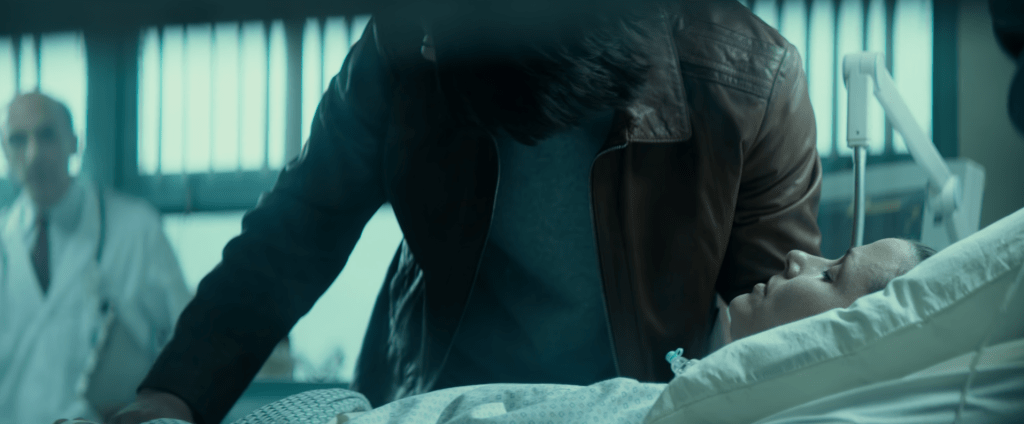
In A Violent Nature

Starring: Ry Barrett, Andrea Pavlovic

Director: Chris Nash

Another Canadian entry, In A Violent Nature was one of my most anticipated horror movies of 2024, and it did not disappoint. Were it not for MadS, then this would be the most inventive horror movie of the year. In A Violent Nature is a standard ‘vengeful spirit returns from the dead to hunt teens in the woods’ setup, but the hook is that almost the entire movie is shot from the killer’s point of view, kind of like a video game. It also features arguably the most grisly kill scene in any movie from 2024, which is saying something considering Terrifier 3 exists. Canadian horror movies have been on a big upswing in recent years.

The Substance

Starring: Demi Moore, Margaret Qualley

Director: Coralie Fargeat

This will probably show up on my ‘Best of 2024’ list, because it was probably the best movie I saw this year. The Substance features Moore’s character (Elisabeth) as an aging television star who is being replaced, but she finds out about this substance that can make her young again. The hook is that the substance makes a double of her, and that double wants to effectively take over her life. It revolves around the theme of beauty standards for women, and how we borrow from tomorrow to pay for today, but holds up as one of the most effective body-horror films of the century.

My Old Ass

Starring: Maisy Stella, Aubrey Plaza

Director: Megan Park

My Old Ass has a simple premise: What if you could talk to an older, future version of yourself? What would you ask them, what would you want to know, and (importantly) what wouldn’t you want to know? This was way, way more heartfelt than I was expecting, and it just struck me in a way few other movies from 2024 did. It is billed as a coming-of-age comedy-drama, but works as well for 18-year-olds as it does 38-year-olds.  

Five ‘Favourite’ Pre-2024 Movies I Watched In 2024

Last year, there were four year-end movie posts: one for the ‘best’ movies of 2023, one for favourite movies of 2023, one for best pre-2023 movies I watched in 2023, and one for favourite pre-2023 movies I watched in 2023. We are going to do the same thing for 2024, and today we’ll move to my five ‘favourite’ movies I watched in 2024 that were released before this year. Go check out the post on my five ‘best’ movies I watched in 2024 that were released prior to this year.

When it comes to discerning between ‘best’ and ‘favourite’, there is sometimes an overlap. However, I think there are movies that are excellent (for technical reasons, for writing, for acting, or usually a combination of the three) that I likely wouldn’t spend a Friday night to sit down and re-watch, and those are the ‘best’. Then there are movies where I would absolutely throw on for a re-watch at midnight when I just want to enjoy myself, and those are ‘favourites’. Clear? Hope so.

Anyway, here are my five favourite movies I watched in 2024 that were released before 2024.

Mad Heidi (Action/Comedy, 2022)

Starring: Alice Lucy, Casper Van Dien

Director: Johannen Hartmann

Ever put on a movie based on its premise, it’s not what you thought it’d be, and it’s even better than you could have imagined? That is ‘Mad Heidi’.

I am a fan of revenge action movies, so when I saw the premise of this movie – a girlfriend goes on a revenge mission to kill the people who killed her boyfriend – I was in. But it’s much zanier than that: This movie takes place in a fictional dystopian Switzerland where the government is a narco-bureaucracy, but instead of drugs, it’s cheese. They are a cheese cartel and bring the hammer down on anyone caught illegally trading. They bring the hammer down on Heidi’s boyfriend, so she plots and executes her revenge.

It is even crazier than I’m making it out to be – at one point, Heidi says, “Yodel me this,” as she stabs some guy in the balls. She kills another man with an accordion. It is absolutely batshit in the most perfect way and was one of the most pleasantly surprising movies in recent memory.

If you have 90 minutes some night, and are looking for mindless fun, this is (was?) on Prime. It is completely absurd, but it knows it’s absurd, and that’s what makes it work so well.

Roman Holiday (Comedy/Romance, 1953)

Starring: Audrey Hepburn, Gregory Peck

Director: William Wyler

In a typical setup from this era of Hollywood, Hepburn’s character (Ann) is a princess from a non-specified European country. Bored of her life, she escapes her confines one night, falls asleep in public, and is found by Peck’s character (Joe Bradley). He doesn’t recognize her at first, but when he does, he realizes he could have the scoop/interview of a lifetime. The rest of the movie is a metaphorical (and sometimes actual) dance between Ann and Joe as he shifts between a reporter trying to get an interview and a guy falling in love with his subject while Ann tries to enjoy a life outside of her royal duties. 

Listen, I’m a sucker for movies set in old European cities, and I’m a sucker for romantic comedies from the post-WW2/pre-Vietnam War era. Put them together, and here we are. The way that Ann’s characteristics bleed into Joe’s, and vice versa, is a prime example of how two people can have a profound impact on each other in such a short period, and the performances from Hepburn and Peck are, erm, impeccable. It is a gold standard for romcoms, and holds up as well today as it did 70 years ago.   

Audition (Horror, 1999)

Starring: Ryo Ishibashi, Eihi Shiina

Director: Takashi Miike

There is an odd premise to ‘Audition’ but the idea behind that story is an interesting one. In short, Ishibashi’s character (Shigeharu Aoyama) is a middle-aged man whose wife dies at the beginning of the movie. Years later, at the urging of his son, he tries to start dating again. That is when he concocts a pretty bad idea: He and a film-producing friend set up an audition for a movie that will never get made with the real purpose of finding another (younger) wife for Shigeharu. One of the women auditioning is Shiina’s character (Asami Yamazaki), and Shigeharu falls hard for her immediately.

As the movie wears on, Asami’s story starts to come apart. Her former music producer is missing, Shigeharu finds her former place of employment the scene of a murder, she disappears after they take a vacation together, and so on. We eventually find out Asami’s backstory (hint: It’s very unpleasant) and this is where the movie takes a hard turn into the horror. We won’t spoil the second half of the film here, but it’s safe to say Asami is absolutely not who Shigeharu thought she was.

The idea of this movie comes down to this: At what point is a transgression worthy of not only some type of revenge, but death. The final act is brutal and tense. It is a near-perfect horror movie from start to finish.  

Terrifier 2 (Horror, 2022)

Starring: Lauren LaVera, David Howard Thornton

Director: Damien Leone

Full disclosure: I had never heard of the ‘Terrifier’ series until this year. I have now seen all three instalments. Where to begin.

The original ‘Terrifier’ movie introduces (or re-introduces, as he was in an anthology film years ago) Art The Clown, a psychotic, other-worldly clown that not only hunts and murders his victims, but goes to extreme (and extremely gruesome) lengths to torture them. The second instalment picks up where the first left off as Art is revived and goes back on a killing spree. LaVera’s character (Sienna Shaw) and her brother Jonathan (played by Elliott Fulham) are the targets for Art, but there is a high body count in between him and them.

This movie is, and I cannot stress this enough, not for people who dislike gory horror movies; there is one murder sequence that is about the most graphic and horrific I have ever seen, and I have seen hundreds of horror movies. I do enjoy these types of films, which might make me part of the problem (the hyper-violent murder-clown is named ‘Art’ for a reason). Whatever.

Despite being on a low budget (reported at $200K), this looks like a movie with a $20M budget, if not more; all the effects are practical, and are very, very well done. The story might strain credulity, but we’re talking about a near-impervious supernatural clown that, at one point, rips someone’s hand in half, so how much that credulity can be strained is a fair question. The ‘Terrifier’ series is probably the best violence-driven horror series since the first few ‘Saw’ movies, and this is its best entry.

Poor Things (Comedy/Sci-Fi, 2023)

Starring: Emma Stone, Mark Ruffalo

Director: Yorgos Lanthimos

This came out in 2023 but wasn’t released at my local theatre, and wasn’t on streaming until well into 2024. Such is life.

‘Poor Things’ has an absolutely wild premise: Stone’s character (Bella Baxter) is a Frankenstein’s Monster-like person created by a mad scientist (Willem Dafoe as Godwin Baxter) in Victorian London (unspecified, but sometime in the mid-to-late 1800s). She is brought to life in an adult body but has a child’s mind, so the hook here is what a person would act like if they had the body of a 30-year-old but the mind of a 5-year-old. And then, what would that person act like as their mind rapidly matures, catching up to their physical appearance.

Bella is brought on a vacation by Ruffalo’s character (Duncan Wedderburn) and the sheer number of laugh-out-loud sequences makes the entire movie worth it (the dinner scene on the boat in particular). It doesn’t always play for laughs, and it can get a bit weird, but there are enough twists to keep audiences guessing as to where it’s all going, and the movie is anchored by an all-time performance from Stone.

The weirdness and themes of the movie might put some people off, but the sets are vivid, the directing is aces, the performances (particularly Stone) are phenomenal, and the story resolves very well. Like ‘Mulholland Drive’ in my previous post, the nature of the filmmaking might not be for everyone, but this was exquisite from start to finish.

Five ‘Best’ Pre-2024 Movies I Watched In 2024

Last year, there were four year-end movie posts: one for the ‘best’ movies of 2023, one for favourite movies of 2023, one for best pre-2023 movies I watched in 2023, and one for favourite pre-2023 movies I watched in 2023. We are going to do the same thing for 2024, and today we’ll start with the ‘best’ movies I watched in 2024 that were released before this year.  

When it comes to discerning between ‘best’ and ‘favourite’, there is sometimes an overlap. However, I think there are movies that are excellent (for technical reasons, for writing, for acting, or usually a combination of the three) that I likely wouldn’t spend a Friday night to sit down and re-watch, and those are the ‘best’. Then there are movies where I would absolutely throw on for a re-watch at midnight when I just want to enjoy myself, and those are ‘favourites’. Clear? Hope so.

Anyway, here are the five ‘best’ movies I watched this year that weren’t from this year.

His Girl Friday (Comedy, 1940)

Starring: Cary Grant, Rosalind Russell

Director: Howard Hawks

The plot is both straightforward and the right amount of preposterous that it slides perfectly into the ‘screwball comedy’ realm. Grant’s character (Walter) is a newspaper editor and Russell’s character (Hildy) is both his ex-wife and a former news reporter. Hildy is about to re-marry, Walter doesn’t feel great about it, so he convinces her to help him with one final story: A man (Earl Williams) is convicted of murder, but is likely innocent. The twist is that the convicted murderer escapes from jail and Hildy hides him in the press room. Of course, not everything goes to plan when trying to clear his name and things devolve from there.

This movie is absolutely flying when the dialogue is going. Generations before the snappy, quick-witted dialogue that was re-popularized for modern audiences by Robert Downey Jr.’s Tony Stark character, screwball comedies like this had a dozen zingers per minute. The chemistry between Grant and Russell is palpable, the jokes oscillate between jabs and haymakers, and the physical comedy adds another dimension entirely.

Sometimes when I got back to watch an old ‘classic’, I walk away wondering what people see in the movie. This isn’t one of those cases – it holds up incredibly well 85 years later and is a genuine comedic masterpiece.

Singin’ In The Rain (Musical, 1952)

Starring: Gene Kelly, Debbie Reynolds

Director: Gene Kelly

I watch every kind of movie that is made, but musicals are ones that are usually at the bottom of the hierarchy. Maybe that’s why ‘Singin’ in the Rain’ never made it on my screen before the age of 38. Whatever the reason, much like ‘His Girl Friday’, it’s easy to see why this movie was revered at the time, and still is to this day nearly three-quarters of a century later.

There isn’t much complicated about the premise: This is set in 1920s Hollywood as the industry is shifting from silent films to ones with sound. Kelly’s character (Don Lockwood) is working with Jean Hagen’s character (Lina Lamont) as that transition is being made, but the problem is her voice sounds like a dog’s chew toy, so they bring in Reynolds’s character (Kathy Selden) to dub over Lamont’s scenes. Of course, this a Golden Age Hollywood romantic comedy/musical, so Don falls for Kathy as Lina gets pushed to the side, and the interplay between the characters plays both as a drama and a comedy, sometimes simultaneously.

The musical numbers are not only fantastic, but they are timeless. The dialogue and chemistry between the stars is obvious, and while the characterization of Lamont might be a bit unfair by today’s standards, it gives a glimpse into what this crucial period in movie history was like at its epicentre. This is a stone-cold classic, and I’m kind of angry it took me so long to get to it.

Breakfast At Tiffany’s (1961)

Starring: Audrey Hepburn, George Pappard

Director: Blake Edwards

Okay, maybe this movie wouldn’t hold up well by 2024 standards – Hepburn’s character (Holly Golightly, which is an amazing character name) is an upper-class socialite who is looking to marry rich while Pappard’s character (Paul Varjak) is a struggling writer with a wealthy (older) girlfriend. The two meet when he moves into her apartment building, and the entire film revolves around a will they/won’t they scenario as they move from room to room, party to party.

Aside from the ‘marry rich’ thread that starts the movie, there is also an awful caricature of a Japanese landlord played by Mickey Rooney. Needless to say, this wouldn’t fly in 2024, and it wouldn’t have even passed the screen test in 1994.

All that aside, when watching this movie, it’s easy to see why Hepburn was one of the biggest movie stars in the world during her heyday. In every one of her scenes, she’s a gravitational force around whom everything revolves, and her quick wit absolutely crushes nearly every line delivery. She shows a bit of her dramatic side as well, but this movie is at its best when she’s playing the high-class socialite, and Hepburn gives a performance for the ages.

This movie wouldn’t pass audience standards in 2024, but it’s carried to greatness by an all-time performance from Hepburn. We need more movies (mostly) like this: Contained stories with attractive performers possessing top-notch comedic timing. The closest we’ve had recently, to my mind, was Jennifer Lawrence in ‘No Hard Feelings’. It isn’t hard to see someone like Florence Pugh or Zendaya doing the same, and bringing in a big box office because of it.

Mulholland Drive (Thriller, 2001)

Starring: Justin Theroux, Naomi Watts

Director: David Lynch

I’m not sure why this slipped through the cracks, but it did, and it’s easy to see why this movie has been hailed as one of the best of this century.

This is another Hollywood-centric movie, only this time it’s Watts’s character (Betty Elms) landing in California as an aspiring actress. A woman (Rita, played by Laura Elena Herring) gets into a car accident, is suffering from amnesia, and is found by Watts in Watts’s apartment. The two of them set off to figure out what happened, so the story is straightforward enough, but as with anything made by Lynch, nothing is as straightforward as it seems.

A person’s enjoyment of ‘Mulholland Drive’ will largely depend on their enjoyment of Lynch’s work in general. He isn’t necessarily one of my favourite filmmakers, but at the least I appreciate him doing non-linear, dream-like scenes that blur between reality and fiction. It can get confusing if the audience is checking their BlueSky timeline every 10 minutes, but the resolutions hit like a 100 MPH fastball to the nose.  

Watts has to cover a lot of range in this movie, and without her doing it, the whole thing would collapse. But she is tremendous, Theroux’s character (Adam Kesher) plays well both as sympathetic and pathetic, and how all the chaotic strands tie together at the end is very fulfilling. It might not land for everyone, but this is one of the best neo-noir thrillers I have ever seen.

The Bombardment (Drama, 2022)

Starring: Alex Hogh Andersen, Fanny Bornedal

Director: Ole Bornedal

If I am a sucker for one thing, it’s comedies/romcoms set in a foreign country. If I’m a sucker for two things, it’s that, and a non-fiction war story. ‘The Bombardment’ is the latter, and it’s something to behold.

This true story from the latter months of World War 2 is set in Copenhagen, Denmark. The set up is that the English Royal Air Force is setting up for a bombing raid on the Nazi Gestapo headquarters in Copenhagen. (Remember, this is still an era with manual navigators.) There are three sets of planes set to bomb the headquarters at different time intervals. During the mission, one of the lead planes clips a tower and crashes into what is effectively an elementary school that happens to be down the street from the Gestapo headquarters. The subsequent planes believe the school is the target, so they rain down their bombs on the school rather than the Gestapo. The second half of the movie is the rescue attempts to retrieve however many children are still alive but buried under the rubble.

Needless to say, this is a brutal movie to watch, but it’s very well-crafted and the story is too good (and important) to ignore. It might not hit for everyone, given the subject matter, but it is an excellent film on a subject that doesn’t often get this kind of exposure (namely, the blunders made during war that cause needless casualties).

The 2023-24 Ottawa Senators, Joonas Korpisalo, and Penalty Killing

It was another disappointing season for the Ottawa Senators in 2023-24 and while those things always have multiple causes, a big one for this team was the penalty kill. Despite ranking 15th by shots allowed per 60 minutes while short-handed, the team was 30th by goals against per 60 minutes, and closer to the putrid Anaheim Ducks’ PK goals-against rate than they were to Toronto’s bad-but-not-awful PK (per Natural Stat Trick). Ottawa finished dead last by PK save percentage at .826 with no other team below .830 and the median being around .863. The difference between Ottawa’s PK save percentage and the middle of the league cost them 13 goals, and that’s a lot.

I was curious why there was such a massive discrepancy between shots and goals against, so I went back and watched every power play that resulted in a goal against Ottawa netminder Joonas Korpisalo this season (there were 39 of them). Here is what I found with thanks to Instat for their services on the video.

Games With Multiple PP Goals Against

In December, Ottawa went to Colorado and lost 6-4, giving up four power play goals against. It is one of those games where if the PK goes 4/5, rather than 1/5, they might have actually won, but they didn’t, so they didn’t.

The first goal against resulted from a lost faceoff draw following the penalty. Colorado whipped the puck around, completing multiple seam passes which, to be fair, they do a lot against even the best penalty-killing teams. The problem was that Korpisalo seemed to have trouble tracking the puck. The sequence that led to the goal saw Cale Makar pass to Nathan MacKinnon, moving the puck from the blue line to the faceoff dot. MacKinnon one-touched the puck to the middle, and Korpisalo could clearly see this happening:

However, Jonathan Drouin one-touched the puck back to MacKinnon, and Korpisalo was still looking for the puck in the bumper – partly thanks to the screen from Valeri Nichushkin right in front of him – even as MacKinnon was about to slap home a one-timer for the goal:

Maybe Korpisalo should have tracked that puck better, but we just saw this exact same thing happen over and over to Connor Hellebuyck in Winnipeg’s playoff loss to Colorado. This is technically an unscreened goal, but it may not have happened without the screen shielding the passing play to begin with.

The second goal against was pure fatigue. Senators forwards Tim Stützle and Ridly Greig both jumped on as the second unit with about 1:15 left in the penalty kill. The puck was in Colorado’s zone, so they had to skate back to their end, but an Avalanche turnover led to Stützle and Greig having a 2-on-1 back the other way. They didn’t score and had to skate back to their end of the ice, making it three trips to one end of the rink or the other in about 25 seconds. Ottawa was gassed and couldn’t apply pressure, the Avalanche threw the puck around a bit, and that led to another MacKinnon cross-seam one-timer. Korpisalo actually saved that, but when defenceman Jacob Bernard-Docker tried to clear the rebound, he just passed it right to Mikko Rantanen, who fired it home into a mostly-empty net:

The third goal against was a back-breaker allowed by Korpisalo. There were fewer than 14 minutes left in the game, Ottawa was up 4-3, and half the penalty had already been killed. The Senators had cleared the puck down the ice three times already on this PK, and denied the Avalanche zone entry twice. If they could kill the final 45 seconds, they would have a lead with about 13 minutes left in the game.

Narrator: they did not kill the final 45 seconds.

There wasn’t anything fancy about the goal. MacKinnon got the puck at the left faceoff circle, double-clutched, and Korpisalo was in perfect position to make the save on the incoming shot:

Of course, he didn’t make the save, and MacKinnon ripped it low blocker, which was the exact same spot he scored his first power play goal. That is a must-have stop, and Korpisalo just missed it.

Things went from bad-to-worse as Ottawa challenged that goal for an offside, lost the challenge, and went back on the PK as a result. Rantanen scored from the bottom of the faceoff circle on a redirection and while I don’t know a lot about goaltending, I don’t think a goalie is supposed to have one-third of his body in the net, turned sideways, on a redirection from five feet in front of the goal line:

In fairness to Korpisalo, the way Colorado had been moving the puck on the PK basically all game, it’s fair that he thought that was going to be a one-touch pass across his crease. But it wasn’t, and this didn’t look great.

Back in October, Ottawa went into Detroit. Things were going well as Ottawa was up 1-0 with a 14-2 shot advantage and 1:50 left in the first period. A very marginal call against Greig put Detroit on the power play and this is a dandy of a complete breakdown in about 10 seconds.

Dylan Larkin wins the faceoff to Moritz Seider, so Mathieu Joseph rushes out to put on pressure. Claude Giroux follows the supporting Detroit forward, who promptly makes a pass deep into Ottawa’s zone to his supporting forward. He one-touches it to Larkin and in a span of literally five seconds, Detroit has completely broken Ottawa’s PK ‘structure’ to create a 2-on-1 down low, which is a one-timer promptly fired home by Shayne Gostisbehere:

Tough to blame Korpisalo for his team falling apart like this.   

The next goal against is with Erik Brännström patrolling the front of the net. David Perron is standing about three feet away and after Brännström stuffs the initial shot, he lets Perron take another instead of tying up his stick or taking the body or literally anything but what he did:

That snapshot is Brännström preventing the first shot. Perron takes another one fractions of a second later to go top shelf on the short side. Again, hard to blame Korpisalo for that one if his defenceman is going to allow his mark to take multiple shot attempts from about 10-12 feet away.

Detroit’s third power play goal of the game is one of those plays where a minor detail led to a goal against, and effectively sealed the win for the Red Wings.

Seider has the puck at the blue line, having just received a pass from Alex DeBrincat. Ottawa’s Parker Kelly had pushed out to DeBrincat for pressure, so Kelly switches to Seider after that pass is made. At this point, Kelly is now responsible for cutting off the passing lane back to Seider, which he does, and Seider passes to Gostisbehere on the halfwall. However, as Ottawa’s Rourke Chartier turns to pressure Gostisbehere, he leaves his stick to the right and in the passing lane going back to Seider instead of to his left and in the lane going to the middle of the ice:

That leaves an 18-wheeler-sized hole in Ottawa’s PK structure, and guess where the puck goes next thanks to a one-touch pass:

I surmise that leaving a clear passing lane to the slot for a clean 20-foot look from Dylan Larkin isn’t in the game plan.

Three goals against in this game: one was a complete breakdown in about five seconds, one was allowing the same player multiple shot attempts from maybe 12 feet away, and one was a missed detail that led to a high-end scorer having a clean look from a prime scoring area. Ottawa would probably like Korpisalo to stop at least one of them, but it’s hard to hang any of those on him, either.

Alright, let’s get to another game that saw three PK goals allowed, this time in Florida at the end of November.

The first goal against should have never happened. Ottawa wins the faceoff and Artem Zub has the puck behind the net in this spot:

Not only does that puck not get cleared, but he mishandles it, and Florida is able to instantly put pressure on behind the goal line. If that puck is cleared – and it should have been – then none of what happens next actually happens.

To make matters worse, Ottawa compounds that Zub flub with more mistakes.

Aleksander Barkov has the puck on the half wall. There is no cross-seam pass available to Sam Bennett, there is no real lane for a pass to Sam Reinhart in the middle of the ice, so the options are back to Brandon Montour on the blue line or down low to Matthew Tkachuk:

It all looks fine, right? Well, Jake Sanderson leaves his feet moments later and as soon as he does, Barkov goes down low to Tkachuk. Because Sanderson left his feet, he can’t get back in position to take away the pass to Reinhart in the middle, who eventually scores the goal:

Clean one-timers from 15 feet away is a tough way to live on the penalty kill.

The next goal allowed is an interesting one. Florida rims the puck in from just inside Ottawa’s blue line, Korpisalo goes behind the net to stop it but it jumps over his stick. Reinhart picks up the loose puck and wraps it around and in the net before Korpisalo can get back in. It looks like a bad goal on the goalie, without question.

The interesting part is that this is the second period, so there is a long change. Ottawa had cleared the puck seconds earlier, but it only gets to the red line rather than deep into Florida’s Zone. Claude Giroux goes for the change seven seconds after a face off (?) but because it’s a long change, and the puck only gets to the red line, Barkov can whip the puck across the ice to the area left empty by the changing forward. It is hard to see behind the logo on the top right, but you can see the change happen as Barkov circles with the puck:

That puck goes to Sam Bennett, who is able to delay long enough at the blue line to let his wingers catch up on the far side. Because that was an easy cross-ice pass for Barkov, and Ottawa doesn’t want to let Bennett just walk to the top of the circle with the puck, the Ottawa defenceman puts pressure on Bennett. However, the changing forward is also coming from the bench to put pressure on Bennett, which leaves just two Ottawa defenders (one of them a forward) to guard about 98% of the defensive zone:

Now, Korpisalo doesn’t stop the puck behind the net, and that allows Reinhart for a wrap-around goal. However, because the forward changed with the puck still at the red line, there was a clear cross-ice pass open for Florida. Because that cross-ice pass happens, the Ottawa defenceman has to pressure the recipient of that pass to ensure he doesn’t have a clear lane to a good shooting position. But because that changing forward is behind the play, and that defenceman has to step up, Florida has a 3-on-2 from the hashmark and below. Any sort of pressure on Korpisalo would give Reinhart not only the chance to wrap the puck around, but pass to the slot to Barkov, or across the seam to Tkachuk:

If Korpisalo stays in his net, maybe none of this happens, but it shows how one mistake – a bad change mere seconds after a face off – snowballs into a goal against that should have never happened for one reason or another. I have a feeling this will become a theme, if it hasn’t already.
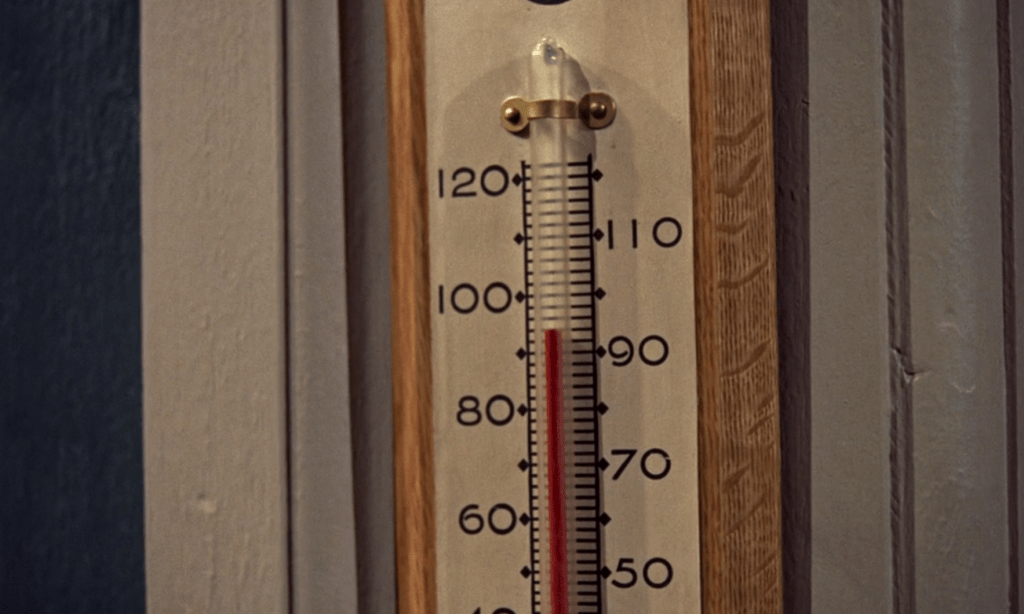
Florida scores another power play goal 1:10 later because Ottawa challenged that last one for an offside, lost, and got penalized for delay of game (again!). That power play goal is scored because Travis Hamonic gets absolutely walked by Bennett despite Ottawa having done a good job of containing and clearing. This:

Turned into this:

Not sure what Korpisalo is supposed to do here but yell at Hamonic.

This was a game where Ottawa allowed three goals on the PK, and maybe one is on Korpisalo for leaving his net and not stopping the puck, but there were Senators breakdowns on all three goals: an open passing lane to the slot, a long change moving everyone out of position, and a defenceman getting danced around. Those are a lot of brains farting.

At this point, we’ve only covered three games but 10 power play goals against. Of those 10 goals, four were off of seam or behind the net passes and one was a clear screen. In other words, at least half the goals are not really attributable to Korpisalo, which should start to turn the conversation a bit.

On December 1st, Ottawa allowed two power play goals against Columbus (ouch). The first was an interesting screen from Jackets forward Boone Jenner as he was skating from the boards to the net front as Patrik Laine was loading up for a shot at the top of the circles:

Jenner gets right in front of Korpisalo as Laine is about to shoot:

And then he gets out of the way the instant Laine takes his shot:

That is a great moving screen from Jenner and it’s hard to fault Korpisalo for giving up a 35-foot Laine wrist shot off the post when he was screened at the time of release.

The following play didn’t result in a goal against, but here is Zach Werenski being contained by three Ottawa penalty killers. Literally two seconds later, Werenski has a clean shot from the high slot:

Suboptimal? Let’s go with that.

About 12 seconds later, a point shot from Werenski results in a deflected goal from Jenner, who was basically responsible for both of Columbus’s PP goals.

A couple of weeks later, Ottawa was at home to Carolina and gave up two more goals against. The first one was a case of over-aggression as Carolina had a fumble at the blue line, and that got two Ottawa Senators forwards chasing towards the neutral zone. That left two-thirds of the offensive zone wide open:

Two seam passes later, and the puck was in the net:

The second PP goal against that game was another shot from the top of the circle and another great screen, this time by Seth Jarvis:

An assist should have been handed to Brännström for his screen, too.

A few days later, Ottawa was in Vegas and things didn’t go well by giving up two more power play goals against in a 6-3 loss. The first was a wild one as Ben Hutton was bringing the puck up the ice and the *entire way* he’s starting down Nicolas Roy:

And this happened two seconds later:

Allowing Ben Hutton to give Nicolas Roy a clean power play breakaway? The bingo card is getting full.

The next goal is something to behold on Claude Giroux’s behalf. He is basically stationary in the slot for a few seconds, and then chases out to the blue line after Alex Pietrangelo (?). Not only does that leave a clean seam pass across the zone to Jonathan Marchessault (which isn’t what happens), but it allows Mark Stone to leak out to the slot for a very clean look from about 20 feet. William Karlsson then has two cracks at the ensuing rebound:

This type of wedge PK is common, but the point is that the second forward isn’t supposed to chase to the blue line when the first forward is already out there. Their role is to work in tandem with the defencemen to prevent the exact types of passes left open by Giroux’s puck-chasing when the first forward is hunting the puck. Maybe the first forward should have settled into the slot and let the defenceman push out to the wing, maybe not, but it’s clear there was a miscommunication somewhere. In other words, what in the Cinnamon Toast Fuck was that?

The next game we’ll show is the end of December, a 6-2 loss to New Jersey when Jacques Martin has fully taken over behind Ottawa’s bench. Ottawa again allowed two PP goals against and the first is on a moving screen like we saw from Boone Jenner in Columbus a couple of games ago:

It is a nice screen from Nico Hischier, but good on Jack Hughes for recognizing that Korpisalo was looking in the direction the shot was going to go as he slid across the other way in anticipation of a short-side shot:

The Devils scored later in the first period as Ottawa has very good chances to get the puck out and fail to do so. The first is Stützle failing on this backhand:

And a couple of seconds later, Greig has an even better chance on his backhand, yet this doesn’t clear the zone, either:

The ensuing scramble gives Jesper Bratt a clean look from the dot even as he has passing options, but he finishes it by going bar-down on the far side:

Probably a goal Korpisalo should have had, but the only reason Bratt was in that position to begin with was a complete failure by two different Ottawa penalty killers having two clean looks to clear the zone, and neither could manage it. And even if Bratt doesn’t shoot, he has great passing options. Just clusterfuckery of the highest order.
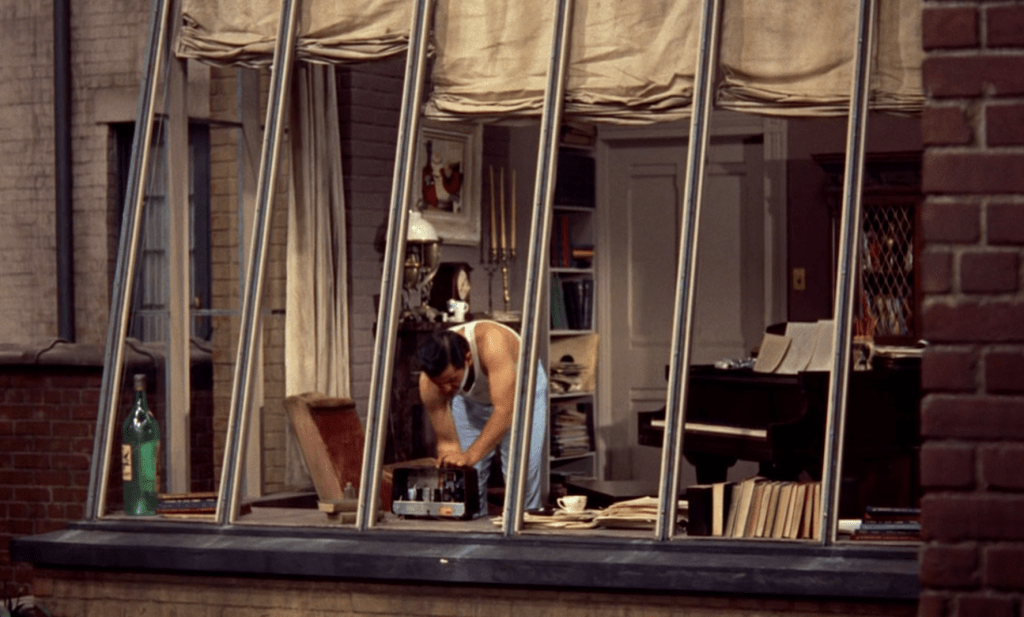
Moving ahead to February, we have a 5-1 loss at home to Anaheim where Ottawa gave up two more PP goals against. The first one is one of those Tip The Cap-type of goals as Frank Vatrano pounded home a one-timer from about 25 feet, going bar-down. No one was saving that and there wasn’t anything that stood out as a problem from a defensive perspective.

The second goal was firmly on Korpisalo as Cam Fowler scored on a point shot that snuck under his arm. Sometimes, the goal against is just bad.

Next up is a 2-1 loss in San Jose where both goals against were on the penalty kill. Double ouch.  

For the first goal against, and stop me if you heard this before, but Giroux was slow cutting off the pass from the half-wall to the middle and the puck was in the net within two seconds (Thomas Bordeleau deflected the slot shot):

For the second goal against, and stop me if you heard this before, but the Senators had a chance to clear the puck and failed to do so:

The Sharks get the puck behind the net and I have no idea what is going on with the Senators here. Why is Artem Zub facing the crowd?

Anyway, Bordeleau opens up for a pass from behind the net and buries the one-timer. There are two Sens penalty killers standing in the crease and no one within five feet of Bordeleau. New coach, same habits.
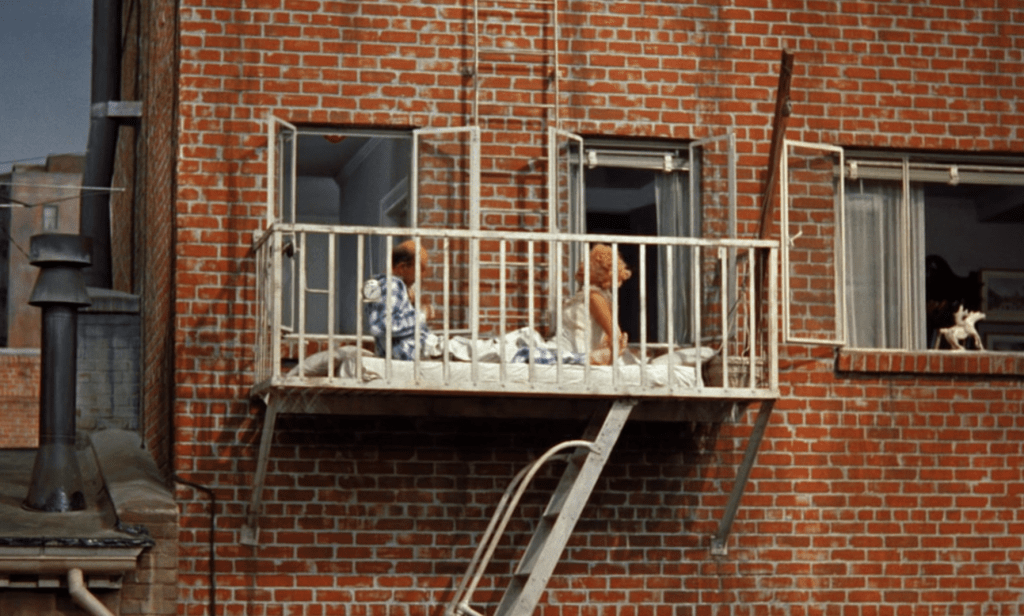
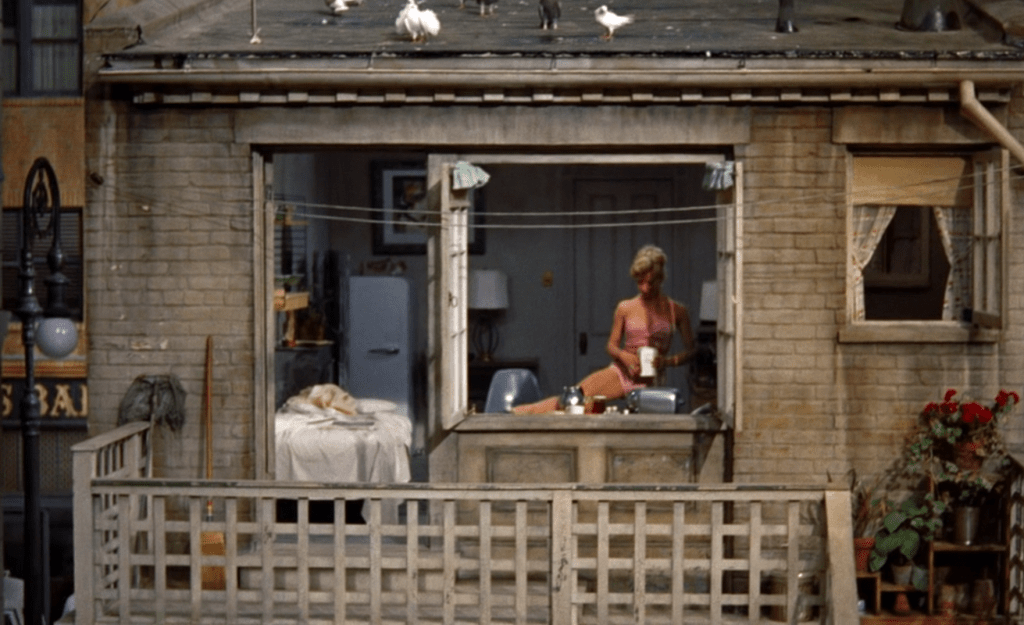
Ten days later, Ottawa was in Boston and got their brains beat in 6-2. The first goal against was from Justin Brazeau, who was standing in front of Korpisalo for the screen. He has time to corral the rebound, shift to his forehand, and bury the puck:

It is wild how often opposing PP forwards are not only left alone in front of Korpisalo, but there is no penalty killer in range to close out on the rebound. That positioning is fine as long as the penalty killers are in position to close on the rebound if there is one, but it’s clear they struggled completing the second half of that task quite often.

As for the second goal against, Ottawa gave up a 2-on-0 earlier in the penalty kill, which wasn’t a great sign. They had a clean chance to clear the puck, and didn’t (quelle surprise). But they again let a player walk to the front of the net with the puck and bury it. It was Brazeau again, and it’s safe to say things aren’t going well when you give up two PP goals in the same game to Justin Brazeau:

The game was all but over by then, but holy hell.

Finally, we reach the end of the two-PP-goal-against portion of this article with a game against Edmonton. The Senators actually won that one at the end of March 5-3, but Oilers did what they do and that’s produce on the man advantage. The first was Leon Draisaitl scoring a one-timer from his usual spot, and that doesn’t need dissecting.

The second goal against is a recurring theme and it’s two forwards chasing the same defenceman to the blue line. Here, the Oilers win the faceoff and both PK forwards push out to him, leaving Connor McDavid wide open to receive a pass as he’s moving down to the circle:

Ottawa’s weakside defenceman had a moment of hesitation towards the blue line, and that left Leon Draisaitl and Zach Hyman in front on a 2-on-1. Probably not an ideal situation:

Hyman wound up being the one to score here, tapping in the backdoor pass.

We have seen complete breakdowns, failures to clear the zone, over-chasing a defenceman, and just bad decision-making. However, this goal highlights one additional issue that is recurring: indecisiveness. There were a couple times where just a quick feint towards the wrong player left an Ottawa penalty killer one step behind where he should be, and with the talent in the league being where it is now, being one step behind leaves open passing lanes leading to easy goals. That indecisiveness crops up again and again and is a symptom of having an aggressive penalty. It is good to be aggressive – Carolina has thrived for years doing that – but failing to make any decision at the right time can be as detrimental as making a bad decision. That indecision opens lanes that shouldn’t be open, and leaves the goalies hung out to dry.

We’ve reached the end of the games where Korpisalo allowed at least two PP goals against. Those games resulted in 26 goals against, and 16 of them have been on clean seam passes, a screened shot, or a deflection. Those are the kinds of goals that are tough to lay at the feet of a goaltender.

Games With One PP Goal Against

Moving on to the single-goal games, we have the very first game of the season, a 5-3 loss to Carolina with DJ Smith behind the bench. In this sequence, Korpisalo has already made a few saves, including a pair of rebound saves with Carolina having free reign to whack at the free puck. About 30 seconds later, we get this from Ottawa:

It is safe to say that the Senators failing to have any skater within 20 feet of the lone Hurricanes skater in front of the net, and also not even having a stick in the passing lane to said player, is not optimal penalty killing. Sebastian Aho makes the very easy pass down low to Michael Bunting, who eventually makes it to the other side of Korpisalo to slide the puck in. Look how much time he has:

That basically functions as giving up a breakaway, which is hard to manage when you have four defenders in the defensive zone.

Later in October, Korpisalo gives up a PP goal against the New York Islanders that he should have had. He coughs up a rebound on a clear wrist shot from the top of the circle and Bo Horvat slams home the puck. It is a goal where maybe Travis Hamonic should have had better stick control of Horvat, but it’s a rebound goal that should have never happened to begin with.

A week later, Los Angeles is in town. Early in the game, the Sens go on the penalty kill and Korpisalo has already had to make a couple of nice saves in addition to Kevin Fiala hitting a post. Los Angeles’s second PP unit hits the ice, and a nice passing play leads to Phillip Danault having not one, but two, clean swipes at the puck from the net-front area. It is another case of clear miscommunication because Ottawa’s weakside forward has recognized the backdoor pass and has dropped down below the hashmarks to cut it off. However, Tyler Kleven stays right in front of Korpisalo, leaving Danault wide open about 15 feet from the goal line:

Danault gets a shot here and follows up his rebound as Kleven is flailing his stick around. It is just very poor decision-making from at least half the PKers.

A week later in Toronto, Ottawa loses the faceoff and no one gets out to William Nylander in time, who fires it home from the middle of the ice:

One thing did make me laugh though. As the scramble for the faceoff is going on, Parker Kelly (#27) goes to dig out the puck, but it kicks out to Nylander. Watch Kelly slide on his stomach to cut off a potential pass to Mitch Marner. It’s pretty good.

Not long after, Anton Forsberg got a lot more starts so our story picks back up in December where Ottawa takes a 5-1 win at home to Detroit. The lone goal was a PP goal against, and it was a 4v3 goal where Patrick Kane ripped home a shot from the circle. It is a goal Korpisalo probably should have had as it snuck under his glove on the short side.

In early January, Ottawa lost 6-3 in Vancouver, giving up five first-period goals. Elias Pettersson ripped home a cross-ice pass from JT Miller, and it’s yet another case where an Ottawa penalty killer has his stick in the passing lane to the defenceman rather than the shooter in the circle:

This lack of identifying the dangerous passing lane keeps happening over and over, and it seems to be happening a lot to Claude Giroux. Pettersson’s shot also deflects off an Ottawa defenceman, just for added hilarity.

A week later is a 5-3 loss to Buffalo, and Tage Thompson scores a PP goal because Ottawa allows him to walk into a shot from about 25 feet away completely unchallenged:

Maybe one Korpisalo should have had, but this is starting to be a lot of goals from about 20-30 feet where the shooter has a clear lane to the net. Goalies stop most of those, but not all of them, and giving clean 20-foot shots to 40-goal scorers is going to end poorly once in a while.

Just before the All-Star break, Ottawa loses 3-2 to Boston and Korpisalo gives up a PP goal to David Pastrňák on a one-timer from about 45 feet. It is genuinely a goal Korpisalo should have had, and he just straight whiffed on.

In February, a 4-1 loss in Nashville had one PP goal against and it’s another goal where the Ottawa skater in front of the net does all of the following: doesn’t take a man, doesn’t block the shot, and provides a screen. It truly is something to behold, and this is how point shots find their way to the back of the net:

Allowing 55-foot goals is never ideal for a netminder, but when his defenceman is acting as a second net-front forward for the opposition rather than a defender, he can be excused once in a while.

The next PP goal against was a 6v4 at the end of a win against the New York Islanders where the Islanders pulled the goalie for a two-man advantage late in the game. It ended up tying the game and it was a Horvat one-timer that was going wide deflected off Kelly and in the net. A tough break where you can’t really single out one or two bad decisions; sometimes the team on the power play just deserves credit or gets lucky (or both).

Late in March, Ottawa gives up a PP goal to Winnipeg, and Mark Scheifele in particular. Before that goal, there are a number of things that highlight the team’s PK problems all season long, regardless of the coach behind the bench.

Early in the power play, Ottawa clears the puck, but Winnipeg gets back in the zone with control thanks to a chipped area pass. After a bit of a bobble, things start to get scrambly, and decisions are certainly made. Here, we have Parker Kelly circled. He has his stick in the passing lane for a seam pass, which is usually a good idea except there is no one there for the seam pass:

There is someone about eight feet in front of him, and it’s hard to tell in a still photo, but the Winnipeg player that is in the circle is skating away from the Ottawa net. He is in no position for a one-timer, and at best will one-touch the puck to the point or down low. If he decides to cradle the puck and try to shoot, Kelly is already moving in that direction to disrupt the shot. In other words, taking away the passing lane to the middle isn’t really adding any value; he’s taking away a shot that isn’t there because the only decision the Winnipeg player has time to make is a one-time pass to a non-dangerous area. However, that stick positioning leaves Scheifele (the guy with the arrow) with a clean lane to receive the pass, and his eventual shot goes in off Artem Zub:

Stick positioning is so, so important on the penalty kill and the Senators fail to make the correct decision repeatedly. To this point of our venture, it has cost them several goals.  

Towards the end of the season, Ottawa had a 2-0 loss in Florida. On a penalty kill about halfway through the first period, the Senators are running around. Korpisalo has already had to make three saves (two of them off passes from behind the net or through the seam) and is looking good. The second Panthers PP unit hits the hits with about 50 seconds left on the PP. Ottawa clears the zone with about 25 seconds left on the power play and then arguably the funniest PP goal against of the season happens.

Here is Ottawa clearing the puck all the way down the ice with 23 seconds left on their penalty kill:  

And here is Anton Lundell in on a clean breakaway literally five seconds later:

Shout out to Sergei Bobrovsky on a great pass from his own goal line, but that is an all-time-bad line change – slow to get off and slow to get on. Just another in a long line of terrible decisions made all season long by the penalty killers.

The last goal we’ll look at is something we’ve mentioned often, and it’s the Ottawa penalty kill hitting the trifecta of not blocking a shot, providing a screen on Korpisalo, and giving up a good look to a good goal scorer. The funny thing is that a split second before Cole Caufield rips the puck top corner, we have this screen shot: the goal scorer (Caufield) is with the puck at the top of the circle but has a viable passing lane to the left of Korpisalo, which would leave a 2-on-1 down low for Montreal:

Caufield is the one that scores here on a straight shot, but he had options, and one of them was to create an odd-man chance down low because Ottawa abandons the front of the net. It is more over-aggression masked as aggression that is taking players out of place and not really doing a whole lot. Maybe Korpisalo should have had this shot, but one clean pass down low creates an advantageous situation for Montreal so even if Caufield doesn’t take the shot, a quick pass gives them a high-danger look at the net. It is truly unbelievable that this keeps happening over and over, but it’s starting to get very believable.

Summary  

Those are the 39 PK goals against allowed by Korpisalo this season. Early in the article, we said that if Korpisalo had a median save percentage on the PK, it would have led to 13 fewer goals against. Well, I classified all 39 goals into seven categories:

  1. Seam/Behind The Net Pass
  2. Screened Shot
  3. Odd-Man Rush
  4. Deflection/Tip
  5. Unscreened Shot
  6. Rebound/Scramble
  7. Other

The first four categories are goals we shouldn’t really hang on Korpisalo, there were two unscreened shots he maybe could have saved but a pass would have resulted in a dangerous chance against regardless. Also, one of the ‘other’ goals was that Boston goal where Brazeau had all day to walk to the front of the net (which happened more than once). These are the goal totals by category:

  1. Seam/Behind The Net Pass (10)
  2. Screened Shot (8)
  3. Odd-Man Rush (3)
  4. Deflection/Tip (3)
  5. Unscreened Shot (10)
  6. Rebound/Scramble (3)
  7. Other (2)

The first four categories – goals we can’t blame Korpisalo for – comes to a total of 24 goals against. Add two unscreened shots where it was a complete breakdown by the Ottawa penalty killers plus the net-front walk by Brazeau, and that’s 27 goals where we can’t really say Korpisalo was the problem. If just one-third of them are cut down by better decision making, Korpisalo’s PK save percentage is near the middle of the league rather than in the bottom-5.    

This isn’t to say Korpisalo was good or didn’t have his own issues; there were a number of times where he lost track of a puck he shouldn’t have, flubbed the handling, gave up a juicy rebound, and things of that nature.

All that aside, it is shocking the number of bad decisions we see from the Ottawa PKers that led directly to goals against. Failing to clear the puck, sticks in the wrong passing lanes, indecision about which player to cover, leaving no one (quite literally) within 20 feet of the net even when the other team has possession, and on and on the list goes. One of my pet theories is that Ottawa is a skilled team that consistently makes bad decisions, and that was certainly the case on the penalty kill.

As for what new coach Travis Green should do, the answer is both simple and unbelievably complicated: get the penalty killers to make better decisions. A stick in the right passing lane rather than the wrong one saves goals, but ensuring that players make that right decision over and over is no simple task. It is what gives them hope because they are good at limiting shots and their aggressiveness puts opponents to a decision, which can work out very well. That is a double-edged sword, though, and the team got cut by that sword over and over in 2023-24.

Design a site like this with WordPress.com
Get started