With Mission Impossible: The Final Reckoning being released this weekend, now is a good time to go through the entire series. We aren’t doing a recap, review, or analysis of the series, though. Not really. What we’re doing instead is following along the entries in the franchise, ranging from 1996 to present day, and how they tell us all we need to know about the career of Tom Cruise, the character of Ethan Hunt, and Hollywood cinema writ large.
Mission: Impossible (1996)
The original in the franchise, or the reboot of the TV show anyway, was released in May of 1996. It was a monster box office hit, finishing third that year in domestic gross at nearly $181-million, or more than double that in present-day value. It also feels like both the end of an era and the beginning of the next one.
To be clear: this is an excellent movie that holds up very well. As an espionage thriller, it does have its humour (especially in the first 15-20 minutes) with great action set pieces, but it nears the end the star-driven drama or thriller in Hollywood. Cruise had done a bunch of those (both The Firm and A Few Good Men were released 3-4 years earlier) and those genres were successful vehicles. Just from the 1993-1995 era alone, even aside from those aforementioned Cruise movies, there were entries like The Fugitive, Indecent Proposal, In the Line of Fire, Clear and Present Danger, Forrest Gump, Apollo 13, and Crimson Tide which all finished top-10 at the domestic box office in their respective years. Put Harrison Ford, Tom Hanks, or Demi Moore in a drama/thriller, and you probably had a box-office smash on your hands.
That ended after 1996. Once we get to 1997, the box-office smashes that get closest to those genres are Air Force One or Face/Off, which could qualify, but also lean more towards shoot-‘em-up-action. (Sidebar: in the first M:I movie, Cruise doesn’t shoot a gun at any point. As with all good espionage thrillers, this is a movie about relationships and brains over brawn.) There were a couple big successes before the end of the century – Titanic especially, and Good Will Hunting as well – but by the time we get to 1999, there is a Star Wars prequel, an Austin Powers sequel, and a Toy Story sequel in the top-4 at the box office. The successful original stories bent more horror (The Sixth Sense and The Blair Witch Project) or comedy (Big Daddy and Runaway Bride). Once we get to the early 2000s, it’s Harry Potter, Spider-Man, more Star Wars, and kids movies. There is still a successful drama-thriller entry here and there, but the mid-90s gold rush is gone.
While 1996 can be used as a delineation point in the types of movies audiences will abandon or consume in the coming years, it’s also about this time that the use of computers/technology comes to the forefront. It isn’t as if movies had never focused on computers – hell, WarGames came out in 1983 – but they were infrequent, and the use of computers as an integral part of everything starts at this time. In 1995, we got Goldeneye, and in 1997 we got Men In Black. Before the century was over, The Matrix was released and the technology floodgates really opened.
That is why it’s cheesy, in a way, to return to this Mission: Impossible entry. Hollywood was still figuring out how computers were actually going to be used in their movies, and how to present that to an audience that was largely still learning to use computers themselves. It is why we have scenes like the fake fire at CIA headquarters where Ving Rhames’ character (Luther), the greatest hacker in the world, has to type ‘ACTIVATE ALARM’ on the screen to let the audience know what’s happening:
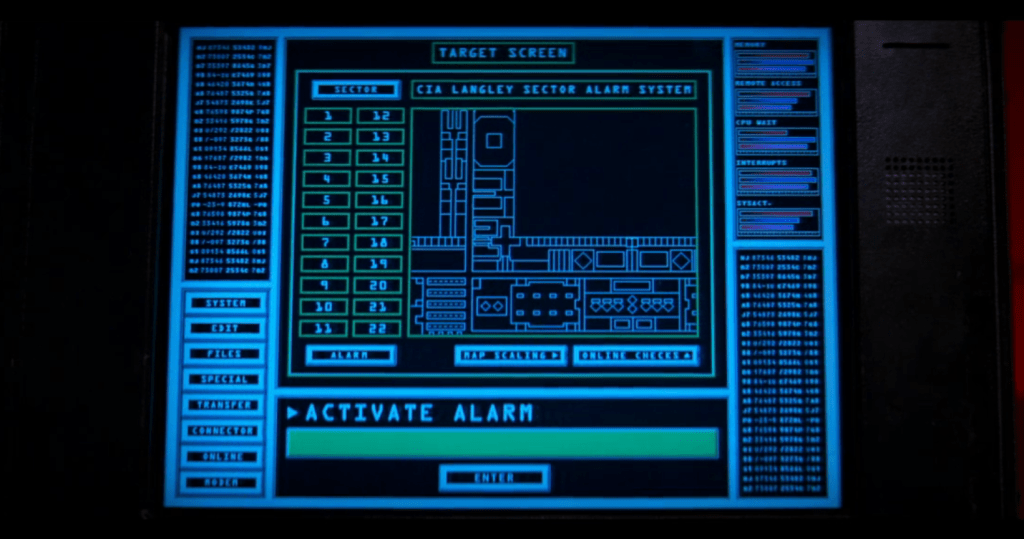
There are a bunch of scenes like this: Ethan Hunt typing ‘Job 314’ as a search string; Luther typing ‘SEND JAMMING SIGNAL’ in giant letters on his laptop to jam phone cells, and so on. I mean, there is even a giant ‘INTRUSION COUNTERMEASURES’ sign inside the CIA vault:
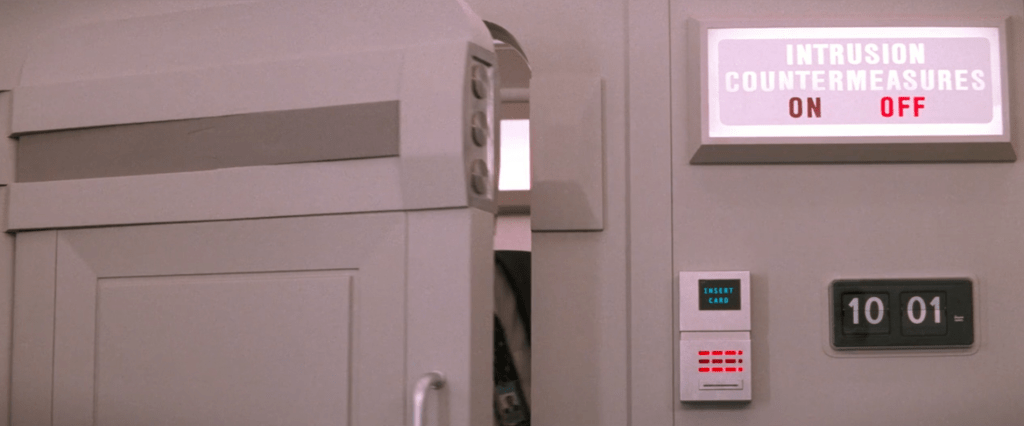
This is very reminiscent of Dr. No, the first James Bond movie released 34 years earlier:
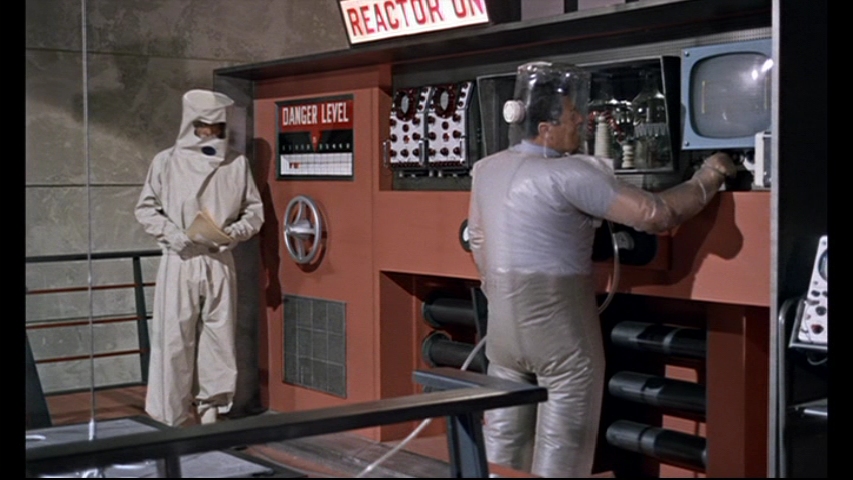
I would say the sign in the CIA vault is an homage if it weren’t for all the instances of very obviously and clearly displaying on computer screens what the person at the computer was doing. As cheesy as it is, it does allow the audience to clearly follow along with what they’re seeing, a point we’ll return to later.
The next 10 years sees Hollywood not only adjust what kinds of movies are made, which is why this first M:I movie is a vestige of a long-gone era, but marks the start of the decline of Cruise as the vehicle of a drama/thriller. Cruise stars in Jerry Maguire later in 1996, which is a hit, but he spends over a year filming his next movie (Eyes Wide Shut) and the landscape has changed by 1999. In fact, after Jerry Maguire and until Top Gun: Maverick in 2022, the only Cruise movies that finish in the top-20 by domestic box office are Mission: Impossible sequels or directed by Steven Spielberg (Minority Report and War of the Worlds).
All this makes Mission: Impossible one of the most fascinating movies of the last 50 years. Not only for the movie itself, but what it tells us about movie-making and movie-viewing shifts in English-speaking countries generally, and Tom Cruise’s career specifically.
Mission: Impossible II (2000)
By the time we get to the second M:I movie, it is four years later. Cruise started filming Eyes Wide Shut in late 1996 and it didn’t wrap until March of 1998. As we just outlined, in the interim, there were rapid changes in both audience viewing habits and the way movies were being made, so this was Cruise doing his first post-drama/thriller movie. And we can all say this about the second Mission: Impossible: it was certainly a movie that was made and released.
This one was directed by John Woo, and he had just had a couple of big successes with Face/Off and Broken Arrow. And the action sequences in this movie are still good, but it’s the story and the writing that makes it suffer, which is why it’s at the bottom of the list for the franchise. What made the first movie so special was the espionage-thriller aspect, showing Hunt’s strategic thinking, which was complemented by a couple of great action sequences. Neither of those are really apparent in this movie. This is more, ‘What if Jean-Claude Van Damme spoke perfect American English and was in a Fast And The Furious movie’ and less, ‘this is a movie about the world’s greatest spy’. It is a Cool Guy Slowly Walks Away From Explosion-type of movie, considering there’s a literal slow-motion scene of him driving a motorcycle through the wreck of a car that just blew up:

But, like the first film, it’s an important entry because Cruise very quickly moves away from being that type of action star. In his future action movies, he either gets his ass kicked often (the M:I entries) or is the quiet badass (Jack Reacher). It takes a bit more time, but this marks the end of him being the Arnold Schwarzenegger-type of action star and more the Bruce Willis-type of action star.
The same thing is going on in Hollywood, generally speaking. The last of the Pierce Brosnan-led James Bond movies is released in 2002 (Die Another Day). It is generally panned and doesn’t crack the top-10 at the domestic box office. This forces the Bond creative team to re-think their approach, hire a new Bond, and take the franchise in a fresh direction. We get a reboot with a grittier Bond (we’ll get to that in a second) and it’s a resounding success. Schwarzenegger has moved to politics as that style of action star goes away – same with Sylvester Stallone. Audiences don’t want the super-cool action hero who always does everything right, and the second Mission: Impossible movie is the last time Cruise will inhabit that type of role for at least 20 years, if not forever.
Mission: Impossible III (2006)
Depending on who you talk to, this is the best of the original trilogy, though I’m still partial to the original. At the time of release, it has been a full decade since that original, and it’s very obvious how much has changed. The opening scene is from the back half of the movie, and has Hunt tied up in a chair across from Michelle Monaghan’s character (Julia), whom we learn is his fiancée, with Philip Seymour Hoffman playing the villain and threatening her life. The scene is taking place in a grimy industrial setting with a hand-held camera shaking like it’s attached to a bobblehead. The grit-ification of cinema in the 2000s – we already mentioned the Bond franchise, and the same happens with Christopher Nolan’s Batman trilogy – is readily apparent here. For the most part, it does work, so it’s not as if it is all for nothing.
This is also where, as mentioned earlier, the era of Cruise getting his ass kicked, or playing the quiet assassin/killer, is in full swing. It kind of starts with Minority Report in 2002, continues here, and extends to the present day. The action star of the 80s and 90s is not the action star of the 2000s, and Cruise makes that adjustment.
It also ties into his off-screen problems. Cruise, a longtime Scientologist, was caught up in controversy with a regular basis at this time:
- In 2005, he got into a public tiff with Brooke Shields when Cruise criticized her for using anti-depressants to help with post-partum depression. Cruise also denigrated psychiatry in general, which seems to have led to a split with director Steven Spielberg.
- After Cruise’s marriage with Nicole Kidman fell apart in a very public way, he started dating Katie Holmes in 2005. We all remember the couch-jumping incident on Oprah Winfrey’s show.
- The nature of scientology itself were becoming more and more available to the public, which included mysterious deaths and disappearances.
All this was starting to make Cruise unlikeable to the public, so being an action star who makes all the right choices and never really loses wasn’t palatable. This third M:I movie features him being a guy who is constantly getting his ass beat until he triumphs at the end. That becomes a bit more typical of him for the next 20 years.
It isn’t dissimilar from what we see from Nolan’s Batman: Begins. In that movie, Bruce Wayne goes overseas for years, constantly gets beat during his training, and devolves so far as to be this-close to shooting the guy who shot his parents. He even has to be rescued by Alfred at one point after being exposed to a psychological toxin. That Bruce Wayne loses, or is lost, at nearly every turn until the final 30 minutes. The same is true for Ethan Hunt in Mission: Impossible III.
This is the end of the first half of Cruise’s career, especially after Paramount breaks away from him in 2006, and most of it is self-inflicted. He does a few smaller movies, tries a return in Knight & Day, but really the only thing that stands out from his next five years is his cameo in Tropic Thunder. Otherwise, the 2006-2011 period is Cruise receding into the background and starting his image rehabilitation.
Mission: Impossible – Ghost Protocol (2011)
The fourth M:I movie may not be a favourite of franchise fans, but it does feature arguably his coolest stunt when he climbs the Burj Khalifa in Dubai (which he actually did). It also is very illustrative of not only where Cruise’s career was at that time, but where Hollywood was and is.
It is easy to forget how star-studded the third M:I movie is. There is Keri Russell just a few years removed from Felicity, there is Laurence Fishburne coming off his run in The Matrix trilogy, and Seymour Hoffman is coming off an extended late 90s-to-mid 2000s run of playing several excellent supporting characters (including 1999’s Magnolia with Cruise). With the rest of the supporting cast, it’s a true ensemble of great, notable actors.
That isn’t the case with the fourth Mission: Impossible movie while Cruise’s reputation is still being rebuilt. There is Jeremy Renner, who is on a very good run of movies at this time, but Simon Pegg is a returning character, Paula Patton was a supporting character in a couple of good movies but was nowhere near Keri Russell’ recognizability in the mid-2000s, while Michael Nyqvist and Vladimir Mashkov were unknowns to American audiences. This is not a cast that would have been in a Tom Cruise action movie 10 years earlier. Hell, the second movie had Anthony Hopkins!
Where the filming takes place is also key to the fourth movie. Here are the primary filming locations for each of the first four films:
- One: England, Czechia
- Two: Australia
- Three: Italy
- Four: India, Russia, United Arab Emirates
Interesting, yeah?
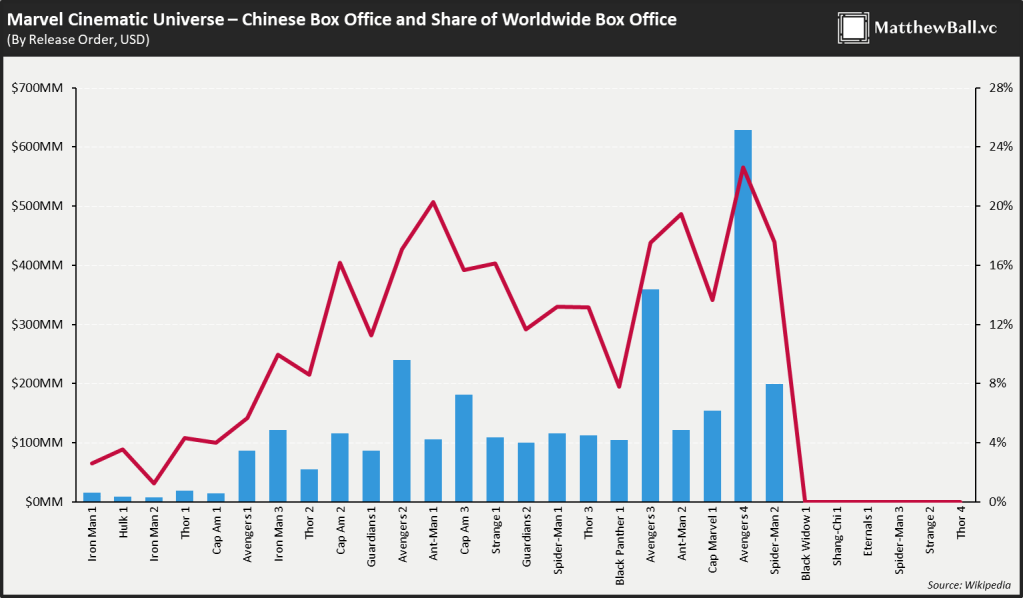
Aside from the 2010s being notable for the rise of the superhero movie, it is also notable for the rise in foreign influence on Western productions. China becomes a huge market for those superhero movies, to the point where Avengers: Endgame got a quarter of its total box office from that country:
As for this movie, specifically, it opened the Dubai International Film Festival in late 2011. It also reportedly got “… production support in the city equivalent to a financial rebate of some 30% of their local spending.” This type of financial incentive has always been around, to a degree, but it becomes more of a battle not only for places like the UAE, but Ireland, England, New Zealand, Canada, Eastern Europe, and on and on. That trend started around this time, and now top streamers like Netflix and Amazon have over two-thirds of their new movie/television productions being non-American productions.
The fourth movie is a success but is also the start of something new entirely. Cruise is no longer the suave action star of the 1990s and early 2000s, mostly because audiences won’t let him be that. It is the rehabbing of his image from someone who is promoting his very controversial religion, to the point where he’s essentially excommunicated from Hollywood, to where he’s today affectionately referred to as Mr. Movies. It also is a herald of movies featuring American actors, with American directors and writers, being filmed in, or partly financed by, countries that aren’t exactly staunch allies of America.
Mission: Impossible – Rogue Nation (2015)
The year is now 2015 and Cruise is a decade removed from the 2005 couch-jumping incident and most of the controversies that put him on a lot of shit lists. Since Ghost Protocol, Cruise has been in Jack Reacher, Oblivion, and Edge of Tomorrow. None are absolute box-office smashes, but their production budgets (per Wikipedia) amount to $358-million and the total box office take for those three movies is about $881-million. Even factoring in the hidden costs of marketing, they made money. What is also notable is that those three movies heavily relied on the international box office for success:
| Movie | Domestic Box | International Box | International % |
| Jack Reacher | $80.1M | $138.3M | 63.3% |
| Oblivion | $89.1M | $197.1M | 68.9% |
| Edge of Tomorrow | $100.2M | $276.8M | 73.4% |
American audiences may not have been all the way back in on Cruise, but international audiences certainly were.
Those three movies, and then Rogue Nation in 2015, is a four-year run that culminates mostly in Cruise’s image rehabilitation. He isn’t back to where he was 15 years earlier (yet), but there are modest box office successes, one critically acclaimed movie in Edge of Tomorrow, and then Rogue Nation, which is a smash hit. It is arguably the best movie in the franchise to that point and gives us the Cruise he needs to be for audiences: The guy who is over-matched, gets his ass kicked, but pulls it off at the end. He is chasing a terrorist group known as The Syndicate, which was created by the English intelligence community but then went rogue. No one believes him, so it’s the belief in himself, and his team’s belief in him, that allows them to succeed.
This is all part of Cruise’s image rehabbing. He is telling audiences that he’s willing to get his ass kicked, and perform death-defying stunts, but they need to trust him to get the job done. It is very effective.
We also get the introduction of the most important non-Cruise character in this franchise, and that’s Rebecca Ferguson’s character of Ilsa Faust. She is an English spy working against Hunt but eventually falls for him and the way he treats his team. They are borrowing straight from The Fast and the Furious franchise here: Hunt’s team aren’t co-workers, they are family. In this way, Ilsa Faust just isn’t a lethal, sexy assassin introduced to be a foe-turned-friend-turned-lover(?) of Hunt’s, but is a stand-in for the audience. If we chose to not let Cruise rehab his image and charm us back into our seats at the cinema, his movie career would effectively be over. But this is still Tom Cruise, so she falls for him, and so do we.
This movie also gets away from production in places like Russia and the UAE, returning to London while also going to Casablanca and Austria. They are globe-trotting, and this time it’s with countries friendly to the United States.
Mission: Impossible – Fallout (2018)
Cruise makes a few unsuccessful movies after Rogue Nation, but returns to Ethan Hunt in 2018’s Fallout, which is probably the best movie in the franchise (at time of writing, I haven’t seen Final Reckoning, but Fallout sports an 87 rating on Metacritic).
Gone is Jeremy Renner’s character, but all of Ving Rhames, Simon Pegg, Alec Baldwin, and Rebecca Ferguson are back. Sean Harris returns from Rogue Nation as the head of The Syndicate while Henry Cavill (Agent Walker) is introduced as the heavy, and Harris’ secret operative. There are also the introductions of Angela Bassett and Vanessa Kirby (White Widow), as well as the re-introduction of Michelle Monaghan (Hunt’s wife from the third movie). Tom Cruise is nearly all the way back, almost fully image-rehabbed from the mid-2000s, and this type of star-studded ensemble cast is more reminiscent of the second and third movies than the fourth and fifth movies.
Also back in the franchise are the humour elements. While the previous couple of Mission: Impossible movies give us physical comedy from Cruise in the Wile E. Coyote kind of way, this brings actual dialogue humour. The second scene in the movie is Hunt and Benji looking to make an exchange with criminals, but gives us this exchange of Hunt telling Benji to relax:
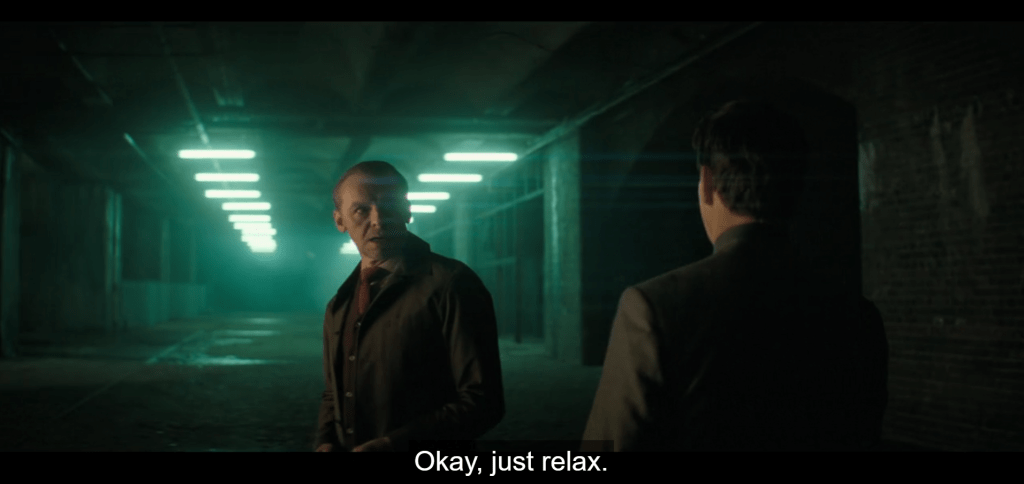
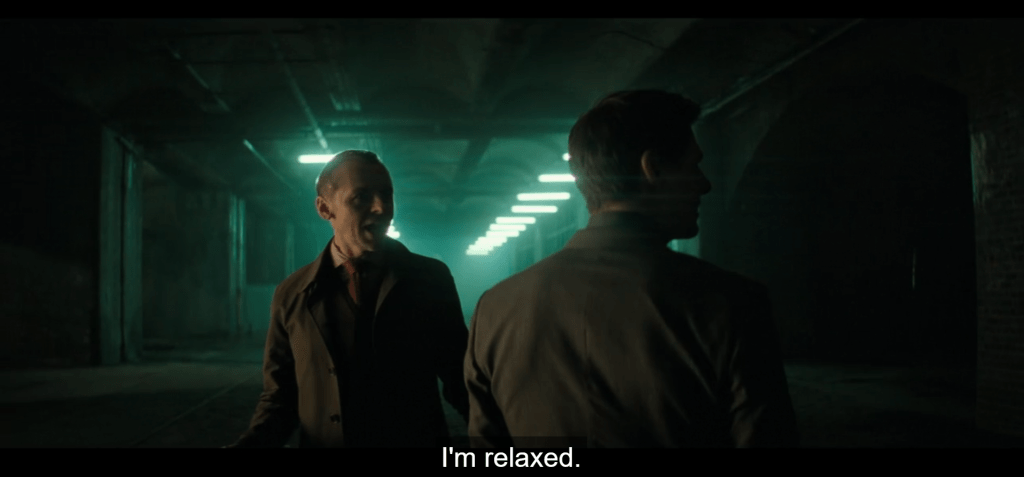
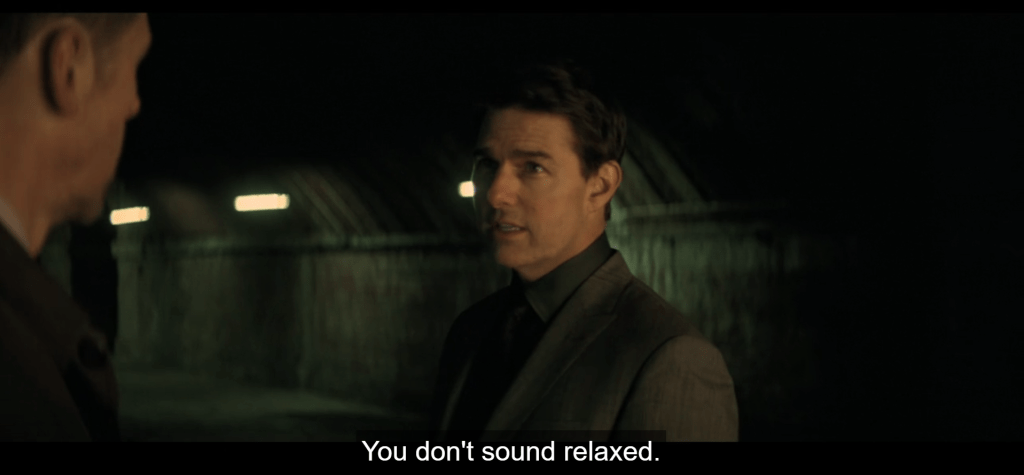
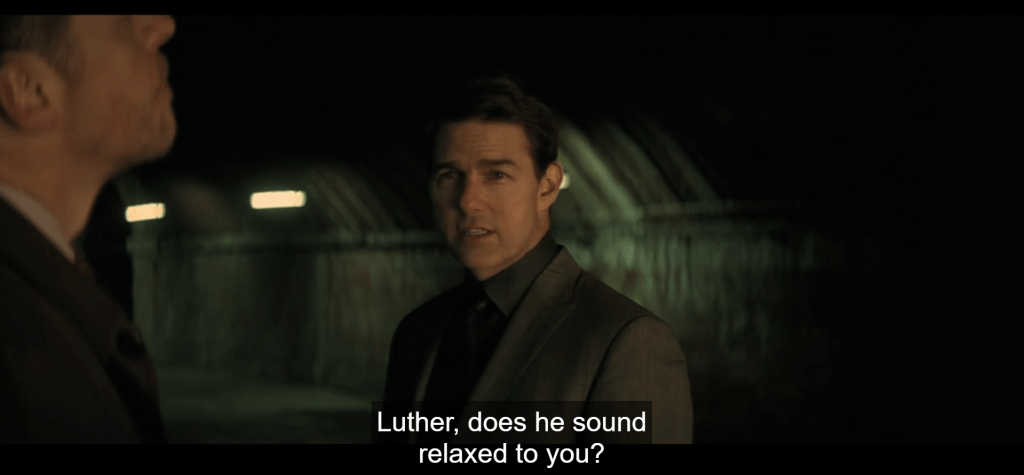
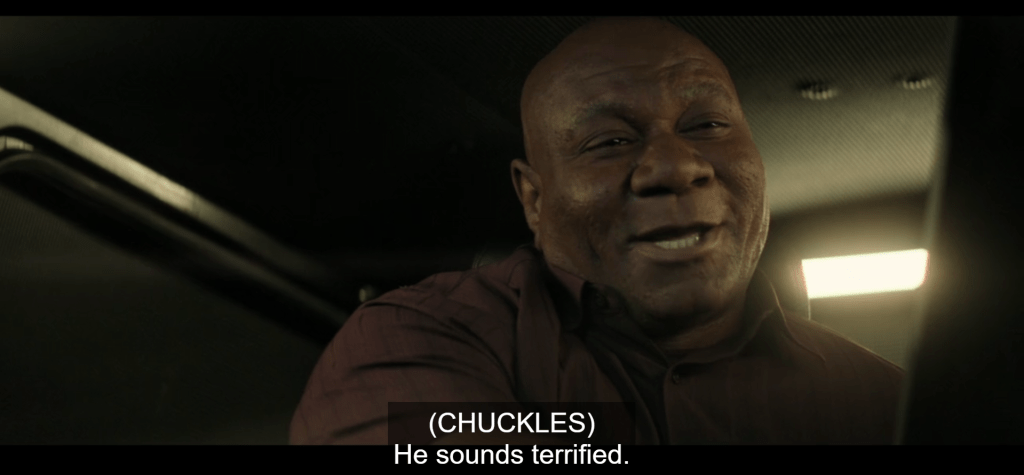
It isn’t laugh-out-loud hilarious, but it is the writers knowing they can be a little more playful with Cruise. His image has improved to the point where audiences can laugh with Cruise, and not just at him.
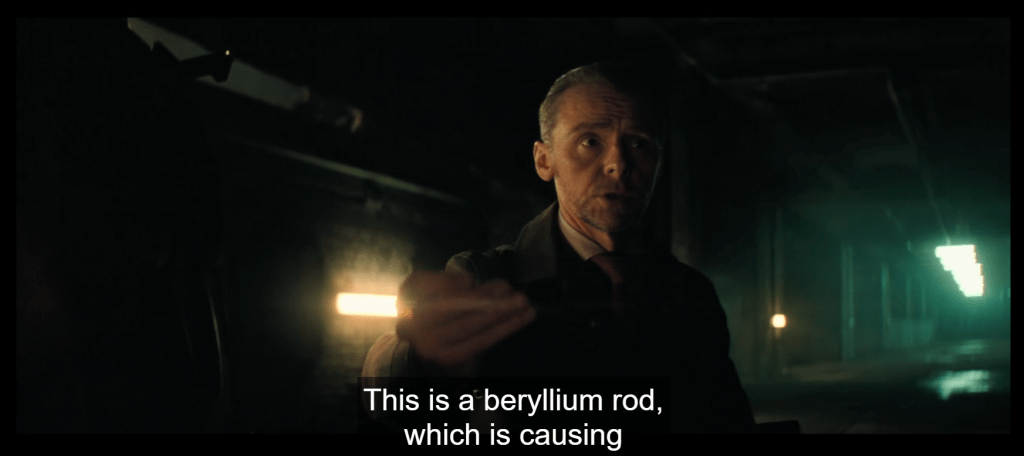
In its own way, Fallout is a kind of return to the very first movie. Remember how they had to type out ‘ACTIVATE JAMMING SIGNAL’ or have a sign that says ‘INTRUDER COUNTERMEASURES ON/OFF’ to help audiences follow along? While each movie does this to some extent, it is a frequent occurrence in Fallout, like later in the same scene just mentioned where Benji is testing plutonium cores to make sure they’re actually plutonium, and we can tell that’s what he’s doing, but he explains it anyway:
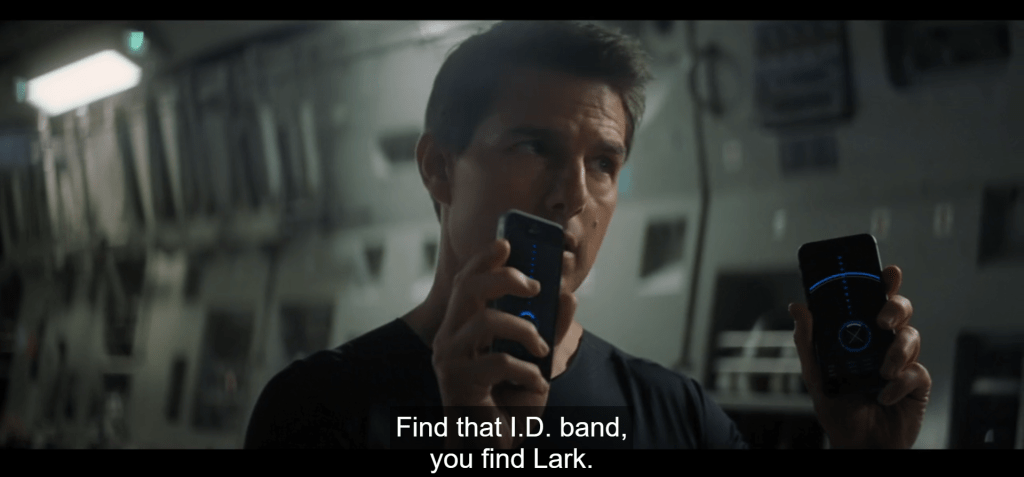
Then there is the scene in the plane with Hunt and Walker where Hunt is explaining that their target is wearing an ID band that they can track with their phones. Hunt then repeats that last point:
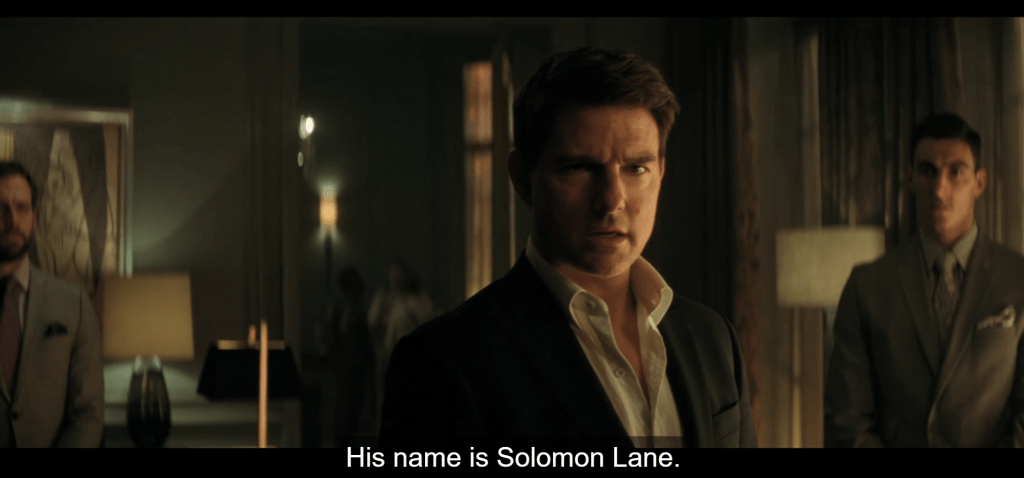
When Hunt meets with the White Widow later, she states the plan is for Hunt to jail-break Harris’ villain character from the last movie. There is an exposition scene telling us who Harris’ character is (Solomon Lane) even though he was the villain in the most recent franchise entry:
In the final act of the film, as the team is driving into the village to stop the nuclear bombs, Benji explains all the steps needed to deactivate the bombs. Then the team repeats the steps back so the audience can follow along:
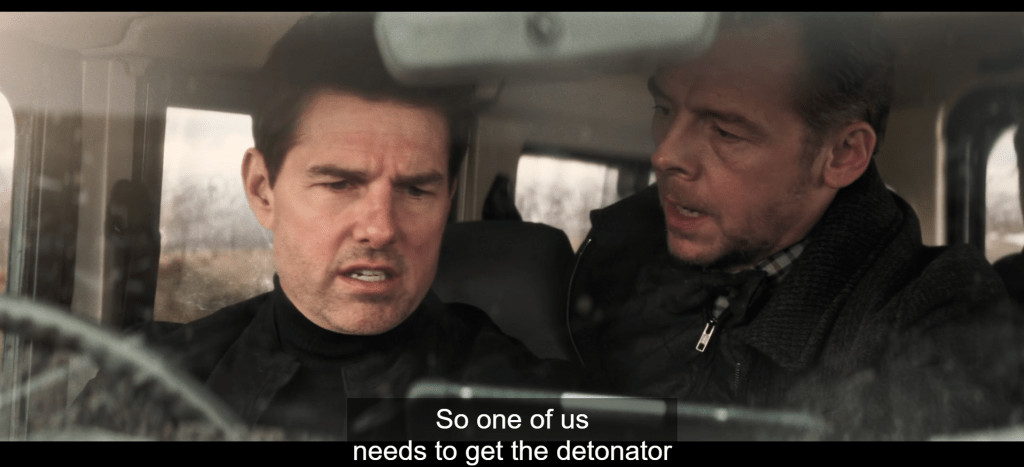
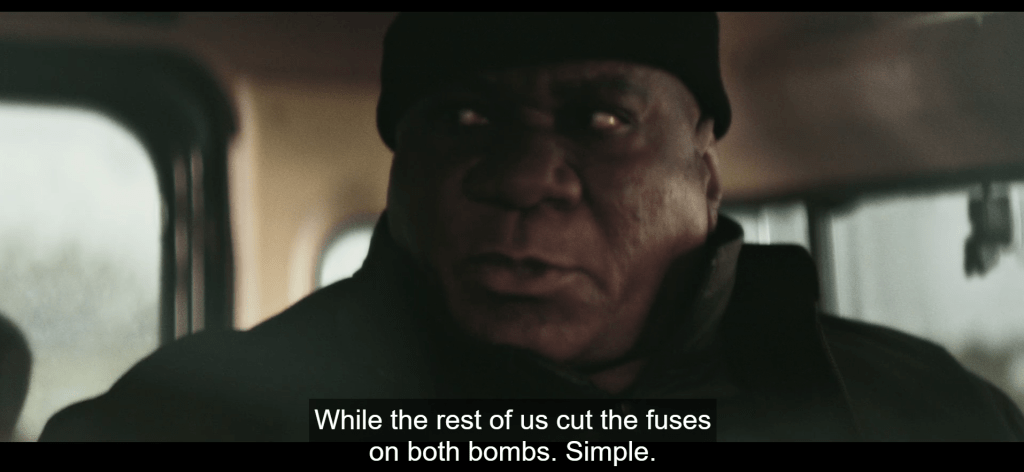
One important thing Fallout does so well is that it demonstrates the IMF team is over-matched, but they have the smarts and the will to outwit and out-grit the villains. Those smarts are repeated on the screen to make sure the audience knows what’s going on, and that makes us feel smart. We feel as if we could be part of that IMF team because duh, of course that rod detects radiation or that ID band leads us to the target. We knew that. Of course we knew that. Because we’re smart.
This repetition of key actions is something modern blockbusters have all done, to some degree, but is critical to spy-thriller blockbusters specifically. What makes these movies special is the intelligence of the characters, because that’s what allows them to win the day, but if the audience can’t follow along with what’s happening, they will feel as if the movie is too high-concept. This way, the movie can show the characters be smart and make the audience feel smart without talking down to us. It is a brilliant piece of movie-making that can turn a spy-thriller like this be a box-office smash, even if the franchise has become known for its excellent action stunts.
Just think of the Marvel movies of the late 2010s. There were extended sequences or dialogue scenes that clearly explained how they’re going to go back in time, or prevent Thanos’ invasion, or whatever else. It demonstrates the intelligence of the characters while bringing the viewers along for the ride.
Mission: Impossible – Dead Reckoning (2023)
There is no need to go long here because by now, Cruise is fully back. Top Gun: Maverick released in 2022 and earned nearly $1.5-billion at the box office, the second biggest movie of the year, and was the sign that film-going had returned post-pandemic (using that term loosely here). It brings back old favourite characters, introduces new ones, and sets Hunt’s path for 2025’s Final Reckoning. The mid-2000s are a distant memory.
Some people call Cruise the last movie star, which may or may not be true. What is undeniable is that there isn’t another actor like him from the post-Classic Hollywood generation. So many stars of the 80s and 90s – Schwarzenegger, Stallone, Willis, De Niro – just never translated to modern audiences, at least not consistently. Cruise did, and he did it with a full, decade-long image rehab to climb back from effectively being a radioactive plutonium core himself to the avatar of blockbuster movies in the 2020s. Beyond that, the entire history of action-spy movies over the last 30 years can be told through the Mission: Impossible franchise, and a large chunk of the Hollywood story overall. The Marvel Cinematic Universe may have changed modern blockbusters, but the Mission: Impossible franchise clarifies those changes for the audience, something its best movies do individually. Even the history of the Mission: Impossible franchise explains the modern history of Hollywood blockbusters, so maybe there isn’t a more apt nickname for Cruise than Mr. Movies.
 Cliffy's hell-hole