It was another disappointing season for the Ottawa Senators in 2023-24 and while those things always have multiple causes, a big one for this team was the penalty kill. Despite ranking 15th by shots allowed per 60 minutes while short-handed, the team was 30th by goals against per 60 minutes, and closer to the putrid Anaheim Ducks’ PK goals-against rate than they were to Toronto’s bad-but-not-awful PK (per Natural Stat Trick). Ottawa finished dead last by PK save percentage at .826 with no other team below .830 and the median being around .863. The difference between Ottawa’s PK save percentage and the middle of the league cost them 13 goals, and that’s a lot.
I was curious why there was such a massive discrepancy between shots and goals against, so I went back and watched every power play that resulted in a goal against Ottawa netminder Joonas Korpisalo this season (there were 39 of them). Here is what I found with thanks to Instat for their services on the video.
Games With Multiple PP Goals Against
In December, Ottawa went to Colorado and lost 6-4, giving up four power play goals against. It is one of those games where if the PK goes 4/5, rather than 1/5, they might have actually won, but they didn’t, so they didn’t.
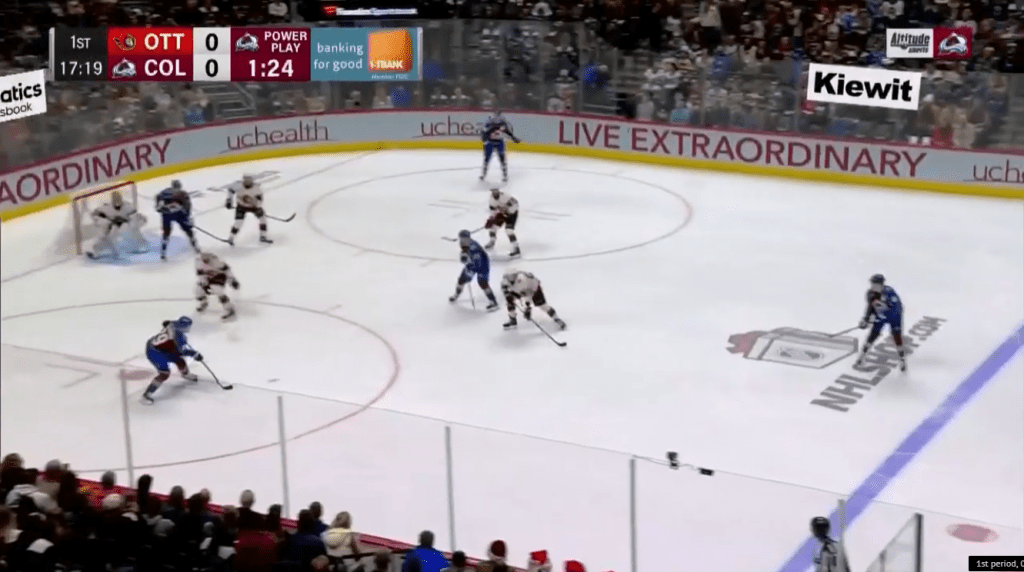
The first goal against resulted from a lost faceoff draw following the penalty. Colorado whipped the puck around, completing multiple seam passes which, to be fair, they do a lot against even the best penalty-killing teams. The problem was that Korpisalo seemed to have trouble tracking the puck. The sequence that led to the goal saw Cale Makar pass to Nathan MacKinnon, moving the puck from the blue line to the faceoff dot. MacKinnon one-touched the puck to the middle, and Korpisalo could clearly see this happening:
However, Jonathan Drouin one-touched the puck back to MacKinnon, and Korpisalo was still looking for the puck in the bumper – partly thanks to the screen from Valeri Nichushkin right in front of him – even as MacKinnon was about to slap home a one-timer for the goal:
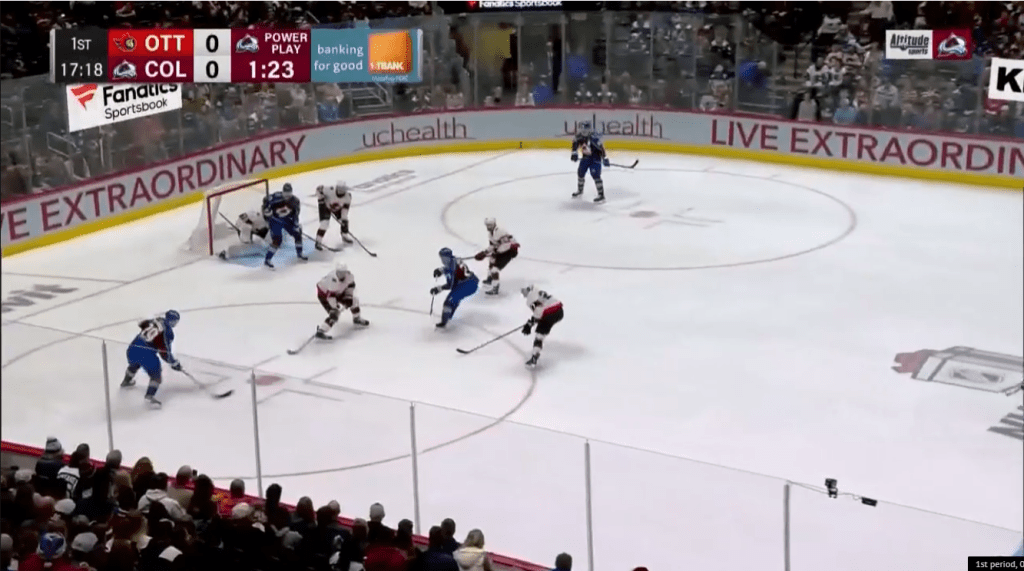
Maybe Korpisalo should have tracked that puck better, but we just saw this exact same thing happen over and over to Connor Hellebuyck in Winnipeg’s playoff loss to Colorado. This is technically an unscreened goal, but it may not have happened without the screen shielding the passing play to begin with.
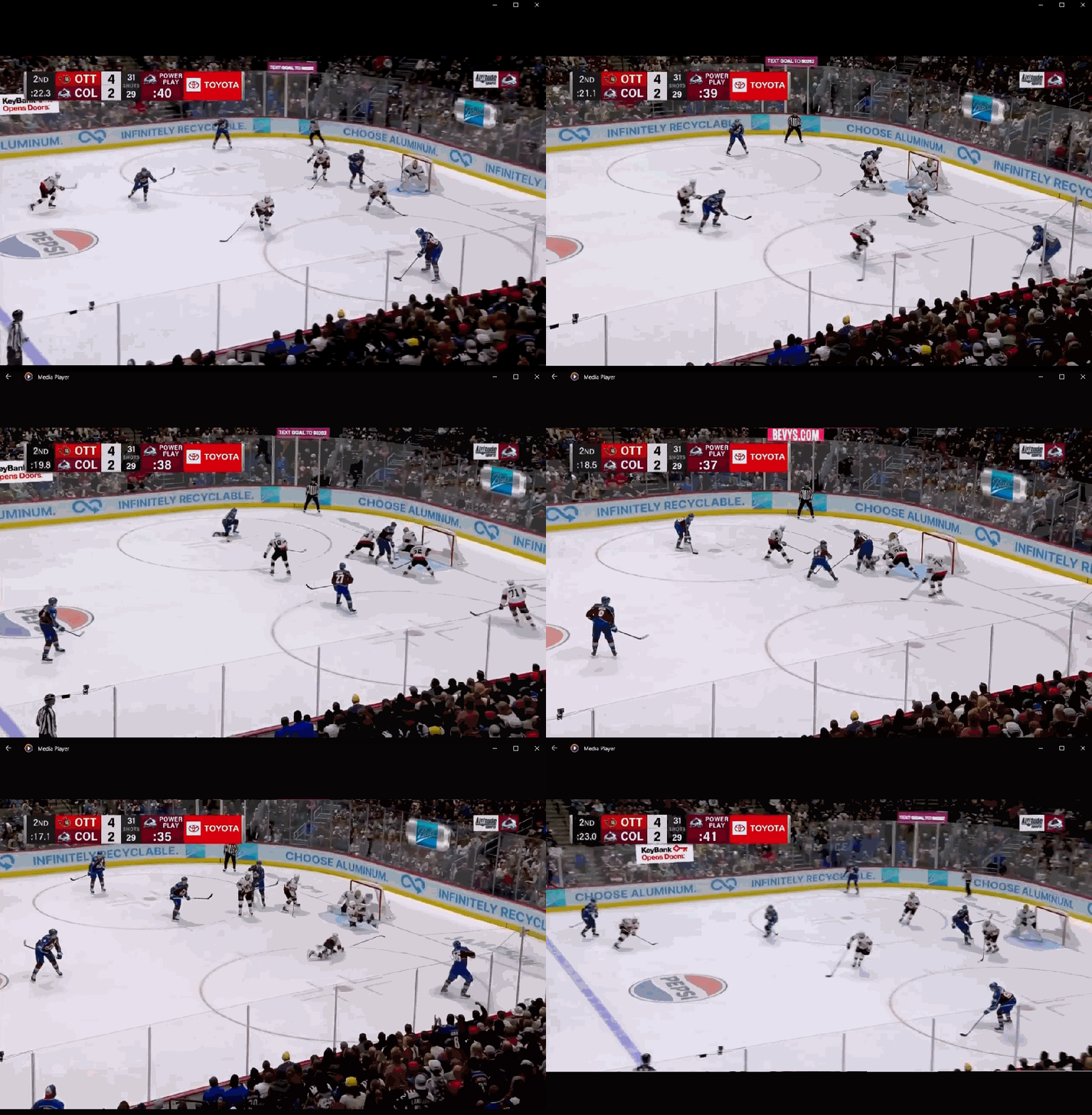
The second goal against was pure fatigue. Senators forwards Tim Stützle and Ridly Greig both jumped on as the second unit with about 1:15 left in the penalty kill. The puck was in Colorado’s zone, so they had to skate back to their end, but an Avalanche turnover led to Stützle and Greig having a 2-on-1 back the other way. They didn’t score and had to skate back to their end of the ice, making it three trips to one end of the rink or the other in about 25 seconds. Ottawa was gassed and couldn’t apply pressure, the Avalanche threw the puck around a bit, and that led to another MacKinnon cross-seam one-timer. Korpisalo actually saved that, but when defenceman Jacob Bernard-Docker tried to clear the rebound, he just passed it right to Mikko Rantanen, who fired it home into a mostly-empty net:
The third goal against was a back-breaker allowed by Korpisalo. There were fewer than 14 minutes left in the game, Ottawa was up 4-3, and half the penalty had already been killed. The Senators had cleared the puck down the ice three times already on this PK, and denied the Avalanche zone entry twice. If they could kill the final 45 seconds, they would have a lead with about 13 minutes left in the game.
Narrator: they did not kill the final 45 seconds.
There wasn’t anything fancy about the goal. MacKinnon got the puck at the left faceoff circle, double-clutched, and Korpisalo was in perfect position to make the save on the incoming shot:
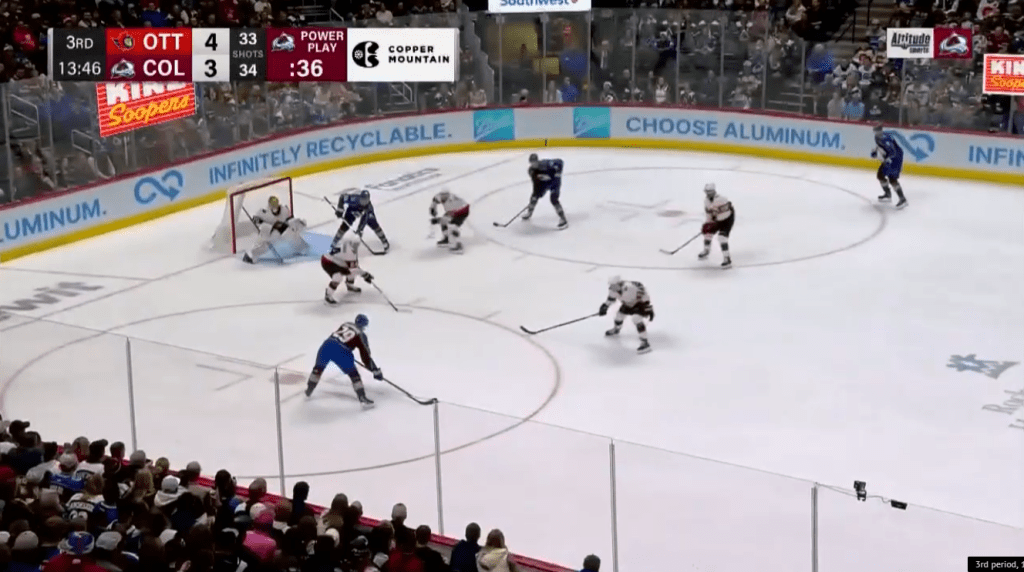
Of course, he didn’t make the save, and MacKinnon ripped it low blocker, which was the exact same spot he scored his first power play goal. That is a must-have stop, and Korpisalo just missed it.
Things went from bad-to-worse as Ottawa challenged that goal for an offside, lost the challenge, and went back on the PK as a result. Rantanen scored from the bottom of the faceoff circle on a redirection and while I don’t know a lot about goaltending, I don’t think a goalie is supposed to have one-third of his body in the net, turned sideways, on a redirection from five feet in front of the goal line:
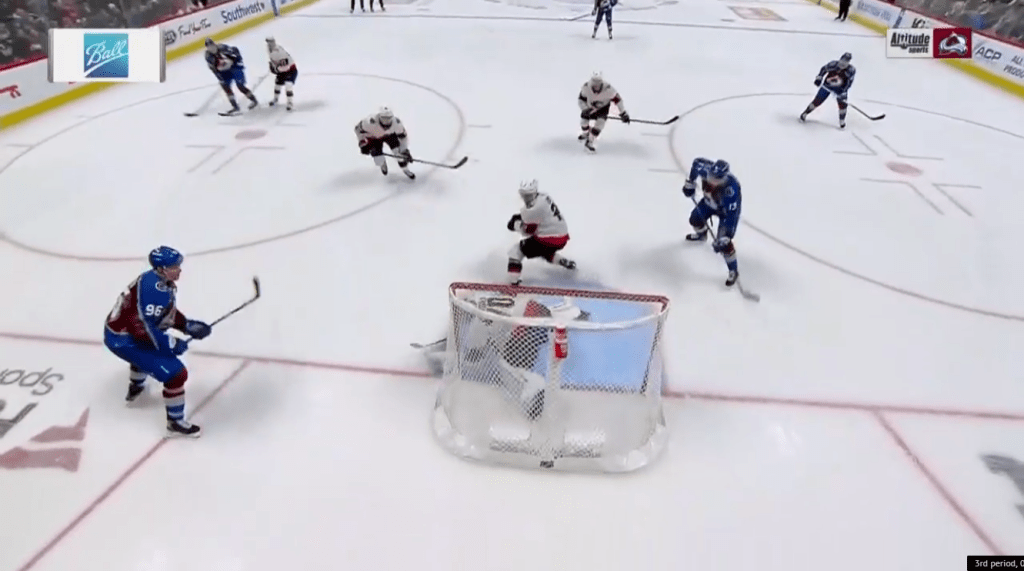
In fairness to Korpisalo, the way Colorado had been moving the puck on the PK basically all game, it’s fair that he thought that was going to be a one-touch pass across his crease. But it wasn’t, and this didn’t look great.
Back in October, Ottawa went into Detroit. Things were going well as Ottawa was up 1-0 with a 14-2 shot advantage and 1:50 left in the first period. A very marginal call against Greig put Detroit on the power play and this is a dandy of a complete breakdown in about 10 seconds.
Dylan Larkin wins the faceoff to Moritz Seider, so Mathieu Joseph rushes out to put on pressure. Claude Giroux follows the supporting Detroit forward, who promptly makes a pass deep into Ottawa’s zone to his supporting forward. He one-touches it to Larkin and in a span of literally five seconds, Detroit has completely broken Ottawa’s PK ‘structure’ to create a 2-on-1 down low, which is a one-timer promptly fired home by Shayne Gostisbehere:
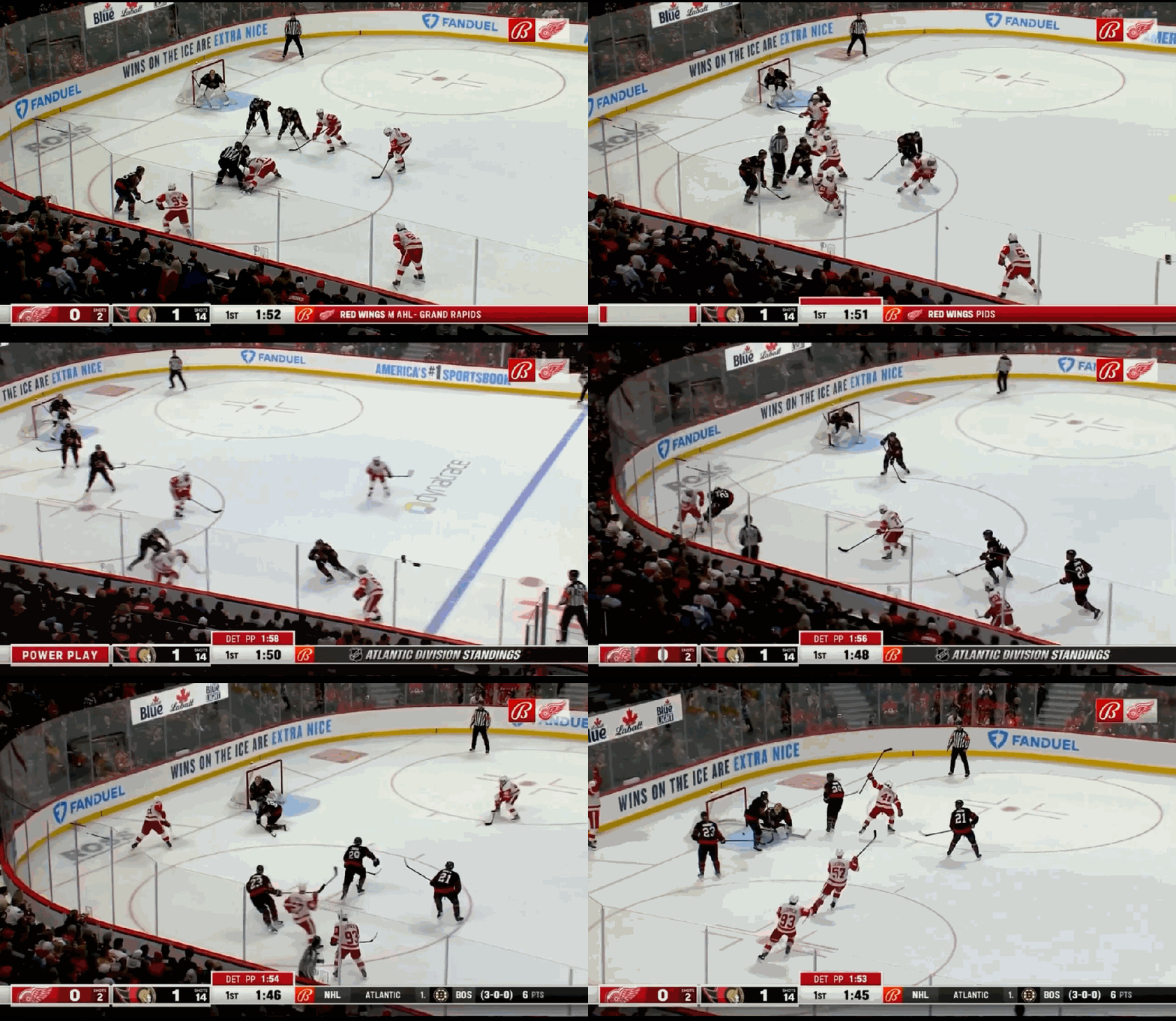
Tough to blame Korpisalo for his team falling apart like this.
The next goal against is with Erik Brännström patrolling the front of the net. David Perron is standing about three feet away and after Brännström stuffs the initial shot, he lets Perron take another instead of tying up his stick or taking the body or literally anything but what he did:
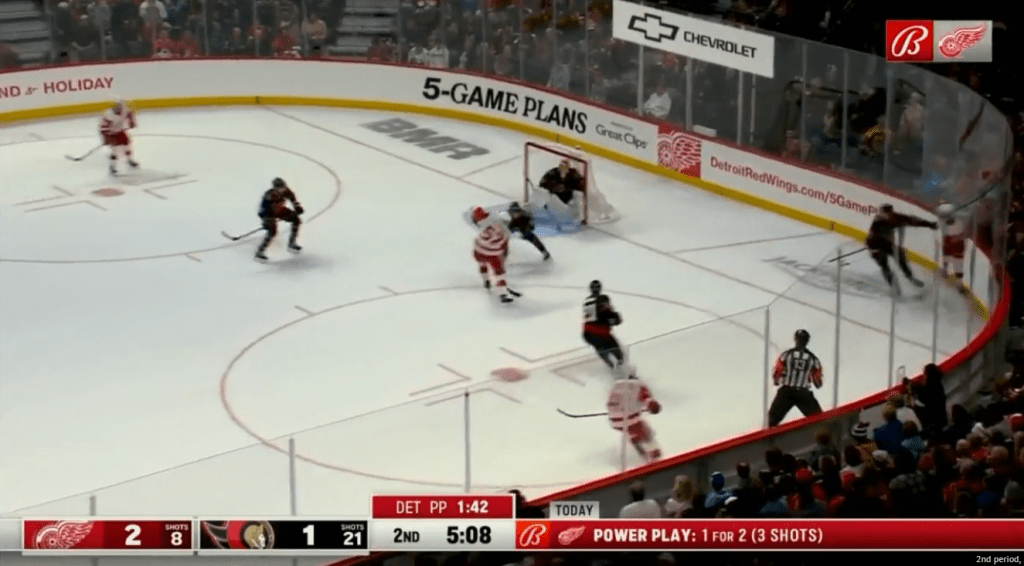
That snapshot is Brännström preventing the first shot. Perron takes another one fractions of a second later to go top shelf on the short side. Again, hard to blame Korpisalo for that one if his defenceman is going to allow his mark to take multiple shot attempts from about 10-12 feet away.
Detroit’s third power play goal of the game is one of those plays where a minor detail led to a goal against, and effectively sealed the win for the Red Wings.
Seider has the puck at the blue line, having just received a pass from Alex DeBrincat. Ottawa’s Parker Kelly had pushed out to DeBrincat for pressure, so Kelly switches to Seider after that pass is made. At this point, Kelly is now responsible for cutting off the passing lane back to Seider, which he does, and Seider passes to Gostisbehere on the halfwall. However, as Ottawa’s Rourke Chartier turns to pressure Gostisbehere, he leaves his stick to the right and in the passing lane going back to Seider instead of to his left and in the lane going to the middle of the ice:
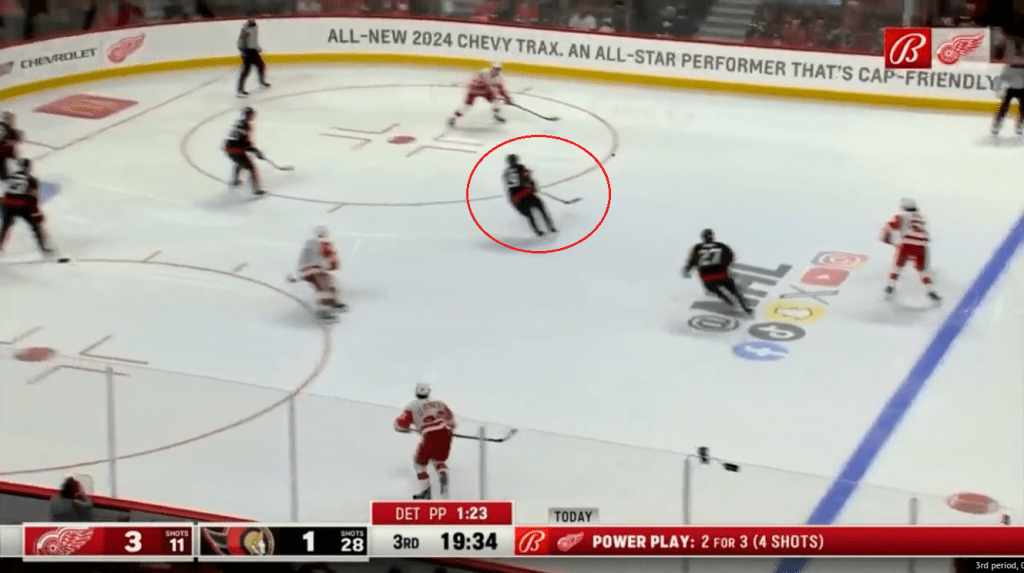
That leaves an 18-wheeler-sized hole in Ottawa’s PK structure, and guess where the puck goes next thanks to a one-touch pass:
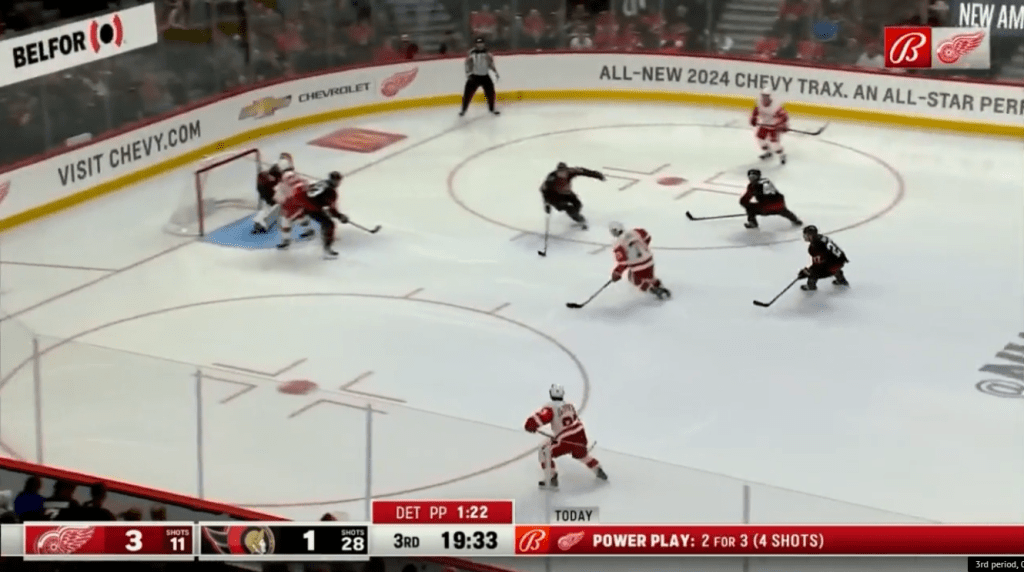
I surmise that leaving a clear passing lane to the slot for a clean 20-foot look from Dylan Larkin isn’t in the game plan.
Three goals against in this game: one was a complete breakdown in about five seconds, one was allowing the same player multiple shot attempts from maybe 12 feet away, and one was a missed detail that led to a high-end scorer having a clean look from a prime scoring area. Ottawa would probably like Korpisalo to stop at least one of them, but it’s hard to hang any of those on him, either.
Alright, let’s get to another game that saw three PK goals allowed, this time in Florida at the end of November.
The first goal against should have never happened. Ottawa wins the faceoff and Artem Zub has the puck behind the net in this spot:
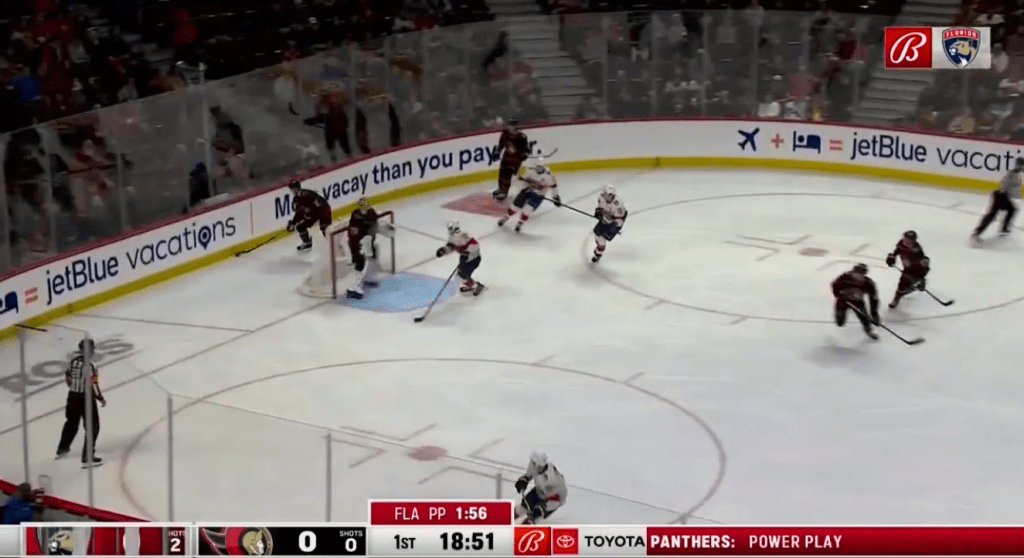
Not only does that puck not get cleared, but he mishandles it, and Florida is able to instantly put pressure on behind the goal line. If that puck is cleared – and it should have been – then none of what happens next actually happens.
To make matters worse, Ottawa compounds that Zub flub with more mistakes.
Aleksander Barkov has the puck on the half wall. There is no cross-seam pass available to Sam Bennett, there is no real lane for a pass to Sam Reinhart in the middle of the ice, so the options are back to Brandon Montour on the blue line or down low to Matthew Tkachuk:
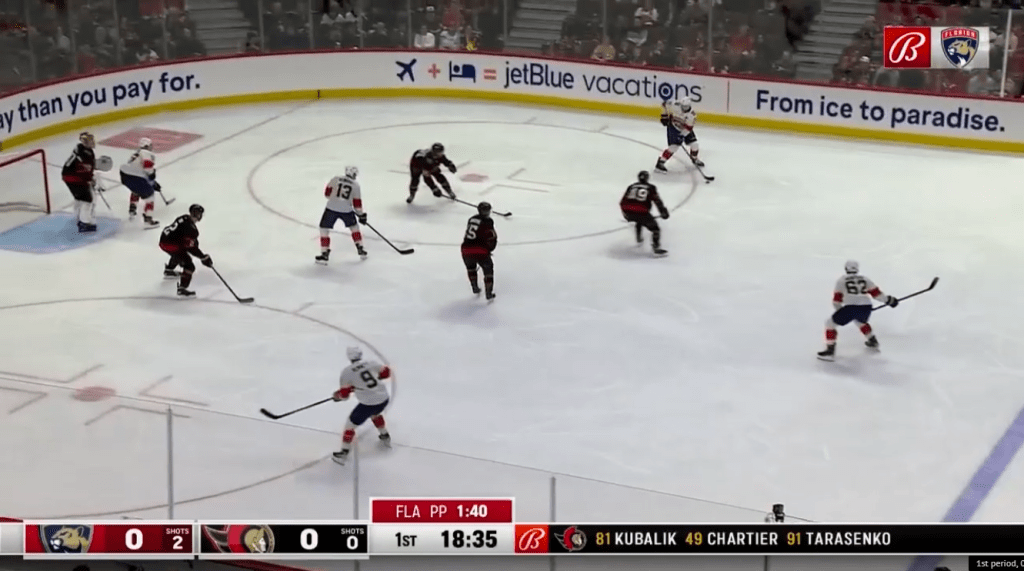
It all looks fine, right? Well, Jake Sanderson leaves his feet moments later and as soon as he does, Barkov goes down low to Tkachuk. Because Sanderson left his feet, he can’t get back in position to take away the pass to Reinhart in the middle, who eventually scores the goal:
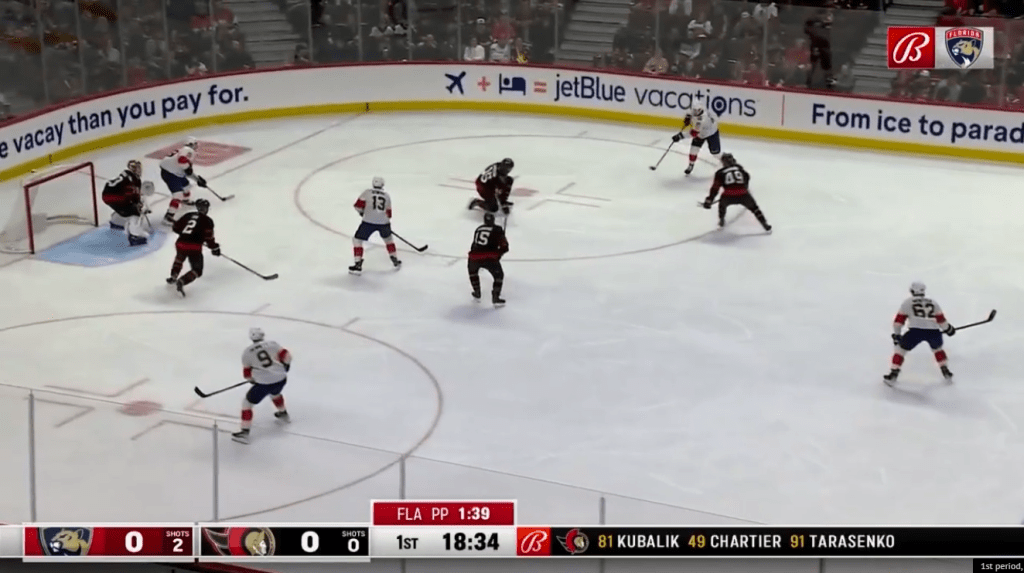
Clean one-timers from 15 feet away is a tough way to live on the penalty kill.
The next goal allowed is an interesting one. Florida rims the puck in from just inside Ottawa’s blue line, Korpisalo goes behind the net to stop it but it jumps over his stick. Reinhart picks up the loose puck and wraps it around and in the net before Korpisalo can get back in. It looks like a bad goal on the goalie, without question.
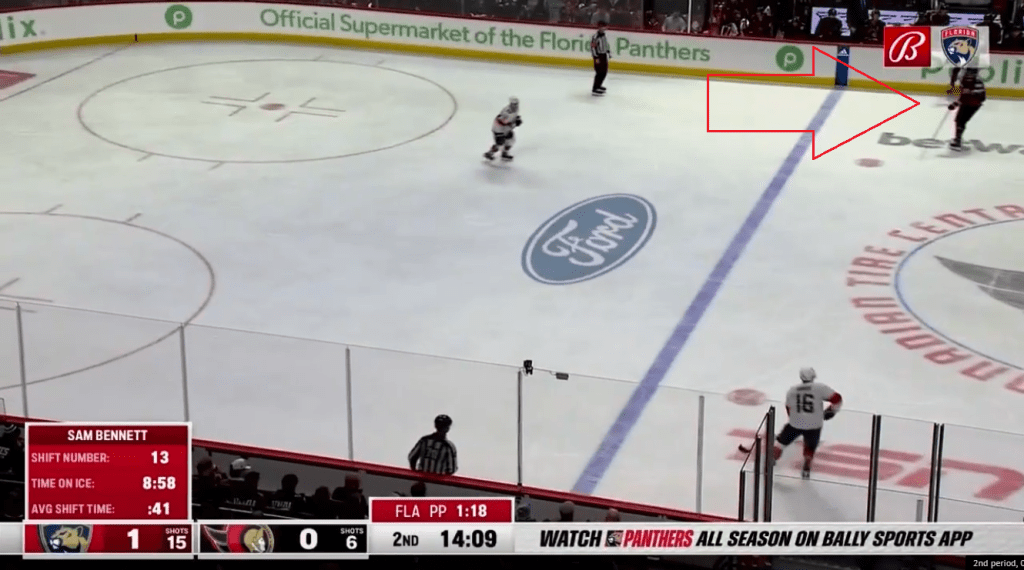
The interesting part is that this is the second period, so there is a long change. Ottawa had cleared the puck seconds earlier, but it only gets to the red line rather than deep into Florida’s Zone. Claude Giroux goes for the change seven seconds after a face off (?) but because it’s a long change, and the puck only gets to the red line, Barkov can whip the puck across the ice to the area left empty by the changing forward. It is hard to see behind the logo on the top right, but you can see the change happen as Barkov circles with the puck:
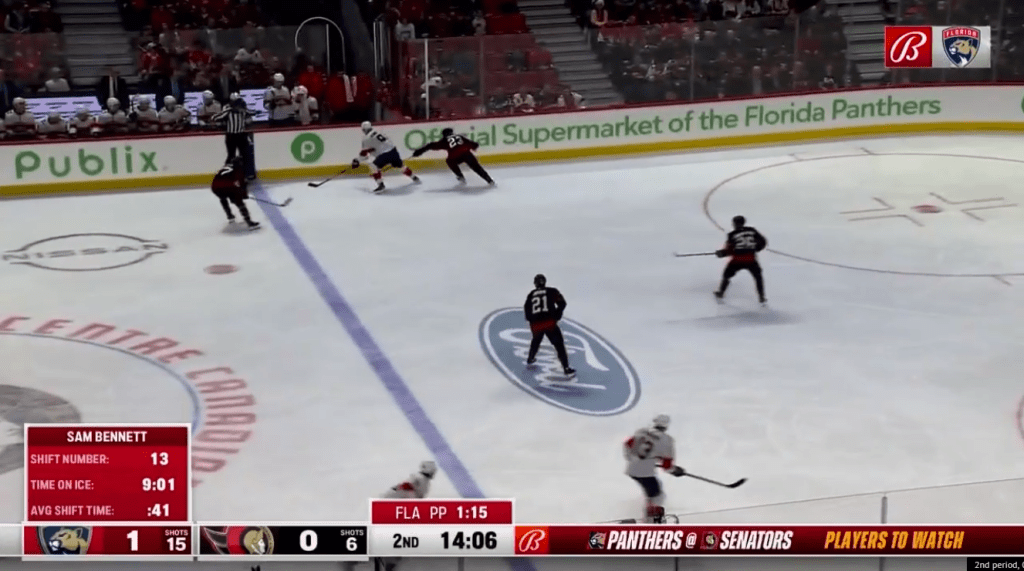
That puck goes to Sam Bennett, who is able to delay long enough at the blue line to let his wingers catch up on the far side. Because that was an easy cross-ice pass for Barkov, and Ottawa doesn’t want to let Bennett just walk to the top of the circle with the puck, the Ottawa defenceman puts pressure on Bennett. However, the changing forward is also coming from the bench to put pressure on Bennett, which leaves just two Ottawa defenders (one of them a forward) to guard about 98% of the defensive zone:
Now, Korpisalo doesn’t stop the puck behind the net, and that allows Reinhart for a wrap-around goal. However, because the forward changed with the puck still at the red line, there was a clear cross-ice pass open for Florida. Because that cross-ice pass happens, the Ottawa defenceman has to pressure the recipient of that pass to ensure he doesn’t have a clear lane to a good shooting position. But because that changing forward is behind the play, and that defenceman has to step up, Florida has a 3-on-2 from the hashmark and below. Any sort of pressure on Korpisalo would give Reinhart not only the chance to wrap the puck around, but pass to the slot to Barkov, or across the seam to Tkachuk:
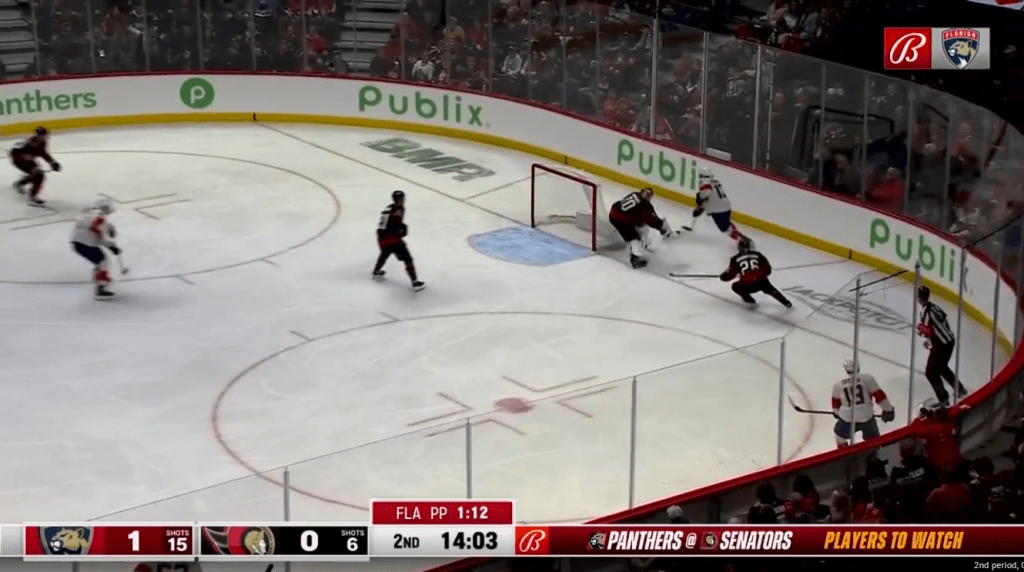
If Korpisalo stays in his net, maybe none of this happens, but it shows how one mistake – a bad change mere seconds after a face off – snowballs into a goal against that should have never happened for one reason or another. I have a feeling this will become a theme, if it hasn’t already.
Florida scores another power play goal 1:10 later because Ottawa challenged that last one for an offside, lost, and got penalized for delay of game (again!). That power play goal is scored because Travis Hamonic gets absolutely walked by Bennett despite Ottawa having done a good job of containing and clearing. This:
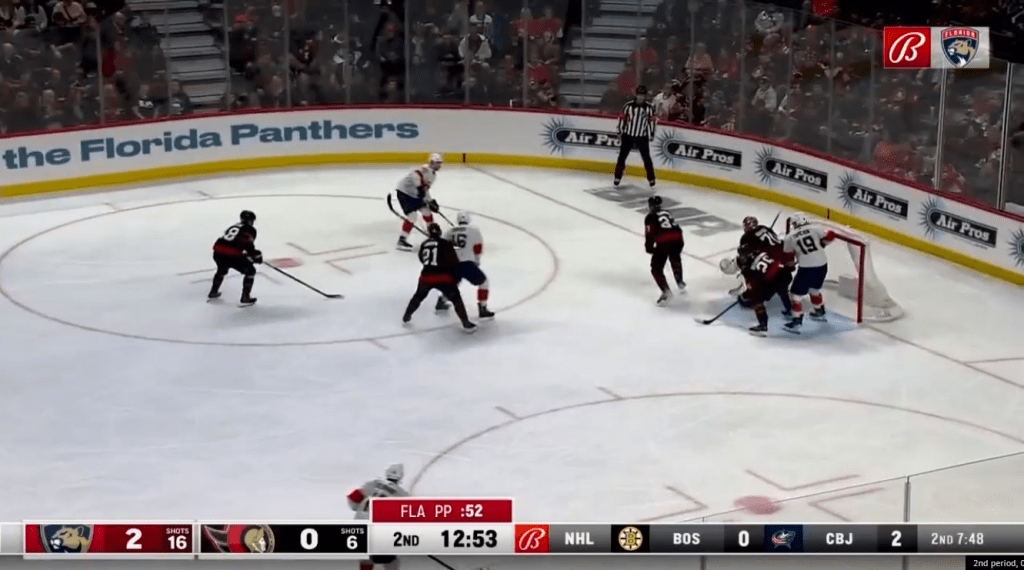
Turned into this:
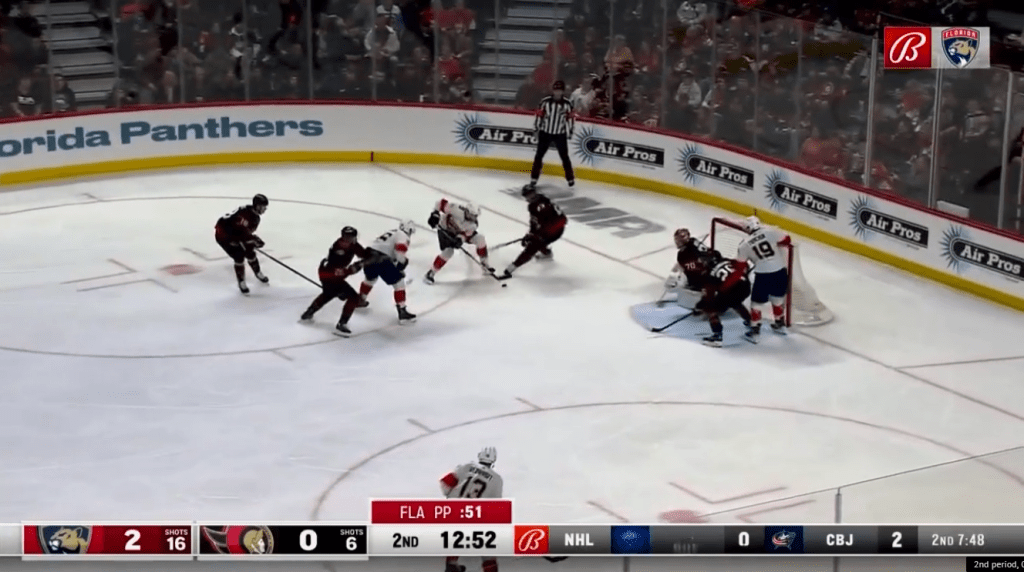
Not sure what Korpisalo is supposed to do here but yell at Hamonic.
This was a game where Ottawa allowed three goals on the PK, and maybe one is on Korpisalo for leaving his net and not stopping the puck, but there were Senators breakdowns on all three goals: an open passing lane to the slot, a long change moving everyone out of position, and a defenceman getting danced around. Those are a lot of brains farting.
At this point, we’ve only covered three games but 10 power play goals against. Of those 10 goals, four were off of seam or behind the net passes and one was a clear screen. In other words, at least half the goals are not really attributable to Korpisalo, which should start to turn the conversation a bit.
On December 1st, Ottawa allowed two power play goals against Columbus (ouch). The first was an interesting screen from Jackets forward Boone Jenner as he was skating from the boards to the net front as Patrik Laine was loading up for a shot at the top of the circles:
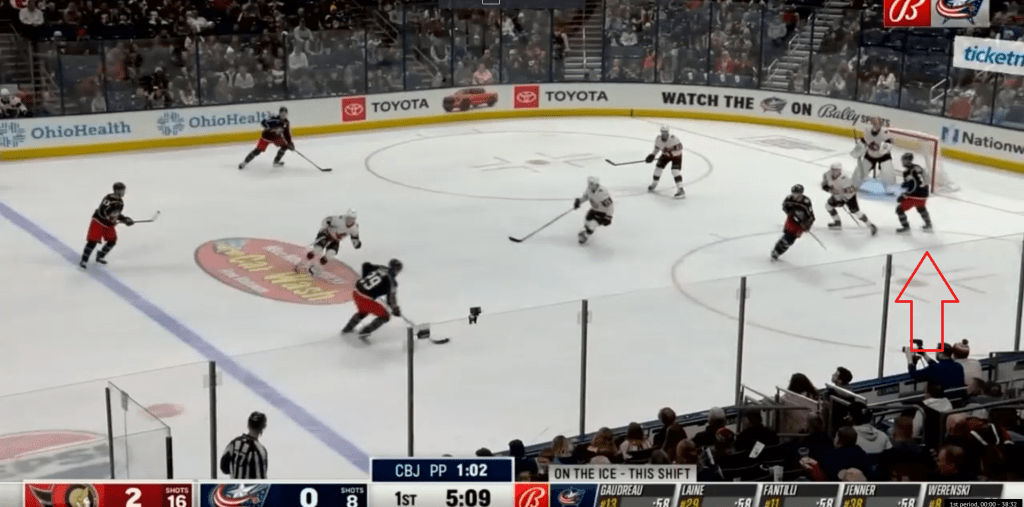
Jenner gets right in front of Korpisalo as Laine is about to shoot:
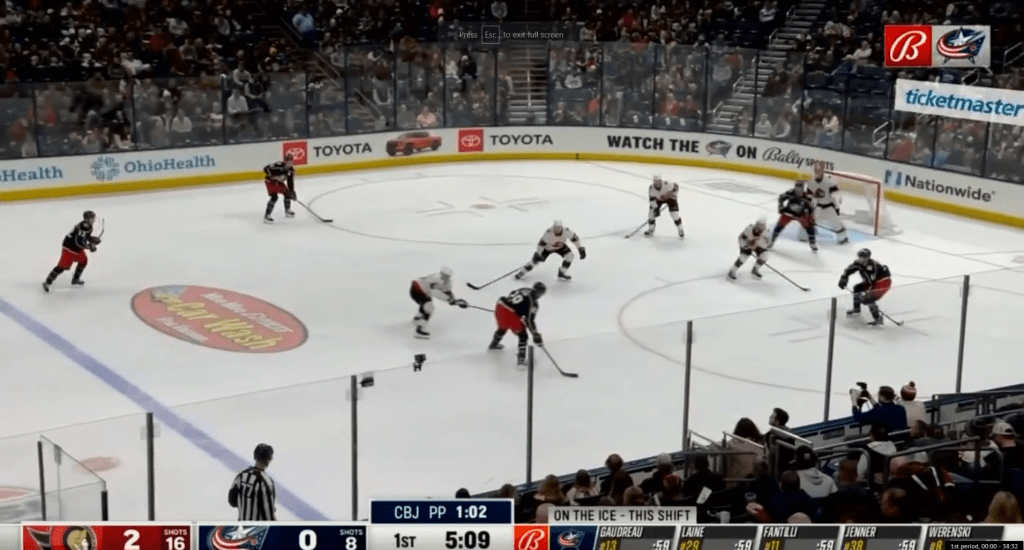
And then he gets out of the way the instant Laine takes his shot:
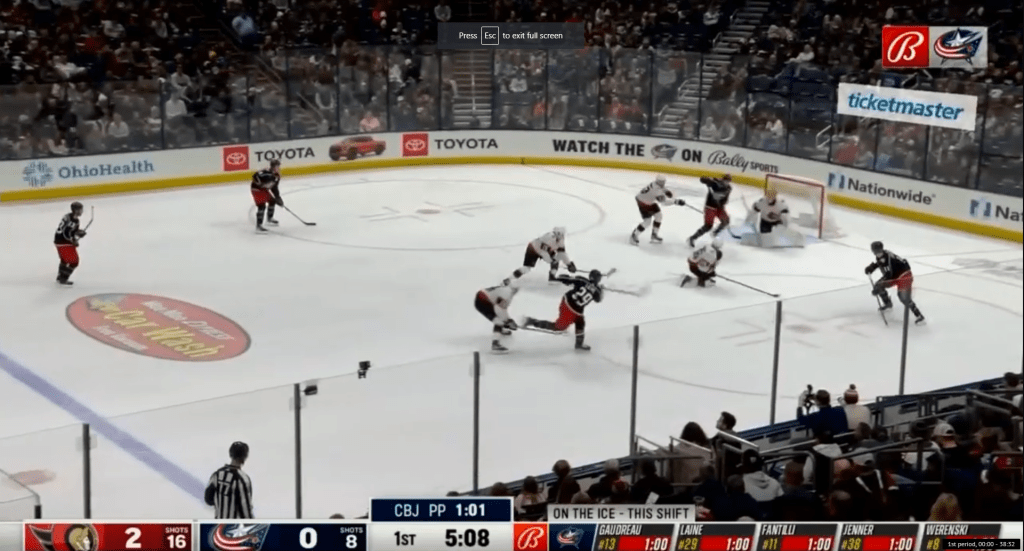
That is a great moving screen from Jenner and it’s hard to fault Korpisalo for giving up a 35-foot Laine wrist shot off the post when he was screened at the time of release.
The following play didn’t result in a goal against, but here is Zach Werenski being contained by three Ottawa penalty killers. Literally two seconds later, Werenski has a clean shot from the high slot:
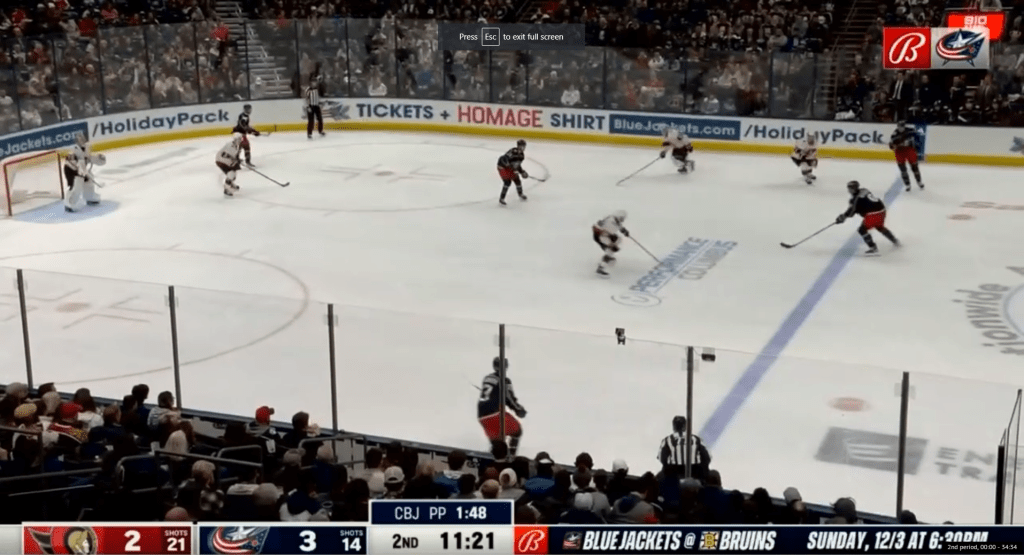
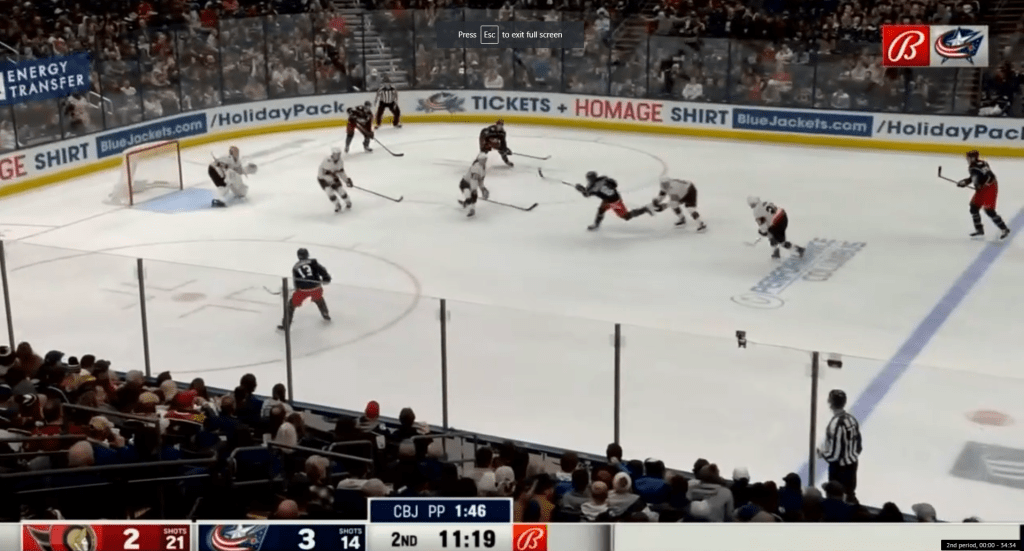
Suboptimal? Let’s go with that.
About 12 seconds later, a point shot from Werenski results in a deflected goal from Jenner, who was basically responsible for both of Columbus’s PP goals.
A couple of weeks later, Ottawa was at home to Carolina and gave up two more goals against. The first one was a case of over-aggression as Carolina had a fumble at the blue line, and that got two Ottawa Senators forwards chasing towards the neutral zone. That left two-thirds of the offensive zone wide open:
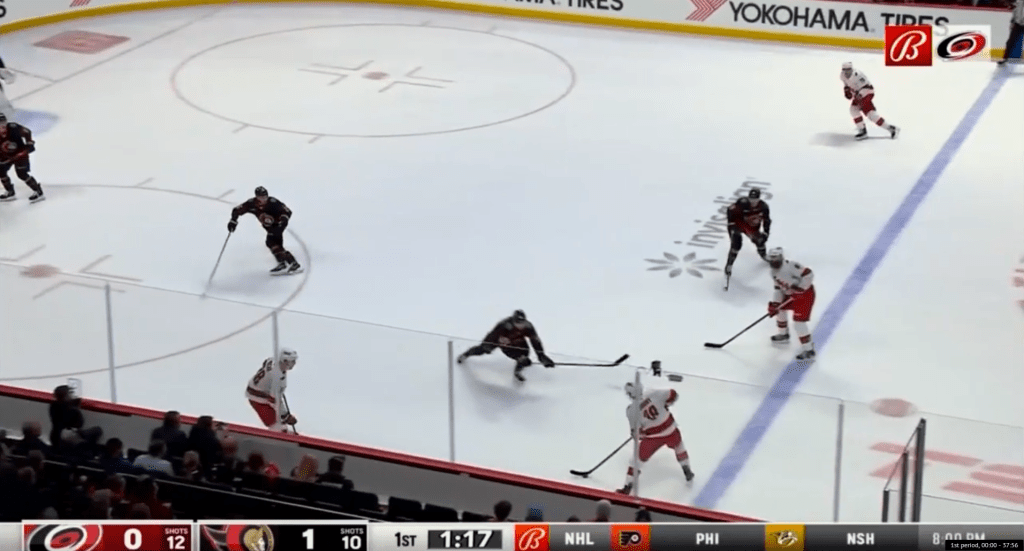
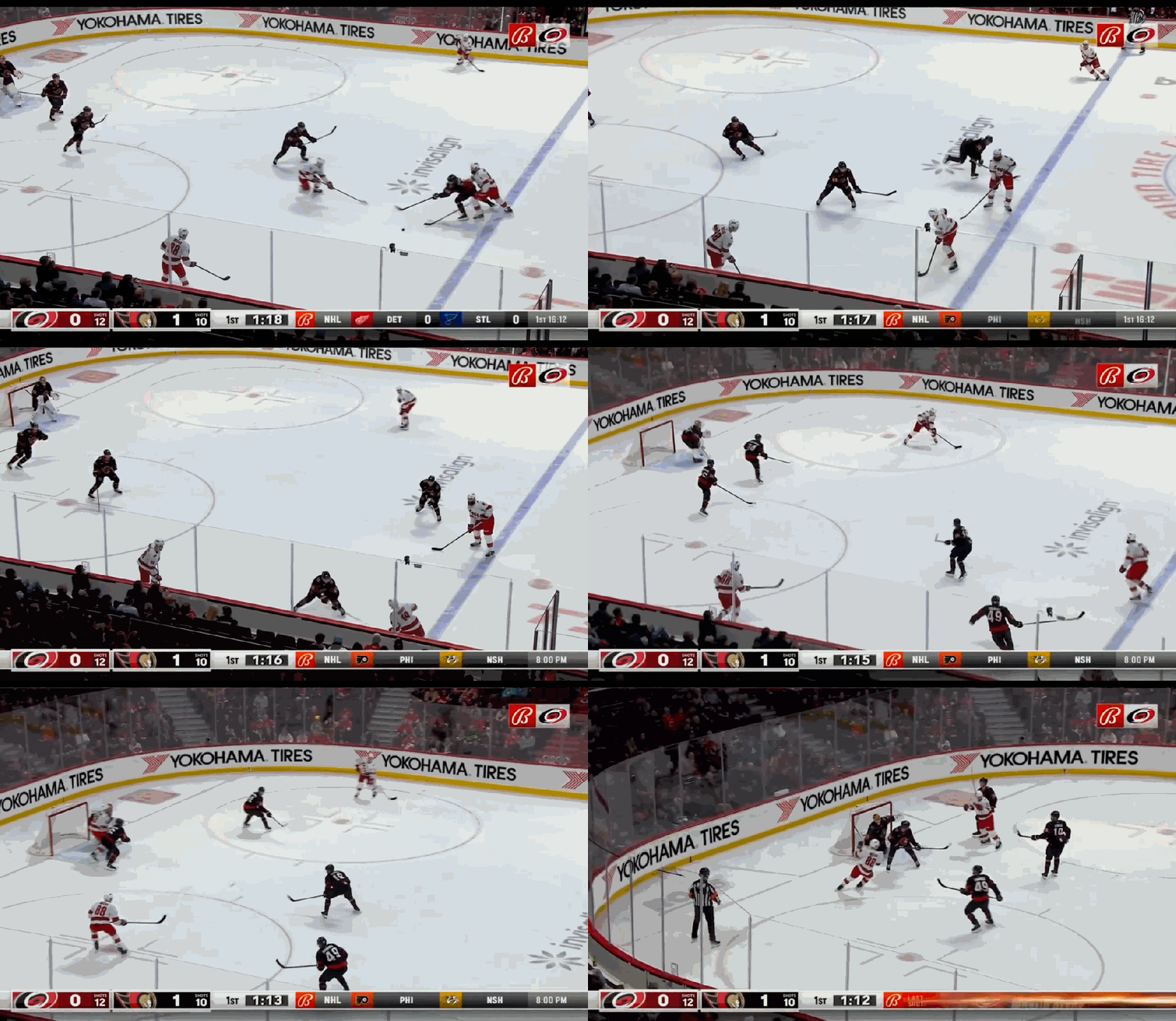
Two seam passes later, and the puck was in the net:
The second PP goal against that game was another shot from the top of the circle and another great screen, this time by Seth Jarvis:
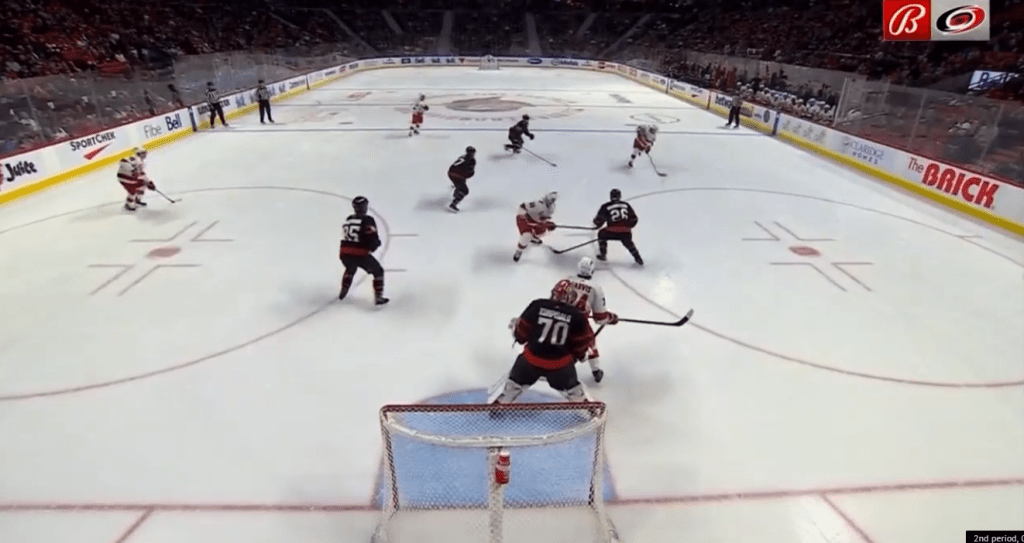
An assist should have been handed to Brännström for his screen, too.
A few days later, Ottawa was in Vegas and things didn’t go well by giving up two more power play goals against in a 6-3 loss. The first was a wild one as Ben Hutton was bringing the puck up the ice and the *entire way* he’s starting down Nicolas Roy:
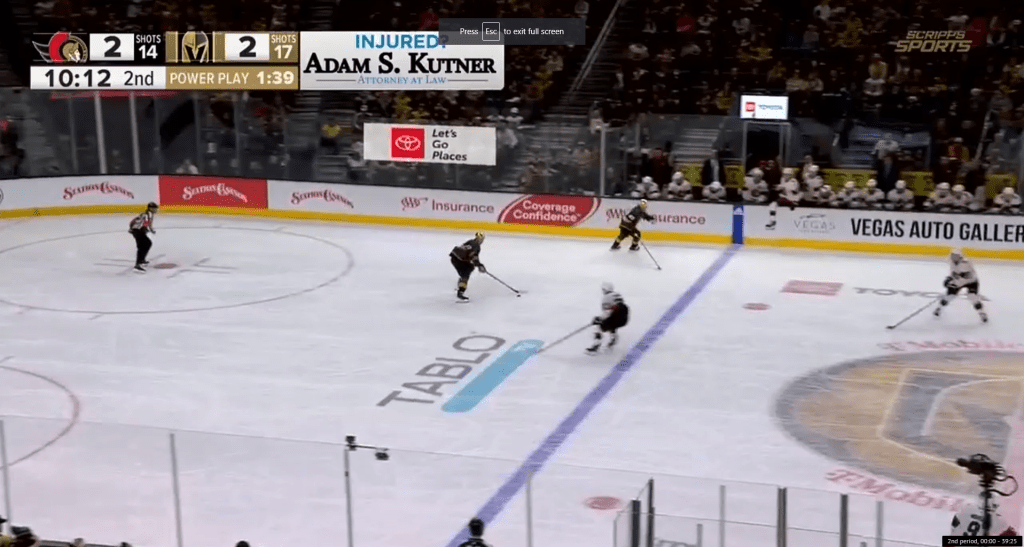
And this happened two seconds later:
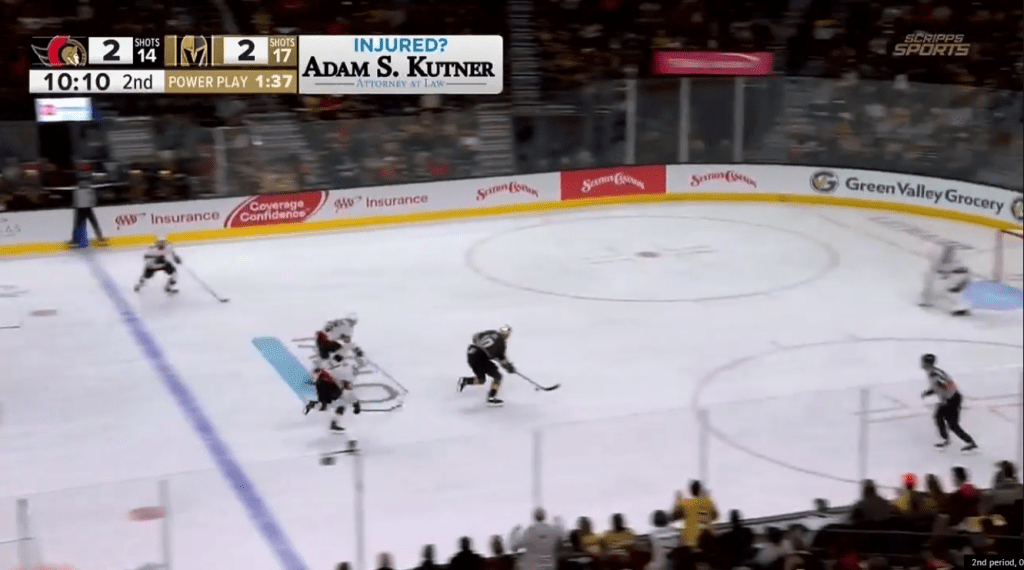
Allowing Ben Hutton to give Nicolas Roy a clean power play breakaway? The bingo card is getting full.
The next goal is something to behold on Claude Giroux’s behalf. He is basically stationary in the slot for a few seconds, and then chases out to the blue line after Alex Pietrangelo (?). Not only does that leave a clean seam pass across the zone to Jonathan Marchessault (which isn’t what happens), but it allows Mark Stone to leak out to the slot for a very clean look from about 20 feet. William Karlsson then has two cracks at the ensuing rebound:
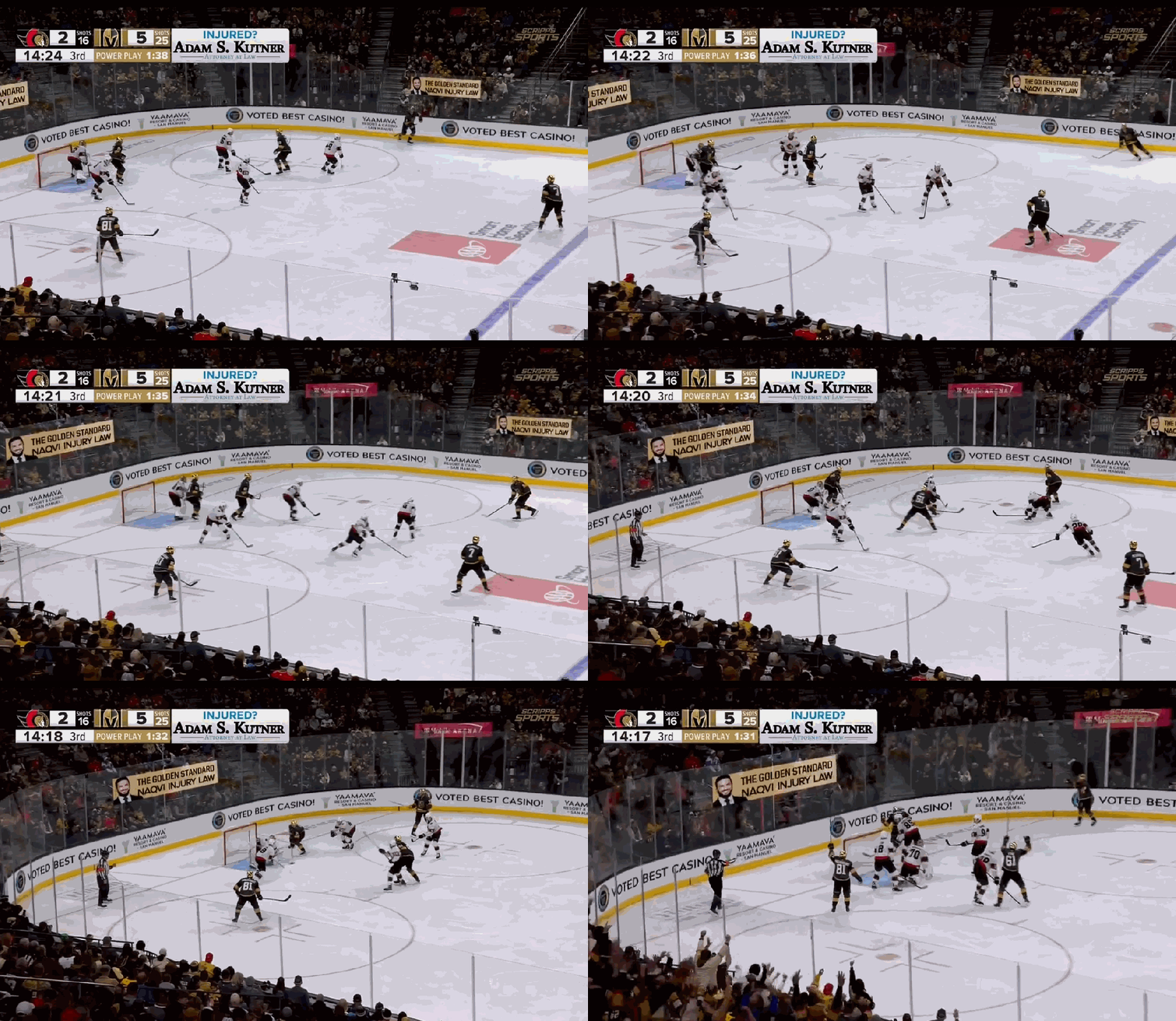
This type of wedge PK is common, but the point is that the second forward isn’t supposed to chase to the blue line when the first forward is already out there. Their role is to work in tandem with the defencemen to prevent the exact types of passes left open by Giroux’s puck-chasing when the first forward is hunting the puck. Maybe the first forward should have settled into the slot and let the defenceman push out to the wing, maybe not, but it’s clear there was a miscommunication somewhere. In other words, what in the Cinnamon Toast Fuck was that?
The next game we’ll show is the end of December, a 6-2 loss to New Jersey when Jacques Martin has fully taken over behind Ottawa’s bench. Ottawa again allowed two PP goals against and the first is on a moving screen like we saw from Boone Jenner in Columbus a couple of games ago:
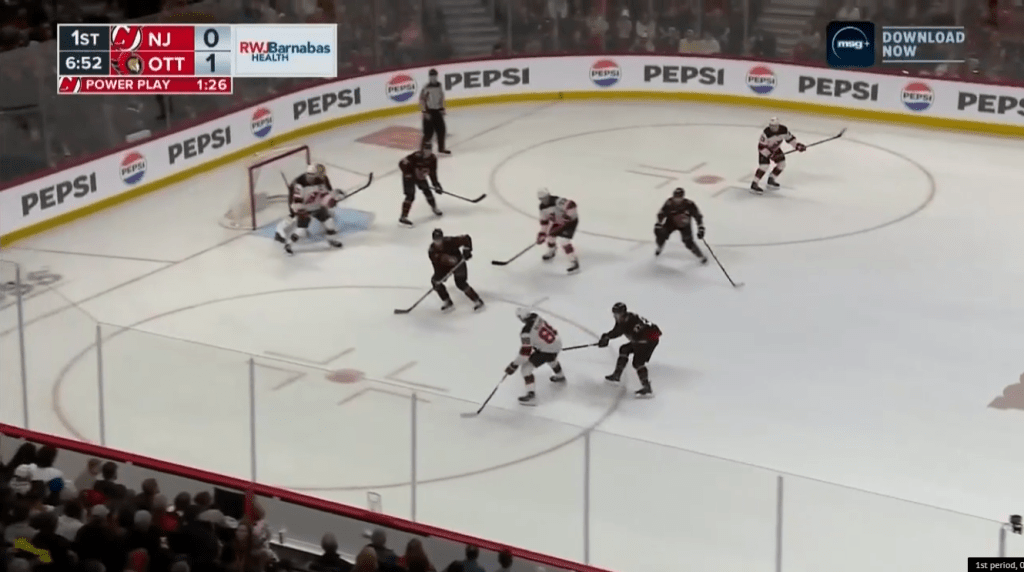
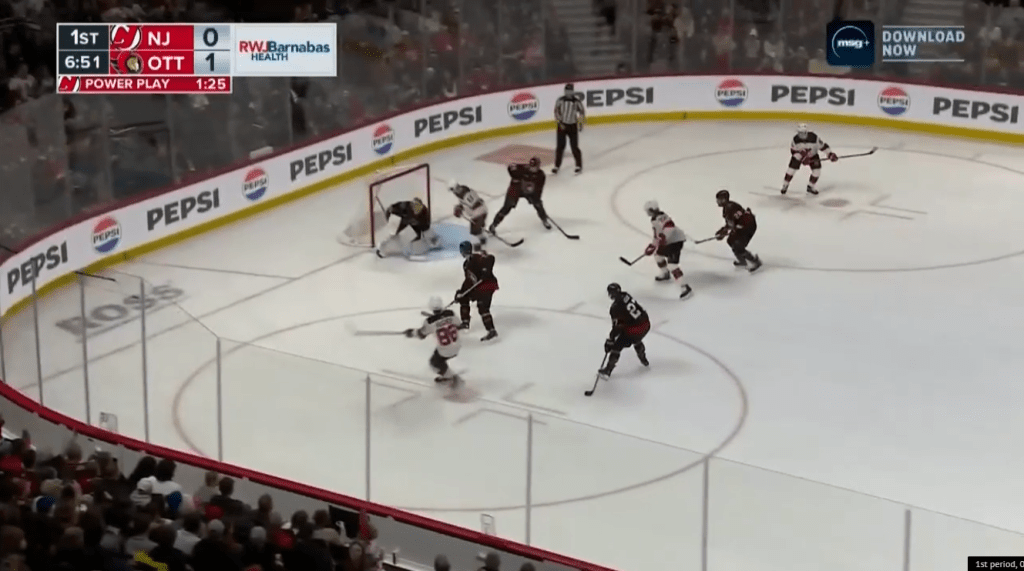
It is a nice screen from Nico Hischier, but good on Jack Hughes for recognizing that Korpisalo was looking in the direction the shot was going to go as he slid across the other way in anticipation of a short-side shot:
The Devils scored later in the first period as Ottawa has very good chances to get the puck out and fail to do so. The first is Stützle failing on this backhand:
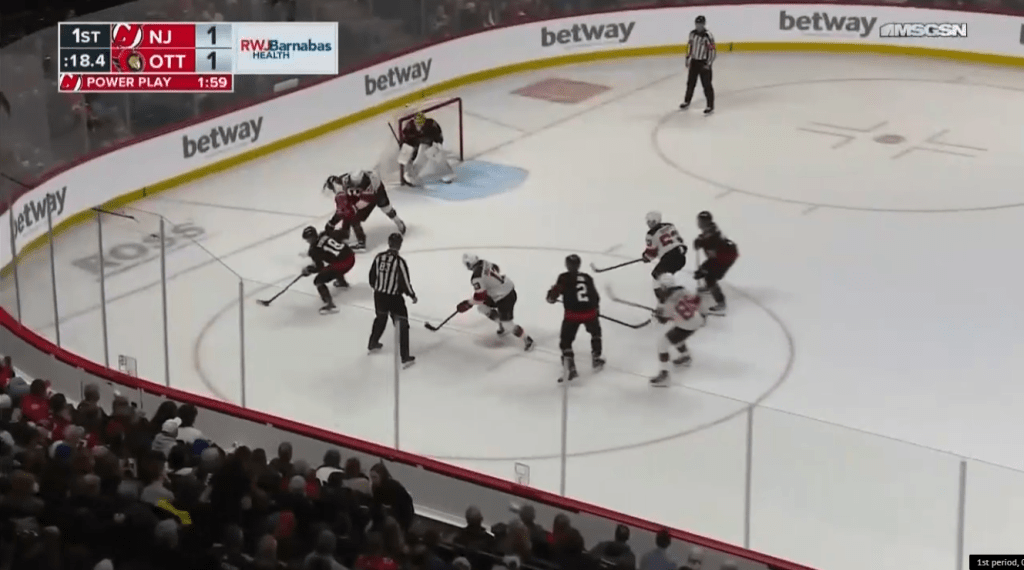
And a couple of seconds later, Greig has an even better chance on his backhand, yet this doesn’t clear the zone, either:
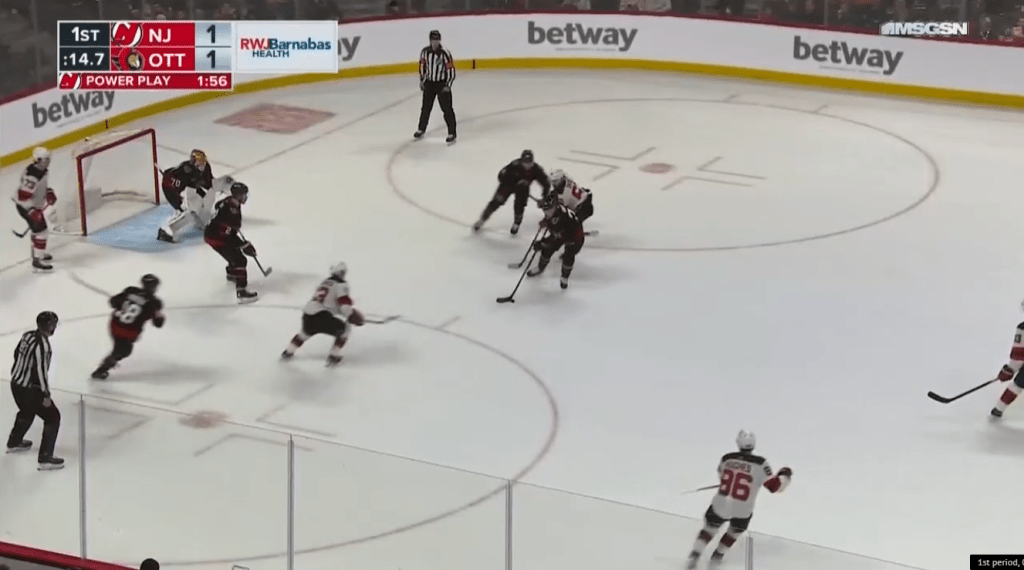
The ensuing scramble gives Jesper Bratt a clean look from the dot even as he has passing options, but he finishes it by going bar-down on the far side:
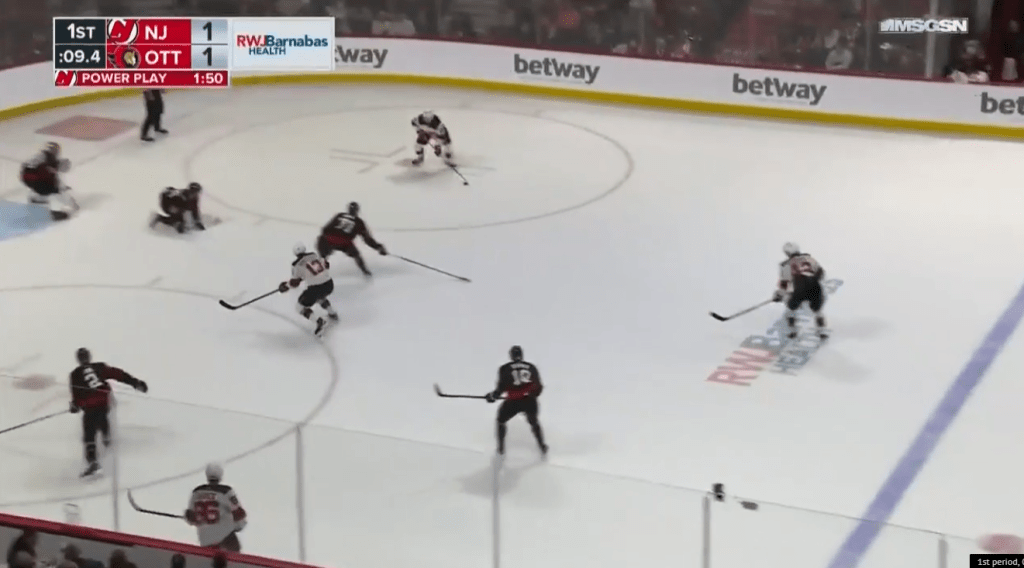
Probably a goal Korpisalo should have had, but the only reason Bratt was in that position to begin with was a complete failure by two different Ottawa penalty killers having two clean looks to clear the zone, and neither could manage it. And even if Bratt doesn’t shoot, he has great passing options. Just clusterfuckery of the highest order.
Moving ahead to February, we have a 5-1 loss at home to Anaheim where Ottawa gave up two more PP goals against. The first one is one of those Tip The Cap-type of goals as Frank Vatrano pounded home a one-timer from about 25 feet, going bar-down. No one was saving that and there wasn’t anything that stood out as a problem from a defensive perspective.
The second goal was firmly on Korpisalo as Cam Fowler scored on a point shot that snuck under his arm. Sometimes, the goal against is just bad.
Next up is a 2-1 loss in San Jose where both goals against were on the penalty kill. Double ouch.
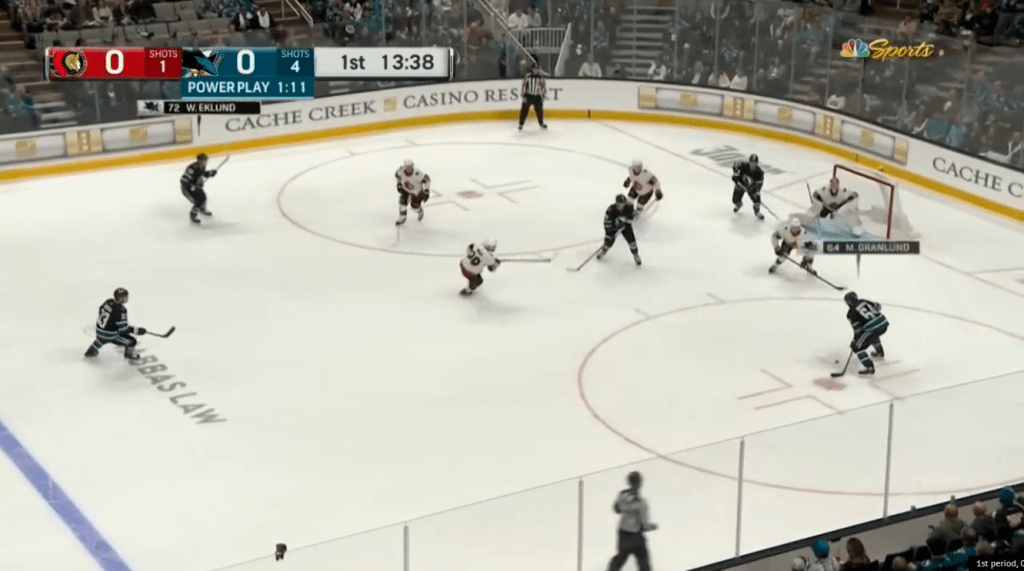
For the first goal against, and stop me if you heard this before, but Giroux was slow cutting off the pass from the half-wall to the middle and the puck was in the net within two seconds (Thomas Bordeleau deflected the slot shot):
For the second goal against, and stop me if you heard this before, but the Senators had a chance to clear the puck and failed to do so:

The Sharks get the puck behind the net and I have no idea what is going on with the Senators here. Why is Artem Zub facing the crowd?
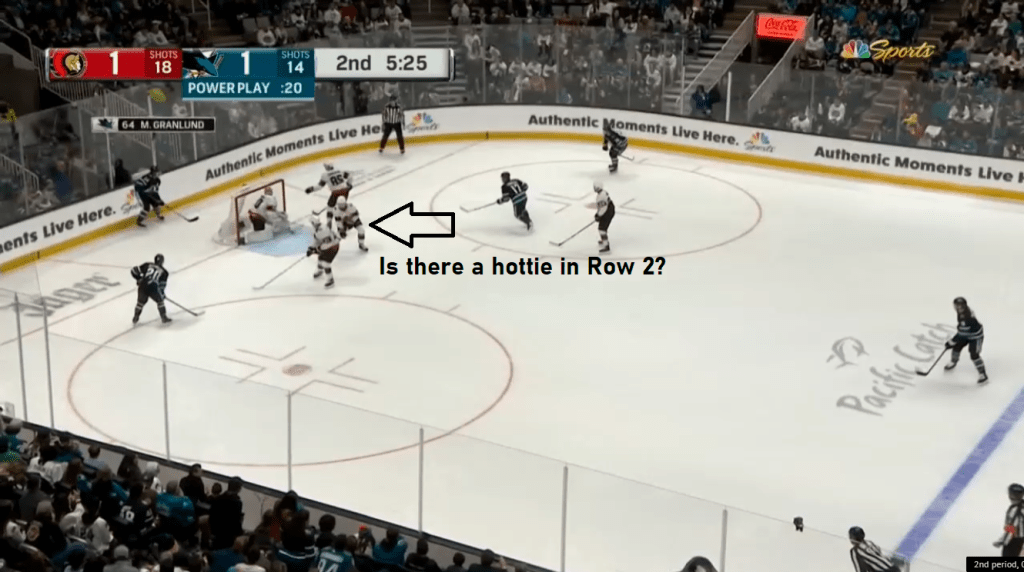
Anyway, Bordeleau opens up for a pass from behind the net and buries the one-timer. There are two Sens penalty killers standing in the crease and no one within five feet of Bordeleau. New coach, same habits.
Ten days later, Ottawa was in Boston and got their brains beat in 6-2. The first goal against was from Justin Brazeau, who was standing in front of Korpisalo for the screen. He has time to corral the rebound, shift to his forehand, and bury the puck:
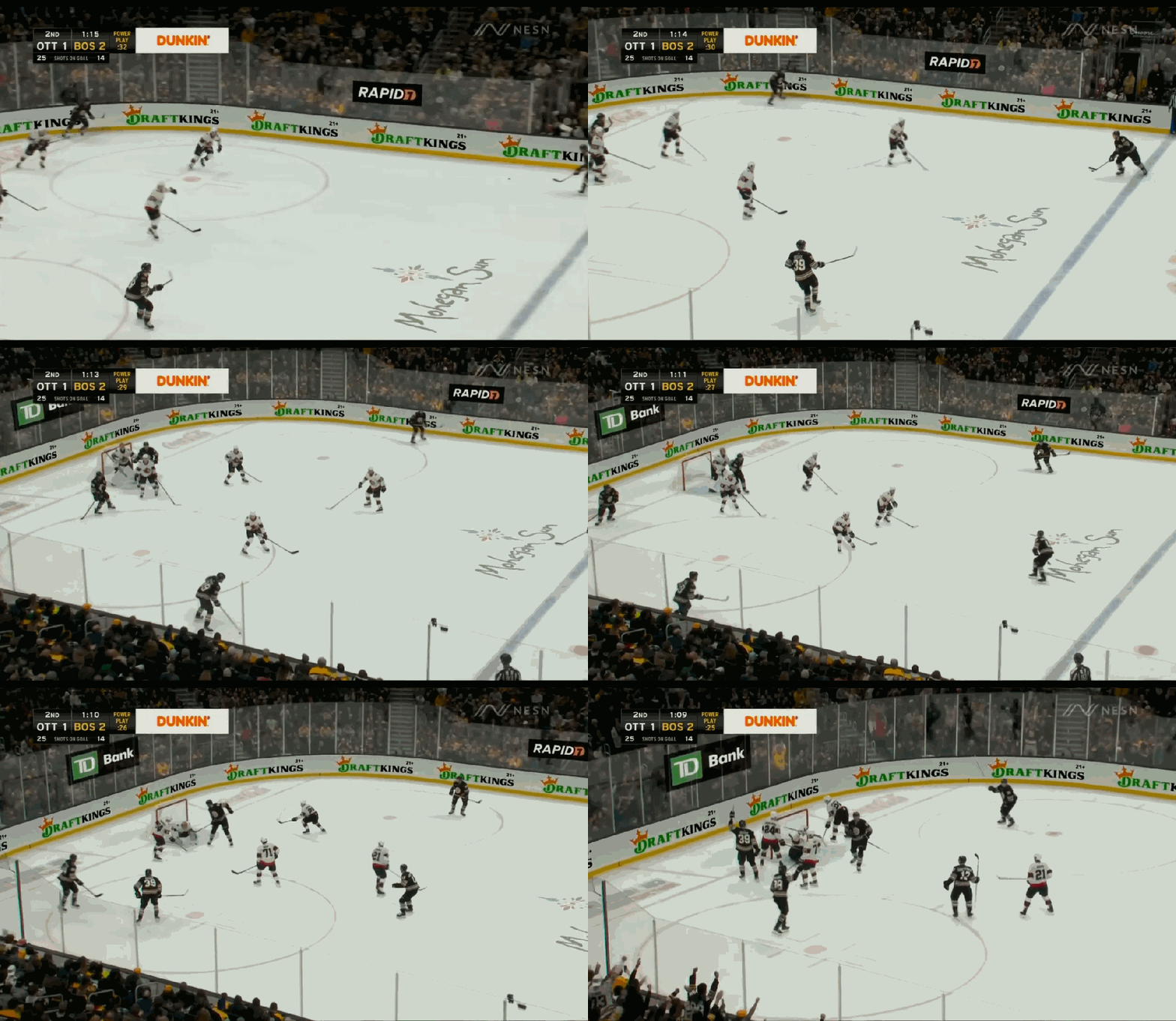
It is wild how often opposing PP forwards are not only left alone in front of Korpisalo, but there is no penalty killer in range to close out on the rebound. That positioning is fine as long as the penalty killers are in position to close on the rebound if there is one, but it’s clear they struggled completing the second half of that task quite often.
As for the second goal against, Ottawa gave up a 2-on-0 earlier in the penalty kill, which wasn’t a great sign. They had a clean chance to clear the puck, and didn’t (quelle surprise). But they again let a player walk to the front of the net with the puck and bury it. It was Brazeau again, and it’s safe to say things aren’t going well when you give up two PP goals in the same game to Justin Brazeau:
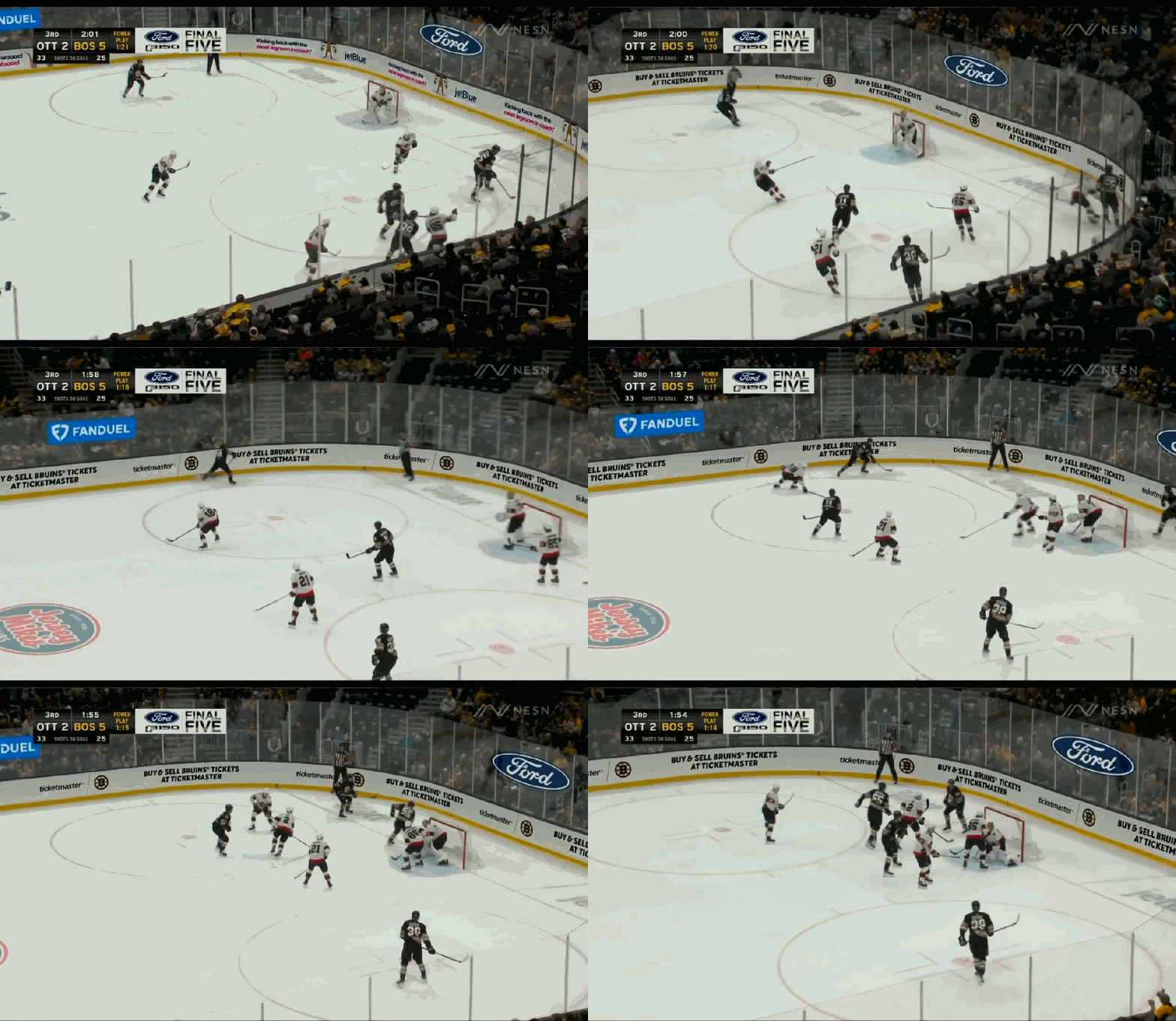
The game was all but over by then, but holy hell.
Finally, we reach the end of the two-PP-goal-against portion of this article with a game against Edmonton. The Senators actually won that one at the end of March 5-3, but Oilers did what they do and that’s produce on the man advantage. The first was Leon Draisaitl scoring a one-timer from his usual spot, and that doesn’t need dissecting.
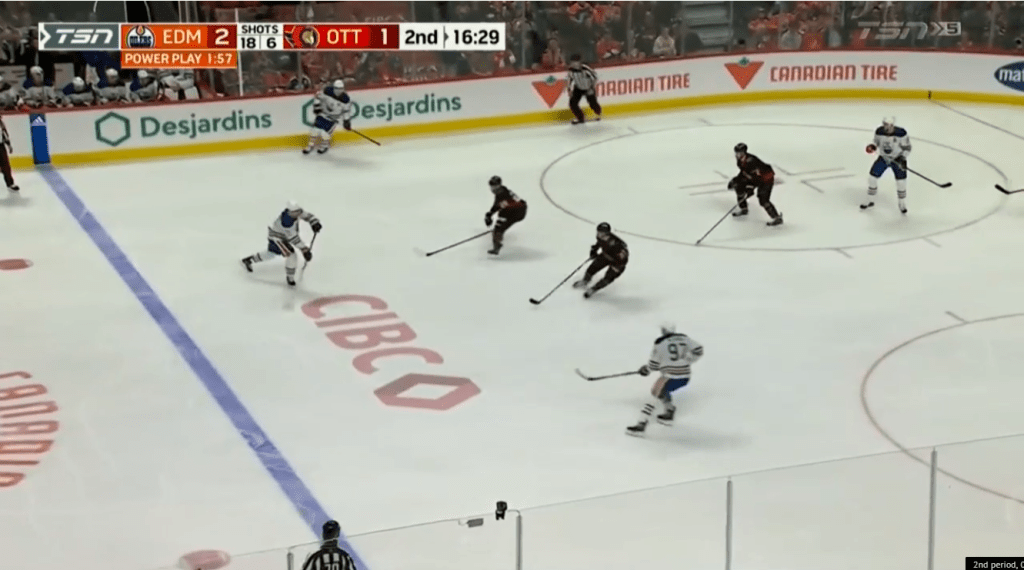
The second goal against is a recurring theme and it’s two forwards chasing the same defenceman to the blue line. Here, the Oilers win the faceoff and both PK forwards push out to him, leaving Connor McDavid wide open to receive a pass as he’s moving down to the circle:
Ottawa’s weakside defenceman had a moment of hesitation towards the blue line, and that left Leon Draisaitl and Zach Hyman in front on a 2-on-1. Probably not an ideal situation:
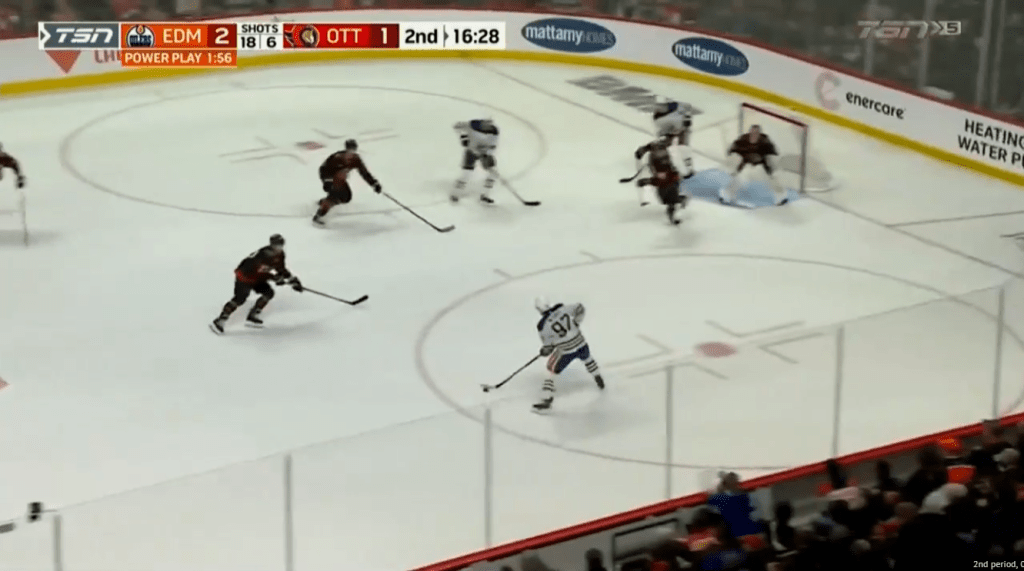
Hyman wound up being the one to score here, tapping in the backdoor pass.
We have seen complete breakdowns, failures to clear the zone, over-chasing a defenceman, and just bad decision-making. However, this goal highlights one additional issue that is recurring: indecisiveness. There were a couple times where just a quick feint towards the wrong player left an Ottawa penalty killer one step behind where he should be, and with the talent in the league being where it is now, being one step behind leaves open passing lanes leading to easy goals. That indecisiveness crops up again and again and is a symptom of having an aggressive penalty. It is good to be aggressive – Carolina has thrived for years doing that – but failing to make any decision at the right time can be as detrimental as making a bad decision. That indecision opens lanes that shouldn’t be open, and leaves the goalies hung out to dry.
We’ve reached the end of the games where Korpisalo allowed at least two PP goals against. Those games resulted in 26 goals against, and 16 of them have been on clean seam passes, a screened shot, or a deflection. Those are the kinds of goals that are tough to lay at the feet of a goaltender.
Games With One PP Goal Against
Moving on to the single-goal games, we have the very first game of the season, a 5-3 loss to Carolina with DJ Smith behind the bench. In this sequence, Korpisalo has already made a few saves, including a pair of rebound saves with Carolina having free reign to whack at the free puck. About 30 seconds later, we get this from Ottawa:
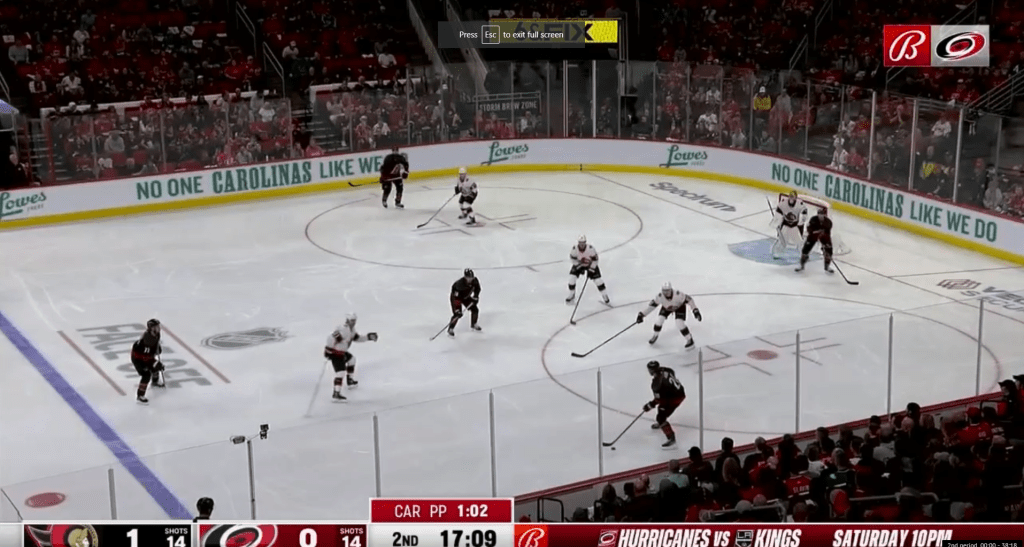
It is safe to say that the Senators failing to have any skater within 20 feet of the lone Hurricanes skater in front of the net, and also not even having a stick in the passing lane to said player, is not optimal penalty killing. Sebastian Aho makes the very easy pass down low to Michael Bunting, who eventually makes it to the other side of Korpisalo to slide the puck in. Look how much time he has:

That basically functions as giving up a breakaway, which is hard to manage when you have four defenders in the defensive zone.
Later in October, Korpisalo gives up a PP goal against the New York Islanders that he should have had. He coughs up a rebound on a clear wrist shot from the top of the circle and Bo Horvat slams home the puck. It is a goal where maybe Travis Hamonic should have had better stick control of Horvat, but it’s a rebound goal that should have never happened to begin with.
A week later, Los Angeles is in town. Early in the game, the Sens go on the penalty kill and Korpisalo has already had to make a couple of nice saves in addition to Kevin Fiala hitting a post. Los Angeles’s second PP unit hits the ice, and a nice passing play leads to Phillip Danault having not one, but two, clean swipes at the puck from the net-front area. It is another case of clear miscommunication because Ottawa’s weakside forward has recognized the backdoor pass and has dropped down below the hashmarks to cut it off. However, Tyler Kleven stays right in front of Korpisalo, leaving Danault wide open about 15 feet from the goal line:
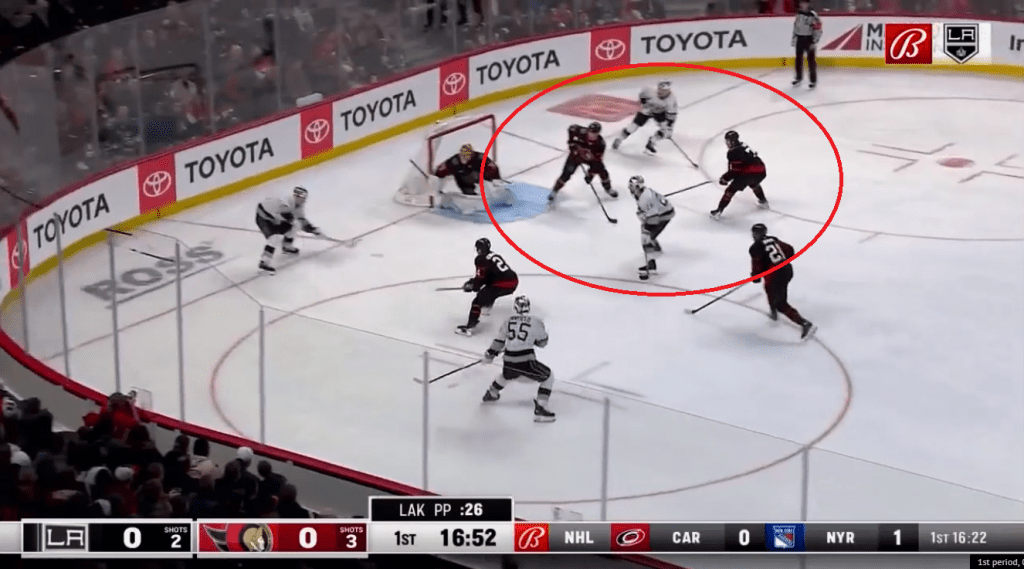
Danault gets a shot here and follows up his rebound as Kleven is flailing his stick around. It is just very poor decision-making from at least half the PKers.
A week later in Toronto, Ottawa loses the faceoff and no one gets out to William Nylander in time, who fires it home from the middle of the ice:
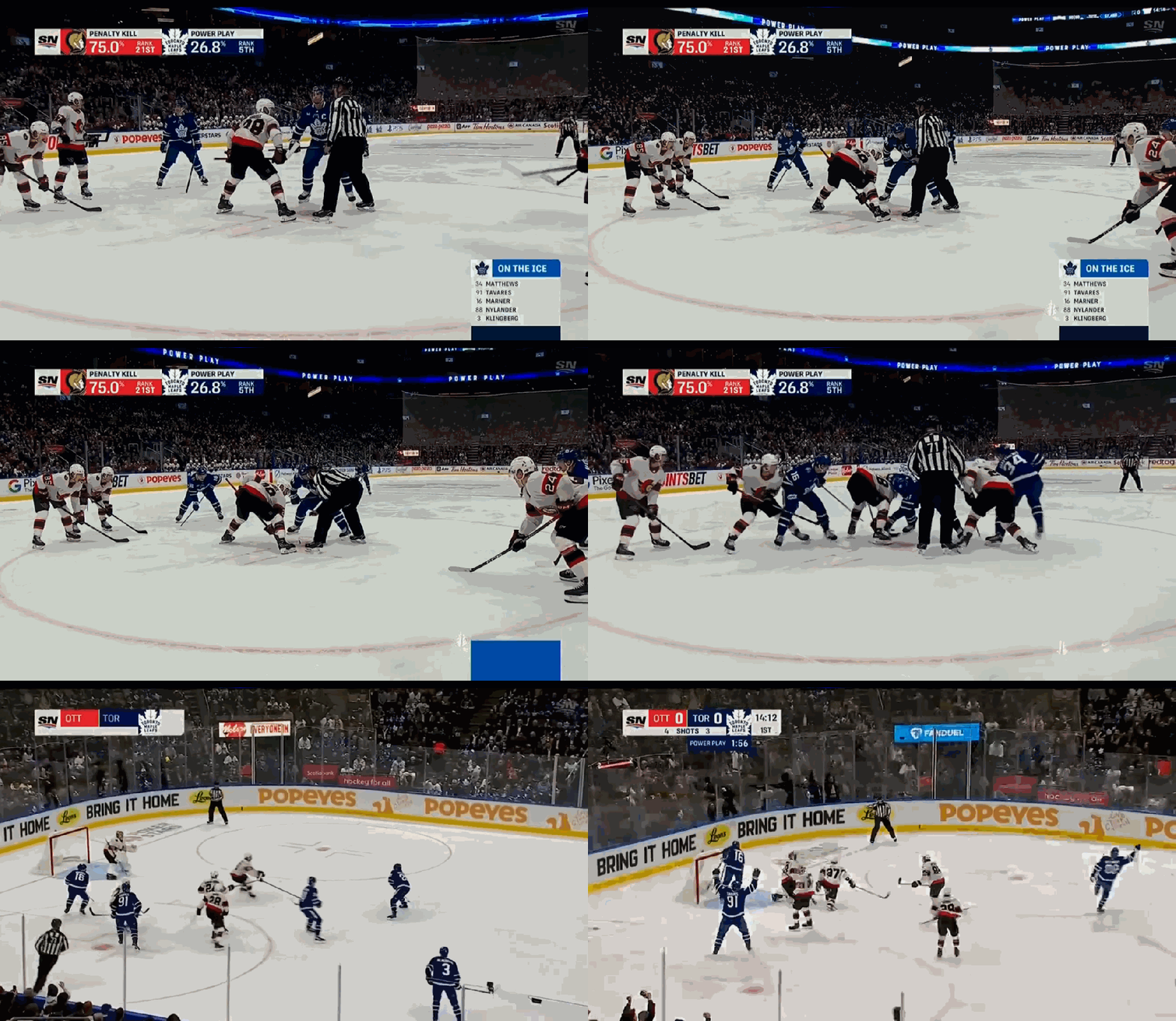
One thing did make me laugh though. As the scramble for the faceoff is going on, Parker Kelly (#27) goes to dig out the puck, but it kicks out to Nylander. Watch Kelly slide on his stomach to cut off a potential pass to Mitch Marner. It’s pretty good.
Not long after, Anton Forsberg got a lot more starts so our story picks back up in December where Ottawa takes a 5-1 win at home to Detroit. The lone goal was a PP goal against, and it was a 4v3 goal where Patrick Kane ripped home a shot from the circle. It is a goal Korpisalo probably should have had as it snuck under his glove on the short side.
In early January, Ottawa lost 6-3 in Vancouver, giving up five first-period goals. Elias Pettersson ripped home a cross-ice pass from JT Miller, and it’s yet another case where an Ottawa penalty killer has his stick in the passing lane to the defenceman rather than the shooter in the circle:
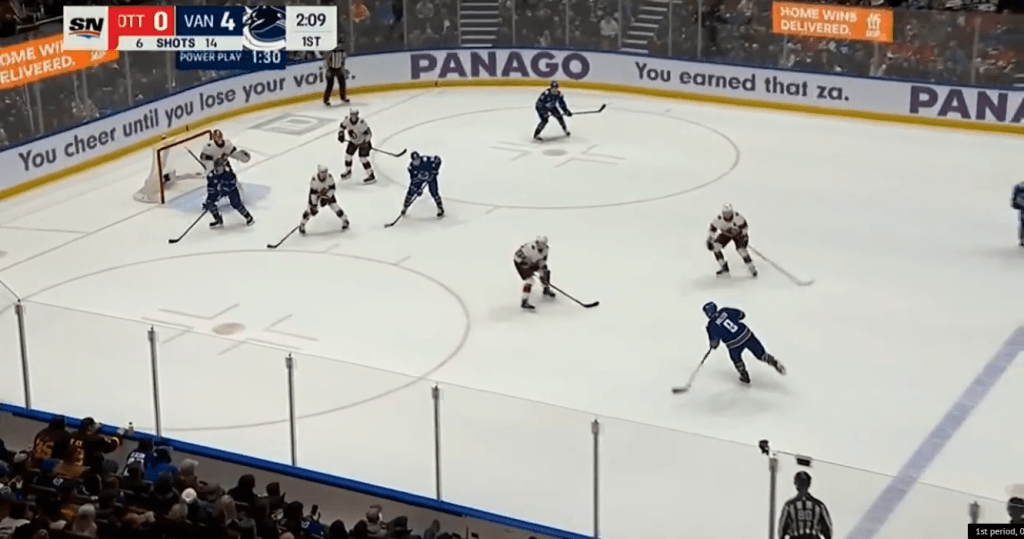
This lack of identifying the dangerous passing lane keeps happening over and over, and it seems to be happening a lot to Claude Giroux. Pettersson’s shot also deflects off an Ottawa defenceman, just for added hilarity.
A week later is a 5-3 loss to Buffalo, and Tage Thompson scores a PP goal because Ottawa allows him to walk into a shot from about 25 feet away completely unchallenged:
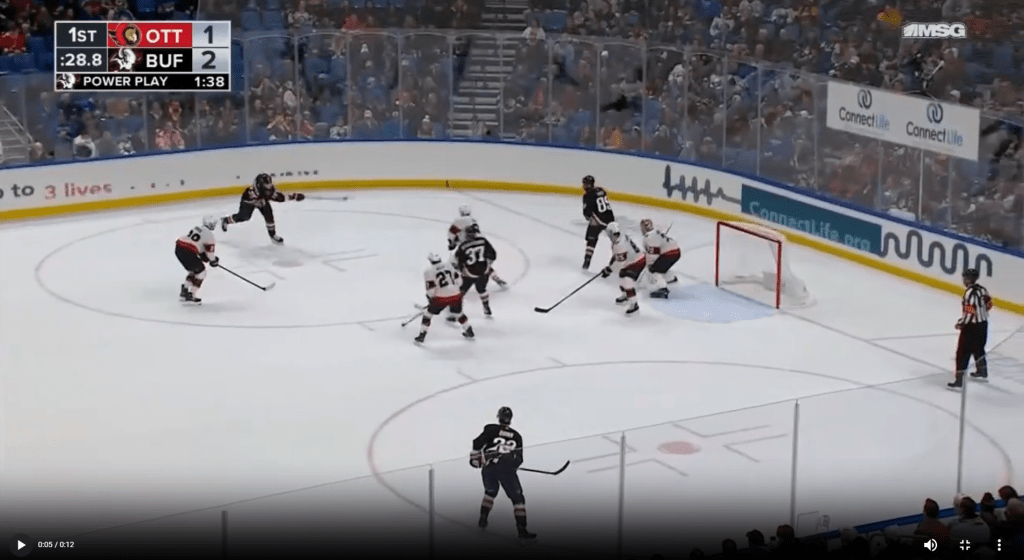
Maybe one Korpisalo should have had, but this is starting to be a lot of goals from about 20-30 feet where the shooter has a clear lane to the net. Goalies stop most of those, but not all of them, and giving clean 20-foot shots to 40-goal scorers is going to end poorly once in a while.
Just before the All-Star break, Ottawa loses 3-2 to Boston and Korpisalo gives up a PP goal to David Pastrňák on a one-timer from about 45 feet. It is genuinely a goal Korpisalo should have had, and he just straight whiffed on.
In February, a 4-1 loss in Nashville had one PP goal against and it’s another goal where the Ottawa skater in front of the net does all of the following: doesn’t take a man, doesn’t block the shot, and provides a screen. It truly is something to behold, and this is how point shots find their way to the back of the net:
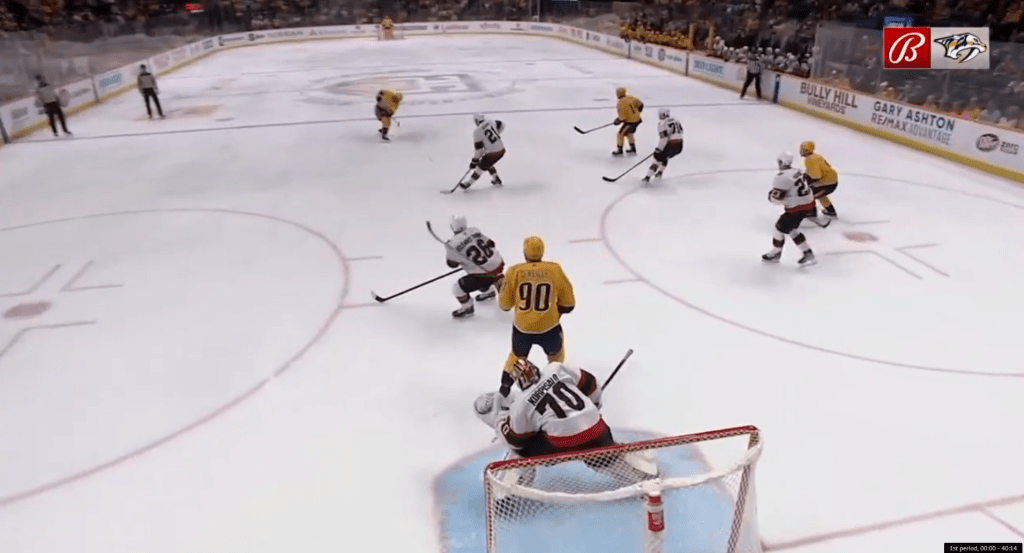
Allowing 55-foot goals is never ideal for a netminder, but when his defenceman is acting as a second net-front forward for the opposition rather than a defender, he can be excused once in a while.
The next PP goal against was a 6v4 at the end of a win against the New York Islanders where the Islanders pulled the goalie for a two-man advantage late in the game. It ended up tying the game and it was a Horvat one-timer that was going wide deflected off Kelly and in the net. A tough break where you can’t really single out one or two bad decisions; sometimes the team on the power play just deserves credit or gets lucky (or both).
Late in March, Ottawa gives up a PP goal to Winnipeg, and Mark Scheifele in particular. Before that goal, there are a number of things that highlight the team’s PK problems all season long, regardless of the coach behind the bench.
Early in the power play, Ottawa clears the puck, but Winnipeg gets back in the zone with control thanks to a chipped area pass. After a bit of a bobble, things start to get scrambly, and decisions are certainly made. Here, we have Parker Kelly circled. He has his stick in the passing lane for a seam pass, which is usually a good idea except there is no one there for the seam pass:
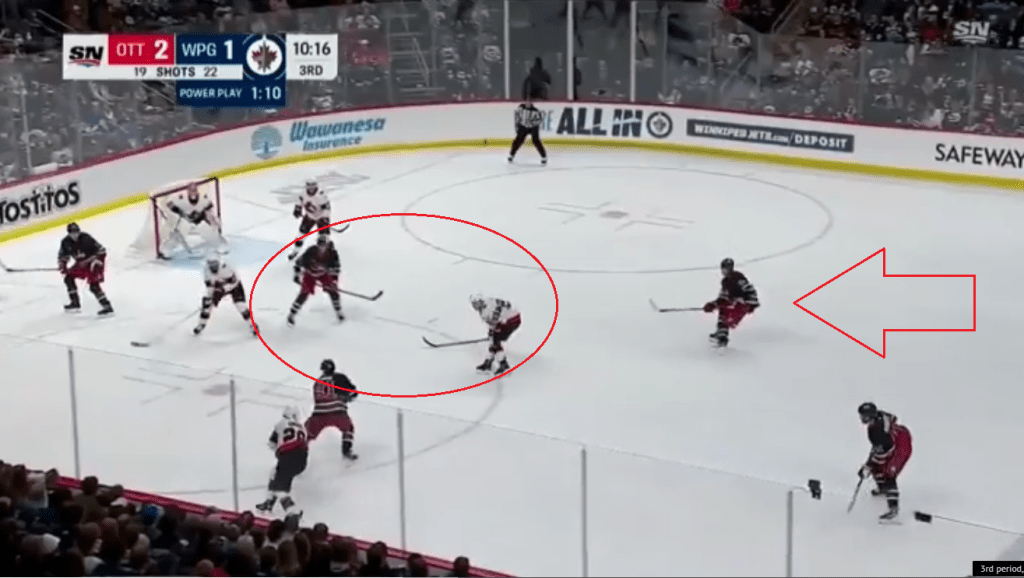
There is someone about eight feet in front of him, and it’s hard to tell in a still photo, but the Winnipeg player that is in the circle is skating away from the Ottawa net. He is in no position for a one-timer, and at best will one-touch the puck to the point or down low. If he decides to cradle the puck and try to shoot, Kelly is already moving in that direction to disrupt the shot. In other words, taking away the passing lane to the middle isn’t really adding any value; he’s taking away a shot that isn’t there because the only decision the Winnipeg player has time to make is a one-time pass to a non-dangerous area. However, that stick positioning leaves Scheifele (the guy with the arrow) with a clean lane to receive the pass, and his eventual shot goes in off Artem Zub:
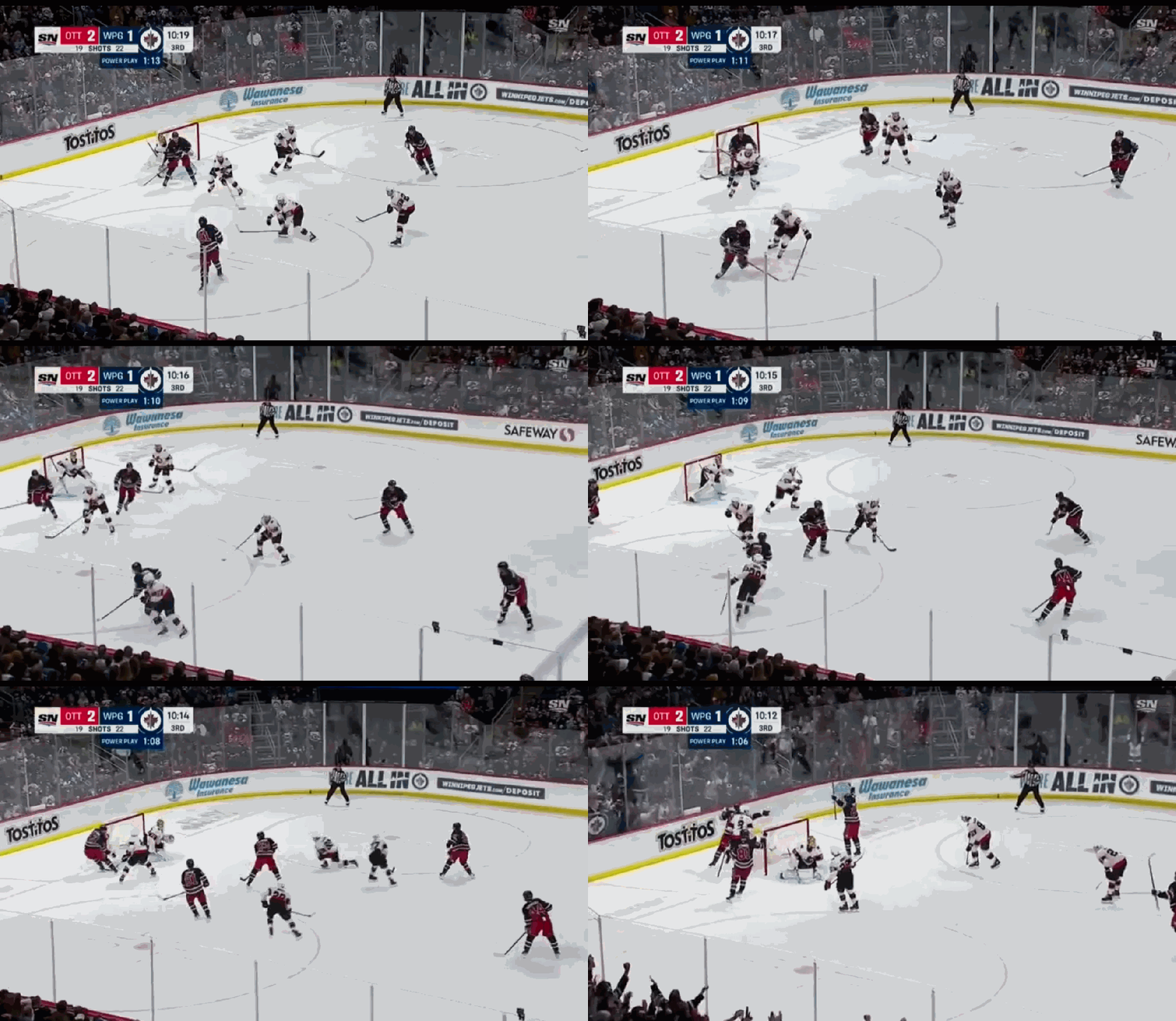
Stick positioning is so, so important on the penalty kill and the Senators fail to make the correct decision repeatedly. To this point of our venture, it has cost them several goals.
Towards the end of the season, Ottawa had a 2-0 loss in Florida. On a penalty kill about halfway through the first period, the Senators are running around. Korpisalo has already had to make three saves (two of them off passes from behind the net or through the seam) and is looking good. The second Panthers PP unit hits the hits with about 50 seconds left on the PP. Ottawa clears the zone with about 25 seconds left on the power play and then arguably the funniest PP goal against of the season happens.
Here is Ottawa clearing the puck all the way down the ice with 23 seconds left on their penalty kill:
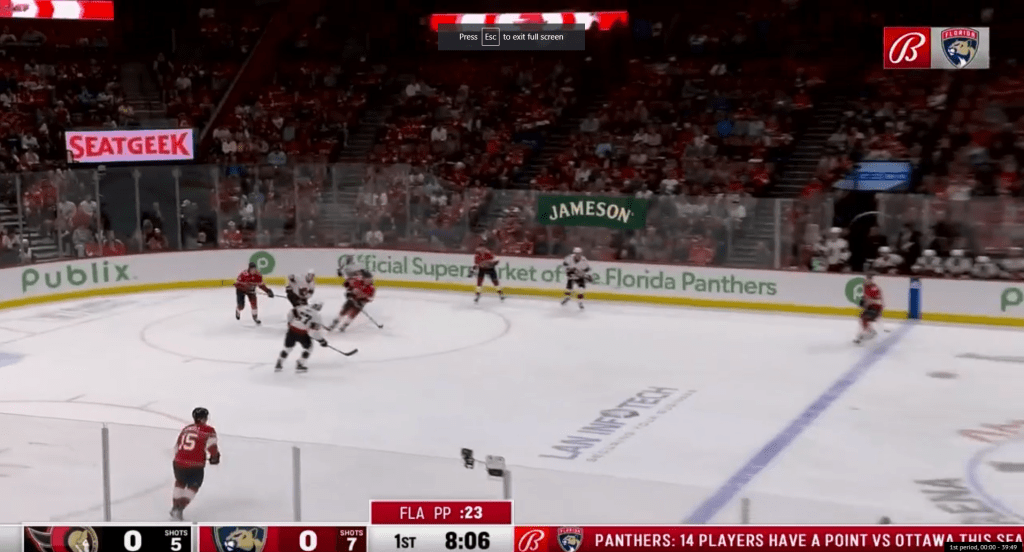
And here is Anton Lundell in on a clean breakaway literally five seconds later:
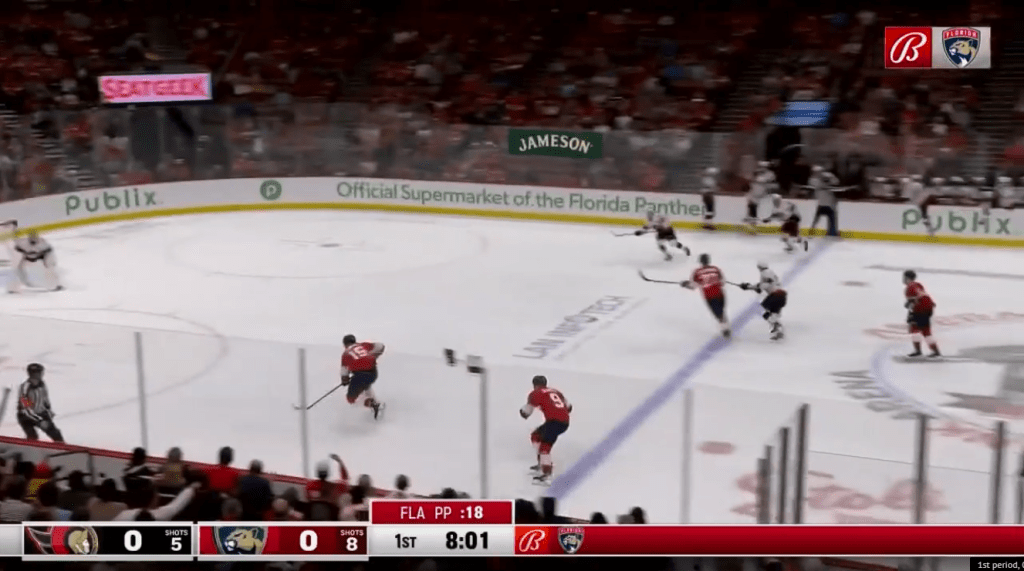
Shout out to Sergei Bobrovsky on a great pass from his own goal line, but that is an all-time-bad line change – slow to get off and slow to get on. Just another in a long line of terrible decisions made all season long by the penalty killers.
The last goal we’ll look at is something we’ve mentioned often, and it’s the Ottawa penalty kill hitting the trifecta of not blocking a shot, providing a screen on Korpisalo, and giving up a good look to a good goal scorer. The funny thing is that a split second before Cole Caufield rips the puck top corner, we have this screen shot: the goal scorer (Caufield) is with the puck at the top of the circle but has a viable passing lane to the left of Korpisalo, which would leave a 2-on-1 down low for Montreal:
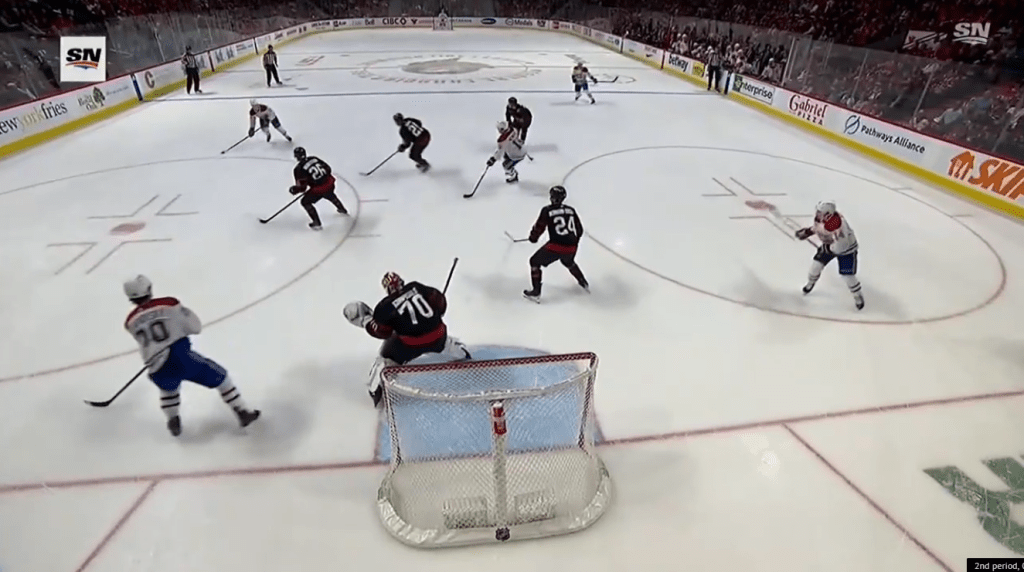
Caufield is the one that scores here on a straight shot, but he had options, and one of them was to create an odd-man chance down low because Ottawa abandons the front of the net. It is more over-aggression masked as aggression that is taking players out of place and not really doing a whole lot. Maybe Korpisalo should have had this shot, but one clean pass down low creates an advantageous situation for Montreal so even if Caufield doesn’t take the shot, a quick pass gives them a high-danger look at the net. It is truly unbelievable that this keeps happening over and over, but it’s starting to get very believable.
Summary
Those are the 39 PK goals against allowed by Korpisalo this season. Early in the article, we said that if Korpisalo had a median save percentage on the PK, it would have led to 13 fewer goals against. Well, I classified all 39 goals into seven categories:
- Seam/Behind The Net Pass
- Screened Shot
- Odd-Man Rush
- Deflection/Tip
- Unscreened Shot
- Rebound/Scramble
- Other
The first four categories are goals we shouldn’t really hang on Korpisalo, there were two unscreened shots he maybe could have saved but a pass would have resulted in a dangerous chance against regardless. Also, one of the ‘other’ goals was that Boston goal where Brazeau had all day to walk to the front of the net (which happened more than once). These are the goal totals by category:
- Seam/Behind The Net Pass (10)
- Screened Shot (8)
- Odd-Man Rush (3)
- Deflection/Tip (3)
- Unscreened Shot (10)
- Rebound/Scramble (3)
- Other (2)
The first four categories – goals we can’t blame Korpisalo for – comes to a total of 24 goals against. Add two unscreened shots where it was a complete breakdown by the Ottawa penalty killers plus the net-front walk by Brazeau, and that’s 27 goals where we can’t really say Korpisalo was the problem. If just one-third of them are cut down by better decision making, Korpisalo’s PK save percentage is near the middle of the league rather than in the bottom-5.
This isn’t to say Korpisalo was good or didn’t have his own issues; there were a number of times where he lost track of a puck he shouldn’t have, flubbed the handling, gave up a juicy rebound, and things of that nature.
All that aside, it is shocking the number of bad decisions we see from the Ottawa PKers that led directly to goals against. Failing to clear the puck, sticks in the wrong passing lanes, indecision about which player to cover, leaving no one (quite literally) within 20 feet of the net even when the other team has possession, and on and on the list goes. One of my pet theories is that Ottawa is a skilled team that consistently makes bad decisions, and that was certainly the case on the penalty kill.
As for what new coach Travis Green should do, the answer is both simple and unbelievably complicated: get the penalty killers to make better decisions. A stick in the right passing lane rather than the wrong one saves goals, but ensuring that players make that right decision over and over is no simple task. It is what gives them hope because they are good at limiting shots and their aggressiveness puts opponents to a decision, which can work out very well. That is a double-edged sword, though, and the team got cut by that sword over and over in 2023-24.
 Cliffy's hell-hole