There was a spot about 9-10 minutes into the MJF/Adam Cole vs. FTR tag team championship match on the July 29th edition of AEW’s Collision that stood out. It wasn’t because of a crazy stunt – though the setup was very nice – but because of a very simple thing: FTR’s Dax Harwood kicked out as if his life depended on it.
The spot was Harwood coming off the second rope and getting caught by an Adam Cole superkick. Harwood went straight to the mat, Cole rolled him over, and Harwood played as if he was out cold. With the referee’s hand on the way down for the three-count, the tag champion shot his right arm up and the count was stopped.
It wasn’t just the superkick, or the dramatic rollover, or the standard wrestling three-count that made it special. It was Harwood paying attention to the smallest detail – he never looked at the referee.
Shout out to Hikaru Shida, too. In her World Title match on Dynamite on August 2nd, she did the same thing after taking Toni Storm’s ‘Storm Zero’ finisher. The audience both in the arena and watching at home had every reason to believe Storm was going to retain her title, and Shida kept up that appearance with the same aplomb as Harwood. It kept the drama and made for an incredible moment when she kicked out of Storm’s finishing move at the final split-second. That layer of drama made the title change feel even bigger.
Wrestling is at a point where everyone over the age of six knows that it’s a scripted show with choreographed wrestling moves. A lot of what we see is called in the ring by the wrestlers, but the outcome is predetermined, and they are usually comfortable enough (or professional enough) to make most matches look like they’ve been rehearsed for hours. The audience of today is not the audience of the 1970s or 1980s.
For pro wrestling to still work, the audience needs to be sucked into the drama. Whether it’s through inter-character tension, intra-character growth, or just good ol’-fashioned deathmatch stunts, the audience needs a reason to be hooked because we know the people powerbombing each other through tables are all friends outside of the ring (or mostly, anyway). To achieve this, details matter. Small things like worked punches that look like they land flush on the jaw or submissions that appear to be ripping a joint out of its socket are necessary.
More than the punishment aspects, it’s the in-between moments that matter. One wrestler that is great at this is Randy Orton. Just watch any match of his from the last decade-plus. Whether it’s rolling a downed opponent over or picking up an opponent to roll them into the ring from the outside, he makes it genuinely look like he’s struggling to pick up 260 lbs. of dead weight. Rather than the downed wrestler getting up, more or less, on their own, Orton makes it look like he’s picking up a lifeless corpse. On a live television show about people fighting, that kind of detail matters when trying to hook an audience into your drama.
Listening to a ‘Cheap Heat’ wrestling podcast a few months ago, Peter Rosenberg and his co-hosts were talking about wrestlers kicking out of a pin, and who is really good at it. It is an interesting conversation because it doubles as a “who pays attention to details” argument. The wrestlers that excel at holding the dramatic tension to the final split-second are the ones that pay attention to those details. It helps create a whole story rather than appearing like a sequence of events. (Movies are starting to have the problem of feeling like sequences stitched together rather than a whole concept playing out on screen, but that’s for another day.)
That brings us to kickouts in general. Personally, there are few aspects of modern pro wrestling more frustrating than when a performer is getting pinned, and they immediately look towards the referee to keep track of the count. It ensures they kick out at the right time, but it gives away the game. If they look to the ref as soon as they’re on the mat, the audience knows a kickout is coming. Otherwise, why would they need to keep track of the 3-count? It is impossible to see live unless a fan is within the first few rows of the ring, but it’s clear as day on a television screen. If there’s a dramatic 30-second sequence leading to a potential pinfall, but the person being pinned is very clearly keeping track of the referee’s hand, it takes away from the drama of the outcome. On a show where we root for winners and losers, knowing someone won’t lose because they’re watching the referee’s hand takes away some of the excitement.
We know why they do it. Live audiences can get very, very loud between just cheering or counting their own “1-2-3”. Wrestlers can lose track of the count depending on the audience, the referee’s position, and sound cues they heard while they were getting pinned. It does help these wrestlers not leave their shoulders on the mat for a second too long, which is an obvious gaffe that will make a match look bad. On the flipside, it also takes away from the match they’re in, and the outcome of that match. Seeing a wrestler fixate on the referee after taking a finishing move just kills any tension.
It brings us back to Harwood who took that superkick, had the referee’s arm coming down for the three-count, and managed to still do this:
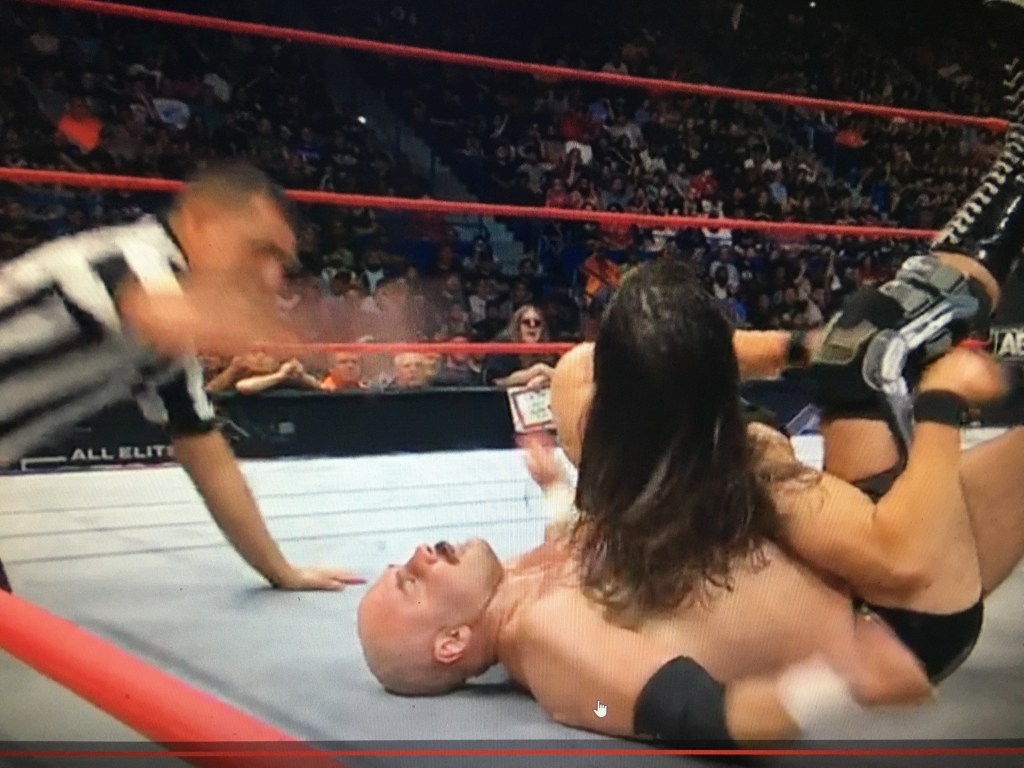
He either has his eyes still closed as he’s shooting his right arm up, or they’re nearly closed. Either way, after taking the superkick and appearing to be unconscious, Harwood kept up the ruse right until the final moment before he kicked out. That type of detail helps maintain believability, and it’s why almost every FTR match is excellent – their attention to detail can keep fans hooked from the first to the final bell.
It might just be a veteran wrestler thing because it is FTR, Orton, and now Shida that stand out in this regard, but it’s something that matters when trying to keep audiences engaged. Those four wrestlers are all considered among the best in the world at what they do. There is a reason for that, and it’s not because they can hit springboard moonsaults at will.
 Cliffy's hell-hole