Going into the 2022-23 season, the Montreal Canadiens were hitting the giant ‘reset’ button on the franchise. The 2022 offseason was the first with Jeff Gorton and Kent Hughes being in charge, it was the first full season with Martin St. Louis behind the bench, they traded for Kirby Dach, and had the 2022 first overall pick in the lineup. This was a team rolling over from its recent form, and that assuredly meant a lot of pain across the lineup. Nowhere was that more evident than on defence.
At the outset of the campaign, defencemen Mike Matheson and Joel Edmundson were both injured, and neither would return until November. It left the blue line to David Savard and a slew of young rearguards. One of those rearguards was Jonathan Kovacevic, who was claimed off waivers from Winnipeg a mere four days before the season started. At the time, the third-round pick from 2017 had a grand total of four NHL games to his name. He couldn’t crack the Jets roster and he found his way to the Canadiens. Fast forward to mid-April 2023, and Kovacevic finished the campaign with two Wins Above Replacement, per Evolving Hockey. That was tied for 26th among all defencemen in the league. On a 60-minute basis, Kovacevic’s WAR (.091) compared faourably to Evan Bouchard (.099), Devon Toews (.089), and Shea Theodore (.088). From the same website, his expected goals impact led all Habs blue liners by a wide margin, and just behind names like Theodore and Noah Hanifin across the league. His actual goals impact was very similar in this respect, bordering on a top-pair impact.
So, we have a defenceman with four career NHL games get claimed by a lottery team and then put up not only the best season for a Habs blue liner, but arguably a top-pair season when comparing to other players around the league. It raises one question: what the fuck happened?
Let’s dive into Kovacevic’s background, what happened in Winnipeg and, most importantly, his breakout season in Montreal. Our primary data sources will be Frozen Tools, Natural Stat Trick, Evolving Hockey, Hockey Viz, and Corey Sznajder’s player tracking Patreon. Other sources will be credited as we use them.
The Early Years
As with a lot of non-hyped prospects from prior to five years ago, there isn’t much public information on Kovacevic’s rise to pro hockey. He was born in Ontario, played Junior ‘A’ in the Central Canada Hockey League, was drafted in the third round of the 2017 draft by Winnipeg, and spent two more years playing college hockey. To the point about his draft year: he was passed in the draft twice before going as a 19-year-old third rounder. He turned 20 years old a month after he was drafted. This was not a teenager that was expected to succeed, though spending a third-round pick on a 19-year-old should give us an indication that some scout somewhere saw something in him.
For anyone that wants to read more about his upbringing, Murat Ates of The Athletic had a write-up on him when he was still in the Jets organization. The notable parts that I saw where his Merrimack coach (college) talk about how he was a tall and lanky kid who was very smart and knew how to move the puck very well, but had to grow into his body; he was 6’4” at 19 years old but, and this is an estimation, he weighed around 160-170 lbs. Here at Dobber, we like to talk about how guys that big typically need years after their draft to not only grow into their body, but develop the spatial awareness necessary to utilize their size to full advantage rather than having it be a hindrance. We can’t say for sure if Kovacevic did/did not fit this bill, but given his college coach quotes, and his long road to the NHL, it might be a fair assumption.
The final note for Kovacevic’s early years is his projection from Hockey Prospecting. It is a website that tracks drafted players, how they’re performing in a specific league at a specific age, and lets us know players with a comparable profile. I noticed Kovacevic’s Draft+2 and Draft+3 seasons had similar, but better, outputs to a current NHL defenceman whose name will come up later:
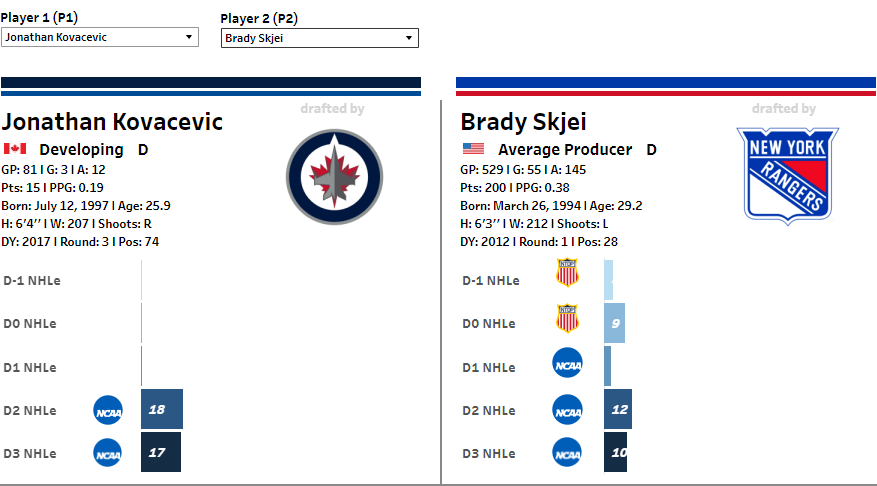
This isn’t to say they’re similar players, stylistically. It’s just to say there are guys that don’t have huge levels of success prior to the NHL who then succeed in the NHL.
There was a scouting report from Elite Prospects back in 2018 extolling the virtues of Kovacevic’s passing which was, they believed, already at an NHL level. It discusses how he can be physical but plays fast, in the sense that he makes good, quick decisions (there’s the hockey smarts again).
Here we have a guy that was passed twice in the Draft, but whose skills were praised not only by his coach, but by an independent scout. He was tall but needed to fill out his frame. He was mobile but not a huge producer. He was smart but needed to incorporate a wider range of skills to make the most of those smarts. In other words, he had some development to go through.
The Winnipeg Years
To call them ‘The Winnipeg Years’ is a bit of a misnomer, considering how little he played in the NHL. But he played three years for the Manitoba Moose in the AHL, with shortened seasons due to injury, healthy scratches, or COVID. Regardless, it gave him over 130 professional hockey games to start round out his profile.
One point I saw brought up with regards to Kovacevic in the AHL, and just the entire Manitoba Moose team, is that it was hard to evaluate individual players. The team went 59-37-12 over the two seasons from 2020-2022, or 99 points every 82 games. That is a pretty good team and can be hard to evaluate prospects on a strong roster. He still led the Moose in points from the blue line in the COVID Bubble season, and was second in 2021-22 (though first in goals). His points/game weren’t at the top, but part of that is the power play production. As pointed out on Twitter, Kovacevic was the team’s best even-strength producer on defence, only losing production because of a lack of PPTOI:
After the 2021-22 AHL season, NHL.com posted a list of 10 players that were ready to make the jump from the AHL to the NHL. It included future mainstays like Jack Quinn, JJ Peterka, Jonatan Berggren, Jakob Pelletier, and Jack Drury. Goalie Pyotr Kochetkov was on the list and got some run in the NHL, while goalie Dustin Wolf was also on there, and probably should have been in the NHL. Alongside all those names was Kovacevic, as he was praised for his genuine two-way ability from the blue line. Yet again, his ability to move the puck and shut down opposing forwards was praised. Too often, a player’s ‘two-way ability’ means something other than that, but it did really seem to be the case for Kovacevic.
Heading into the 2022-23 season, Kovacevic finally seemed ready to make the leap to the NHL on a full-time basis. He had grown into his frame, he rounded out his game, and was in his prime years at the age of 25. He would be thrown another hurdle, though, and it may end up being the best thing that ever happened to his hockey career.
Montreal
As mentioned earlier, Winnipeg put Kovacevic on waivers in October of 2022 to cut their roster down to size for the regular season. Montreal had the top waiver priority and, given the depth problems they were facing on the blue line, used it to claim Kovacevic. He dressed the first game of the season on October 12th and would proceed to play 76 more games. It doesn’t give us a definitive picture of the kind of player Kovacevic is, but it can help point us in the right direction.
I want to tackle his mobility first because it is of utmost importance for a defenceman in the modern NHL, particularly at 5-on-5. Very few can stick around for long if they’re not capable of doing more than just sometimes making a good first pass, so, how good is at he at A) often clearing the zone and B) doing so with control? On a per-minute basis, he cleared the zone roughly as much as Shea Theodore and Rasmus Dahlin (red line), and did so with possession nearly as often as guys like MacKenzie Weegar and Alex Pietrangelo:
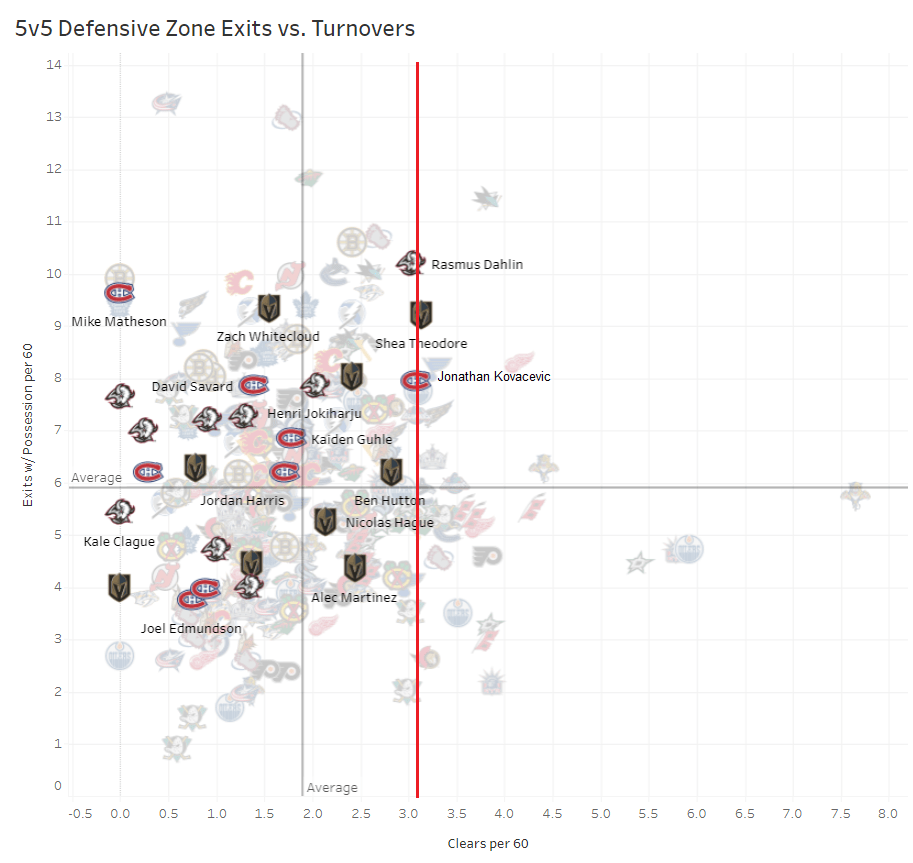
That exact profile most closely resembled Evan Bouchard. So, good start for the puck-moving stuff. To reinforce his zone-exit prowess, let’s look at his workload. Below is a full list of defencemen that fit the following two criteria: at least 200 tracked minutes at 5-on-5, and at least 32.5 defensive zone retrievals plus exits with possession, all per 60 minutes. There are six of them, and guess who appears:
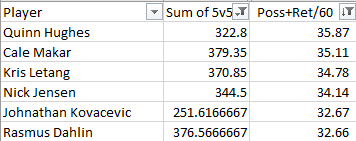
By this measure, he outpaced names like Charlie McAvoy, Noah Dobson, Erik Karlsson, Shea Theodore, Victor Hedman and, well, I think we get the idea. He not only cleared the defensive zone a lot, he often did it with possession, and not only much more often than any other Montreal defenceman, but more than the vast majority of NHL defencemen, period. This is his first full season, by the way.
His zone entry rates weren’t as strong, but his carry-in percentage was similar to Vince Dunn. That means even though he didn’t carry the puck into the offensive zone very often, when he did, he was frequently successful. Another checkmark for mobility.
For one season, Kovacevic was tremendous in transition, especially when we consider the environment he was in. This wasn’t Dahlin with a high-powered offence or McAvoy with one of the best regular season rosters we’ve seen in recent memory; this was a rookie waiver claim on a lottery team.
It’s all well and good that he was superb in transition, especially in his half of the ice, but did he actually help generate offence? Let’s look at that.
On the season, Montreal generated 2.53 expected goals/60 minutes when he was on the ice at 5-on-5. Without him, that fell to 2.16, a drop of nearly 15%. The team scored 2.68 goals/60 at 5-on-5 with him on the ice, and that fell to 2.37, a drop over 13%. So, yes, the team did generate more offence with him on the ice, but was it because of him?
Scoring chance contributions per 60 minutes at 5-on-5 (SCC/60) measures an individual player’s scoring chance rate and his rate of assists on teammate scoring chances, all per 60 minutes. It is a shortcut to see how involved a player is in a team’s scoring chances when they’re on the ice. As we’d expect, defencemen aren’t as involved as forwards, but they do play a vital role in creating offence. His assist rate wasn’t strong – a shade above league average – but his scoring chances were, and it put him in the same range as a very talented teammate, as well as a guy that was a Norris Trophy candidate through 50 games:
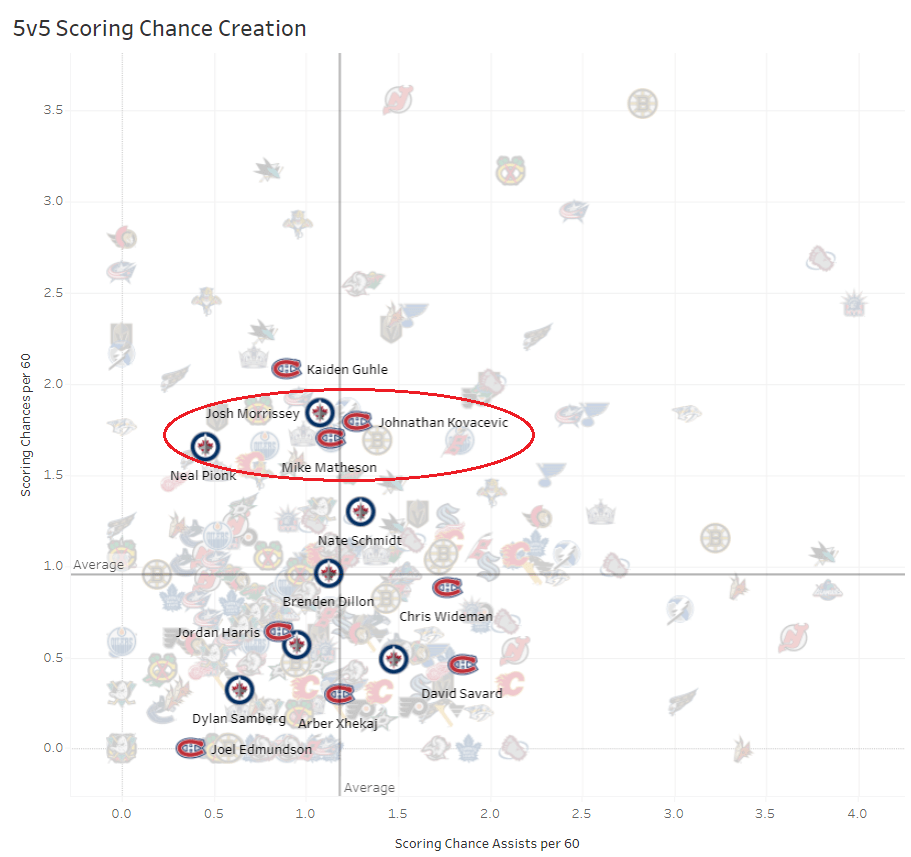
On top of the earlier zone-exit chart, this is the second one we’ve seen where Kovacevic was the only Montreal defenceman to be above-average on both the x- and y-axis. It might be a low bar to clear for most of that roster, but exceeding Matheson – a guy who was great when healthy – is a pretty good sign.
In his first season, Kovacevic was elite at retrievals/exits, good at entries, and good at scoring chance creation. To that last point, his overall SCC/60 number (2.86/60) was very close to some high-end blue liners like Brandon Montour (2.91), Alex Pietrangelo (2.9), Hampus Lindholm (2.82), and Devon Toews (2.71). His rate wasn’t just good for Montreal, it was good across the league by rating as a top-pair, number-2 defenceman.
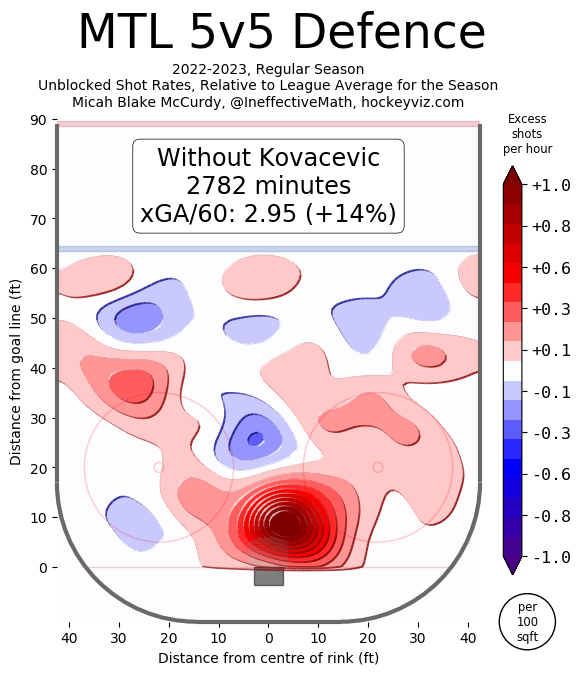
Setting aside the transition/offensive metrics, how good was he at, you know, playing traditional defence? The easiest way to show it is by demonstrating how Montreal fared defensively with him off the ice [red is bad]:
And how they fared with him on the ice:
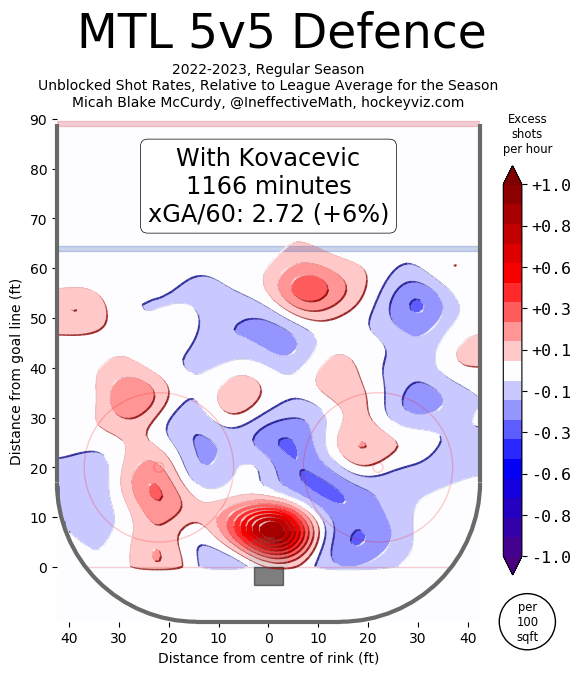
Both show too many shots given up right around the crease, but it’s less with Kovacevic, and they also give up far less from the right faceoff dot. Considering he most often played the right side when paired with Jordan Harris, that should be a credit to Kovacevic.
How did he clean up the dangerous areas better than his teammates? Well, outside of the aforementioned retrievals/exits limiting second chances from opponents, he did a great job limiting initial chances. Arber Xhekaj and Chris Wideman had fewer chances against on zone entries allowed, but they also combined for just 97 games played, and they were extremely sheltered, per Frozen Tools:
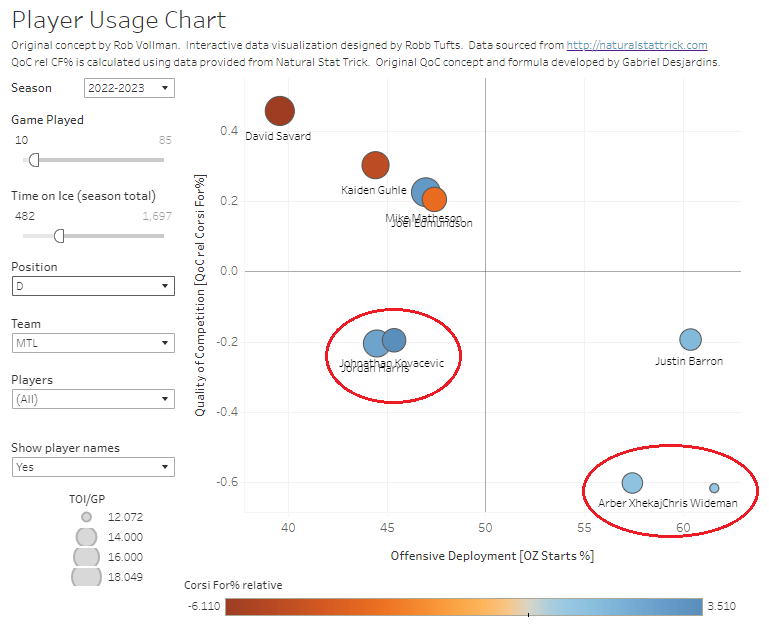
Not that Kovacevic was hammered with top competition, but he started in the defensive zone way more often than those other two, and did face much stiffer competition. Considering the games played and workload, it was a tremendous performance from Kovacevic.
He wasn’t just getting lucky, either. Once again, a graphic that shows Kovacevic as the only above-average Montreal defenceman on both axes. This one shows denial percentage on opponent entries and carry against percentage, and the further to the top-left, the better:
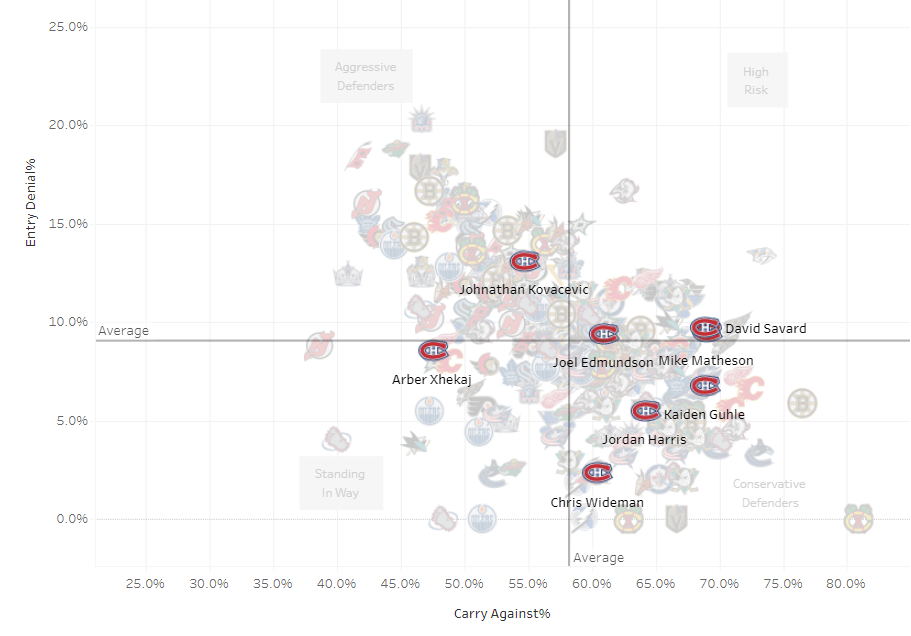
Other guys in that Kovacevic range: Andersson, Skjei, and Toews.
So, on the defensive side of things, he’s great at denying initial entries, great at limiting opposition that is carrying the puck, and can escape secondary chances because he can move the puck. At least, he did for one season.
To sum it all up, this was Kovacevic’s rookie season on a lottery team as a waiver claim:
- Similar WAR/60 rates to Bouchard, Toews, and Theodore
- Similar expected goals impacts to Theodore and Noah Hanifin
- Cleared the defensive zone at a similar rate Theodore and Dahlin
- Cleared the zone with possession at a similar rate to Pietrangelo and Weegar
- Had more defensive zone retrievals+possession exits per 60 minutes than McAvoy, Karlsson, or Hedman
- Zone entry success percentage and rates comparable to Vince Dunn
- Created scoring chances at a rate similar to Josh Morrissey, Brandon Montour, and Hampus Lindholm
- Denied the blue line/carry-ins to the opposition at rates similar to Toews and Rasmus Andersson
Seems good?
There are still issues, obviously. He needs to clean up the net-front – help from his teammates would be beneficial here – and he needs to improve his playmaking. The thing is, even if he doesn’t, and all he does is repeat his 2022-23 season six or seven more times, he’s no worse than a second-pair defender.
Does he improve? Does he simply stagnate and stay at this level for the medium-term? Does he regress? Sorry, I don’t have those answers. What I will say is that Kovacevic’s early life was filled with good habit-forming from his parents, his coaches have praised his work ethic and his hockey smarts at every level, and even independent scouts said much of the same things. He took a few years to improve in the AHL and appears to have made good on all his effort in his rookie season.
I am a believer. If he excelled in just one area, I would understand the reticence. The twist here is that outside of maybe some playmaking issues – which, as a defenceman, is not a huge deal – he was at least average, if not good-to-excellent, literally everywhere else. Scoring chance creation, blue-line denials, retrieving pucks in the defensive zone, transitioning out of the defensive zone, zone entries, and creating chances off those entries were all in the realm of solid-to-great. And, again, he was a rookie waiver claim on a lottery team.
This could be a big win for the Habs. They extended him for an additional year so they can’t extend him yet, but another season like this could easily see Kovacevic earn a contract like Jake Walman just got, if not more. Montreal’s blue line was in dire need of a rebuild and while they still have a ways to go, they may have found a genuine diamond in the rough with the 25-year-old Ontario native.
 Cliffy's hell-hole