Having re-watched season 7 of Game of Thrones twice now since the pandemic began, I feel confident saying something along these lines: season 7 was very, very good.
With the benefit of hindsight, a lot of the pitfalls of season 7 make a lot more sense. Allow me to explain, character by character.
Tyrion
One of the most popular criticisms of late-Thrones Tyrion was that he almost became… dumb. This is a guy who out-smarted Catelyn Stark, ran King’s Landing, tried to extend the olive branch to the Martells (which bore fruit later), and was generally viewed as one of the more intelligent players on the show. Later in the series, though, a number of blunders put this intelligence into question.
When it comes down to it, it seems obvious that Tyrion was blinded by his hatred for his family, specifically his father, rather than love. This comes to a head in episode 5 when he meets Jaime in the crypts beneath the Red Keep. Even three years after killing his father, in essence dispensing the justice he felt justified (and it was), he still could not get past the hatred his father had for him, and the sentence passed to him. It is obvious, in hindsight, that this is what’s clouding his judgment all through seasons 7 and 8.
When Tyrion says that House Lannister has long been the seat of power in Westeros, he’s right. Or, he would have been right about 10 years earlier. As we know from a conversation earlier in the series between Tywin and Cersei, the gold mines under Casterly Rock are empty. Therefore, House Lannister is only the power in Westeros as long as people still *think* there is gold in the gold mines. Had Tyrion done a little bit of digging, perhaps literally, he would have known there was no reason to take Casterly Rock, giving up The Reach to the Lannister army.
But, Tyrion let emotion get the better of him. Instead of reinforcing the one area of the country they rely upon for food supplies, they attack the one area of the country that is basically useless, because he wants a symbolic victory, for himself and for the Targaryen regime. Sometimes, symbolism is important. Here, all it did was show Tyrion to not be as clever as he thinks he is, something Olenna rightly pointed out.
Arya and Sansa with Littlefinger
One of the fairer criticisms of season 7 was the Arya/Sansa arc over the final few episodes. It seemed as if their conflict came out of nowhere and was just a mechanism to do away with Littlefinger, one of the more beloved villains not only on this show, but on television from the last decade. But, I don’t think the criticism is necessarily warranted upon re-watch.
One thing that always drove me nuts was all the ravens in season 7. It seemed basically every scene in Winterfell in that season had ravens cawing in the background. It wasn’t until my most recent re-watch that you don’t hear ravens during all the conversations at Winterfell, you only hear them:
- After Arya’s return in episode 4
- When people are having conversations in a room together, or a character is searching for something
EXCEPT
There is one exception, and it’s when Arya and Sansa reunite with Bran for the first time, and they’re pushing Bran on his wheelchair through the Winterfell courtyard. I really recommend everyone watch this video of the entire reunification process, from Arya/Sansa in the Winterfell Crypts, to the two of them meeting Bran at the Weirwood Tree, to the three of them walking through the courtyard.
During the conversation at the Tree, it is clear the three of them know that Littlefinger is up to something: he has given Bran the catspaw dagger the assassin used to try to kill him in season 1. As Sansa states, Littlefinger is not a generous man, he wouldn’t give something unless he could get something in return. What does Littlefinger want?
We need to remember back earlier in season 7. Remember when he went to talk to Sansa, and Sansa basically just shut him down?
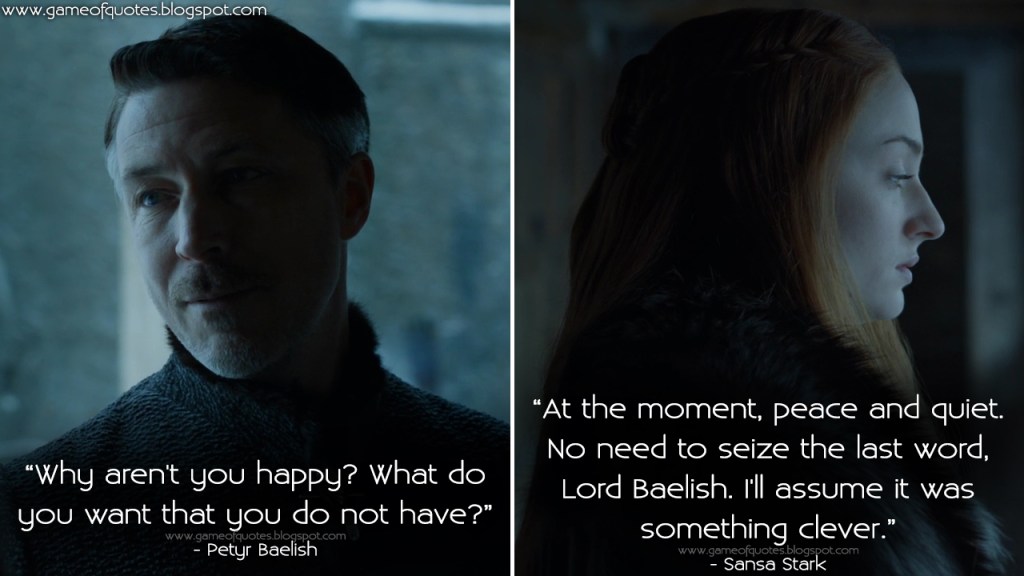
At this point, between this and the meeting in season 6 in the Mole’s Town stable, Littlefinger knows he’s lost his control over Sansa. He is smart enough to know that.
So, what does he do next? He tries to get on Bran’s good side. Unfortunately, Bran is a weirdo now and knows everything Littlefinger has ever said. So, no bones there.
At this point, Littlefinger has lost his control on Sansa, has no control over Bran, and will never get control over Arya. Yet, he wants Sansa more than anything in the world, so he’ll try to drive a wedge between the kids.
His plan might have worked, except remember the raven cawing over Littlefinger’s shoulder at the end of the video linked above? Yeah, that’s Bran spying on him. How do we know that and it’s not just a random sound cue? Because there are a lot of sound cues over the rest of the season at Winterfell with people having conversations in rooms, or while looking for things.
Don’t believe me? Check out this video of when Arya is searching Littlefinger’s room for the letter Sansa wrote back in season 1, and listen for the ravens at the 2:33 mark and the 3:07 mark:
You can also hear the ravens in this video, as Sansa is entering Arya’s room, where she finds her bag of faces. They are especially prominent right at the start:
Without just posting a bunch of videos, there are other examples pointed out in this Reddit thread. There is a sound cue when Littlefinger and Maester Wolken are talking about the scrolls, for example. In other words, it seems that instead of having an onscreen conversation, or laying the foundation for this over a couple seasons as they did with the Red Wedding, the showrunners used sound cues to give us a heads up that this was all a ruse.
Is it fair to the audience? I am not sure. We had been primed for years to think of Bran when we hear ravens, but I’m not sure there’s a straight line between “ravens should make you think of Bran” and “because the kids know Littlefinger is up to something, and you hear ravens, you should assume everything you see on your screen is a ruse.”
All the same, it’s obvious the Stark children were planning Littlefinger’s demise all along, and they just wanted proof they could present to the other lords and ladies that would justify killing the acting Lord of the Vale. It was just very hard to catch on the first, or even second, watch. And in the end, the fact they used Littlefinger’s desire for Sansa against him to trap him is a very poetic end for a figure who loved her mother for most of his life.
Jon’s Bad Plan
Going beyond the Wall seemed real stupid at the time and even in hindsight it doesn’t feel like a great decision. But after re-watching season 7 a couple of times, I understand it a bit more.
Up until this point, Dany’s whole schtick is she didn’t want to be the Queen of the Ashes, hence the siege and the attempted ferrying of the Dornish army and the not-burning of the Red Keep and so on. She didn’t want innocent people to die for someone else’s war. How does she do that? Squash Cersei, but with as little bloodshed of the innocents as possible.
To do that, they need to minimize Cersei’s sphere of influence. Just look at the Battle of the Gold Road. At this point, Cersei has the Stormlands, the Riverlands, and the Reach. Even with just three of the seven Kingdoms, thousands die between the battle of the Reach and the Battle of the Gold Road. Mostly soldiers, but as we saw with the scene between Arya and the Lannister army, they don’t all want to be there.
So, if mid-season 7 Dany leaves the Seven Kingdoms to Cersei to go North, Cersei can expand her influence to include all the Kingdoms, save the North and the Vale. Now, she would be sitting at five Kingdoms, and likely even more bloodshed than necessary.
This is the paradigm in which we need to work: minimization of bloodshed, not conquering the Iron Throne. If they want to minimize bloodshed – remember at this point, Dany is still not 100% convinced of the army of the dead, though she’s close – they need to minimize the reach of the Lannister army. So, if they can keep Cersei to 2-3 Kingdoms while executing the aforementioned Bad Plan, then there would ostensibly be less bloodshed when it came down to it.
Is it a bad plan? Absolutely. In no way should the King of the North be going on such a dangerous mission. But if we work under the assumption that casualties need to be kept as low as possible, then this is one of the few things they could do to bring Cersei into the fold.
Again, bad plan? Yes. But if we take the perspective of Dany and Jon and what they’re trying to accomplish at that point, then it’s at least defensible.
So here we are. I think this explains the three most contentious issues of season 7, beyond the pace of travel (which, let it go, man). This wouldn’t have appeared as ham-fisted had they just done 10 seasons of 10 episodes each, but the use of sound cues to indicate what’s going on, as well as the undercurrent of Tyrion’s life-long trauma, are excellent shortcuts to get to the same place.
Season 7 is better than you remember. Season 8 isn’t, though.
 Cliffy's hell-hole