The sports world has ground to a halt because of the spread of COVID-19. All across the globe, leagues are shutting down, and we’ve seen that all come to a head this week.
But it’s not all sports that are gone. We still have esports. It’s a general term that includes a wide variety of games, from first-person shooter squad-based games, to turn-based chess-style games, to card games, and the more fantasy-side of things. That last section is where League of Legends fits in.
I thought that given most sports leagues will be out of action for at least a month, that there may be some people with an itch to scratch. Some esports leagues are equipped to play remotely, and some have already done so. League of Legends is one of them, and it’s also one of the games offered on DraftKings.
Let’s start with a brief overview of the game.
The Map
League of Legends is a 5-on-5 squad-based game, but it’s not a shooter. It takes place on a map called ‘The Rift’, and it’s an arena battleground, not a huge map. This is what it looks like from overhead:
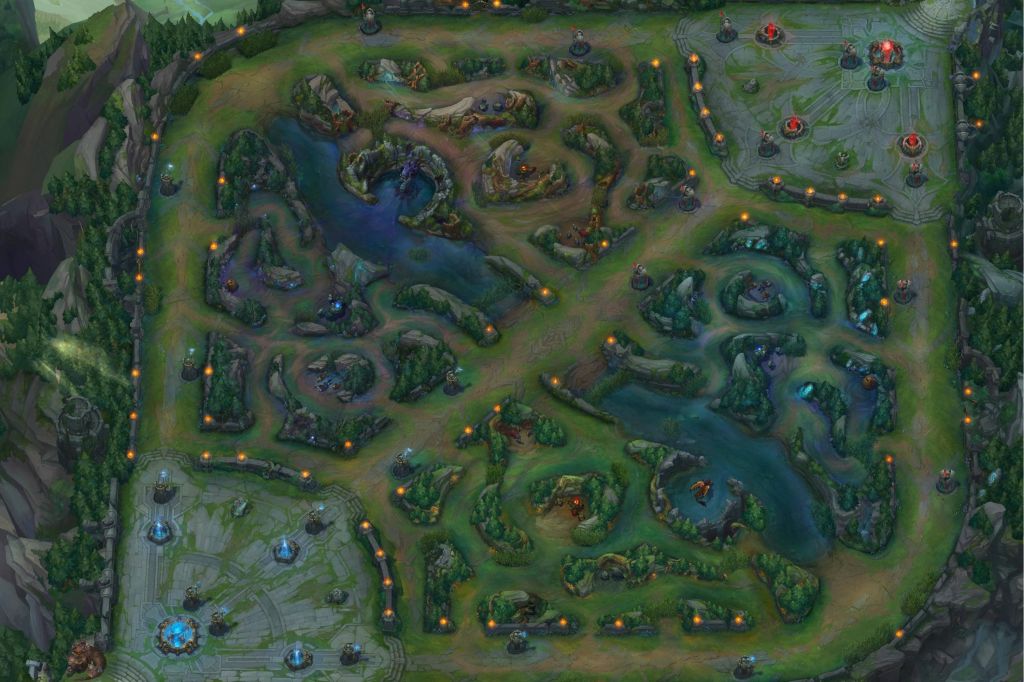
At the top-right, there’s a red-side base, and on the bottom-left, there’s a blue-side base. Each base has a ‘nexus’, or the glowing thing closest to the top-right and bottom-left corners. The objective is to be the first team to blow up the other team’s nexus. There are three lanes with minions to kill for gold, and each lane gets the same number of minions, so both teams get the same opportunity for the same amount of gold. (Though they rarely end up killing the same number of minions, and that differential is a crucial stat.)
Let’s break the map down into sections.
As mentioned, each team has their own base. In their own base is three turrets protecting the three inhibitors, and two more towers protecting the nexus. In order to blow up the nexus, at least one of the inhibitors needs to be destroyed. To do that, the opposition needs to blow up the tower protecting the inhibitor, and so on out. This is what everything is called inside the base:
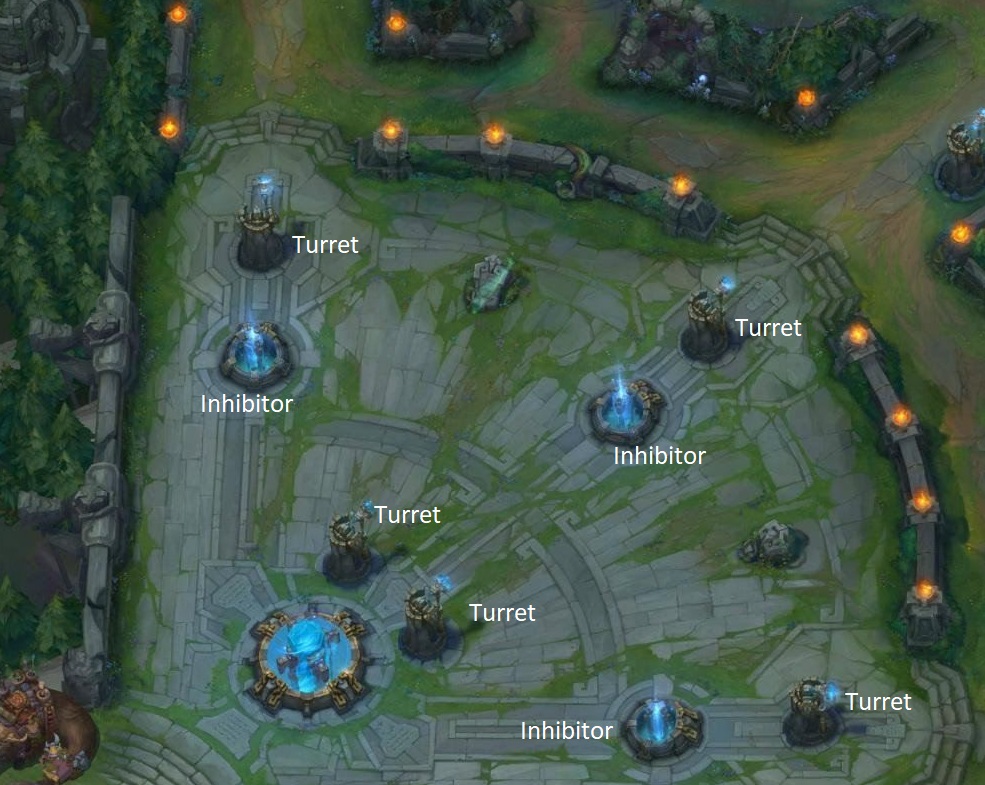
The turret/inhibitor placement is the same for both teams and bases. If an inhibitor is destroyed, the team that destroyed the inhibitor gets ‘super minions’ in that lane for five minutes. Super minions are harder to kill and deal more damage than regular minions, which helps teams push towards the opposing base without doing anything.
Leading out from the base are the three aforementioned lanes. Along the bottom and right side of the maps is bottom lane, sometimes just called ‘bot’. Going diagonally up and to the right is mid lane, or just ‘mid’, with the final lane, on the left and top, called, well, top lane. Outside the base, there are two more turrets placed along each lane that teams can run to for protection, or opponents can blow up for gold.
Those turrets, by the way, have plates on them up until the 14-minute mark. Each turret has five plates worth 120 gold each, or 40 percent of a kill each. All five plates is worth two kills in gold, so the Rift Herald can be valuable early on (the Herald will be explained later). Teams get extra gold for destroying the first turret of the game, but they have to be in range of the tower to get the gold when it is destroyed. Trying to be the cool champion and walking away from the explosion can cost you.
Plates fall off at 14 minutes, and only the outer-most turrets have them. The inner ones do not at any point.
Players also get bonus gold for the first kill of the game, called first blood.
Readers will notice that there are five players per team, but only three lanes. We’ll get back to that.
As for the rest of the map, the entire middle of the map, between bottom lane and top lane, is called the ‘jungle’. The jungle is broken down into four quadrants:
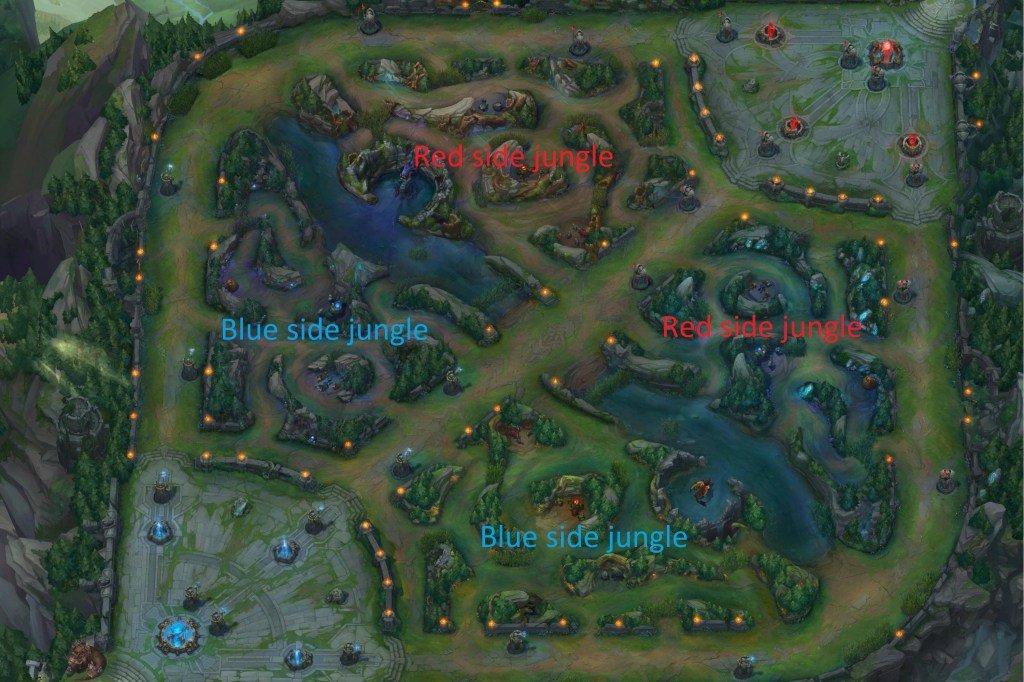
The water running through the middle of the jungle, perpendicular to mid-lane, is called the river. It’s the mid-point of the map, and players on the opponent’s side of the river need to beware.
There are three major monsters in the jungle that players need to know. The first is Baron Nashor, usually just called Baron, and infrequently called Nashor or Nash. He is located here at a place called the Baron Pit in the river on the left side:
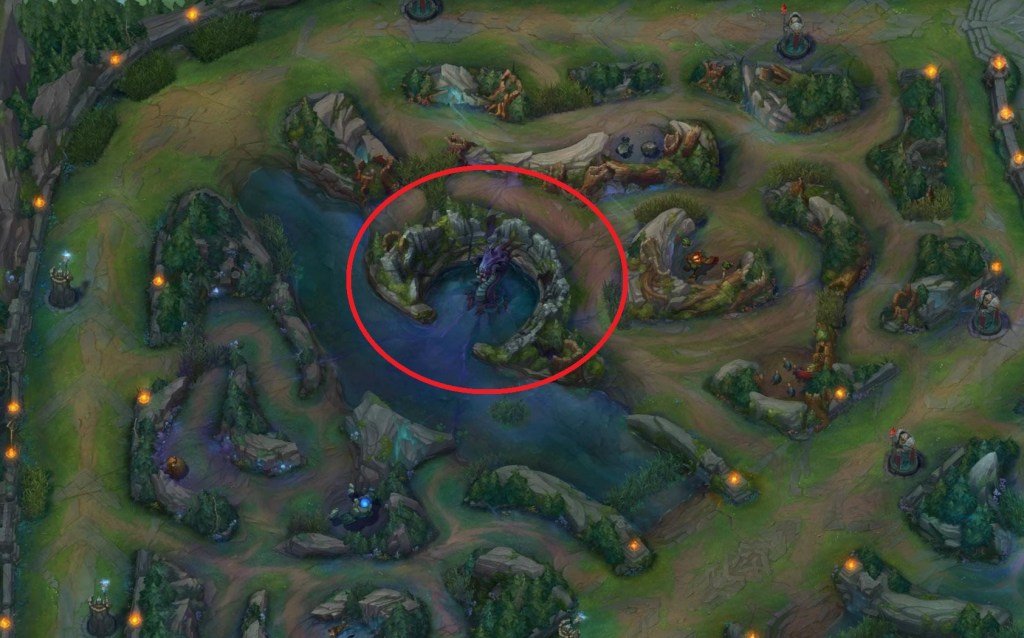
The Baron only spawns at the 20-minute mark and is very hard to kill. One person can’t do it, two people can sometimes do it later in the game when champions are strong, but it usually takes three or more (often the whole team). It’s a pit with walls around it, so even if you kill it, you could be trapped by the opponent, and that can make it a dance, of sorts. Killing the Baron gives your team a ‘buff’ for a few minutes, and that buff makes it very hard for opponents to kill your minions, making it easier for the team with the Baron to push into the base. In that sense, killing the Baron can end a game if a team gets a good push going with the Baron buff, so the Baron is often contested.
When a team kills the Baron, only the players alive at the time the Baron dies get the buff. If a player on a team with the Baron buff dies with the buff active, they lose it. In order for the minions to get their super powers, a player with the buff needs to be nearby. Thus, even if a team kills Baron, it’s important to get as many people out alive as possible. Killing Baron, but only getting one person out, is basically breaking even in gold immediately when considering kill and assist money, and then with the players off the map, the healthy team can take even more off the map in terms of minions, jungle monsters, and towers. It’s why teams usually won’t go for Baron unless they have a combat advantage (an opposing player or two dead, or a big item advantage).
Before the Baron spawns, there is something called ‘Rift Herald.’ It’s a monster that spawns at the same place as the Baron, and one that teams can kill, but it does much less damage than the Baron, so a single champion can kill the Herald by themselves. The purpose of killing the Rift Herald is that the team to do so gets a beast that charges into towers, causing significant damage to them. It helps blow up towers, providing gold, and which in turn gives the team (and specifically the lane opponent) more room to roam without the fear of taking hits from the turret.
The third monster to know is the dragons. They’re located here:
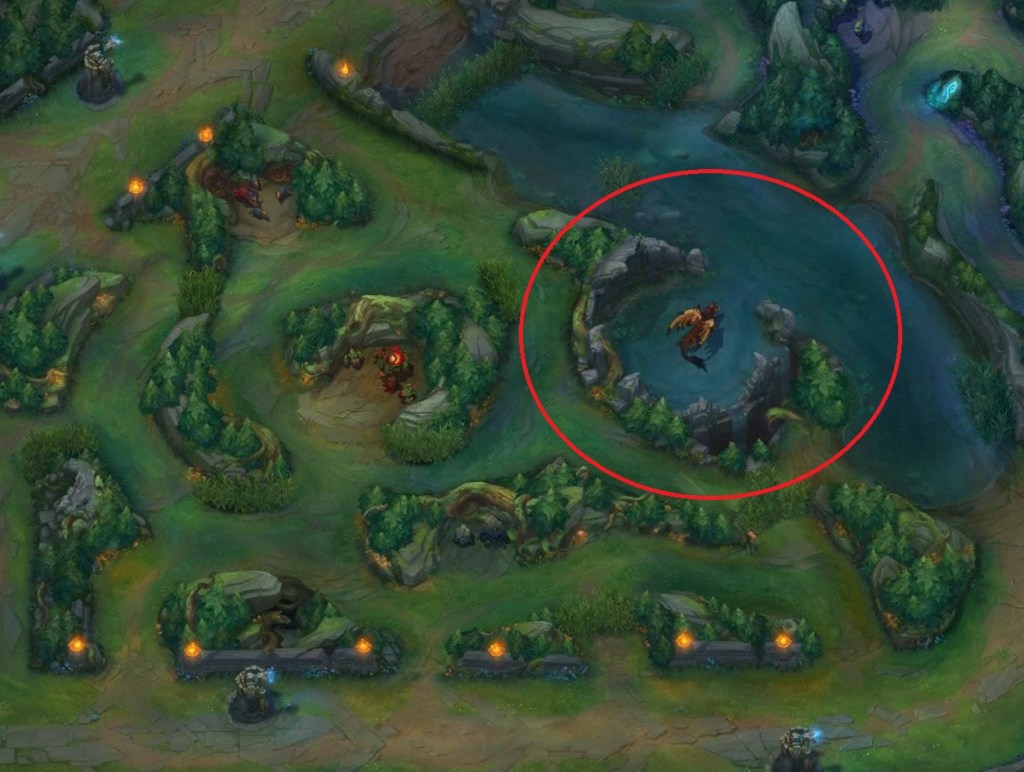
Dragons are also much weaker than the Baron, so one player can kill them fairly early in the game. There are four types of dragons: mountain, ocean, infernal, and cloud. Each gives different boosts to the team, such as speed, damage, regeneration, or armour. Kill four of them, and you get a ‘Soul’, which is an extra powerful buff with even more speed, damage, regeneration, or armour. They are very powerful buffs that last for the rest of the game, so we see a lot of team fights around the dragon. Each ‘soul’ changes the layout of the map automatically, as ocean soul will sprout more brushes, mountain soul more rocks (barriers), infernal soul destroys some walls, and cloud makes it quicker to walk through certain portions of the jungle. The map effect is for both teams, though the soul’s actual buff will only go to the team that gets the fourth dragon.
In the jungle, there are ‘creeps’, or monsters that a player can kill for experience and gold.
Champions, experience, gold, and items
Wait, experience and gold?
Yes. Each player, before the game, selects their character, or ‘champion’. Each champion has unique abilities and skill sets. Those champions need to acquire gold and experience throughout the game to get stronger base stats, while buying items to make them more durable, damaging, or somewhere in between.
Some champions can pack on lots of health and armour, providing a tank with low damage, or what is sometimes known as the ‘front line’, while others cast magic spells but have little health or armour. Some are a mix of high health and armour (though not as much as tanks) with damage, while others are long-range marksmen. Some of the damage-dealers (like marksmen) do physical damage, while spell-casters (or mages) do magic damage. Different types of damage require different kinds of armour (or resistances).
Finding the right mix of champions is crucial; too little damage with too many tanks means you’ll never kill the opponent, while too much damage with no tanks leaves everyone vulnerable to be decimated quickly. Having armour instead of magic resistance leaves a player vulnerable to mages, while having magic resist instead of armour leaves players vulnerable to marksmen.
Early in the match, from each of the three inhibitors, little monsters called ‘minions’ spawn. They spawn in groups of either six or seven, and they’re most players’ early source of gold and experience. However, to get the gold, the champion needs to ‘last hit’ the minion to kill it. What that means is that the player has to kill the minion to get the gold. If the minion dies to an opposing minion or a tower, then the player gets no gold. In that sense, being able to last-hit efficiently is one of the most important skills in the game. If a player can’t do that, they’ll fall way behind the gold matchup early, and then they’re basically useless.
Players get gold from minions, monsters in the jungle, killing the opponent, assists on kills, and blowing up towers. More gold means more items, which makes it easier to kill the opponent, and gain more gold, and on and on we go.
But there’s only so much gold on the map, right? If three players are all killing the same minion lane, they just split the gold, and then no one gets ahead. That’s why the teams (mostly) split up their champions.
- The top lane will get one champion, usually someone who has both health and damage, because they’re often by themselves.
- The mid lane gets one, and it’s often some sort of spell caster because in the middle of the map, all of your teammates aren’t far away to help, so they don’t need as much health and armour. Relying on teammates to react in time, though, is another matter. Such is the nature of the position.
- There is one player who roams the jungle, but there’s less gold there, so you’ll see them attack in lanes with their teammates to kill the opponent and help get everyone ahead.
- That leaves two players, and they both go bottom lane. One is usually some kind of marksman, and the other a ‘support’. The support can be either a quasi-tank, a player who can help with shielding/regeneration, or some sort of weak fighter. Again, all five champions have to mesh well together, the support among them.
That’s basically the entire premise of the game. I’ll review briefly:
- It’s a 5-on-5 game with each player controlling a unique champion.
- Teams have to destroy at least one inhibitor to attack the nexus. Destroying the nexus wins the game.
- One player from each team goes top lane, one mid, two in the bottom lane, and one in the jungle.
- Players level up with experience and purchase powerful items with gold. Gold and experience come from last-hitting minions or jungle monsters, killing opposing champions or towers, or small other boosts in the game.
There is obviously a lot more to the game. Strategies about which champions work best with which (there are over 100 of them, so), knowing when to attack a lone enemy and when not, knowing when to push for a team fight or not, knowing which items to prioritize by purchase order (and possibly changing your build path depending on what the opponent does), knowing when to attack Baron/Rift Herald/Dragon and when to back off, and on and on the list goes. Despite there only being one map with the same monsters, no two games are the same.
It’s a fun game to watch once you can grab the basics, and once you understand the strategy, it gets really fun to watch. It can be slow at times as teams seek out gold for items rather than attack each other, but with the Baron and dragons providing huge advantages, those areas are often contested, forcing the teams to fight.
Feel free to reach out if anything is confusing here.
I thought I would add a glossary of common terms you may hear on a broadcast.
- Ace – when one team completely wipes out the other team. That often can lead to the game flat-out ending, if not a major deficit.
- Buff – these are powers given to a player or team for completing an objective, or as part of an item’s power. Buffs include the Baron and dragons, but there are also blue buffs (mana regeneration) and red buffs (extra burn damage) in the jungle. Certain items can buff up a player or team as well.
- Brushes – Around the map, there are small brushes players can hide in to surprise their opponents.
- Cooldown – Most champions have four abilities (we’ll get to that in a second), and after being used, abilities have a period of time where they cannot be used again. Depending on the ability, it could be anywhere from one second to dozens of seconds. Obviously, those with longer cooldowns typically have much larger impacts. It’s about balance. Players can also buy items that reduce cooldown time.
- Crowd control – usually just shortened to ‘CC’, it generally means an ability that can, wait for it, control a crowd of opponents. It usually means a stun or slow ability that impacts an area. You’ll often see teams chain two or three CC abilities together on a single opponent in order to remove the opportunity for escape and ensuring the kill, while dissuading the opponent’s teammates from engaging.
- Dive (or turret/tower dive) – When a player is pinned under a turret trying to kill minions for gold, sometimes the opponent will ‘dive’ or ‘turret dive’ to go for the kill and get out before the turret (or opponent) can kill them. It often requires at least two, if not three people to pull off.
- Elder dragon – after the teams get a soul dragon (which usually happens at the 25-minute mark, give or take a couple minutes), the Elder dragon spawns in the dragon pit. It’s usually after the 30-minute mark, but it provides a big damage buff to all living members. It can help end the game quickly.
- Engage or Initiation (reliable or unreliable) – this is basically how teams start fights. There is reliable engage, sometimes called hard engage, and unreliable engage, or soft engage. The first kind (reliable) usually means some sort of point-and-click that takes no skill and can stun an opponent, leaving them vulnerable to further attacks. Soft engage usually takes some skill to pull off, and may not stun the opponent, which could allow them to escape. Different types of engage work with different types of champions, but not having reliable engage makes it very hard to start team fights, and that’s a problem late in games.
- Fog of War – it’s where your team cannot see. When watching the game as a spectator, we can often see everything happening on the map. Players in the game, though, see considerably less (only where there are teammates, turrets, minions, or wards), and that’s the fog of war.
- Freeze – without making this 500 words, there are ways to manipulate the timing of when you kill the opposing minions, and that pushes the minions (collectively called the wave) either towards your turret or towards the opposing one. A ‘freeze’ is a manipulation to leave a group of opposing minions near your turret. The purpose is to use the turret as protection while killing minions for gold. The added bonus is it leaves a lot of territory behind the opponent, making them susceptible to a jungler or mid-laner moving up/down behind them, trapping the foe between the two. Which brings us to the next term…
- Gank – when players go to a lane that is not theirs (say, bottom lane to mid), to help their teammate kill their lane opponent. It’s basically a surprise attack (though sometimes it’s not such a surprise). It is also one of the main functions of the jungler in the early portions of the game.
- Lane swap – sometimes, if a particular lane is falling way behind, that team could swap two lanes (often bottom and top, or bottom to mid) to give the player(s) that is (are) behind a chance to catch up with either the help of teammates, or absence of the opponent as they respond to the swap by swapping themselves.
- Laning phase/mid game/late game – there are three general sections of the game. The first 15 minutes (give or take), is called laning phase. It’s basically just people trying to kill minions in their lane (and junglers killing monsters in their jungle) and gain as much gold as possible as quickly as possible. There are often ganks, but rarely full 5-on-5 team fights; teams are just too focused on gathering gold in their lanes. The mid game is usually the time after laning phase (sometime around the 20-minute mark) but before the 30-minute mark. This is when teams start fighting for control around Baron, and this is when team fights start to happen. The late game is exactly that, it’s when players start to have four or five items and are approaching full builds (champions max out at six items, so at a certain point, gold stops mattering). This is basically all about controlling vision and team fighting. You won’t see true laning in the late game.
- Priority – your minions are generally your vision line. They’re programmed to just march forward if nothing impedes them, so the further they can march, the further your team can see (and the less the opponent can see). Thus, sometimes, pushing your minions past the mid-point of the map, or towards the opposing turrets, is called gaining ‘priority’. A champion that has killed their lane’s minions, while the opposing champion that hasn’t, has the priority because of how far up they can move up their vision line, and they can also go look around the jungle to find someone and catch them out. Pro teams place a lot of importance on priority. Well, the good ones anyway.
- Q-W-E-R – the key binds that come with the game attach QWER to an individual champion’s abilities. So if people hear “so-and-so’s Q”, that means the ability attached to the Q key. And onward down the line.
- Recall/shop – players need to recall to get back to their base without walking the whole way, but recalling requires them to stand still in one spot for eight seconds. It can be a one-way ticket to the death realm if not recalling in a safe area. After they’ve recalled, players can shop for their items in their base. When they recall, they regenerate quickly both their health and mana.
- Roam – when a player moves to a lane that is not theirs, often to help a teammate falling behind, or to kill the opposition. It can be just to place wards (which are discussed below), so that’s what makes it different from ganking. Supports often do this early in the game.
- Skill shot – some abilities are point-and-click, while others take aiming with the mouse. The latter is called a skill shot.
- Smite – teams that last-hit a dragon or Baron get the buff of the dragon or Baron. Attacks can be champion abilities or basic attacks, but the jungler has a special smite ability. It gets stronger as the game goes on, but it’s basically a massive amount of instant damage only to jungle monsters. It cannot be applied to an opposing champion. However, it’s so powerful that if a jungler dies later in the game, the team is at a significant disadvantage around Baron or dragon. It replaces one of the summoner spells, which is in this glossary.
- Spawn time – a player respawns in their base after they die. However, the length of time they remain dead gets longer as the game wears on. For that reason, even losing two or three members later in the game can cause a massive shift as all the Buffs are available and opponents are off the map for 45 seconds. That’s more than enough time to run roughshod on the map. Deaths around the Baron pit sometimes end the game, regardless of who actually killed the Baron.
- Summoner Spells – usually just called summoners, they’re abilities standard in the game. Each champion gets to pick two before the game, and they range from healing/speed boost, to flashing a short range which can help escape the opponent (this is popular), to a teleport ability, providing swift aid in a team fight (also popular). They have very long cooldowns, especially early in the game, and can be very powerful when used properly. Forcing the opponent to use them recklessly can provide a team with a summoner advantage. This is a very good situation, as it typically allows the team with the advantage to dictate the pace.
- Ultimate (or ulty) – the champion’s ‘R’ ability is called an ultimate and can do devastating damage in the right situation. A few champions don’t do damage with their ultimate, but rather shield or heal teammates, or provide great disruption to the opponent (also called engage).
- Vision – simply what a team can see. Gaining priority can help establish deeper vision, giving your team a better idea of what’s going on behind enemy lines.
- Wards or Warding – some players have wards in their inventory, and sometimes they have to buy them. Some are invisible to the opponent, some are not. Either way, they help establish vision, or perhaps check the Baron to see if the opposition is trying to kill it. When a player – usually the support or jungler – goes around the map placing wards for vision, it’s called warding.
 Cliffy's hell-hole